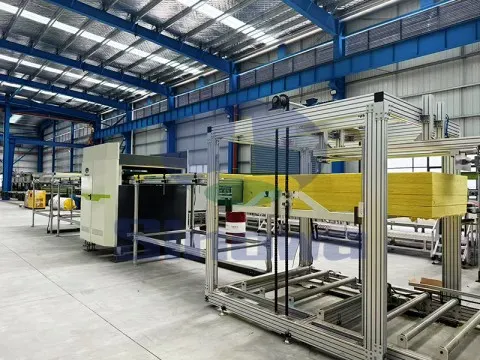
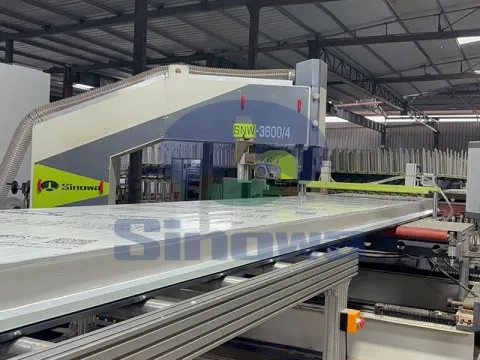
sandwich panel machine
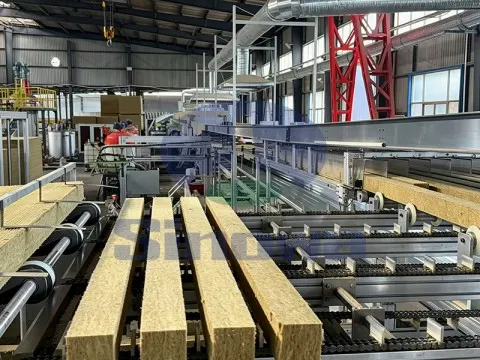
The fundamental structural composition of rock wool sandwich panel equipment covers multiple core functional modules, each undertaking independent processing tasks while maintaining precise logical connection with adjacent units. The raw material feeding module serves as the initial starting point of the entire production flow, responsible for the orderly supply of metal sheets and rock wool raw materials. For metal surface materials, this module is equipped with unwinding devices that stably fix coiled metal raw materials, achieving continuous and uniform material output through hydraulic or mechanical transmission structures. Auxiliary correction mechanisms are embedded within the unwinding structure to eliminate lateral deviation of metal coils during transportation, ensuring the flatness and linearity of sheet feeding. In terms of rock wool core material supply, the feeding unit adopts layered material arrangement and conveying structures, which can adjust the feeding density and laying thickness of rock wool according to production requirements. This structural design effectively avoids material accumulation and uneven distribution, laying a solid foundation for the uniform thermal insulation and fireproof performance of finished panels. Meanwhile, the feeding module is fitted with quantitative control components to realize scientific matching between metal materials and rock wool raw materials, reducing unnecessary material waste in the production process.
Following the feeding procedure, the metal sheet forming module carries out cold bending shaping of flat metal sheets, which determines the external contour, edge structure, and assembly accuracy of finished sandwich panels. This module consists of multiple groups of rolling forming units arranged in an orderly sequence, with each group of rollers designed with specific bending radian and pressure parameters. Flat metal sheets pass through successive roller sets, undergoing gradual bending, embossing, and shaping to form standardized edge grooves, overlapping structures, and surface reinforcing ribs. The graded processing method prevents structural damage and surface indentation caused by one-time intense bending of metal sheets, effectively maintaining the surface flatness and mechanical strength of metal layers. All rolling components are made of high-hardness alloy materials with wear-resistant and anti-deformation characteristics, ensuring long-term stable operation under continuous high-load working conditions. Moreover, the spacing and pressure of rolling rollers can be moderately adjusted to adapt to metal sheets of different thicknesses, endowing the equipment with flexible production capacity for diversified panel specifications.
The glue coating and composite integration module acts as the core functional unit to realize the bonding between metal outer layers and rock wool cores, directly influencing the interlayer bonding strength and overall structural stability of sandwich panels. This module is equipped with automatic glue spreading devices that evenly coat high-performance adhesive on the inner surfaces of upper and lower metal sheets. The glue supply system adopts constant-pressure circulating conveying to maintain stable glue output, avoiding defects such as glue accumulation, missing coating, and uneven glue layers. Before formal bonding, the equipment is fitted with surface pretreatment structures to remove dust, oil stains, and oxide layers from metal inner walls, enhancing the adhesion between adhesive and metal materials. During the composite process, mechanical compression structures apply uniform vertical pressure to the stacked combination of metal sheets and rock wool cores. This pressure eliminates internal gaps between layers, enabling the adhesive to fully penetrate the tiny gaps of rock wool fibers and form a compact integrated structure. The pressure value and compression time are dynamically regulated according to core material density and panel thickness, ensuring that each finished panel achieves consistent bonding firmness without causing fiber compression deformation of rock wool cores.
The heating and curing system is an essential component to accelerate adhesive solidification and stabilize composite structures, optimizing the forming efficiency and structural durability of rock wool sandwich panels. This system adopts sealed thermal insulation furnace body structures with distributed heating elements arranged evenly inside. Hot air circulation technology is utilized to maintain uniform temperature distribution in the curing cavity, preventing local overheating or insufficient heating. In the early curing stage, moderate low temperature is adopted to slowly evaporate trace moisture in the adhesive and rock wool fibers, avoiding bubbling and delamination caused by rapid moisture vaporization. In the middle and later stages, the temperature is appropriately increased to promote the cross-linking reaction of adhesive molecules, rapidly enhance interlayer bonding strength, and complete the preliminary shaping of composite panels. The internal temperature of the furnace body is monitored in real time by sensing components, and the intelligent control system automatically adjusts heating power to offset ambient temperature interference. This precise temperature control mode not only shortens the curing cycle but also avoids performance degradation of rock wool materials caused by extreme temperature, retaining the inherent fire resistance and thermal insulation characteristics of the core material.
The trimming and shaping module undertakes the fine processing of initially cured composite panels to eliminate irregular edges and surface burrs generated in the composite process. This module integrates mechanical cutting, edge pressing, and surface flattening structures. The trimming units symmetrically arranged on both sides cut off excess metal edges and protruding rock wool fibers according to preset dimensional standards, ensuring consistent width of each panel. The edge pressing structure conducts secondary shaping on the assembly grooves at panel edges to optimize the clamping precision between adjacent panels during on-site installation. Meanwhile, the surface flattening mechanism uses elastic pressure rollers to perform gentle rolling on panel surfaces, eliminating tiny bulges and depressions formed during compression bonding. All trimming tools are made of high-precision wear-resistant materials to ensure smooth and neat cutting sections without metal burrs or fiber scattering. The entire trimming process operates synchronously with the production line transportation speed to avoid production stagnation caused by independent processing, maintaining the continuity of automated production.
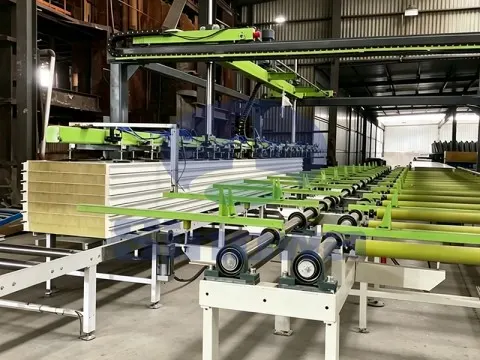
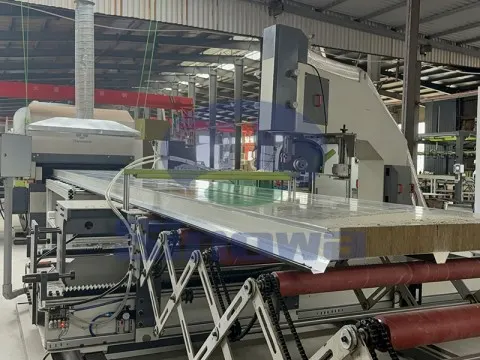
The fixed-length cutting and finished product output module serves as the terminal processing link of the production line, realizing fixed-size cutting and orderly output of continuous composite plates. This module is equipped with high-speed mobile cutting structures that follow the moving speed of panels to complete synchronous cutting, effectively avoiding length errors caused by relative displacement. The cutting tool adopts flat shear structural design to ensure flat and vertical cutting sections without tilting deformation. Before cutting, the positioning sensing system detects the moving distance of panels in real time and sends cutting instructions to the execution structure when reaching the preset length. After cutting, the finished product conveying platform transports qualified panels to the stacking area through buffer transmission. The conveying platform is fitted with anti-slip and shock-absorbing structures to prevent surface scratch damage and structural vibration of newly formed panels during transportation. In addition, the output end is equipped with simple sorting and temporary storage structures to classify panels of different specifications, facilitating subsequent centralized packaging and transportation.
The intelligent control system runs through all functional modules of rock wool sandwich panel equipment, acting as the central nerve to coordinate the collaborative operation of the entire production line. The system consists of data sensing components, logic control units, human-computer interaction terminals, and fault feedback modules. Temperature sensors, pressure sensors, speed detectors, and thickness monitoring devices are installed at key processing positions to collect real-time operating data such as feeding speed, curing temperature, composite pressure, and panel thickness. The control unit analyzes and processes the collected data, automatically adjusting the operating parameters of each module to maintain the stability of the production process. Operators can set production specifications, operating speed, and processing parameters through the human-computer interaction terminal, and the system automatically executes programmed production procedures. When abnormal conditions such as material blockage, parameter deviation, and component failure occur, the fault feedback module immediately triggers alarm prompts and executes emergency shutdown instructions for related units to prevent equipment damage and defective product proliferation. The integrated intelligent control mode reduces manual operation difficulty, lowers human error rates, and improves the overall automation level of the production line.
The working principle of rock wool sandwich panel equipment is based on the combination of mechanical transmission physical processing and chemical adhesive curing reaction, realizing the efficient compounding of heterogeneous materials. Metal sheets and rock wool core materials are transported to designated processing positions in an orderly manner through transmission structures. After surface pretreatment and uniform glue application, the materials are stacked and combined layer by layer. External mechanical pressure is applied to eliminate interlayer gaps, and a stable composite connection is formed by relying on the permeation and solidification of adhesives. During the heating and curing stage, reasonable temperature gradients accelerate the molecular polymerization of adhesives, enhancing the binding force between metal layers and rock wool cores. Subsequent trimming, shaping, and fixed-length cutting standardize the external dimensions and surface quality of panels. Throughout the production process, mechanical structures maintain stable motion trajectories, and the intelligent system dynamically optimizes processing parameters, enabling raw materials to be efficiently converted into standardized finished panels under continuous assembly line operation. This working principle fully conforms to the processing characteristics of rock wool fiber materials and metal sheet materials, balancing production efficiency and product structural stability.
In terms of production performance characteristics, modern rock wool sandwich panel equipment exhibits prominent advantages in production efficiency, product consistency, and resource utilization. The continuous assembly line layout eliminates intermediate handling and waiting links between processes, realizing uninterrupted feeding, processing, and output. The production rhythm can be adjusted according to market demand, adapting to low-volume trial production and large-scale batch manufacturing. In terms of product quality control, standardized mechanical processing and intelligent parameter regulation ensure that the thickness, density, bonding strength, and external dimensions of each batch of panels maintain low deviation rates. The equipment optimizes the material laying mode and glue application dosage, effectively reducing the waste of rock wool fibers and adhesives. The closed production structure minimizes dust diffusion during rock wool processing, improving the on-site production environment while reducing raw material loss. In addition, the modular structural design facilitates daily maintenance and component replacement of the equipment. Damaged parts can be independently disassembled and repaired without affecting the normal operation of other modules, lowering the comprehensive maintenance cost of the production line.
The equipment has strict adaptability requirements for raw materials, and the matching degree of raw material parameters directly affects production smoothness and finished product quality. For metal surface materials, the equipment is compatible with metal sheets with moderate ductility and surface flatness. Metal sheets with uniform thickness and smooth surface are conducive to stable rolling forming and even glue bonding, avoiding cracking and peeling defects during processing. For rock wool core materials, qualified raw materials need to have uniform fiber distribution, appropriate bulk density, and low impurity content. Rock wool with loose fibers and excessive impurities is prone to local hollowing and uneven stress during compression composite processing, reducing the overall thermal insulation and fire resistance of panels. Adhesives used for interlayer bonding need to possess excellent temperature resistance, aging resistance, and initial adhesion. High-performance adhesives can maintain stable bonding performance in variable temperature environments, preventing interlayer delamination caused by environmental changes. The feeding system of the equipment can be fine-tuned according to raw material characteristics to adapt to raw materials of different specifications within a reasonable range, improving the production compatibility of the production line.
Reasonable installation and commissioning procedures are the premise to ensure the long-term stable operation of rock wool sandwich panel equipment. During the installation stage, the equipment needs to be placed on a flat and solid foundation to avoid structural vibration and component displacement caused by uneven ground. Each functional module is arranged in sequence according to the production process flow, and the horizontal height and transmission connection of adjacent units are precisely calibrated to ensure smooth material transportation. The connection parts of mechanical transmission components are lubricated and sealed to reduce operating friction and dust erosion. After mechanical installation, circuit lines and sensing components are debugged to verify the sensitivity of data monitoring and the accuracy of signal transmission. In the commissioning stage, no-load trial operation is firstly carried out to check whether the operating speed and motion trajectory of each mechanical structure are normal and eliminate abnormal noise and jamming phenomena. Then low-speed material trial production is conducted to adjust parameters such as glue application amount, composite pressure, and curing temperature, observing the bonding state and surface quality of trial-produced panels. After confirming that all indicators meet the production standards, the operating speed is gradually increased to reach the rated production state.
Daily maintenance and scientific operation management are crucial to extend the service life of rock wool sandwich panel equipment and maintain stable production performance. In daily operation, operators need to regularly clean dust, fiber residues, and adhesive attachments on the equipment surface, especially focusing on cleaning rolling rollers, glue spreading nozzles, and cutting tools, to prevent residual impurities from affecting processing accuracy. Transmission bearings, gears, and chains are regularly supplemented with lubricating oil to reduce mechanical wear and keep transmission flexible. Heating components and temperature sensing devices are inspected periodically to eliminate temperature deviation caused by component aging. The pressure detection system is calibrated regularly to ensure the accuracy of composite pressure control. During the shutdown interval, the equipment is kept in a dry and ventilated environment to avoid metal corrosion and circuit damp failure. In addition, enterprises need to formulate standardized operation procedures to restrict non-professional personnel from adjusting equipment parameters at will, avoiding product quality problems and equipment failures caused by misoperation. Regular professional maintenance and parameter optimization can effectively reduce equipment failure rates and long-term operating costs.
Rock wool sandwich panels produced by professional production equipment have outstanding comprehensive performance, enabling them to adapt to diverse complex building scenarios. In industrial buildings such as large factories and logistics warehouses, the panels serve as wall and roof enclosure structures. Their excellent fire resistance effectively slows down flame spread, providing safe guarantee for industrial production and material storage. The lightweight structural characteristics reduce the bearing load of building frames, lowering the construction difficulty and infrastructure cost of large-span buildings. In low-temperature storage buildings such as cold storage, the low thermal conductivity of rock wool cores effectively isolates internal and external temperature exchange, reducing energy consumption for constant temperature operation. In dust-free purification workshops of pharmaceutical and electronic industries, the smooth and seamless surface of finished panels is not easy to accumulate dust, and the sealed composite structure avoids internal mildew and pollution, meeting high-standard environmental purification requirements. In public infrastructure such as airport terminals and stadiums, the panels with neat appearance and diverse color matching optimize the architectural aesthetic effect while ensuring structural safety. In addition, the panels can also be applied to temporary construction facilities and building renovation projects, relying on convenient installation and stable performance to shorten construction cycles.
With the continuous upgrading of the global construction industry's energy-saving and environmental protection standards, rock wool sandwich panel equipment is evolving towards intelligent optimization, energy conservation, emission reduction, and diversified production. In terms of intelligent technology, modern production lines are gradually equipped with automatic detection and feedback systems, which can intelligently identify surface defects, dimensional deviations, and bonding gaps of panels, realizing real-time screening of defective products. The remote data monitoring function enables enterprise managers to grasp production progress and equipment operating status in real time, facilitating scientific production scheduling. In terms of energy saving optimization, the heating system adopts energy-saving heating elements and heat recovery structures to reduce heat loss during curing. The transmission motor uses variable frequency energy-saving control to adjust power output according to operating load, cutting down comprehensive energy consumption. In terms of production diversification, the equipment expands the adjustable range of processing specifications, realizing integrated production of panels with different thicknesses, groove structures, and surface patterns. Meanwhile, the equipment is optimized for environmental protection, adopting closed dust removal and waste recycling structures to collect residual rock wool fibers and metal scraps, realizing resource recycling and reducing production pollution.
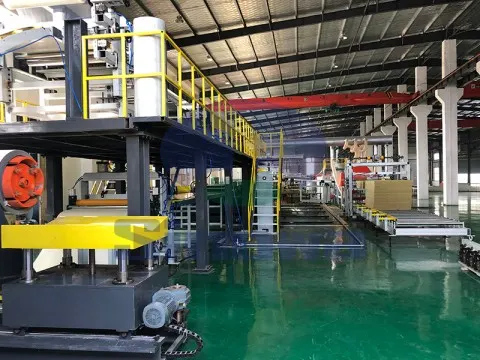
In the context of the booming development of the modern construction industry, rock wool sandwich panel equipment occupies an important position in the field of new building material manufacturing by virtue of its automated processing capability, stable product quality, and wide application compatibility. The complete production system realizes the standardized and large-scale production of high-performance composite panels through the collaborative operation of multiple functional modules. From raw material feeding to finished product output, every processing link is precisely controlled by mechanical structures and intelligent systems to ensure that finished panels have excellent fire resistance, thermal insulation, sound insulation, and structural stability. With the continuous progress of industrial manufacturing technology, the structural design, intelligent level, and energy-saving performance of such equipment will be further optimized. In the future, rock wool sandwich panel production equipment will continue to iterate and upgrade, providing more efficient, environmentally friendly, and diversified production solutions for the construction material industry, and making important contributions to the high-quality development of the global modern construction industry.
Sinowa is a professional manufacturer of sandwich panel machine in china, we provide diversified and high-performance sandwich panel production lines, including fully automatic continuous PU sandwich panel line and customized special lines to meet mass production and personalized order demands. These sandwich panel lines support processing multiple foam core materials, such as PU, PIR, mineral wool, rock wool and glass wool, covering different insulation and fireproof standards.
Featuring stable operation, high efficiency, energy saving and easy maintenance, our PU sandwich panel line deliver sandwich panels with excellent thermal insulation, fire resistance, sound insulation and lightweight durability. The finished panels are widely applied in industrial workshops, warehouse roofing and wall cladding, cold storage insulation, serving global construction and industrial insulation markets.
https://www.cnsinowa.com/sandwich-panel-machines/rock-wool-sandwich-panel-equipment.html