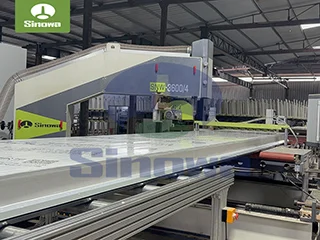
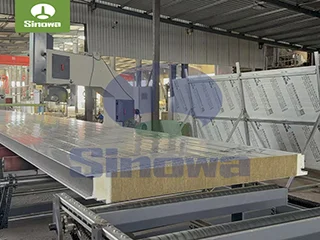
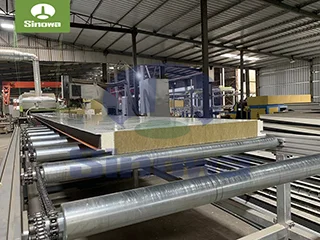
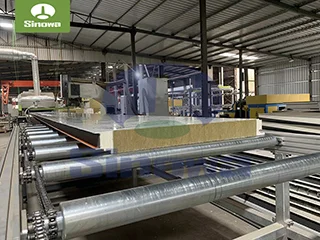
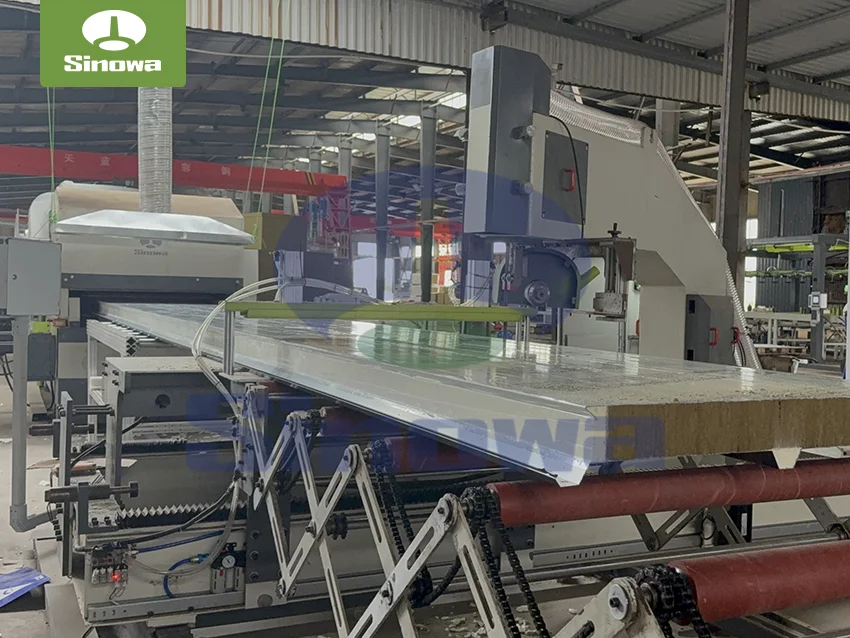
 sandwich panel line
The overall mechanical structure of a complete foam rock wool board production line adopts modular integrated layout, and all functional units are connected through synchronous conveyor systems to ensure consistent operating speed and coordinated process rhythm across the whole line. The entire equipment can be divided into six core functional modules according to production sequence, including raw material feeding and pretreatment module, high-temperature melting and centrifugal fiber forming module, online foaming and composite mixing module, continuous fiber laying and pre-pressing module, constant-temperature curing and drying module, as well as finished product cutting, edge trimming and conveying module. Each module is equipped with independent frequency conversion speed regulation devices and online monitoring sensors, avoiding production stagnation caused by mismatched operating speeds between front and rear processes. The main frame of the whole line is made of thickened high-strength steel structural components, which can bear long-term continuous high-load operation and frequent pressure adjustment during board forming, effectively reducing equipment vibration and operating deviation during high-speed production. Unlike discontinuous batch production equipment, the continuous structural design of this production line eliminates repeated start-stop losses of mechanical equipment, shortens material turnover time between processes, and improves overall material utilization rate while boosting hourly production capacity. Meanwhile, the internal pipeline and air duct layout of the equipment are optimized for heat circulation, which makes full use of waste heat generated by high-temperature melting and curing processes to preheat incoming raw materials, reducing overall energy consumption in the production process and realizing energy-saving operation of mechanical equipment.
Raw material pretreatment and automatic feeding is the initial link of the entire production process, which directly determines the uniformity of subsequent fiber forming and the stability of finished board performance. The main raw materials adopted for production are natural basalt mineral materials, slag and auxiliary inorganic functional materials, without any harmful chemical raw materials that will release volatile substances during use. Before entering the melting furnace, bulk raw materials need to go through multi-stage crushing, screening and proportional mixing treatment. The crushing unit crushes large block mineral raw materials into uniform fine particles with controllable particle size, and the screening device removes impurity particles with excessive particle size and non-melting sundries to avoid blocking furnace body pipelines and damaging centrifugal fiber spinning equipment in subsequent processes. After screening, multiple raw materials are transported to the automatic mixing bin, where electronic metering equipment realizes accurate proportional distribution of different raw materials according to preset production parameters. Uniformly mixed raw materials are sent to the sealed melting furnace through a fully enclosed automatic conveyor, which avoids raw material dust overflow in the workshop and improves the cleanliness of the production environment. In this link, the rock wool sandwich panel production line cancels manual material distribution and manual feeding operations throughout the process, reducing human errors in raw material ratio and labor cost input in the front-end process, and ensuring consistent raw material composition of each batch of semi-finished products.
High-temperature melting and centrifugal fiber forming is the core process that determines the basic fiber structure of rock wool substrates. The sealed high-temperature melting furnace adopts gradient temperature control mode to heat mixed mineral raw materials to a fully molten flowing state, maintaining stable internal temperature field to ensure complete melting of all inorganic raw materials without unmelted particle residues. Molten mineral liquid flows out stably from the furnace bottom diversion port and enters the high-speed centrifugal fiber spinning unit. Driven by high-speed rotating centrifugal rollers, the molten liquid is thrown into ultra-fine inorganic rock wool fibers under the action of centrifugal force and high-pressure airflow. The rock wool sandwich panel line adjusts rotating speed of centrifugal rollers and airflow pressure in real time to control fiber length, fiber diameter and fiber distribution density, which are key indicators affecting the tensile strength, thermal insulation performance and sound absorption effect of final boards. After fiber forming, a small amount of environment-friendly water-based adhesive is evenly sprayed onto dispersed rock wool fibers through atomizing spraying equipment. The adhesive can bond loose single fibers into an integral fiber network structure without blocking micropores between fibers, retaining the inherent porous heat insulation characteristics of rock wool materials. All flue gas and fine fiber dust generated during melting and fiber spinning processes are collected and processed by matched circulating air purification systems inside the equipment, realizing closed-loop treatment of production waste gas and reducing impact on the external atmospheric environment.
Online foaming composite treatment is the key differentiated process of foam rock wool sandwich panel machine compared with conventional rock wool board production equipment. After rock wool fibers form preliminary fiber mesh layers, controllable physical foaming treatment is carried out synchronously on line. Different from chemical foaming processes relying on chemical reaction agents, this production line adopts physical high-pressure airflow foaming technology, which injects stable dry airflow into gaps between rock wool fiber layers to form uniform closed foam micropores inside the fiber matrix. The foaming system can accurately adjust air injection volume, foaming pressure and foaming time according to preset board density parameters, so as to control pore size distribution and porosity inside composite boards precisely. The composite structure formed by interpenetrating rock wool fiber network and closed foam pores complements material performance advantages: rock wool fiber skeleton provides excellent high-temperature flame retardancy and structural compression resistance, while internal foam pores cut off heat conduction paths and reduce air flow heat transfer, further optimizing the thermal insulation performance of the board. In addition, the foam filling structure fills loose gaps between rock wool fibers, effectively solving the problem of easy fiber shedding and poor surface flatness of traditional rock wool boards, improving surface integrity and wear resistance of finished products, and making the boards more adaptable to later surface coating and on-site construction bonding operations.
Continuous laying, pre-pressing and fixed-pressure shaping processes realize integral forming of composite fiber foam materials. The mixed composite materials of rock wool fibers and foam structures are evenly laid into continuous fiber felt layers with consistent thickness and width through a pendulum lapping machine. The pendulum lapping equipment adopts reciprocating uniform laying mode to avoid local thickness deviation and density difference of semi-finished boards caused by uneven manual or single-direction laying. After laying, the fiber felt firstly passes through the pre-pressing unit for preliminary pressure shaping to discharge redundant residual air inside the material and stabilize the preliminary overall structure of the board. Then the semi-finished board enters the double-belt constant-pressure pressing machine for secondary precise pressing. The pressing system supports stepless adjustment of pressing pressure and pressing gap, which can adapt to production requirements of finished boards with different thickness specifications ranging from thin insulation boards to thick sound-absorbing partition boards. The double-belt conveyor keeps consistent conveying speed and uniform pressure up and down during pressing, preventing surface warping, internal hollowing and thickness inconsistency of boards caused by uneven pressure. After fixed-pressure shaping, the continuous board body has stable overall structure, uniform internal density and complete surface forming, and can maintain stable structural size without rebound deformation after leaving the pressing unit.
Constant-temperature curing and drying treatment is designed to remove residual moisture inside boards and completely cure internal adhesives, enhancing long-term dimensional stability and structural durability of finished foam rock wool boards. The curing drying tunnel adopts segmented independent temperature control design, setting gradient temperature zones from low temperature to high temperature and then cooling temperature. In the low-temperature preheating zone, residual surface moisture of pressed boards is slowly evaporated to avoid rapid water evaporation causing surface cracking; in the medium-temperature curing zone, internal adhesive completes cross-linking curing reaction to strengthen bonding force between fibers and foam structures; in the final cooling and shaping zone, high-temperature boards are cooled to normal temperature gradually to eliminate internal thermal stress generated in high-temperature processes. The whole curing process adopts circulating hot air internal circulation mode, which recycles waste heat generated in the tunnel to reduce external heat energy input. The closed tunnel structure also prevents moisture absorption of semi-finished boards from external humid air during drying. After complete curing and cooling, the internal structure of foam rock wool boards tends to be completely stable, with low water absorption rate, stable thermal expansion and cold contraction coefficient, and no obvious deformation or performance attenuation under long-term alternating changes of ambient temperature and humidity.
The final stage of the rockwool sandwich panel making machine includes online fixed-length cutting, edge trimming, waste recycling and automatic finished product conveying. Continuous long boards output from the curing tunnel are sent to the precision cutting unit, which adopts numerical control fixed-length cutting system to complete transverse cutting according to customized length requirements. The high-speed cutting tool is optimized for fibrous composite materials, which can realize smooth cutting without fiber burrs and edge collapse, ensuring neat cutting sections of finished boards. Subsequent edge trimming equipment trims irregular edges on both sides of boards to unify overall board width, and all trimmed edge waste materials are automatically collected and conveyed back to the front-end raw material crushing module for secondary recycling and reproduction. This closed-loop waste recycling system maximizes raw material utilization rate and reduces production waste discharge. Finally, qualified finished boards are transported by the output conveyor to the finished product stacking area for automatic stacking, and the whole production process is completed without manual turnover and manual cutting intervention in the whole link.
The entire foam rockwool board production line is equipped with a centralized PLC automatic control system to realize one-stop intelligent control of all production links. The central control operation panel displays real-time operating parameters of all equipment modules on the whole line, including furnace temperature, centrifugal rotating speed, foaming pressure, pressing gap, curing tunnel temperature, conveying speed and cutting size. Operators can complete parameter adjustment, production mode switching and equipment start-stop control through simple screen operation. The built-in fault self-diagnosis system can monitor abnormal operating conditions of equipment in real time, including material blockage, temperature deviation, speed mismatch and pipeline pressure abnormality. Once potential faults are detected, the system will send early warning prompts automatically and conduct partial linkage protection shutdown to avoid equipment damage and unqualified product batch problems caused by continuous faulty operation. In actual production operation, the control system supports two operating modes: automatic continuous production and manual single-module debugging. The automatic mode is applied to large-batch standardized board production, while the manual debugging mode facilitates daily equipment maintenance, process parameter testing and new product formula trial production, greatly improving the flexibility and maintainability of the whole production line.
In terms of daily operation and equipment maintenance, the rockwool sandwich panel production line adopts modular detachable structural design, which facilitates regular inspection, cleaning and replacement of vulnerable parts for maintenance personnel. Key vulnerable components such as centrifugal spinning rollers, cutting tools and conveyor belts are designed with unified installation specifications, reducing the difficulty and cycle of equipment maintenance. Meanwhile, the equipment reserves independent cleaning ports inside the melting furnace, air duct system and fiber laying bin, which can regularly clean accumulated fiber dust and residual material dirt without disassembling large mechanical structures, ensuring long-term efficient and stable operation of the equipment. In terms of production safety, all high-temperature operation areas, high-speed rotating components and pressure working units are equipped with fully enclosed protective covers and emergency stop devices. The whole line also adopts isolation design for electrical control cabinets and high-temperature mechanical structures to avoid potential safety hazards such as electric leakage and high-temperature scalding during long-term production.
Compared with traditional single-function insulation board production line, this integrated foam rock wool board production line has prominent process and performance advantages. Firstly, it realizes synchronous composite forming of rock wool fiber and foam structure in one continuous line, avoiding secondary compounding processing of semi-finished products in separate production lines, shortening overall production flow and reducing intermediate transportation loss of semi-finished materials. Secondly, the online physical foaming process avoids residual harmful substances caused by chemical foaming agents, making finished boards more environmentally friendly and suitable for indoor closed building spaces with high requirements for indoor air quality. Thirdly, the full-process closed production design effectively controls dust and flue gas pollution in the production workshop, matching increasingly strict industrial environmental protection production requirements. In addition, the flexible parameter adjustment function of the production line enables one equipment to produce multiple types of insulation boards with different densities, thicknesses and pore structures, covering wall insulation, roof heat preservation, pipeline insulation, indoor sound absorption and fire protection partition scenes, expanding the application scope of a single production line and improving the return on equipment investment for manufacturers.
Looking at the future development trend of building insulation material manufacturing industry, energy conservation, intelligence and green environmental protection will become the core development directions of thermal insulation panel production line. The next iteration of foam rock wool board production lines will further upgrade intelligent monitoring functions, introducing real-time online performance detection modules to synchronously detect thermal conductivity, compression strength and surface flatness of finished boards during production, realizing real-time feedback and automatic adjustment of production parameters according to product performance data. In terms of energy saving optimization, waste heat recovery systems will be further upgraded to realize full recycling of waste heat from melting, curing and cutting links, further reducing overall power and heat consumption of the whole line. In terms of material adaptation, the production line will be optimized to match more recycled inorganic mineral raw materials, improving the utilization rate of industrial solid waste and fitting the global circular economy development trend. As global building energy-saving standards continue to be upgraded and fire safety codes become more stringent, high-performance foam rock wool boards will gain wider market penetration, and matched high-efficiency continuous production lines will become mainstream manufacturing equipment for inorganic composite insulation materials, providing stable and reliable equipment support for upgrading the overall manufacturing level of the insulation material industry.
In summary, the foam rock wool board production line is a highly automated, energy-saving and environmentally friendly integrated manufacturing equipment combining material processing technology, mechanical transmission technology and intelligent control technology. Through scientific and orderly continuous production processes, it stably produces composite insulation boards with dual advantages of rock wool fire resistance and foam thermal insulation performance. It not only solves many performance defects of traditional single insulation materials, but also helps insulation material manufacturers realize large-scale, low-consumption and green standardized production. With the continuous upgrading of global construction industry requirements for building safety, energy conservation and environmental protection, this type of composite insulation sandwich panel machine will continue to iterate and improve in process accuracy, intelligent level and energy-saving performance, playing an increasingly important role in the entire green building material manufacturing chain.
https://www.cnsinowa.com/sandwich-panel-machines/foam-rock-wool-board-production-line.html