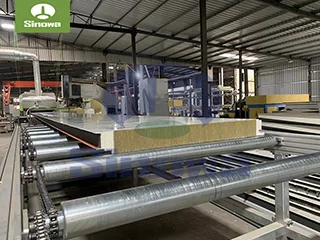
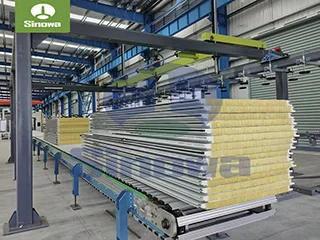
sandwich panel line
The core structural performance of finished rock wool sandwich panels processed by the continuous rock wool sandwich panel line is inherently rooted in the integrated structural design and precise processing technology of the sandwich panel production equipment. The production line is equipped with a full set of automated material conveying and positioning calibration structures, which can ensure the accurate alignment of upper and lower metal surface plates and the neat arrangement of internal rock wool fiber core materials in the whole production process, avoiding the structural hidden dangers such as core material deviation, surface layer dislocation and uneven material distribution that are easy to occur in manual or semi-continuous production processes. In the key lamination and composite forming link, the continuous production line adopts integrated high-pressure synchronous lamination structural components, which can provide uniform and lasting composite pressure for the whole plate surface of the sandwich panel, so that the adhesive between the metal surface layer and the rock wool core material can be evenly distributed and fully infiltrated, forming a tight and integrated composite bonding structure. This special composite processing mode makes the finished panel have excellent overall structural integrity, the surface layer and the core material will not produce layered separation or local degumming under the action of external conventional mechanical force or long-term natural environmental erosion, and the overall stress can be evenly dispersed when bearing external load, avoiding local stress concentration leading to panel deformation or damage. In terms of dimensional structural stability, the continuous production line is equipped with automatic fixed-length cutting and precise shaping correction devices, which can control the dimensional error of each batch of finished panels within a very small range, ensuring the consistency of thickness, width and length of the panels, and providing convenient assembly conditions for on-site rapid construction and seamless splicing installation. In addition, the production line can adjust the core material paving density and fiber laying direction according to the structural performance requirements of different panels, so that the rock wool core inside the sandwich panel forms a three-dimensional cross-linked fiber structure with different compactness, further optimizing the compressive resistance, tensile resistance and impact resistance of the panel, enabling the panel to maintain stable structural performance in long-term use, and not prone to warping deformation, shrinkage cracking and other problems due to temperature changes, humidity alternation and natural wind pressure impact.
According to the differences in core material structural configuration, internal fiber arrangement mode and comprehensive mechanical bearing performance, the rock wool sandwich panels produced by the continuous rock wool sandwich panel line can be divided into several distinct structural performance types, each with unique structural advantages and performance adaptation characteristics to meet the diversified structural safety needs of different building parts and engineering environments. The first type is the conventional light-duty rock wool sandwich panel with uniform low-density core structure, which is produced by the production line through uniform single-layer rock wool fiber paving and standard pressure composite processing. This type of panel has a relatively light overall weight while maintaining basic structural stability, with moderate compressive strength and bending resistance, and its core material adopts a loose and uniform fiber distribution structure, focusing on balancing basic structural bearing capacity and lightweight characteristics. The structural design of this panel does not pursue ultra-high mechanical load-bearing performance, but focuses on realizing basic enclosure and protective structural functions, with flexible overall structure and convenient handling and assembly, suitable for building parts with low load-bearing requirements and no severe external mechanical impact. The second type is the reinforced medium-density rock wool sandwich panel with crisscross fiber core structure, which is processed by the continuous production line through a special cross-laying process for rock wool core materials, making the internal rock wool fibers form a staggered and interwoven three-dimensional structural network. Compared with conventional light-duty panels, this type of panel has significantly improved tensile strength, compressive resistance and structural shear resistance, the internal fiber cross-linked structure can effectively disperse external horizontal and vertical loads, avoid local structural damage under medium-strength pressure and impact, and has better overall structural rigidity and anti-deformation ability. The production line can adjust the core material density within a moderate range for this type of panel, making it maintain stable structural performance under long-term static load and frequent slight vibration, with good structural fatigue resistance. The third type is the heavy-duty high-density rock wool sandwich panel with integrated reinforced composite structure, which adopts high-density rock wool core materials and multi-layer reinforced paving processing on the continuous production line, and adds local structural reinforcement treatment in the key stress-bearing areas of the panel. This type of panel has the highest structural integrity and mechanical bearing capacity among all types, with excellent compressive resistance, extreme bending resistance and strong impact resistance, and the internal integrated composite structure can withstand large external loads and harsh external mechanical effects without structural deformation or damage. The overall structural stability of the heavy-duty panel is outstanding, and it can maintain reliable structural safety even in extreme weather conditions such as strong wind and heavy rain or long-term high-load service environment, meeting the high-standard structural requirements of high-rise buildings and heavy-duty engineering projects.
Another important classification dimension of rock wool sandwich panels produced by the continuous rock wool sandwich panel production line is based on functional structural optimization characteristics, forming different panel types optimized for fireproof structure, sound insulation structure, thermal insulation structure and moisture-proof closed structure respectively, and each functional structural type has been specially adjusted and optimized in the production line processing technology and internal structural configuration. The fireproof structural optimized rock wool sandwich panel takes advantage of the inherent non-combustible characteristics of rock wool core materials, and the production line adopts seamless edge sealing and integral composite forming technology in the production process, so that the internal core material and the surface layer form a closed fire-resistant integrated structure without gaps. This structural design can effectively block the spread of flame and heat flow, avoid the rapid spread of fire along the panel gaps and internal structural layers, and will not produce harmful substances when encountering high temperature, maintaining the integrity of the structural enclosure function in the fire environment. The sound insulation structural optimized sandwich panel is produced by the production line through adjusting the internal fiber pore structure and core material thickness, forming a porous sound-absorbing and shock-insulating internal structure, which can effectively absorb and isolate various frequency noise vibrations, reduce sound transmission and resonance impact between buildings, and the overall structural tightness ensures excellent sound insulation and noise reduction effect. The thermal insulation structural optimized panel adopts fine-density rock wool core paving and low thermal conductivity structural configuration on the production line, the internal porous fiber structure can lock static air to form a stable thermal insulation layer, weaken heat conduction and heat radiation transfer, and the composite tight structure avoids thermal bridge phenomenon, maintaining stable indoor temperature and reducing building energy consumption. The moisture-proof closed structural sandwich panel is processed by the production line with edge sealing reinforcement and surface layer anti-seepage composite technology, the internal core material is tightly wrapped by the metal surface layer to form a fully closed structural state, which can prevent external moisture and water vapor from penetrating into the core material, avoid core material damp deformation and structural performance attenuation, and maintain long-term structural stability and functional reliability in humid and rainy environments.
Various types of rock wool sandwich panels with different structural performances produced by the continuous rockwool sandwich panel production line have extensive and targeted practical uses in multiple construction and engineering fields, realizing the perfect matching between structural performance characteristics and terminal application scenario demands. Conventional light-duty uniform core rock wool sandwich panels are mainly used for temporary building facilities, simple factory enclosures, indoor ordinary partition walls and low-rise building auxiliary enclosure structures. These application scenarios have low requirements for panel heavy load-bearing and extreme structural performance, and pay more attention to convenient and fast installation, low overall building load and basic enclosure protection functions. The lightweight structural characteristics of the light-duty panels can reduce the overall structural load of the building foundation and main body, and the standardized size produced by the continuous production line is convenient for on-site rapid splicing and disassembly, which can meet the rapid construction and temporary use needs of construction site office buildings, staff dormitories, disaster relief temporary shelters and simple warehouse enclosures, and also suitable for indoor space partition adjustment in ordinary office buildings and commercial places, realizing flexible space division without increasing excessive building structural burden.
Reinforced medium-density crisscross fiber rock wool sandwich panels with balanced structural strength and comprehensive performance are widely applied to the main enclosure walls and roof structures of ordinary industrial factories, logistics warehouses, agricultural breeding facilities and ordinary commercial buildings. These engineering scenarios need the panels to have both reliable structural bearing capacity and good comprehensive functional performance such as fire prevention, thermal insulation and sound insulation, and also require the panels to maintain stable structural performance under long-term natural environmental erosion and frequent daily use. The reinforced structural design of this type of panel can withstand conventional wind pressure, snow load and external slight impact, avoiding structural deformation and damage in long-term outdoor service, while the excellent fireproof and thermal insulation structure can meet the safety production and energy-saving use needs of industrial production workshops and logistics storage centers. In agricultural facilities such as breeding houses and greenhouses, the moisture-proof and thermal insulation structural characteristics of the panels can create a stable internal environmental condition, and the moderate structural strength can adapt to the complex outdoor natural environment of agricultural sites, ensuring the long-term stable operation of agricultural production and breeding work. In addition, this type of panel is also commonly used for public building auxiliary partition walls and corridor enclosure structures, balancing structural safety, functional performance and economic applicability, and meeting the daily use needs of public places.
Heavy-duty high-density reinforced composite rock wool sandwich panels with ultra-high structural performance are mainly used for high-rise building exterior wall enclosure structures, high-standard industrial workshop main body walls and roofs, data center enclosure engineering and special safety protection engineering facilities. These key engineering projects have extremely strict requirements on building structural safety, wind resistance, seismic performance and long-term durability, and need panels to maintain intact structural state and reliable protection function in extreme weather and unexpected emergencies. The ultra-high compressive and bending resistance of heavy-duty panels can adapt to the high wind pressure and complex structural stress environment of high-rise buildings, and the integrated reinforced structure has good seismic performance, ensuring the structural stability of high-rise building exterior walls under various extreme conditions. In high-standard industrial production workshops involving high-value production equipment and important production processes, the heavy-duty panels can provide stable and safe enclosure protection, avoiding structural damage affecting production safety. Data centers and power related special engineering facilities have high requirements for structural stability and fire safety, and the excellent structural integrity and fireproof performance of heavy-duty rock wool sandwich panels can effectively protect the safe operation of internal core equipment and ensure the continuous and stable operation of important infrastructure.
Various functional structural optimized rock wool sandwich panels produced by the continuous rock wool sandwich panel production line also play an irreplaceable role in special functional engineering fields. Fireproof structural optimized panels are widely used for fire isolation partition walls, building fire separation belts, factory fireproof enclosure walls and school, hospital public place fire protection structural facilities, effectively blocking fire spread and ensuring personnel evacuation safety and building fire protection safety. Sound insulation structural optimized panels are applied to studio partition walls, factory noise reduction workshops, urban commercial street sound insulation enclosure and residential building noise reduction partition structures, reducing noise interference and creating a quiet and comfortable internal environment. Thermal insulation structural optimized panels are commonly used for constant temperature workshop enclosure, cold storage auxiliary structural walls and energy-saving building exterior wall thermal insulation integration engineering, effectively reducing building energy consumption and maintaining stable internal temperature environment. Moisture-proof closed structural panels are suitable for coastal humid area building enclosure, chemical factory corrosion-resistant enclosure and underground auxiliary building partition structures, adapting to harsh humid and corrosive service environments and maintaining long-term structural and functional stability. With the continuous development of prefabricated construction and green energy-saving building concepts, the continuous rock wool sandwich panel production line will continue to optimize structural configuration and production technology, derive more rock wool sandwich panel types with differentiated structural performances, and further expand the application scope of such panels in modern construction engineering, contributing more reliable basic material support for the high-quality development of the construction industry.
https://www.cnsinowa.com/sandwich-panel-machines/continuous-rock-wool-sandwich-panel-line.html