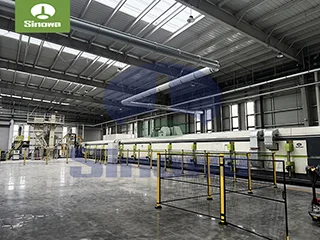
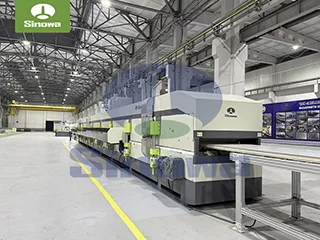
sandwich panel line
The basic structural composition of a standard PU sandwich panel production line covers multiple functional units arranged in sequence according to the production process flow, and each functional unit undertakes independent processing tasks while maintaining synchronous linkage operation with the front and rear equipment modules. The front-end part of the entire production line starts with the raw material feeding and uncoiling system, which is the initial link to provide continuous surface layer raw materials for subsequent composite processing. The main raw materials for the surface of PU sandwich panels are usually metal coils with anti-corrosion and color-coated treatments, and different types of metal substrates can be selected according to the actual use scenarios of finished panels. The uncoiling system adopts a hydraulic-driven decoiler structure, which can stably support large-diameter and heavy-weight metal coils, and realize slow and uniform coil release through hydraulic power regulation. During the operation of the decoiler, the tension control device keeps the metal sheet in a flat and tight feeding state, avoiding sheet deviation, wrinkling and uneven feeding problems caused by uneven tension in the subsequent forming process. This feeding stability is the basic premise to ensure the consistent thickness and flatness of the surface layer of each batch of sandwich panels, and also lays a foundation for the accurate matching of subsequent roll forming and edge processing procedures.
After the metal sheet is uncoiled and fed out smoothly, it enters the surface protection film covering and preliminary trimming processing link. In the actual production and subsequent transportation, hoisting and installation process of PU sandwich panels, the surface of metal sheets is easy to produce scratches, abrasions and surface coating damage due to external friction and collision, so surface protective film treatment is a necessary pre-processing step before formal forming and composite processing. The film covering equipment in the production line can automatically attach protective films of corresponding specifications on the upper and lower surfaces of the metal sheet, and the film attaching speed is synchronized with the sheet feeding speed to ensure no film wrinkling, film deviation and incomplete fitting between the film and the metal surface. After the film covering operation is completed, the sheet enters the edge slitting and trimming device, which carries out fixed-size cutting and trimming on both sides of the metal sheet according to the production size requirements of the sandwich panel. The edge trimming process can remove the irregular edge parts of the original metal coil, ensure that the width of the metal sheet entering the subsequent forming process is uniform and consistent, and avoid the problem of inconsistent edge dimensions of finished panels caused by raw material deviation. At the same time, the edge trimming treatment can make the edge of the metal sheet smooth and flat, preventing the subsequent equipment from being scratched by sharp burrs and avoiding the hidden danger of edge cracking of the composite panel in the later use process.
The metal sheet after film covering and edge trimming is transported to the roll forming system, which is one of the core equipment modules to determine the surface shape and structural profile of PU sandwich panels. Different application scenarios require sandwich panels with different surface profiles, including flat panels, corrugated panels, ribbed structural panels and other common types, and the roll forming system completes the cold bending and forming of metal sheets through multiple groups of precision arranged forming rollers. The forming rollers are made of high-strength steel materials and processed through precise machining and surface hardening treatment, which can maintain long-term stable forming accuracy and reduce wear and deformation during long-term continuous operation. Each group of forming rollers is arranged according to the gradual forming principle, and the metal sheet is gradually bent and shaped step by step, avoiding the structural damage and surface coating cracking caused by one-time violent bending of the metal sheet. In the working process of the roll forming system, the automatic correction device monitors the feeding position of the metal sheet in real time, and fine-tunes the running track of the sheet at any time to ensure that the forming position of each sheet is consistent, so that the profile radian, structural size and overall flatness of each finished sandwich panel can meet unified processing standards. The roll forming speed is intelligently linked with the operating speed of the front and rear equipment of the production line, realizing synchronous operation of the whole line and avoiding production stagnation or sheet accumulation caused by speed mismatch.
After the roll forming process is completed, the profiled metal sheet enters the preheating treatment link, which is a key pre-processing step to ensure the good foaming effect of polyurethane core material and stable bonding between the core material and the metal surface layer. The preheating system adopts a closed heating structure with uniform temperature distribution inside, and the heating temperature can be adjusted and controlled according to the characteristics of polyurethane raw materials and the production environmental conditions. In the natural production environment, the temperature of the metal sheet and the polyurethane raw material will change with the seasonal and daily ambient temperature, and the temperature difference will directly affect the foaming reaction speed, expansion ratio and curing bonding effect of polyurethane materials. Through the preheating treatment of the metal sheet, the temperature of the metal surface layer is kept within the optimal range suitable for polyurethane foaming reaction, which can effectively avoid the problems of insufficient foaming, uneven foam pores and weak bonding between the core material and the metal plate caused by low temperature of the metal surface. At the same time, preheating can remove the tiny moisture attached to the surface of the metal sheet, eliminate the adverse effect of moisture on the chemical reaction of polyurethane foaming, and further improve the bonding firmness and overall structural stability between the core material and the surface layer. The preheating time and heating temperature are flexibly adjusted according to the thickness of the metal sheet and the production speed, ensuring that each sheet can reach the optimal reaction temperature state before entering the foaming composite link.
The polyurethane foaming and raw material mixing and pouring system is the core functional unit of the entire PU sandwich panel production machine, and directly determines the thermal insulation performance, structural strength and internal uniformity of finished sandwich panels. Polyurethane foam core materials are formed by the chemical reaction and foaming expansion of two main liquid raw materials, and the two components need to be accurately proportioned, fully mixed and evenly poured in a sealed environment to ensure the stability of the foaming effect. The metering equipment in the foaming system adopts precise flow control components to accurately control the output proportion and flow rate of the two raw materials, avoiding the problems of insufficient reaction, incomplete foaming and reduced core material performance caused by unreasonable raw material ratio. After accurate metering, the two liquid raw materials enter the high-speed mixing device for full stirring and blending, so that the components are evenly mixed at the molecular level and prepared for subsequent foaming reaction. The mixed liquid polyurethane raw material is evenly poured on the surface of the bottom metal sheet that has been formed and preheated, and the pouring position and pouring volume are automatically adjusted according to the thickness specification of the produced sandwich panel, ensuring that the foamed core material can fully fill the gap between the upper and lower metal sheets without excess overflow or insufficient filling.
After the polyurethane raw material is poured, the upper and lower metal sheets with the foaming raw material in the middle enter the double belt laminating and curing system together, which is the key equipment to realize composite bonding and foam curing forming of PU sandwich panels. The double belt laminating system consists of upper and lower circulating conveyor belts with high pressure resistance and wear resistance, which can provide stable and uniform pressing force for the composite panels in the curing process. After entering the laminating system, the polyurethane raw material begins to undergo chemical foaming reaction and gradual curing and solidification under the action of constant temperature and constant pressure. The internal temperature of the laminating system is kept stable through an intelligent temperature control system, creating a constant temperature environment required for polyurethane foaming and curing reaction. The circulating conveyor belt runs at a constant speed, driving the composite semi-finished panels to move forward slowly, so that the polyurethane foam fully expands, fills the internal space of the sandwich panel, and closely bonds with the inner surface of the upper and lower metal sheets in the process of gradual curing. The pressure applied by the double belt can ensure that the overall thickness of the sandwich panel is uniform and consistent, avoid local bulging or depression of the panel caused by uneven foaming expansion, and make the internal foam pore structure uniform and dense. The length of the double belt laminating system is designed according to the curing time required for polyurethane materials, ensuring that the polyurethane core material is completely cured and formed before leaving the laminating equipment, and the initial bonding strength and structural stability of the composite panel meet the basic processing requirements.
After completing the lamination and primary curing process, the semi-finished continuous PU sandwich panel enters the fixed-length cutting and edge finishing link. The continuous composite panel produced by the production line is an integral long strip structure, which needs to be cut into standard fixed-length finished panels according to the actual engineering use requirements. The cutting equipment adopts automatic tracking and fixed-length cutting technology, which can set different cutting length parameters according to different order requirements. In the cutting process, the equipment can automatically track the running speed of the panel, realize synchronous cutting with the panel transportation, and ensure that the cutting section is flat and smooth without burrs, cracks and edge deformation. After fixed-length cutting, the sandwich panel enters the edge trimming and shaping device again to carry out fine trimming on the four sides of the cut single panel, remove the residual foam and tiny burrs on the edge, and make the overall dimensional accuracy of the finished panel reach the unified standard. This fine edge treatment not only improves the appearance flatness of the product, but also ensures the precise docking and assembly of multiple panels in the actual construction and installation process, reducing the assembly gap and improving the overall sealing and thermal insulation effect of the engineering enclosure structure.
The cut and trimmed PU sandwich panels have completed the main composite forming and cutting processing, and then need to go through the cooling and secondary curing link to further stabilize the internal structural performance of the panels. Although the polyurethane core material has been initially cured in the double belt laminating system, the internal temperature of the panel is still high after cutting, and the internal chemical reaction of the core material is not completely finished. The cooling system adopts natural air cooling and auxiliary circulating air cooling mode, which gradually reduces the surface and internal temperature of the panel to the normal ambient temperature, and avoids the problem of panel deformation and core material bonding failure caused by rapid temperature change. In the cooling process, the polyurethane core material completes the secondary curing reaction, the internal molecular structure tends to be stable, the bonding strength between the core material and the metal surface layer is further improved, and the overall hardness, compression resistance and structural stability of the sandwich panel are fully guaranteed. The cooling conveying speed is matched with the front-end production and cutting speed to ensure that each panel has enough cooling and curing time, and the performance stability of the finished product is not affected by the fast-paced continuous production.
After cooling and secondary curing, the qualified finished PU sandwich panels are transported to the automatic stacking and finishing system. The stacking equipment adopts mechanical automatic grabbing and stacking structure, which can neatly stack the single panels according to the specified quantity and stacking standards, avoiding manual handling and stacking errors and reducing the labor input in the production link. In the stacking process, the equipment automatically adjusts the position of each panel to ensure that the panels are aligned up and down, neatly arranged and no offset stacking, which is convenient for subsequent overall packaging, transportation and storage. After stacking is completed, the finished panels can enter the final packaging link according to production and delivery needs. The packaging process adopts protective wrapping materials to wrap the stacked panels as a whole, protecting the surface protective film and the panel structure from damage during long-distance transportation and outdoor storage, and ensuring that the finished panels can maintain good appearance and performance state when delivered to the construction site.
The stable operation of the entire PU sandwich panel manufacturing line cannot be separated from the coordinated support of the intelligent control system and daily operation and maintenance management. The core control part of the production line adopts a centralized integrated control mode, which uniformly controls the operating parameters, operating speed, temperature regulation, raw material metering and equipment linkage state of all functional units. The control system can monitor the real-time operating status of each equipment module in the production line in real time, including the running speed of each conveyor, the heating temperature of the preheating and curing system, the flow rate of polyurethane raw material metering, the cutting length parameters and the stacking quantity settings. Once abnormal conditions such as equipment jamming, parameter deviation and raw material supply interruption occur in the production process, the control system will automatically send out prompt signals and make adaptive adjustment or temporary shutdown protection actions to avoid equipment failure and unqualified product production. The parameter setting of the control system has flexible adjustability, which can be modified and optimized according to different raw material characteristics, product specification requirements and production environmental changes, so as to adapt to the diversified production needs of different types of PU sandwich panels.
Daily maintenance and regular maintenance of the PU sandwich panel production equipment are important guarantees to extend the service life of the equipment and maintain stable production quality. In the daily production process, it is necessary to regularly check the tension of the uncoiling system, the wear degree of the roll forming rollers, the smoothness of the polyurethane raw material conveying pipeline and the sensitivity of the temperature control components. The residual foam raw materials and processing debris generated in the production process need to be cleaned up in time to avoid equipment blockage and mechanical wear caused by long-term accumulation. The hydraulic and pneumatic components of the production line need to be regularly checked for oil pressure and air pressure stability, and hydraulic oil and lubricating grease need to be replaced and supplemented regularly to ensure the flexible operation of mechanical transmission parts. For the metering and mixing components of the polyurethane foaming system, regular cleaning and calibration are required to ensure the accurate proportioning of raw materials and avoid product performance fluctuation caused by metering deviation. Scientific and standardized maintenance management can not only reduce the failure rate of the production line and improve production continuity, but also keep the dimensional accuracy and product performance of produced sandwich panels stable for a long time, reducing the production loss caused by equipment failure and unqualified products.
With the continuous upgrading of construction engineering standards and the continuous improvement of industrial insulation and energy-saving requirements, the market demand for PU sandwich panels with stable performance, good thermal insulation effect and long service life is constantly increasing, which also puts forward higher requirements for the production capacity, processing accuracy and product adaptability of PU sandwich panel production lines. Modern fully automatic PU sandwich panel production lines are gradually developing towards higher automation degree, stronger process flexibility and better energy-saving operation effect. On the premise of maintaining the basic production process flow and core structural composition, the production line is continuously optimized in terms of energy consumption control, raw material utilization rate and product diversification production capacity. The optimized production line can not only meet the mass production needs of standard PU sandwich panels, but also adapt to the personalized production of special-specification panels required by special engineering projects, balancing production efficiency and product diversification.
In practical industrial production and engineering application matching, the operation and debugging of continuous PU sandwich panel production line need to be combined with the actual use environment of finished panels to carry out targeted process optimization. For sandwich panels used in cold storage low-temperature insulation projects, the foaming density and core material thickness parameters of polyurethane need to be adjusted to ensure excellent low-temperature thermal insulation performance and structural frost resistance; for sandwich panels used in factory building exterior wall and roof enclosure, the forming structural strength and surface anti-corrosion treatment matching need to be focused on to adapt to outdoor wind and rain erosion and long-term outdoor use environment; for interior partition sandwich panels used in commercial buildings, the appearance flatness and environmental protection performance of the panels are the key adjustment directions of production process parameters. The strong process adjustability of the PU sandwich panel production line enables it to cope with the production needs of various application scenarios, and provides reliable material guarantee for the construction industry to realize energy-saving insulation, structural enclosure and rapid construction.
In conclusion, the PU sandwich panel continuous production line is a comprehensive and integrated industrial manufacturing equipment integrating multiple disciplines and multiple process links. From raw material feeding and surface preprocessing, roll forming and temperature preprocessing, polyurethane foaming and composite curing, to fixed-length cutting, cooling shaping and automatic stacking packaging, each production link is closely connected and mutually restricted, and the coordinated operation of each functional system determines the overall production efficiency and finished product quality. The reasonable structural design of the production line, precise process parameter control and standardized operation and maintenance management are the three key elements to ensure the stable production of high-quality PU sandwich panels. With the continuous development of the construction industry towards energy saving, environmental protection and high efficiency, the PU sandwich panel production machinery will continue to play an important role in the field of composite building material manufacturing, and continuously provide high-performance and standardized sandwich panel products for various construction and industrial engineering projects, promoting the standardized and high-quality development of the entire building insulation and enclosure material industry.
https://www.cnsinowa.com/sandwich-panel-machines/pu-sandwich-panel-production-line.html