sandwich panel machine
The overall structural design of industrial sandwich panel production line follows the principles of modular integration and rhythmic operation, with each functional module precisely matched in operating speed and process parameters to ensure the continuity and stability of the entire production process. The complete production system covers raw material feeding, surface material leveling and forming, adhesive coating, core material laying or foaming injection, composite pressing, constant temperature curing, fixed-length cutting, cooling shaping, and automatic stacking, forming a closed-loop production system with no redundant intermediate links. Each functional unit is independently adjustable in parameters while maintaining overall linkage, which enables the equipment to adapt to different core material types and panel specification requirements, realizing flexible production of diversified composite panels.
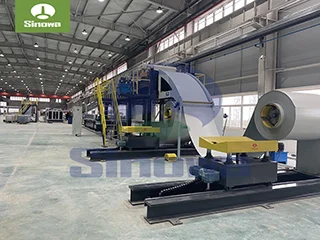
The raw material feeding module serves as the starting point of the entire sandwich panel line, undertaking the stable supply of upper and lower metal surface materials. This unit is mainly composed of multi-group unwinding structures and tension adjustment components, which can stably release coiled metal raw materials and maintain constant material tension during operation. In the production process, uneven tension of metal sheets is a key factor leading to panel surface wrinkling and dimensional deviation, so the built-in tension sensing and automatic adjustment system of the feeding module will dynamically correct the tightness of materials according to production speed and material thickness changes. This real-time adjustment ensures that the metal sheets entering the subsequent forming process remain flat and uniform, laying a solid foundation for the consistent appearance and structural accuracy of finished panels. Meanwhile, the feeding module is equipped with auxiliary material sorting and deviation correction functions to avoid material offset and overlapping during high-speed operation, effectively reducing the rate of defective products caused by raw material conveying errors.
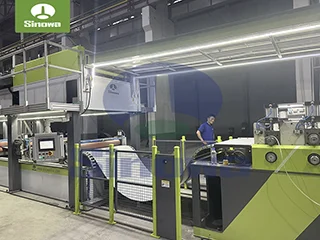
Following the feeding process, the surface material leveling and roll forming module completes the precision shaping of metal sheets. Flat metal coiled materials often have tiny bending deformation and surface irregularities after long-term winding and storage, so the leveling unit first uses multiple groups of parallel pressing rollers to perform multi-point pressure correction on the metal sheets, eliminating internal stress and surface flatness defects of the materials. The leveled metal sheets then enter the roll forming area, where continuous rolling and bending operations are completed through dozens of groups of precision forming rollers arranged in an orderly gradient. Each group of rollers corresponds to a specific bending angle and forming radian, gradually pressing the flat metal plate into the required three-dimensional profile structure. This progressive forming method avoids the structural damage and stress concentration caused by one-time strong bending, ensuring the structural strength and dimensional stability of the formed metal surface layer. The roller gap and forming stroke of the roll forming system can be fine-tuned according to different plate thicknesses and profile standards, meeting the production requirements of various specification panels.
The adhesive coating and core material compounding stage is the core link that determines the bonding performance and overall quality of sandwich panels. Before compounding, the sandwich panel equipment will carry out uniform adhesive coating on the inner surface of the formed upper and lower metal sheets through a high-precision spraying system. The spraying system adopts atomized coating technology to disperse the adhesive into fine uniform particles, forming a thin and continuous adhesive layer on the metal surface. This uniform coating mode effectively avoids the problems of local glue shortage, glue accumulation, and uneven bonding force that are common in traditional manual gluing processes. The coating amount and spraying range can be automatically adjusted according to the core material type and panel thickness, ensuring that the adhesive can fully infiltrate the contact interface between metal and core material, maximizing the bonding effect.
For different types of sandwich panel production, the core material compounding process adopts targeted operation modes. When producing panels with solid core materials such as rock wool and expanded polystyrene, the sandwich panel production equipment realizes automatic cutting, fixed-length conveying and precise laying of core materials through a special core material feeding device, ensuring that the core material is evenly arranged between the upper and lower metal sheets with consistent density and no gaps. For flexible foam core materials such as polyurethane and polyisocyanurate, the system adopts high-pressure mixed foaming and injection technology. Different chemical raw materials are proportionally mixed through a precise metering system, and the mixed liquid materials are evenly injected between the closed metal surface layers. The liquid materials undergo rapid chemical reaction, foaming, expansion and filling in the closed cavity, forming a continuous and dense foam core layer that is closely integrated with the metal surface layers. This integral foaming and compounding structure enables the core material and surface materials to form an inseparable whole, greatly improving the overall structural stability and thermal insulation performance of the panel.
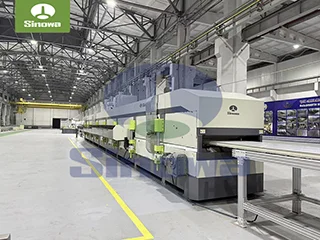
The pressing and constant temperature curing module is a key functional unit to realize firm composite bonding and structural shaping of sandwich panels. After the completion of material compounding, the semi-finished panels enter the double-belt pressing system, which applies stable and uniform static pressure to the composite materials through upper and lower circulating pressing belts. The pressure value can be intelligently adjusted according to the hardness of the core material and the designed thickness of the panel, avoiding excessive pressure crushing the porous core structure or insufficient pressure leading to loose lamination and poor bonding fastness. While maintaining constant pressure, the sealed thermal insulation curing bin provides a stable temperature environment for the chemical curing reaction of the adhesive and foaming materials. Most composite adhesives and foam forming reactions require specific temperature conditions to complete cross-linking and curing, and the constant temperature system can accurately control the internal temperature of the curing area within a reasonable range, accelerating the curing speed of composite layers and eliminating unstable factors such as incomplete curing and slow molding caused by temperature fluctuation.
The circulating operation of the double-belt structure ensures that the panels maintain continuous pressure and constant temperature state during the whole curing process, so that the bonding interface fully reacts and forms high-strength bonding force, and the internal structure of the core material tends to be uniform and stable. After sufficient curing and shaping, the internal stress of the composite panel is completely released, and the overall structural rigidity and dimensional stability are fundamentally improved, which can effectively avoid panel deformation, layer separation and other quality problems in subsequent use and installation.
The fixed-length cutting and post-processing module realizes the precise sizing and finishing of finished panels. The cured continuous composite panels are conveyed to the cutting station at a stable synchronous speed, and the high-precision measuring and positioning system tracks the conveying length of the panels in real time. When the panels reach the preset size standard, the automatic cutting device starts instantaneous fixed-length cutting. The cutting process adopts non-stop synchronous cutting technology, which can complete the cutting operation while the sandwich panel manufacturing line is running continuously, without stopping the machine or reducing speed, effectively ensuring the continuity and high efficiency of production. The cutting tool adopts high-hardness structural design, which can realize flat and smooth cutting sections without burrs, cracks or material delamination, ensuring the dimensional accuracy and appearance quality of finished panels.
After cutting, the panels enter the natural cooling and shaping area to complete the final structural stabilization. A small amount of residual temperature generated in the curing process will be gradually dissipated through natural air circulation, and the internal structure of the panels will be further stabilized with the temperature drop, avoiding secondary deformation caused by rapid temperature change. After cooling, the automatic stacking device neatly arranges the qualified finished panels according to fixed specifications, realizing automatic collection and arrangement of products, which greatly reduces manual handling and sorting work, and improves the overall production efficiency and site management level.
The intelligent control system runs through the whole operation process of the industrial sandwich panel production machine, serving as the core brain of the entire production line. The system adopts integrated programmable control logic, which can uniformly schedule and precisely control the operating parameters of each functional module such as feeding, forming, gluing, pressing, curing and cutting. Operators can set production parameters such as panel thickness, width, length, production speed and gluing amount through the centralized operation interface. The control system will automatically match the operating speed and parameter values of each unit to realize synchronous linkage operation of the whole line. In the production process, the system can monitor the operating state of each module in real time, including material conveying speed, pressure value, curing temperature, cutting accuracy and other key data. Once abnormal parameters or equipment faults are detected, the system will automatically trigger prompt feedback and perform self-protection adjustment to avoid batch defective products and equipment damage.
The automated operation mode of the equipment effectively reduces the dependence on manual operation skills, lowers the technical threshold of production work, and ensures the consistency and standardization of product quality. Compared with traditional semi-manual production methods, the intelligently controlled continuous production mode can eliminate human errors in parameter adjustment and operation control, making the thickness, density, bonding strength and dimensional accuracy of each batch of panels maintain a high consistent level. Meanwhile, the system has a parameter storage function, which can store the production parameters of conventional specification panels, and realize one-click parameter calling and rapid production switching when producing the same type of products again, greatly improving the flexibility and response speed of production.
Industrial sandwich panel production machinery has significant technical and production advantages in practical industrial applications. First of all, the integrated continuous production mode realizes one-step molding of composite panels, which integrates more than ten traditional independent processes into one streamlined production line, greatly shortening the production cycle and improving unit time output. Secondly, the precise parameter control system realizes refined control of each production link, effectively optimizing the internal structure and interface bonding state of the panels, and significantly improving the overall performance of finished products in terms of thermal insulation, sound insulation, seismic resistance and structural stability. In addition, the modular structural design of the equipment makes daily maintenance and later debugging more convenient, each functional module can be independently inspected and maintained, reducing equipment failure rate and maintenance cost, and ensuring long-term stable operation of the production line.
With the continuous upgrading of industrial building material standards and the expansion of application scenarios, the performance requirements for sandwich panel products are constantly improving, which also promotes the continuous technological iteration of sandwich panel making machine. Modern production machines are gradually developing towards higher automation, higher precision, energy saving and environmental protection, and multi-functional integration. The optimized curing and heating system can effectively reduce energy consumption while ensuring curing efficiency, realizing green and low-carbon production. The upgraded gluing and foaming system can improve the utilization rate of raw materials, reduce material waste, and further improve the production economy. At the same time, the equipment is constantly expanding its adaptive capacity, which can meet the production needs of multi-type core materials and multi-structure composite panels, and can produce special panels with fire resistance, low temperature resistance, corrosion resistance and other special properties, adapting to the differentiated application needs of different industrial scenarios.
In the field of modern industrial construction and new building materials, industrial sandwich panel manufacturing machine plays an irreplaceable basic supporting role. The high-efficiency and standardized production capacity of the equipment provides a reliable guarantee for the large-scale popularization and application of sandwich panel products. The finished panels produced by the equipment have the advantages of light weight, high strength, convenient installation, excellent thermal insulation and sound insulation performance, and good weather resistance, and are widely used in industrial factory buildings, warehouse enclosures, cold storage insulation structures, clean workshop partitions, temporary engineering buildings and other fields. With the continuous development of the construction industry towards industrialization, modularization and energy conservation, the market demand for high-quality composite sandwich panels will continue to grow, and industrial sandwich panel production machines will also usher in broader application prospects and development space, continuously empowering the upgrading and innovation of the new building materials industry through technological optimization and performance improvement.
https://www.cnsinowa.com/sandwich-panel-machines/industrial-sandwich-panel-production-machine.html