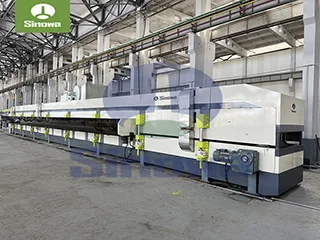
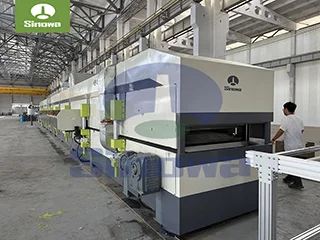
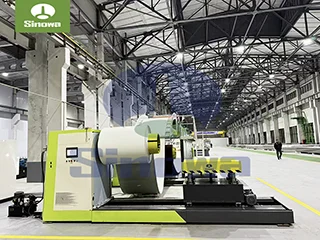
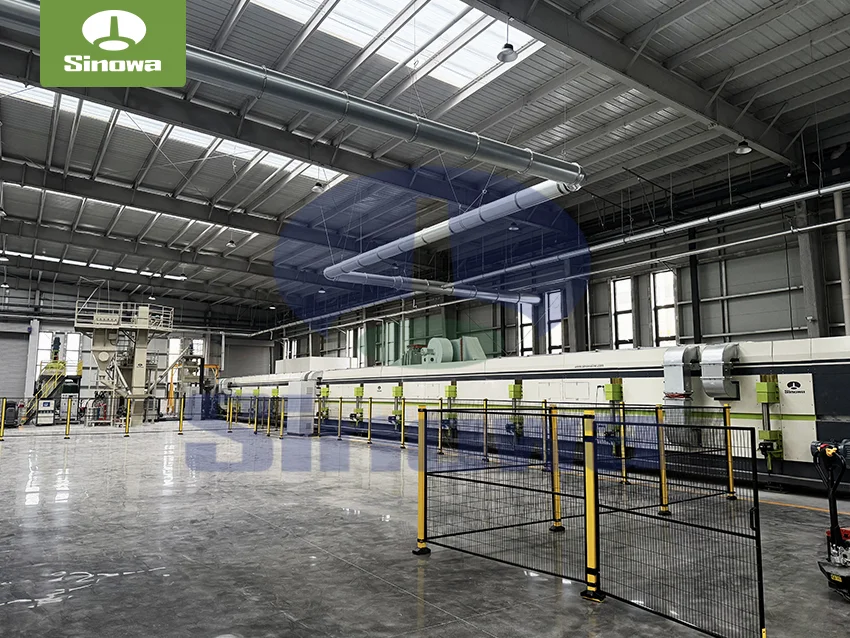
 sandwich panel machine
The operational logic of the PU sandwich panel machine centers on the synchronous coordination of multiple functional modules, each undertaking an independent and interconnected production task to form a closed-loop and uninterrupted production workflow. The entire production process starts from raw material preparation and pretreatment, covering surface material forming, precise PU raw material mixing and injection, in-situ foam expansion and bonding, constant-temperature curing and shaping, fixed-length precision cutting, and finished product conveying and stacking. Every production link is regulated by unified operational parameters, ensuring that the physical properties, structural dimensions, and surface flatness of each batch of finished panels maintain high consistency, which is the core advantage of automated continuous production over manual and semi-automatic production modes.
Raw material pretreatment and surface material forming constitute the initial core stage of the entire production process. The sandwich panel machine is equipped with automatic unwinding units that stably release coiled surface materials, including color steel sheets, aluminum sheets, and other metal substrates, as well as composite non-metal plates applicable to special scenarios. Before formal forming, the surface materials go through multi-stage leveling and tension adjustment mechanisms to eliminate material wrinkles, deformation, and uneven tension caused by coiling and long-term storage. This preprocessing step is critical to avoiding surface defects such as bulges and depressions on finished panels and ensuring the overall flatness of composite products. Subsequently, the materials enter the roll forming system, which adopts multi-group precision rolling modules to carry out gradual cold bending and shaping according to preset panel structure requirements. The gradual forming process avoids structural damage and internal stress concentration on the surface materials, effectively enhancing the overall structural rigidity and deformation resistance of the panels, enabling the finished products to withstand external environmental stresses such as wind pressure, snow load, and temperature changes in long-term outdoor and industrial use scenarios.
The PU foaming and injection system is the most technologically critical part of the sandwich panel production equipment, directly determining the insulation performance, bonding strength, and structural stability of the sandwich panel core layer. Polyurethane foam is formed by the chemical reaction between two liquid raw materials, polyol and isocyanate, and the machine's high-pressure foaming unit realizes precise metering, uniform mixing, and stable injection of the two raw materials. The equipment is fitted with independent raw material storage and temperature regulation devices, which maintain the liquid raw materials within a constant and optimal temperature range to ensure stable fluidity and chemical activity of the materials. Stable temperature control prevents insufficient reaction caused by low temperature or excessive foam shrinkage caused by high temperature, effectively avoiding common quality problems such as uneven foam density, hollow core layers, and poor bonding between the core layer and surface layers.
During the injection process, the high-pressure mixing structure of the polyurethane sandwich panel machine enables the two raw materials to complete instantaneous and uniform blending in a closed cavity, eliminating material stratification and incomplete mixing that often occur in low-pressure mixing equipment. The uniformly mixed liquid PU materials are evenly injected between the upper and lower surface materials through a precision injection port. With the advancement of the conveyor system, the liquid materials undergo continuous chemical reactions, gradual volume expansion, and full filling of the gap between the two surface layers. In this process, the foam not only forms a continuous and dense insulation core layer but also produces a strong physical bonding effect with the inner surfaces of the upper and lower plates, integrating the surface materials and the foam core into an inseparable composite structure. This in-situ foaming and composite forming mode avoids the bonding gaps and delamination risks existing in traditional secondary bonding processes, greatly improving the overall structural integrity and service life of the sandwich panels.
The constant-temperature curing and laminating system further optimizes the forming quality and structural stability of the panels. The PU sandwich panel making machine is equipped with a fully enclosed thermal circulation curing channel, which forms a stable and uniform temperature environment through hot air circulation and contact heating structures. The double-track closed conveyor belt runs through the entire curing and laminating area, maintaining stable clamping pressure and fixed spacing for the upper and lower surface materials during the foam expansion and curing process. This structure effectively restricts the irregular expansion and deformation of the foam, ensures the uniform thickness of the finished panels, and guarantees the flatness and smoothness of the panel surface. The synchronized operation of the conveyor speed and curing temperature enables the foam to complete full reaction, curing, and shaping within the preset time, avoiding quality defects such as incomplete curing, soft core layers, or excessive brittleness of the foam caused by insufficient or excessive curing time.
After completing curing and preliminary shaping, the continuous long strip of composite panels enters the precision cutting and finishing stage. The machine's automatic fixed-length cutting unit adopts high-speed and stable cutting structures, which can accurately complete horizontal cutting according to custom length parameters. The intelligent length counting and positioning system realizes real-time monitoring of panel conveying distance, ensuring that the dimensional error of each finished panel is controlled within a tiny range. The cutting process is stable and efficient, without generating large-area burrs, plate deformation, or foam fragmentation, which effectively guarantees the neatness of panel edges and the integrity of the core layer structure. For panels requiring edge trimming and groove processing, the supporting finishing modules can complete integrated processing, making the panel edges more standardized and convenient for on-site assembly and docking in actual construction projects.
The final stage of production includes automatic conveying, cooling shaping, and stacking storage. The cut single panels are transported to the cooling area through the conveying system to complete natural heat dissipation and secondary shaping, eliminating residual internal stress generated during the thermal curing process and further stabilizing the structural performance of the panels. After full cooling and shaping, the automatic stacking device neatly arranges the finished panels according to fixed specifications, realizing orderly collection of finished products and effectively reducing manual handling and stacking work. The fully automated post-processing link not only improves overall production efficiency but also avoids panel surface scratches, corner damage, and messy stacking problems caused by manual operation, ensuring the consistent appearance quality of finished products.
The outstanding performance of PU foam sandwich panel production machine lies in their high degree of automation and production stability, which fundamentally optimizes the traditional production mode of composite panels. The entire production process realizes integrated linkage from raw material input to finished product output, with all key parameters including conveying speed, raw material injection volume, curing temperature, and cutting length controlled by a unified intelligent system. This centralized control mode ensures the synchronization and coordination of each production link, avoids production stagnation and quality fluctuations caused by mismatched parameters of different modules, and enables the equipment to maintain stable high-efficiency operation for a long time. Compared with semi-automatic production lines that require manual parameter adjustment and auxiliary operation, fully automated equipment greatly reduces the dependence on manual experience, lowers the error rate in the production process, and realizes standardized and batch production of high-quality panels.
In terms of product performance optimization, the advanced structural design of the equipment endows PU foam sandwich panels with excellent comprehensive properties. The precisely controlled foaming process enables the foam core layer to form a uniform and closed-cell structure, which greatly improves the thermal insulation and heat preservation performance of the panels. This structural characteristic makes the finished panels have extremely low thermal conductivity, effectively blocking heat transfer, and providing reliable energy-saving effects for building envelopes, cold storage insulation walls, and temperature-controlled industrial workshops. At the same time, the dense closed-cell foam structure also gives the panels good waterproof, moisture-proof, and sound insulation capabilities, adapting to complex and changeable use environments such as humid, rainy, and noisy industrial sites.
In addition to thermal insulation and sound insulation advantages, the composite panels produced by this equipment also have excellent mechanical properties and structural durability. The tight composite structure formed by in-situ foaming and bonding enables the surface plates and foam core layer to bear external force together, giving the panels good compression resistance, bending resistance, and overall stability. The panels will not easily deform, crack, or delaminate under long-term static load and conventional external impact, and can maintain stable structural performance in a wide temperature range. Moreover, the polyurethane foam core material has good chemical stability, with resistance to conventional atmospheric corrosion, mild acid and alkali erosion, and aging resistance, ensuring that the panels can maintain stable use performance for a long time after installation and reduce the frequency of later maintenance and replacement.
The polyurethane sandwich panel equipment also has strong production flexibility and scene adaptability, meeting the diversified production needs of different industries and application scenarios. By adjusting the operating parameters of the foaming system, laminating spacing, and cutting specifications, the machine can produce sandwich panels with different thicknesses, densities, and structural strengths. It can adapt to the production of light-weight decorative panels for civil buildings, high-strength insulation panels for industrial workshops, high-density cold storage insulation panels with ultra-low thermal conductivity, and special functional panels for environmental protection and chemical plants. Meanwhile, the equipment can match different surface materials according to user needs, realizing the production of multi-series composite panels, which greatly expands the application coverage of products and enables manufacturers to flexibly respond to diverse market demands.
From the perspective of production cost and resource utilization efficiency, PU foam sandwich panel manufacturing machine has significant advantages over traditional production equipment. The precise metering and injection system of the equipment avoids excessive waste of PU raw materials, improves the utilization rate of chemical raw materials, and reduces unnecessary material consumption. The highly automated production mode greatly reduces the configuration of on-site operators, lowers labor input and management costs in the production process, and improves the overall operational efficiency of the sandwich panel production line. In addition, the stable and standardized production process greatly reduces the rate of defective and unqualified products, avoids resource waste and cost loss caused by rework and scrapping, and further improves the economic benefits of industrial production.
In the context of the global promotion of energy-saving and low-carbon building development, the technical value and market significance of PU foam sandwich panel machinery is increasingly prominent. As a key equipment for producing high-efficiency energy-saving building materials, it provides reliable technical and equipment support for the upgrading of modern building enclosure structures. The lightweight characteristics of PU sandwich panels can effectively reduce the self-weight of buildings, lower the load-bearing pressure of building structures, and reduce the consumption of structural building materials in the construction process. At the same time, the excellent thermal insulation performance of the panels can significantly reduce the energy consumption of building heating and cooling operation, realize the optimization of building energy consumption, and conform to the development trend of green and low-carbon construction in the modern construction industry.
With the continuous progress of industrial manufacturing technology, PU foam sandwich panel production machinery is also constantly evolving and upgrading in terms of intelligent control, structural optimization, and energy-saving operation. Modern equipment is gradually equipped with more precise parameter sensing and real-time monitoring functions, which can realize real-time collection, analysis, and adjustment of production data such as foaming density, curing temperature, and conveying speed. The intelligent monitoring system can automatically identify abnormal parameter fluctuations in the production process and make timely adaptive adjustments, further improving production stability and product consistency. In terms of structural design, the equipment adopts more compact and reasonable overall layout, which reduces floor space on the premise of ensuring production efficiency, optimizes the production workshop layout, and improves the space utilization rate of industrial production sites.
In terms of operational energy consumption optimization, the upgraded equipment adopts energy-saving heating and circulating power structures, which effectively reduce invalid energy consumption in the production process and improve the overall energy utilization efficiency of the sandwich panel line. The optimized transmission and mechanical operation structure reduces mechanical friction loss and equipment operation noise, realizing low-energy and low-noise green production. While improving production efficiency and product quality, it also reduces the impact of production operations on the surrounding environment, meeting the increasingly stringent environmental protection and green production requirements of modern industrial manufacturing.
In practical industrial production applications, the stable operation of PU sandwich panel production line directly determines the market competitiveness of composite panel products. The high-standard and consistent product quality produced by automated equipment enables sandwich panels to be widely used in various high-demand engineering scenarios, including large-scale industrial factory buildings, logistics warehousing cold storage, clean workshops in the pharmaceutical and electronic industries, temporary engineering buildings, and modern rural prefabricated buildings. With the continuous expansion of the prefabricated building industry and the continuous improvement of building energy-saving standards, the market demand for high-performance PU foam sandwich panels continues to grow, which also puts forward higher requirements for the precision, efficiency, stability, and intelligence of supporting production equipment.
In conclusion, the PU foam sandwich panel machine, as a highly integrated, automated, and efficient professional production equipment, integrates advanced chemical foaming technology, mechanical manufacturing technology, and intelligent control technology. It realizes efficient, standardized, and low-consumption production of high-performance polyurethane composite sandwich panels, solves many pain points such as low efficiency, unstable quality, and high cost in traditional panel production modes. With its excellent production performance, flexible production capacity, and outstanding energy-saving and environmental protection value, this equipment has become a core supporting facility in the field of modern green building materials production. It not only promotes the technological upgrading and industrial development of the sandwich panel manufacturing industry but also provides solid material and equipment support for the high-quality development of the prefabricated construction industry and the realization of building energy conservation and emission reduction goals, with broad application prospects and long-term industrial development value.
https://www.cnsinowa.com/sandwich-panel-machines/pu-foam-sandwich-panel-machine.html