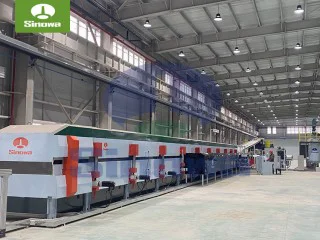
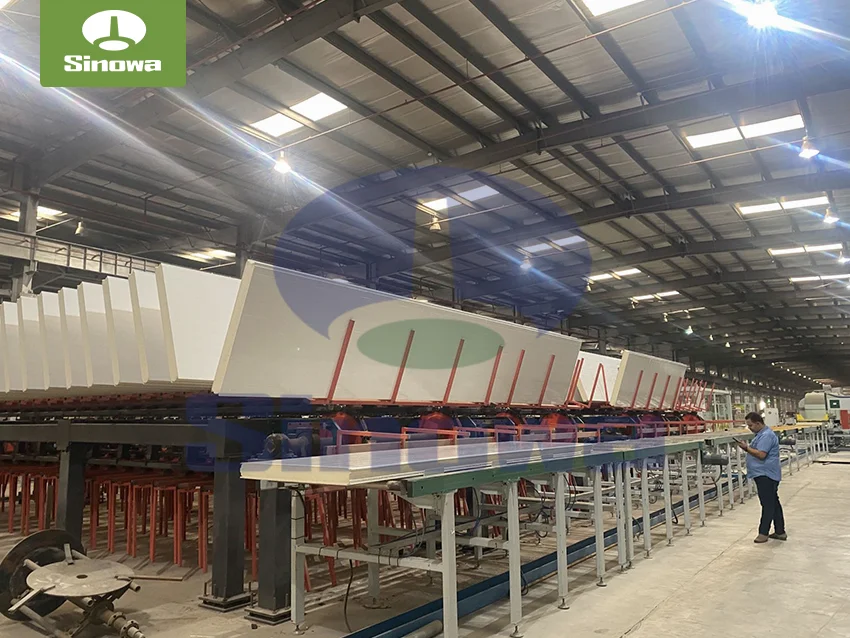
 sandwich panel machine
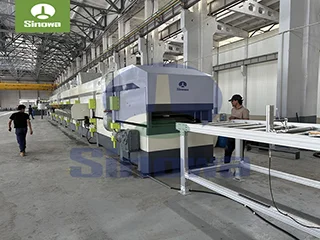
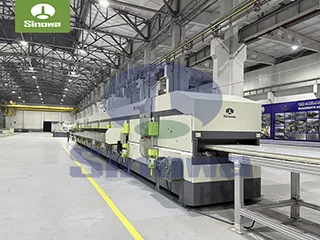
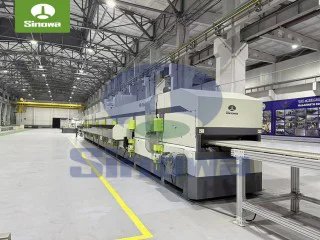
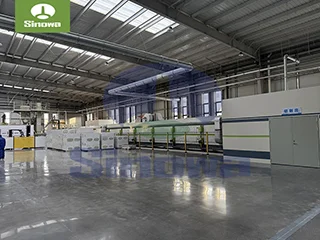
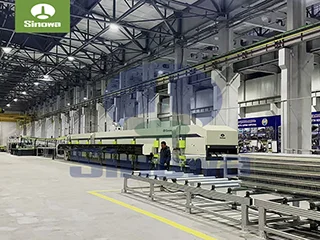
A complete color steel sandwich panel machine adopts a linear integrated layout, with all functional modules arranged sequentially following the natural production flow of sandwich panels to ensure synchronous operation and seamless connection between every processing procedure. The whole sandwich panel production line can be divided into six interdependent core functional sections without independent operating gaps, including raw material unwinding and pretreatment section, roll forming section, core material automatic feeding section, precise gluing and composite pressing section, fixed-length cutting and edge trimming section, and centralized intelligent control section. Each section operates independently according to preset operational parameters while maintaining real-time linkage with adjacent modules, so that the running speed, pressure value, heating temperature and feeding volume of the entire line can be automatically adjusted synchronously. This integral structural design avoids material deviation, production stagnation and panel layer dislocation caused by mismatched operating speed between different processing units, and maximizes the continuity of the whole production process. Unlike scattered single processing machines that require manual material handling between procedures, the integrated color steel sandwich panel making machine minimizes manual participation throughout production, only requiring operators to set initial production parameters and conduct routine equipment inspection, which greatly reduces human-induced errors and cuts overall labor input for panel production.
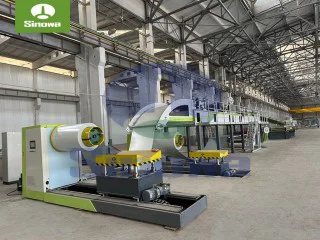
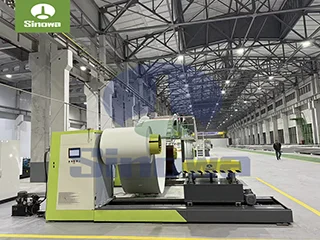
The front-end raw material unwinding and pretreatment section acts as the starting point of the entire production workflow, responsible for processing upper and lower color steel coils that serve as the outer protective layers of sandwich panels. Color steel coils are stored in large roll shapes after factory production, featuring inherent winding tension and subtle surface bending stress, which will affect subsequent forming and bonding effects if not processed properly. The hydraulic unwinding device in this section stably releases steel coils at a constant speed, and is equipped with an automatic tension adjustment structure to adapt to steel coils with different inner diameters and winding tightness. This structure prevents common raw material defects such as plate wrinkling, edge stretching and lateral deviation during continuous feeding. After unwinding, color steel plates enter a multi-roller leveling unit composed of multiple groups of precision alloy rollers, which gradually eliminates internal mechanical stress generated during coil winding and storage through repeated gentle rolling. This pretreatment procedure guarantees completely flat and smooth steel plate surfaces, removing tiny warpages and uneven areas that may damage the surface anti-corrosion coating and reduce later bonding firmness. In addition to steel plate processing, this section also includes a surface cleaning unit that removes floating dust, oil stains and residual impurities on the surface of color steel plates. Clean steel plate surfaces are essential to enhance adhesive adhesion force, as tiny contaminants will directly lead to local degumming and layering between steel plates and core materials in finished panels after long-term outdoor service.
Following pretreatment, flat color steel plates are transported to the roll forming section, a key module that determines the appearance profile and structural assembly performance of finished sandwich panels. Different from one-time stamping forming that easily causes metal plate cracking and coating peeling, the sandwich panel production machine adopts gradual continuous roll forming technology. Multiple groups of profiling rollers with customized tooth spacing and radian extrude flat steel plates step by step to bend plates into required profiles, including flat panels for building interior partitions, trapezoidal corrugated panels for roof waterproofing, and plug-in edge panels for seamless wall enclosure installation. The gradual deformation mode protects the color-coated protective layer on steel plates from scratch and damage, maintaining the original weather resistance and anti-rust performance of metal surfaces. Operators can adjust roller gaps and working pressure or replace matched roller sets according to actual production needs to switch panel profiles flexibly, enabling a single sandwich panel line to manufacture multiple types of sandwich panels without replacing core equipment. All forming rollers operate at a speed fully synchronized with the front-end feeding system, ensuring no accumulated material or stretched plates during high-speed continuous production, and controlling the dimensional error of formed plate profiles within an extremely small range to meet precise assembly requirements of modular buildings.
While outer color steel plates are processed and formed, the core material automatic feeding section runs synchronously to transport thermal insulation core materials to the composite bonding area. Common core materials matched with this machine include porous foam materials and fibrous thermal insulation materials, both of which feature lightweight properties and excellent heat insulation performance to meet building energy-saving demands. The core material feeding device realizes automatic fixed-thickness laying, with adjustable laying thickness adapting to different thermal insulation requirements of building walls and roofs. Before lamination, core materials are trimmed automatically to keep consistent overall width matching upper and lower color steel plates, avoiding uneven edge sizes of finished panels. The synchronous matching of steel plate forming speed and core material feeding speed ensures that metal outer layers and thermal insulation inner core materials can be perfectly aligned in the subsequent bonding procedure, eliminating lateral misalignment that would lead to unqualified finished products. This fully automatic core material feeding system replaces manual material paving in traditional production lines, realizing uniform and stable material laying all the time and avoiding uneven core material thickness caused by unstable manual operation.
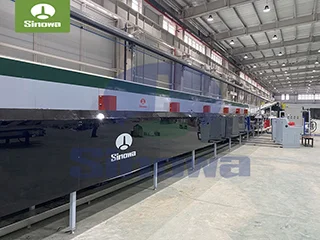
The gluing and constant-temperature composite pressing section is the core component that decides the overall structural strength, service life and anti-layering performance of sandwich panels. The bonding firmness between metal outer plates and thermal insulation core materials directly determines whether panels can resist wind pressure, temperature difference deformation and long-term outdoor aging during building service. The high-precision automatic gluing system coats quantitative adhesive evenly on the inner surfaces of upper and lower color steel plates and two sides of core materials. The system supports adaptive adjustment of glue output according to core material types: for porous fibrous core materials, it increases proper glue penetration volume to form mechanical occlusion bonding between adhesive and core material pores; for dense foam core materials, it maintains uniform surface glue coating to balance bonding strength and raw material consumption. The quantitative gluing design effectively avoids two common quality defects: insufficient glue leading to weak bonding and later panel layering, and excessive glue causing internal residual bubbles and panel surface bulges. After gluing, laminated composite materials enter the double-belt constant-pressure pressing unit with independent zone temperature control. The circulating heating system maintains a stable and uniform temperature field inside the pressing chamber to accelerate adhesive curing reaction without local overheating that causes adhesive aging and failure. The adjustable mechanical pressing structure applies uniform vertical pressure to the whole panel surface, discharging all residual air between layers and making steel plates and core materials closely integrated into an integral composite structure. The adjustable gap between upper and lower pressing belts allows the machine to produce panels with different overall thicknesses, covering thin partition panels for indoor use and thick high-insulation panels for outdoor building envelopes.
After integral composite curing, continuous long strip sandwich panels enter the post-processing section for finishing and sizing treatment, including flying saw fixed-length cutting and automatic edge trimming. The dynamic flying saw cutting device realizes real-time cutting during continuous plate movement, requiring no production line shutdown for static cutting and retaining the uninterrupted production advantage of the whole line. Operators can set arbitrary cutting lengths via the control terminal according to customer construction demands, and the cutting blade produces smooth and burr-free cross-sections without secondary manual polishing. The follow-up edge trimming unit fine-tunes panel edges to eliminate tiny dimensional deviations generated in the previous forming and pressing procedures, ensuring unified overall size of every finished panel batch. Finally, finished qualified panels are transported to the automatic stacking platform via conveyor rollers, and the stacking mechanism arranges panels neatly in fixed layers to facilitate subsequent centralized packaging, transportation and warehouse storage. The whole post-processing process requires no manual intervention, further improving overall production automation level and reducing manual damage to finished panel surfaces.
The intelligent central control system serves as the brain of the entire color steel sandwich panel line, connecting all functional sections to realize unified parameter management and real-time operational monitoring. Equipped with a visual human-machine interaction interface, the system allows operators to complete one-click startup, parameter setting, production mode switching and emergency shutdown operations simply through touch screen input. All key operational parameters including feeding speed, heating temperature, pressing pressure, glue flow rate and cutting length are digitally displayed in real time, and the system automatically matches parameters of all linked modules to ensure overall operational coordination. During continuous production, the control system conducts 24-hour real-time monitoring of equipment operating status, and automatically identifies abnormal conditions such as material jamming, temperature fluctuation, pressure deviation and motor overload. Once potential faults are detected, the system will send real-time early warnings and trigger partial automatic protection actions to prevent equipment damage and avoid large quantities of defective products. Meanwhile, the system records complete production data including daily output, operational parameter changes and fault logs, helping production managers track production conditions, optimize processing parameters and formulate regular equipment maintenance plans scientifically.
Compared with traditional semi-automatic sandwich panel manufacturing equipment, modern integrated color steel sandwich panel production line possess prominent advantages in production efficiency, product quality consistency, material utilization rate and operational cost control. In terms of production efficiency, the full continuous linear production mode eliminates intermediate material handling, waiting and transferring links between separate processes, greatly shortening the overall production cycle and achieving stable high-volume output suitable for large-scale order demands. In terms of product quality, full digital parameter control replaces subjective manual operation, making the thickness, bonding strength, flatness and dimensional accuracy of each panel in the same batch highly consistent, which solves the unstable product quality problem plaguing small-scale manual production. For raw material utilization, precise quantitative gluing and fixed-length cutting technologies cut down the waste of adhesive, color steel plates and core materials effectively, reducing unnecessary production cost loss. Additionally, the compact integrated structure occupies less factory floor space than scattered single machines, simplifying workshop layout and daily site management for manufacturing enterprises.
Nevertheless, stable long-term operation of color steel sandwich panel manufacturing machine relies on standardized daily and periodic maintenance procedures, which cannot be ignored in actual industrial production. Daily routine maintenance focuses on cleaning residual adhesive, core material debris and metal dust on roller surfaces, conveyor belts and cutting blades after daily shutdown, preventing accumulated debris from affecting plate forming accuracy and cutting smoothness. Weekly maintenance includes checking the tightness of transmission chains and belts, calibrating pressure sensors and temperature sensors to guarantee detection accuracy of core control components, and inspecting the sealing performance of glue supply pipelines to avoid adhesive leakage. Regular monthly maintenance focuses on lubricating all rotating mechanical bearings, checking the wear degree of forming rollers and pressing belts, and replacing vulnerable wearing parts in time. Scientific and regular maintenance can effectively extend the service life of the whole production line, reduce unexpected equipment downtime, and maintain stable production quality for a long time.
Driven by global dual-carbon goals and the popularization of prefabricated buildings, the iteration and upgrading of color steel sandwich panel production machine is advancing continuously, with three clear development directions emerging in the industry. Firstly, further intelligent upgrading will be realized, introducing automatic parameter self-calibration and remote fault diagnosis functions to reduce on-site operation dependence and realize remote monitoring and maintenance of production lines. Secondly, equipment will develop towards higher energy-saving performance, optimizing heating circulation systems and motor transmission structures to lower overall power consumption during continuous operation, matching the energy-saving production requirements of green building material factories. Thirdly, the machine will strengthen multi-functional compatibility to support production of new fire-resistant and sound-insulation enhanced core materials, enabling finished sandwich panels to meet stricter building safety and comfort standards. Moreover, modular structural design will become more mainstream, allowing quick disassembly, transportation and assembly of production lines, which is more suitable for mobile production demands of temporary building material processing projects.
In conclusion, color steel sandwich panel machinery is indispensable core equipment supporting the sound development of the global lightweight prefabricated building material industry. By integrating multiple advanced mechanical and automatic control technologies, this series of equipment realizes efficient, stable and standardized manufacturing of composite sandwich panels, solving multiple bottlenecks of traditional panel production. As the global construction industry continues to transform towards prefabrication, energy conservation and environmental friendliness, the market demand for high-performance color steel sandwich panels will keep growing steadily, which in turn promotes continuous technological innovation and performance optimization of matching production machines. With continuous technical upgrading and process improvement, color steel sandwich panel machines will provide more reliable, efficient and low-carbon manufacturing solutions for the global construction material industry, and play a more vital role in promoting the high-quality development of modern modular and green buildings worldwide.
https://www.cnsinowa.com/sandwich-panel-machines/color-steel-sandwich-panel-machine.html