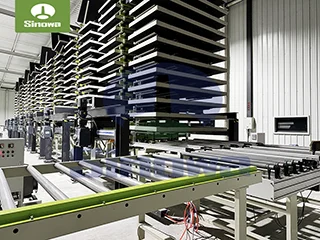
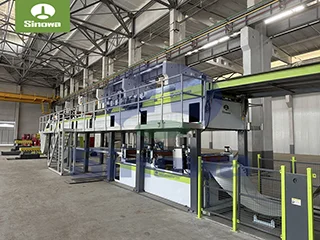
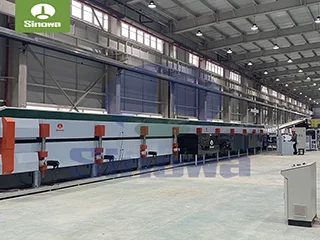
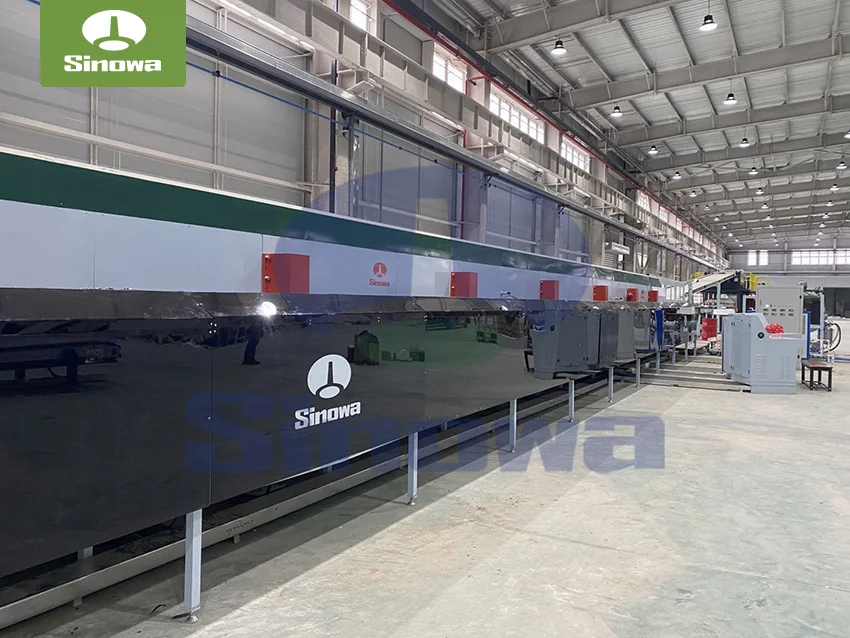
 sandwich panel line
A complete PU sandwich panel production line is a highly integrated automated manufacturing system that integrates raw material pretreatment, continuous foaming, composite molding, fixed-length cutting, and surface finishing, specifically optimized for the unique performance requirements of cold storage insulation scenarios. Unlike ordinary building insulation panels, cold storage-grade PU sandwich panels need to maintain stable thermal insulation capabilities in long-term low-temperature, high-humidity, and alternating temperature environments, which puts forward strict technical requirements for the formula ratio of core materials, the bonding strength of composite layers, and the overall structural uniformity of the panels. The production line adopts continuous high-pressure foaming technology to inject rigid polyurethane foam materials with a high closed-cell rate between two layers of durable metal facing materials. The precise material proportioning system ensures that the foam core forms a uniform and compact closed-cell structure during the instantaneous foaming and curing process, with independent internal micro-cavities that effectively block gas convection and heat radiation transmission. This unique structural characteristic endows the finished panels with extremely low thermal conductivity, which far surpasses traditional insulation materials in isolating external heat transfer and preventing internal cold air loss.
The thermal insulation mechanism of cold storage PU sandwich panels lies in the efficient barrier effect of their closed-cell foam core on multiple heat transfer paths. Heat exchange between the inside and outside of cold storage buildings mainly occurs through thermal conduction, thermal convection, and thermal radiation. Traditional insulation materials with open-cell structures cannot completely block air flow, leading to continuous heat convection inside the material and gradual attenuation of insulation performance during long-term use. In contrast, the closed-cell structure of PU foam core produced by professional sandwich panel line locks low-thermal-conductivity gas inside independent cell cavities, completely inhibiting internal air convection and greatly reducing thermal conduction efficiency. Meanwhile, the compact integral composite structure formed by continuous production effectively avoids thermal bridging phenomena that commonly exist in assembled insulation structures. Thermal bridging is a key factor causing cold loss and frosting in cold storage facilities, and the integrated molding process of the production line ensures consistent thermal resistance across the entire panel surface, eliminating local weak insulation points and maintaining uniform temperature stability inside the cold storage for a long time.
In terms of production process optimization, the professional PU sandwich panel line for cold storage construction achieves precise control over every link of panel molding to adapt to the harsh operating environment of cold storage facilities. The raw material pretreatment module of the production line strictly screens and purifies foam raw materials to avoid impurity residues that may affect foaming uniformity and lead to performance differences. The automated feeding and proportional mixing system realizes accurate matching of polyether and isocyanate raw materials, ensuring that the foam core has appropriate density, hardness, and toughness. Excessively low density will reduce structural strength and lead to core layer shrinkage in low-temperature environments, while excessively high density will increase thermal conductivity and weaken insulation effects. Through programmable parameter adjustment, the production line can flexibly adjust core material density and panel thickness according to different cold storage temperature zone requirements, covering the insulation needs of medium-temperature fresh-keeping warehouses, low-temperature freezing warehouses, and ultra-low-temperature industrial cold storage spaces.
The composite molding process of the continuous PU sandwich panel production line is crucial to the overall durability and insulation stability of cold storage PU panels. The continuous rolling and composite technology enables the metal facing and PU foam core to form an integrated bonding structure without gaps or delaminations. In long-term low-temperature and high-humidity cold storage environments, traditional manually assembled or semi-mechanized panels are prone to delamination, cracking, and water vapor penetration at the bonding interface, which will quickly destroy the internal insulation structure, cause heat conduction efficiency to rise sharply, and lead to frequent frosting and defrosting inside the cold storage. The high-temperature curing and pressure-maintaining molding process adopted by the professional production line enhances the interface bonding force to the maximum extent, ensuring that the panel can resist structural deformation and interface separation under long-term temperature alternation and environmental humidity changes. This stable composite performance guarantees that the insulation capacity of the panel will not deteriorate significantly after years of service, greatly extending the service life of the cold storage insulation system.
The finished PU sandwich panels produced by professional continuous sandwich panel line have outstanding comprehensive performance that perfectly matches the construction characteristics of modern cold storage. In terms of thermal insulation efficiency, the standardized closed-cell structure enables the panels to maintain ultra-low thermal conductivity in conventional atmospheric environments, and the thermal resistance value remains stable in low-temperature working conditions, effectively reducing the heat infiltration rate of the cold storage enclosure structure. Practical application data shows that cold storage facilities using high-quality PU sandwich panels can effectively reduce the working time and operating load of refrigeration units, avoiding frequent start-stop operation of equipment caused by temperature fluctuations, thereby realizing significant energy saving effects throughout the operation cycle. For large-scale logistics cold storage groups and long-term operational industrial cold storage, this stable energy-saving advantage can continuously reduce daily operation costs and improve the economic benefits of facility operation.
In addition to core thermal insulation performance, the structural and environmental adaptability of PU sandwich panels produced by dedicated sandwich panel machine fully meet the professional requirements of cold storage construction. The integral composite structure gives the panels high compressive strength and bending resistance, enabling them to bear certain external loads without deformation, which is suitable for wall, roof, and partition construction of various cold storage buildings. The smooth and dense surface of the outer metal facing has excellent waterproof, moisture-proof, and anti-corrosion properties, which can effectively block external water vapor from penetrating into the panel core. Water vapor invasion is a major hidden danger of cold storage insulation failure, as the water or ice formed by condensed water will greatly improve thermal conductivity and completely destroy the insulation structure. The compact structure of PU panels avoids water absorption and moisture accumulation, ensuring long-term dryness and stability of the internal insulation layer, and preventing frosting, ice accumulation, and mold growth inside the cold storage enclosure.
The continuous PU sandwich panel line standardized manufacturing mode also brings remarkable advantages for cold storage construction efficiency and engineering quality control. Traditional cold storage insulation construction relies on on-site cutting, assembly, and auxiliary bonding of bulk insulation materials, which is not only time-consuming and labor-intensive but also prone to uneven material thickness, incomplete sealing of assembly gaps, and inconsistent construction quality. The automated production line realizes factory prefabrication of panels, with unified specifications, accurate dimensions, and flat surfaces of finished products. The standardized panel size and precise edge sealing structure enable rapid on-site assembly and splicing, greatly shortening the construction cycle of cold storage projects. Meanwhile, the matching splicing structure between panels can effectively seal assembly gaps, avoid cold air leakage and external heat infiltration from gaps, and further optimize the overall thermal insulation effect of the cold storage building envelope. The integral sealing performance formed by standardized assembly makes up for the quality instability of traditional on-site construction and improves the overall airtightness and insulation uniformity of the cold storage.
With the continuous upgrading of cold chain industry standards and the increasing emphasis on building energy conservation, the technical iteration of polyurethane sandwich panel production line is also constantly advancing, focusing more on environmental protection performance, long-term stability, and scenario-based customization. Modern production line optimize the foaming agent formula in the production process to reduce the emission of harmful substances during manufacturing, making the finished panels more environmentally friendly and safe, and meeting the green construction requirements of modern cold storage facilities for food, medicine, and precision product storage. At the same time, the production line can adjust the panel formula and structure according to special cold storage scenarios, such as high-humidity fresh food cold storage, low-temperature freezing cold storage, and explosion-proof industrial cold storage, to enhance the targeted environmental adaptability of the panels. For example, optimized formula panels can resist microbial growth and corrosion in high-humidity environments, while enhanced structural panels can adapt to extreme low-temperature environments without brittle cracking, ensuring reliable operation of the insulation system in complex working conditions.
The application value of professional polyurethane sandwich panel line in cold storage construction is also reflected in the long-term operational stability of cold storage facilities. As the core enclosure and insulation material of cold storage, the performance durability of PU panels directly affects the safety of stored goods and the stability of the cold chain system. Panels produced by non-standard processes often have hidden problems such as uneven foaming density, insufficient closed-cell rate, and weak interface bonding, which will lead to accelerated aging of insulation performance after 2 to 3 years of use, resulting in increased cold loss, frequent failure of refrigeration equipment, and even quality deterioration of stored goods. The standardized and refined production process of professional production line eliminates these potential quality hazards, ensuring that the panels maintain stable thermal insulation, structural integrity, and airtightness during long-term service. This long-term stability reduces the frequency of cold storage maintenance and renovation, lowers the comprehensive operation and maintenance cost of the facility, and provides a reliable guarantee for the stable operation of the cold chain system.
In the context of the rapid development of the global cold chain logistics industry, the demand for high-quality and high-stability cold storage construction materials continues to grow, and the polyurethane sandwich panel machine, as the core equipment for cold storage insulation material manufacturing, undertakes the important task of supporting the high-quality development of the cold storage construction industry. Its automated, standardized, and customized production characteristics not only improve the manufacturing efficiency and product quality of cold storage insulation panels but also promote the standardized and modular development of the entire cold storage construction industry. Compared with traditional insulation construction schemes, the industrialized production mode supported by professional production line realizes the integration of material performance optimization and construction process upgrading, solves many pain points in traditional cold storage insulation construction such as poor insulation effect, short service life, low construction efficiency, and unstable engineering quality.
Looking at the development trend of cold storage construction in the future, energy conservation, environmental protection, intelligence, and durability will become the core development directions of cold chain infrastructure construction. The continuous technological innovation of PU sandwich panel production line will further enhance the comprehensive performance of cold storage insulation panels, including lower thermal conductivity, stronger environmental adaptability, better green environmental protection performance, and longer service life. With the continuous optimization of production processes and the expansion of customized production capabilities, thermal insulation sandwich panel machine will be able to meet the personalized construction needs of various special cold storage scenarios, provide more efficient and reliable insulation material solutions for modern cold storage construction, and continuously boost the high-quality development of the global cold chain industry by improving the energy-saving level and operational stability of cold storage facilities.
https://www.cnsinowa.com/sandwich-panel-machines/pu-sandwich-panel-line-for-cold-storage-construction-with-thermal-insulation.html