 sandwich panel line
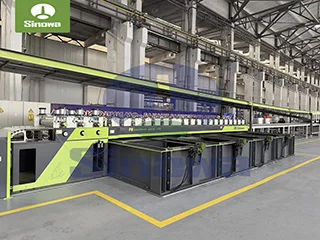
The overall structure and operating logic of the PIR sandwich panel production line follow a continuous and integrated production concept, with each functional module closely connected and coordinated to form a closed-loop production system. The entire production process starts with the feeding and pretreatment of surface materials. Most panel surface layers adopt metal sheets with good structural strength and weather resistance, which are placed on the dual uncoiling device of the production line. The equipment is designed with a stable tension control system to ensure that the coiled sheet is uncoiled evenly without deviation or wrinkling, laying a foundation for subsequent precise composite molding. After uncoiling, the surface materials will go through surface pretreatment procedures, including surface cleaning and activation treatment, to remove oil stains, dust, and oxide layers on the material surface. This process effectively improves the bonding adhesion between the surface material and the PIR foam core layer, avoiding delamination, peeling, and other quality problems of finished panels in long-term use.
Subsequently, the pretreated surface materials enter the roll forming system, which bends and shapes the flat metal sheet according to the preset panel specification parameters. The roll forming module is equipped with precision roller groups and servo adjustment devices, which can flexibly adapt to different sheet thicknesses and panel profile requirements. All adjustment parameters are uniformly controlled by the intelligent control system, realizing stepless adjustment of forming dimensions and ensuring the consistency of the appearance and structure of each batch of panels. After forming, the surface materials are sent to the preheating tunnel for constant-temperature preheating treatment. Appropriate preheating can balance the surface temperature of the materials, eliminate internal stress generated during roll forming, and create optimal temperature conditions for the subsequent foaming and composite curing process, which helps to improve the uniformity of PIR foam reaction and enhance the overall structural stability of the composite panel.
The foaming and mixing system is the most critical core module of the entire PIR sandwich panel line, which directly determines the thermal insulation performance, density uniformity, and structural toughness of the panel core layer. Different from ordinary foam materials, PIR foam has stricter requirements on raw material ratio, mixing uniformity, and reaction temperature due to its unique molecular structure and performance advantages. The production line is equipped with a high-precision metering and mixing unit, which stores the two core liquid raw materials in independent constant-temperature storage tanks. The system can automatically and accurately control the feeding ratio and flow rate of raw materials according to production parameters, avoiding performance differences caused by manual operation errors. The high-pressure mixing head adopts an optimized structural design, which can fully stir and blend the raw materials and auxiliary materials in an instant, ensuring uniform chemical reaction of the mixed materials and preventing local foam hollowing, uneven density, or insufficient curing.
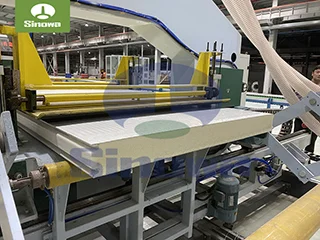
The uniformly mixed PIR foaming material is evenly injected between the upper and lower surface materials, and then the composite assembly enters the double-belt continuous laminating system. The double-belt conveyor maintains stable transmission speed and uniform pressure distribution, and cooperates with the constant-temperature curing zone to complete the expansion, foaming, and integrated composite curing of the PIR core layer. In the closed curing space, precise temperature and pressure control enable the PIR material to complete chemical cross-linking reaction stably, forming a rigid and compact foam core layer with uniform pore structure. This continuous composite molding process realizes the seamless bonding of the surface material and the core material, making the integrated structure of the sandwich panel more firm and durable, with excellent compression resistance, bending resistance, and overall stability.
After curing and molding, the continuous integrated panel enters the cooling and shaping stage. The graded cooling system gradually reduces the surface and internal temperature of the panel to room temperature through multi-stage air cooling, which can effectively eliminate the internal stress generated during high-temperature curing and avoid panel deformation, warping, and size deviation after cutting. After cooling and shaping, the panel is sent to the flying saw cutting system for fixed-length cutting. Driven by a high-precision servo control system, the cutting equipment can realize dynamic following cutting during the continuous operation of the panel, ensuring high squareness and flatness of the cutting end face. The system can flexibly set cutting lengths according to production needs, realizing automatic switching of different specifications and greatly improving production flexibility.
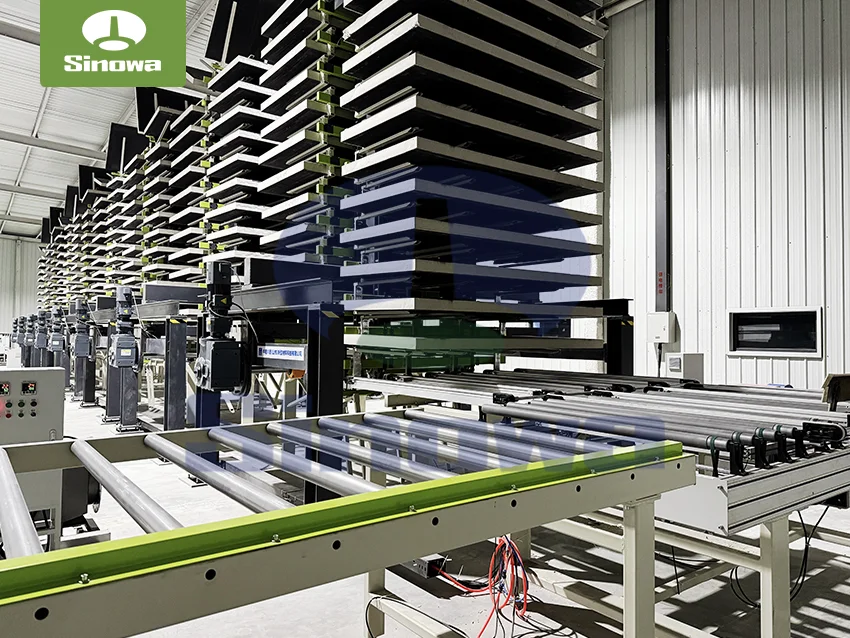
The final stage of production is automatic sorting, turnover, and stacking. The cut finished panels are transported through the conveying device, and the turnover mechanism adjusts the panel placement direction to ensure uniform stacking specifications. The automatic stacker completes orderly stacking according to the preset stacking height and quantity, realizing unattended operation of the final link of production. The whole production process from feeding to stacking is fully automated and interconnected, with smooth operation of each link, which not only greatly improves production efficiency and output stability but also effectively reduces manual intervention and human error, ensuring the consistent quality of mass-produced PIR sandwich panels.
Although the PIR sandwich panel machine has a highly automated and intelligent operating system, long-term high-load continuous operation will inevitably cause wear and aging of mechanical parts, slight deviation of control parameters, and attenuation of system sensitivity. Minor equipment abnormalities that are not dealt with in time will gradually evolve into major faults, leading to production shutdown, reduced product qualification rate, and increased production costs. Therefore, scientific and systematic after-sales maintenance services are indispensable supporting conditions for the long-term healthy operation of the production line. Professional after-sales maintenance is not limited to fault repair after equipment failure, but covers full-cycle preventive maintenance, daily inspection, parameter calibration, part replacement, and technical guidance throughout the equipment service life.
Daily and regular preventive maintenance is the most basic and core part of after-sales service, which can effectively reduce the failure rate of the continuous sandwich panel line. Professional maintenance personnel will formulate targeted maintenance plans according to the operating intensity, working environment, and service time of the equipment. Daily maintenance mainly includes cleaning the surface dust and residual materials of each functional module, checking the tightness of transmission parts, the flexibility of roller operation, and the normal operation of the conveying system, and timely cleaning the residual foam materials in the foaming mixing cavity to avoid material accumulation affecting mixing accuracy. At the same time, it is necessary to check the temperature and pressure parameters of the curing zone and preheating tunnel every day to ensure that all operating indicators are within the standard range and avoid quality fluctuations caused by parameter deviation.
Regular periodic maintenance focuses on in-depth inspection and maintenance of key core components and precision control systems. For the mechanical transmission system, maintenance personnel will regularly lubricate the bearings, gears, and transmission chains of the sandwich panel equipment to reduce mechanical friction loss and prevent abnormal noise and jamming during operation. For the high-precision foaming metering and mixing system, regular calibration of raw material metering accuracy and cleaning and maintenance of the mixing head are required to ensure the uniformity and stability of raw material mixing, so as to guarantee the consistent performance of the panel core layer. The servo control system and electrical control components also need regular line inspection and signal debugging to eliminate hidden dangers such as line aging and signal delay, ensuring the sensitive and accurate operation of the intelligent control system.
In addition to preventive maintenance, efficient fault diagnosis and emergency maintenance services are crucial to ensure continuous production. In the daily operation of the continuous sandwich panel production line, sudden problems such as transmission deviation, foaming abnormality, cutting size deviation, and system alarm may occur due to accidental factors or part aging. The professional after-sales service team has rich equipment operation and fault handling experience, which can quickly locate fault points through remote diagnosis or on-site inspection, analyze the root cause of faults, and formulate targeted repair schemes. For minor faults that affect single-process operation, the team can complete rapid repair and parameter adjustment in a short time to minimize production interruption time; for major component damage and system failures, the team can provide timely replacement of matching parts and professional debugging services to ensure that the equipment returns to normal operating state as soon as possible.
Long-term after-sales maintenance services also include regular equipment upgrade and optimization guidance and professional technical training. With the continuous update of building material production standards and the diversification of market product demands, the production process and parameter requirements of PIR sandwich panels are constantly optimized. The after-sales team will track the latest production technology and process optimization schemes, provide customers with reasonable equipment parameter optimization suggestions and partial functional upgrade guidance according to the actual production conditions of the customer's production line, helping the equipment adapt to new production demands and improve production efficiency and product quality. At the same time, professional technical training will be provided for the customer's operation and maintenance personnel, including standardized equipment operation procedures, daily maintenance skills, common fault identification and simple troubleshooting methods, so as to improve the customer's independent operation and maintenance capability, realize the combination of external professional maintenance and internal daily protection, and form a long-term equipment protection mechanism.
The value of after-sales maintenance services runs through the entire service life of the PIR sandwich panel production machinery. Scientific and standardized maintenance can effectively delay the aging speed of equipment parts, maintain the precision and stability of equipment operation, and greatly extend the overall service life of the production line. Stable equipment operation can avoid frequent production shutdowns and quality fluctuations, reduce the comprehensive operation and maintenance costs of enterprises, and ensure the continuity and stability of production capacity. For production enterprises, high-quality after-sales maintenance service is not only a guarantee of equipment operation, but also an important support for stable product quality and long-term production and operation development.
In the increasingly competitive modern building material manufacturing industry, the stability of production equipment and the completeness of supporting services have become important factors for enterprise development. The PIR sandwich panel manufacturing line with its advanced automated production technology and excellent product molding quality, provides reliable equipment support for the production of high-performance energy-saving building panels. Meanwhile, comprehensive, professional and full-cycle after-sales maintenance services solve the operational worries of production enterprises, maximize the equipment operation efficiency and service value, and lay a solid foundation for enterprises to carry out stable, efficient and high-quality production for a long time. In the future, with the continuous innovation of equipment manufacturing technology and service concepts, the integration of high-efficiency production equipment and refined after-sales maintenance services will further promote the standardized and intelligent development of the PIR sandwich panel manufacturing industry.
https://www.cnsinowa.com/sandwich-panel-machines/pir-sandwich-panel-line-with-after-sales-maintenance-service.html