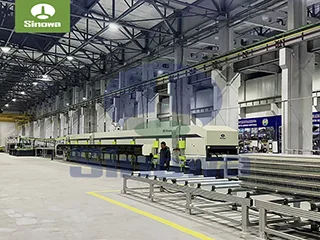
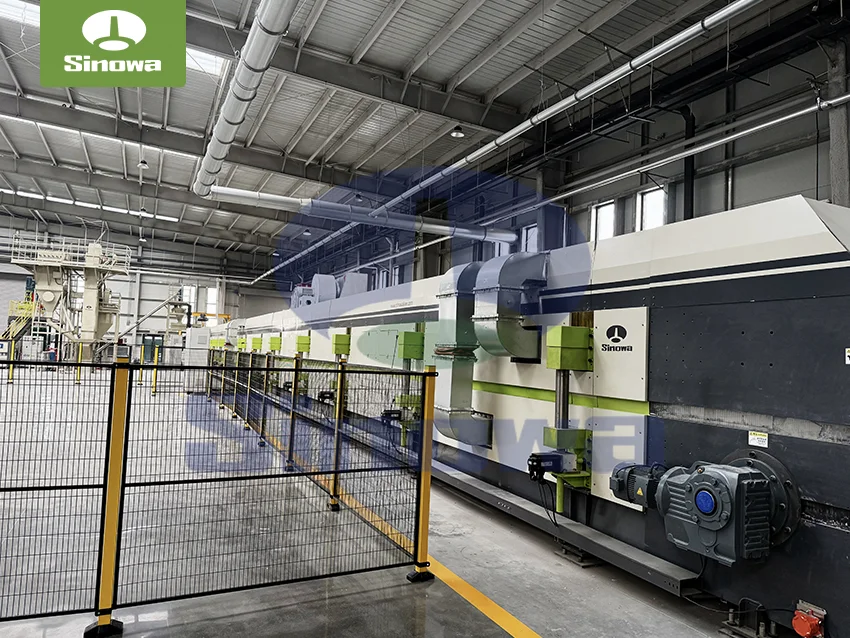
 sandwich panel line
A complete insulated sandwich panel assembly line is designed based on the composite structural characteristics of sandwich panels, which consist of two outer metal surface layers and a middle thermal insulation core layer bonded as an integral whole. The core design concept of the entire production line is to realize synchronous feeding, precise positioning, uniform bonding, constant-temperature curing and standardized cutting without manual interruption, so as to eliminate inconsistent bonding strength, uneven panel thickness and surface scratch defects caused by manual scattered production. Unlike intermittent semi-automatic production equipment that requires frequent manual material handling and position calibration, modern continuous assembly lines adopt a closed-loop conveyor transmission structure, where all functional units are arranged in linear sequence according to the production process logic. All mechanical operating parameters, including conveyor running speed, pressing pressure, curing temperature and adhesive spraying volume, are centrally regulated by a unified electrical control system, ensuring that every produced panel maintains consistent dimensional accuracy, bonding tightness and overall mechanical performance. The production line is compatible with multiple mainstream insulation core materials commonly used in the construction sector, including foam polymer materials and inorganic mineral fiber materials, and can adapt to different surface metal sheet thicknesses and surface embossing requirements through simple parameter adjustment, improving the overall production flexibility to match diversified building engineering demands.
The whole manufacturing process launched by the insulated sandwich panel line starts with raw material unwinding and surface pretreatment, which serves as the foundation for subsequent stable compounding and firm adhesive bonding. Metal coiled materials for upper and lower panel surfaces are installed on independent unwinding racks at the front end of the production line. Equipped with automatic deviation correction devices, the unwinding structure can dynamically correct the left and right offset of metal sheets during high-speed conveying, avoiding longitudinal wrinkles and edge deviation of surface plates in the follow-up roll forming process. After stable unwinding, metal sheets enter the surface pretreatment unit to remove surface dust, oil stains and oxide layers generated during metal coil storage and transportation. This pretreatment process does not involve surface coating with protective coatings in advance; instead, it focuses on improving the surface roughness of metal sheets moderately, so that adhesives or foaming raw materials can form tighter molecular combination with metal surfaces in the later bonding stage. Well-treated metal sheets are then conveyed to the roll forming unit, where groups of precision forming rollers gradually press flat metal sheets into customized plate profiles, including trapezoidal ribbed surfaces, flat surfaces and hidden groove structures for wall and roof panels. The profiling depth and groove spacing of metal sheets are precisely locked by mechanical positioning modules, ensuring that the upper and lower metal panels can achieve complete edge alignment in the subsequent composite process without dislocation or staggering.
Following metal sheet forming, the insulated sandwich panel production line enters the core material laying and adhesive coating stage, the most critical link that determines the thermal insulation performance and overall structural strength of finished sandwich panels. For assembly lines matching inorganic fiber core materials such as rock wool, automatic core material distribution equipment arranges cut core material blocks neatly and continuously between upper and lower formed metal sheets according to fixed intervals. The equipment realizes seamless butt joint between adjacent core material units to avoid hollow gaps inside panels that would reduce thermal insulation and fireproof performance. Meanwhile, quantitative adhesive spraying devices arranged on both sides of the production line spray environmental-friendly structural adhesives evenly on the contact surfaces between metal sheets and core materials. The spraying system supports stepless adjustment of adhesive dosage according to core material types and production speed, preventing excessive adhesive overflow that causes panel surface pollution or insufficient adhesive amount that leads to layered peeling of panels in long-term use. For assembly lines supporting on-site foaming thermal insulation core materials, instead of pre-laid solid core materials, high-precision foaming injection units mix two groups of liquid foaming raw materials in a fixed proportion and inject the mixed liquid evenly into the closed cavity formed by upper and lower metal sheets. The liquid raw materials expand rapidly under constant temperature conditions, automatically fill the entire internal space of the panel, and form a continuous seamless foam insulation core after complete curing. This integrated foaming process eliminates splicing gaps existing in prefabricated core materials, further optimizing the overall airtightness and thermal insulation effect of finished panels.
After completing the combination of metal surface layers and insulation core layers, the semi-finished continuous panel enters the double-belt laminating and constant-temperature curing unit, the core functional module that realizes integral bonding and shaping of sandwich panels. The double-belt pressing structure applies stable and uniform horizontal pressure to the upper and lower surfaces of the composite panel, avoiding local depressions or uneven overall thickness caused by uneven pressure distribution. Compared with single-point pressing equipment, the circulating double-belt structure keeps continuous contact with the panel surface during the whole pressing process, protecting the formed metal plate profiles from secondary extrusion deformation. Built-in circulating heating modules inside the laminating equipment maintain a stable curing temperature environment throughout the bonding process. Constant temperature helps accelerate the physical and chemical reaction of adhesives and foaming materials, promoting rapid solidification of bonding interfaces and enhancing the stripping resistance and shear resistance of the integrated panel structure. The curing time is matched synchronously with the conveying speed of the entire production line, ensuring that panels can complete sufficient curing reaction during continuous conveying without staying in the heating unit. After high-temperature pressing and curing, panels pass through an independent cooling section with natural air circulation systems. The cooling process gradually reduces the surface and internal temperature of panels to ambient temperature, eliminating internal stress generated by high-temperature pressing. This step effectively prevents panel warping, bending and core material cracking after finished products are stacked and stored for a long time.
Subsequent fixed-length cutting and edge finishing processes endow continuous long panels with unified dimensional specifications suitable for actual construction installation. The intelligent cross-cutting unit receives preset length parameters from the central control system and completes automatic high-speed cutting according to the customized size requirements of different construction projects. The cutting tool adopts wear-resistant structural design to ensure smooth cutting sections without metal burrs, core material fragmentation or adhesive residue burrs. Synchronous tracking cutting technology is adopted in this unit, meaning the cutting tool moves forward synchronously with the running panel during cutting instead of stopping the entire production line. This non-stop cutting mode effectively improves overall production efficiency and avoids production efficiency loss caused by frequent start and stop of mechanical equipment. After cutting, edge trimming modules trim redundant metal edges and exposed core materials on both sides of panels, making the overall outline of panels neat and uniform. Well-trimmed panels are transmitted to online visual inspection stations, where high-resolution industrial cameras conduct full-scan detection on panel surface flatness, bonding interface integrity, cutting dimensional accuracy and surface scratch defects. Unqualified products with dimensional errors, surface damage or incomplete bonding are automatically screened out from the normal production line through sorting push rods, while qualified finished panels continue to be transmitted to the final stacking and packaging unit.
The final stage of the insulation sandwich panel machine covers automatic stacking and protective packaging, realizing seamless connection between finished panel production and on-site transportation. Automated stacking manipulators classify and stack qualified panels layer by layer according to unified specifications, with flexible anti-collision buffer structures installed on mechanical arms to avoid extrusion damage to panel surfaces during stacking. Stacked panel bundles are wrapped with flexible protective films and edge protection materials automatically by follow-up packaging equipment, isolating dust, moisture and mechanical friction damage during long-distance transportation and outdoor temporary storage. The whole post-processing process requires no manual participation, reducing labor costs in the final packaging link and ensuring consistent packaging quality of each batch of products. All production data including real-time production output, equipment operating status, defective product rate and operating temperature of each unit are uploaded to the central control terminal in real time, facilitating production managers to monitor the overall operating condition of the assembly line remotely and adjust production parameters timely according to order changes.
In actual industrial production applications, modern insulated sandwich panel manufacturing line solve multiple common pain points existing in traditional manual and semi-automatic panel production modes. Firstly, the highly integrated linear structure reduces the floor space required for panel manufacturing workshops compared with scattered independent production machines, optimizing the overall layout of production workshops and reducing infrastructure input for production sites. Secondly, full-process automated operation cuts down manual participation links from raw material feeding to finished product packaging, lowering safety risks caused by manual contact with high-temperature pressing equipment and sharp cutting tools on site. More importantly, unified parameter control throughout the production line eliminates performance differences between different batches of panels caused by human operation errors. In prefabricated building projects with high requirements for wall thermal insulation consistency and overall structural stability, standardized panels produced by automated assembly lines can effectively reduce on-site installation gaps and improve the overall sealing performance of building envelopes.
With the global construction industry accelerating its pace of carbon neutrality transformation and prefabricated building popularization, the technological development of insulated sandwich panel production machine is moving toward three core directions: higher intelligent integration, energy-saving operation optimization and multi-functional composite production expansion. In terms of intelligent upgrading, more production links are equipped with self-adaptive adjustment functions. The production line can automatically identify raw material thickness changes and core material type switching, and independently adjust pressing pressure, curing temperature and adhesive spraying dosage without manual parameter modification, further reducing requirements for on-site operation technicians. For energy-saving optimization, the production line adopts waste heat recovery structures in heating and curing units to recycle residual heat generated during panel curing and reuse it for preheating of front-end metal sheets, reducing overall energy consumption of long-term continuous production. In terms of production function expansion, upgraded assembly lines can realize one-time integrated production of composite panels with additional functions such as anti-corrosion surface layers and sound-absorbing internal structures on the basis of conventional thermal insulation sandwich panels, matching the increasingly complex functional demands of special buildings including pharmaceutical clean workshops and coastal anti-corrosion industrial plants.
From the perspective of the entire industrial chain, the insulated sandwich panel assembly line acts as a key connecting equipment linking upstream metal material and insulation core material suppliers and downstream prefabricated building construction projects. The upgrading and popularization of automated assembly lines directly promote the standardized development of insulated building enclosure materials, accelerate the construction speed of modular buildings, and reduce the overall energy consumption of building operation in the whole life cycle. Unlike single-function processing machines, this integrated assembly line focuses on overall process coordination rather than single-unit efficiency improvement, realizing systematic optimization from raw material input to finished product output. As global countries continue to raise building energy-saving standards and expand the market scale of prefabricated construction, the market demand for high-stability, low-energy-consumption and high-intelligence insulated sandwich panel manufacturing machine will continue to grow steadily. Continuous technological iteration of such production equipment will further empower the high-quality development of the modern green construction industry, supporting the realization of low-carbon and efficient development goals for the global construction sector in the future.
https://www.cnsinowa.com/sandwich-panel-machines/insulated-sandwich-panel-assembly-line.html