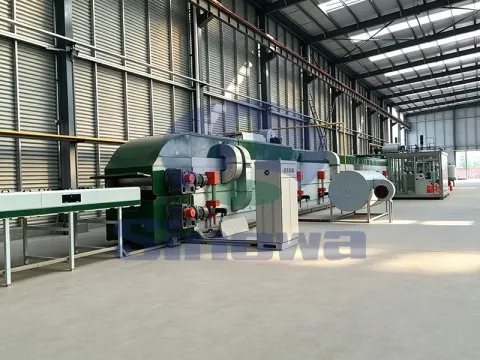
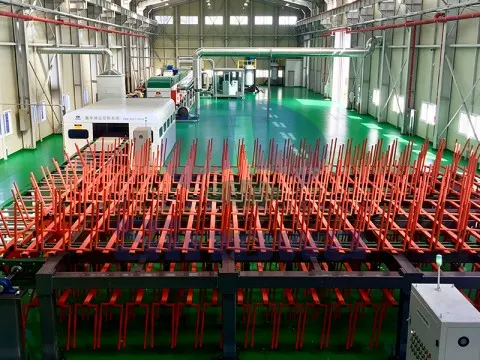
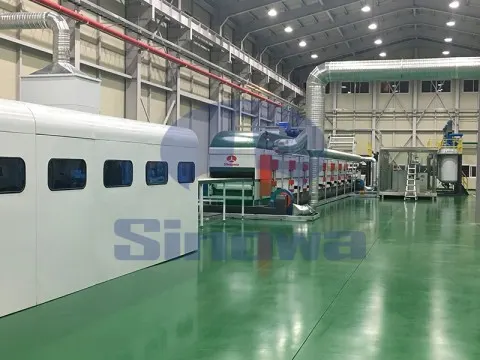
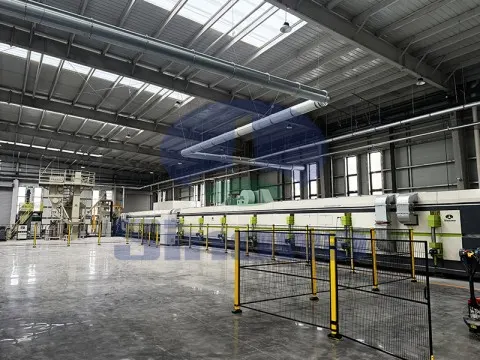
sandwich panel line
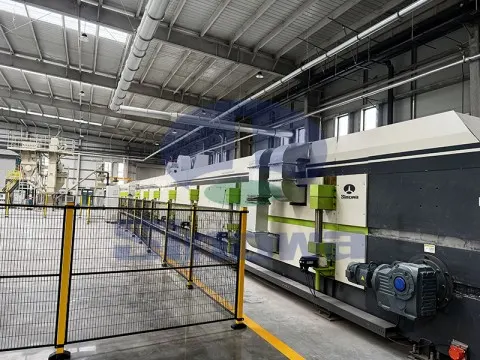
The structure of a fireproof insulation board production line is composed of several core functional units, each of which undertakes specific processing tasks and is closely connected to form a continuous and efficient production flow. The entire line usually starts with the raw material preparation unit, which is the foundation of ensuring product performance. This unit mainly includes equipment for raw material storage, mixing, and preprocessing. Raw materials used for fireproof insulation boards are diverse, including inorganic materials such as gypsum, white cement, perlite, and glass fiber, as well as organic materials such as modified polyurethane and phenolic resin. In the raw material preparation stage, these materials need to be stored in separate silos according to their properties to avoid moisture absorption or chemical reactions. Then, they are transported to the mixing equipment through precise metering systems, where they are fully stirred and mixed in a specific proportion. The metering accuracy of raw materials directly affects the fire resistance, insulation performance, and mechanical strength of the final products, so the metering system in this unit is usually equipped with high-precision sensors and automatic control devices to ensure that the proportion of each component meets the preset standards. For some raw materials that need preprocessing, such as glass fiber, they need to be cut into appropriate lengths in advance to enhance the bonding force with other materials and improve the structural stability of the boards.
Following the raw material preparation unit is the forming unit, which converts the mixed raw material mixture into board blanks with a certain shape and thickness. The forming equipment in this unit varies according to the type of fireproof insulation board and production scale, and common types include molding machines, continuous paving machines, and pressing equipment. For example, in the production of gypsum-based fireproof insulation boards, the mixed slurry is poured into the molding mold through the pouring system, and then pressed into shape by the pressing equipment under a certain pressure to ensure that the board blank has a uniform thickness and compact structure. In the production of foam-based fireproof insulation boards such as polyurethane and phenolic resin, the mixed raw materials are injected into the forming mold, and then undergo foaming and curing reactions to form a board blank with a closed-cell structure. The forming unit is usually equipped with automatic conveying devices, which can continuously transport the board blanks to the next processing link, improving production efficiency. At the same time, the forming parameters such as pressure, temperature, and time are strictly controlled to avoid defects such as cracks, uneven thickness, and loose structure of the board blanks, which may affect the subsequent processing and product performance.
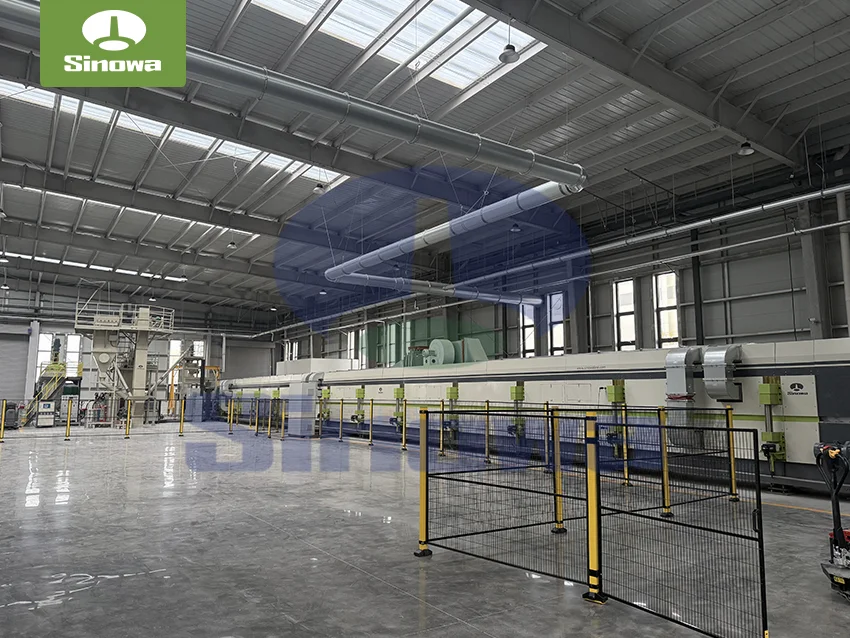
The curing and drying unit is another key part of the fireproof insulation board production line, which is mainly used to improve the hardness, strength, and stability of the board blanks. After forming, the board blanks still have high moisture content and unstable performance, so they need to be cured and dried through professional equipment. The curing process is usually carried out in a curing chamber with constant temperature and humidity, where the board blanks are kept at a specific temperature and humidity for a certain period of time to promote the full reaction of the raw materials and form a stable internal structure. For example, phenolic resin-based fireproof insulation boards need to be cured at a high temperature to ensure that the resin is fully cross-linked, forming a heat-resistant and fire-resistant structure. The drying process is used to remove the excess moisture in the board blanks, and common drying equipment includes hot air drying ovens, continuous drying tunnels, and other types. The drying temperature and time need to be reasonably set according to the type and thickness of the board blanks to avoid excessive drying or insufficient drying. Excessive drying may cause the board blanks to crack, while insufficient drying will lead to low strength, poor water resistance, and easy deformation of the final products. In addition, some production lines are also equipped with a conditioning unit after drying, where the dried board blanks are placed in a balanced environment for a certain period of time to make the internal moisture and stress evenly distributed, further improving the dimensional stability of the products.
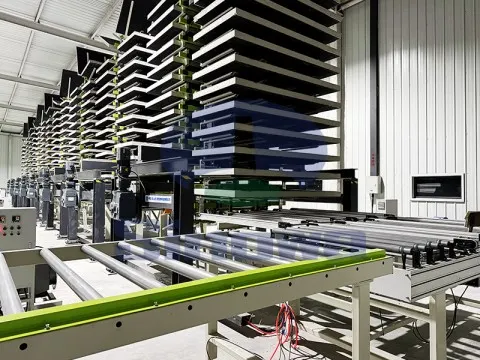
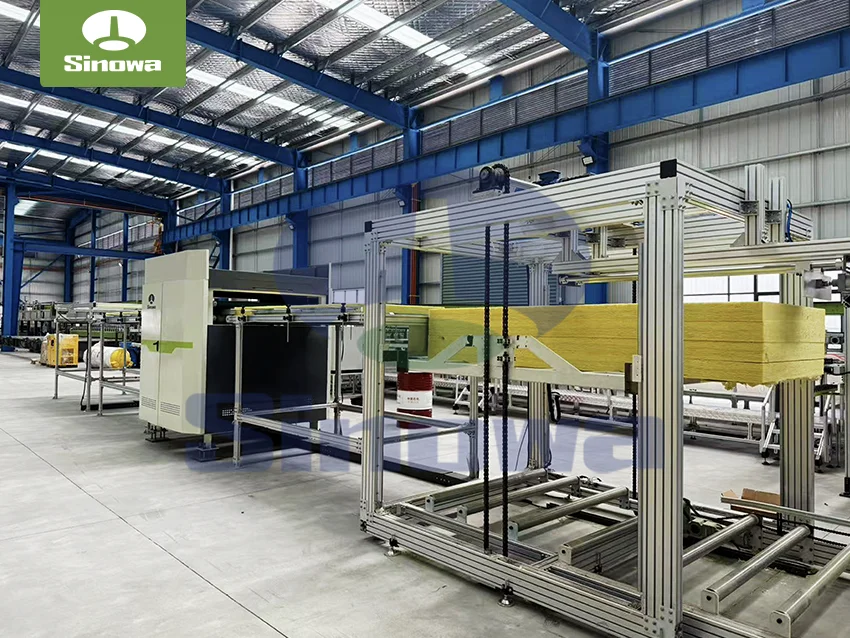
The post-processing unit is the last link in the fireproof insulation board production line, which mainly includes cutting, trimming, sanding, and surface treatment. After curing and drying, the board blanks are usually larger than the required size, so they need to be cut into standard sizes by cutting equipment. The cutting equipment is usually equipped with high-precision cutting blades and positioning devices to ensure that the cutting size is accurate and the cutting surface is flat. Trimming equipment is used to trim the edges of the cut boards to remove burrs and irregular parts, improving the appearance quality of the products. Sanding equipment is used to polish the surface of the boards to make the surface smooth and flat, which is conducive to subsequent construction or surface decoration. For some boards that need special surface treatment, such as waterproof treatment, the post-processing unit will also be equipped with corresponding equipment to coat the surface of the boards with waterproof agents such as acrylic emulsion or UV glue to improve the water resistance of the products. Finally, the post-processing unit is also equipped with a sorting and packaging system, which sorts the qualified products according to their specifications and packages them to facilitate storage and transportation.
In addition to the above core functional units, the fireproof insulation board production line also includes auxiliary systems such as electrical control systems, dust removal systems, and thermal energy supply systems. The electrical control system is the "brain" of the entire production line, which is composed of a central control cabinet, PLC controllers, touch screens, and other equipment. It can realize automatic control and monitoring of the entire production process, including raw material metering, mixing, forming, curing, drying, and post-processing. Operators can set production parameters through the touch screen and monitor the operation status of each equipment in real time. When an abnormality occurs in the production process, the control system will issue an alarm in time and take corresponding protective measures to avoid production accidents and ensure the stable operation of the production line. The dust removal system is used to collect the dust generated during the raw material mixing, cutting, and sanding processes to avoid environmental pollution and protect the health of operators. The thermal energy supply system provides the required heat energy for the curing and drying units, and common thermal energy sources include natural gas, electricity, and steam. The thermal energy supply system needs to have stable thermal energy output to ensure that the temperature in the curing chamber and drying tunnel is kept constant, which is crucial for improving product quality consistency.
The performance of the fireproof insulation board production line is mainly reflected in production efficiency, product quality stability, energy conservation and environmental protection, and operational flexibility. Production efficiency is an important indicator to measure the performance of the production line, which is usually expressed by the daily output of the line. With the continuous improvement of automation technology, modern fireproof insulation board production lines have realized continuous and automated production, and the daily output can reach thousands of square meters. The high production efficiency not only reduces the production cost but also meets the large demand for fireproof insulation boards in the market. Product quality stability is another core performance indicator of the production line. Due to the adoption of high-precision metering equipment, advanced mixing technology, and strict process control, the products produced by the production line have uniform performance indicators, such as consistent fire resistance, insulation performance, and mechanical strength. The error of key indicators such as board thickness and density is controlled within a small range, which can effectively avoid the problem of uneven product quality caused by manual operation. In addition, the production line is usually equipped with online quality inspection equipment, which can detect the performance of the products in real time during the production process and remove unqualified products in time to ensure that the qualified rate of the final products meets the requirements.
Energy conservation and environmental protection are important performance requirements of modern fireproof insulation board production lines. In the production process, the production line adopts a series of energy-saving technologies and equipment to reduce energy consumption. For example, the thermal energy supply system adopts efficient heat exchange equipment to improve the utilization rate of thermal energy; the drying unit adopts a circulating hot air system to reduce the loss of thermal energy; the electrical control system adopts frequency conversion control technology to adjust the operating speed of the equipment according to the production load, reducing electrical energy consumption. At the same time, the production line also pays attention to environmental protection, and the dust removal system and waste treatment equipment are used to reduce the emission of dust and waste, meeting the environmental protection standards. For example, the dust generated during the production process is collected by the dust removal system and then treated uniformly, which avoids air pollution; the waste generated during the cutting and trimming process is recycled and reused, improving the utilization rate of raw materials and reducing environmental pollution.
Operational flexibility is also an important performance of the fireproof insulation board production line. With the diverse needs of the market for fireproof insulation boards, the production line needs to be able to produce different types, specifications, and performance of products by adjusting production parameters and equipment configurations. Modern fireproof insulation board production lines usually adopt a modular design, and each functional unit can be flexibly combined and adjusted according to production needs. For example, by changing the raw material ratio and forming parameters, the production line can produce inorganic fireproof insulation boards, organic fireproof insulation boards, and composite fireproof insulation boards; by adjusting the cutting equipment and sanding parameters, the production line can produce boards of different sizes and thicknesses to meet the needs of different application scenarios. In addition, the operation of the production line is simple and convenient, and the operators can master the operation skills through simple training, which reduces the difficulty of operation and the cost of personnel training.
The types of fireproof insulation boards produced by the production line are diverse, and they can be divided into different categories according to raw material composition, fire resistance level, and product structure. According to the raw material composition, they can be divided into inorganic fireproof insulation boards, organic fireproof insulation boards, and composite fireproof insulation boards. Inorganic fireproof insulation boards are mainly made of inorganic materials such as gypsum, white cement, perlite, and glass fiber. These materials have excellent fire resistance, non-combustibility, and good thermal stability, and will not release toxic gases when exposed to fire. Common inorganic fireproof insulation boards include gypsum-based fireproof insulation boards, perlite fireproof insulation boards, and glass fiber reinforced fireproof insulation boards. Gypsum-based fireproof insulation boards have the advantages of light weight, good sound insulation, and easy construction, and are widely used in interior walls, ceilings, and other parts of buildings. Perlite fireproof insulation boards have excellent insulation performance and fire resistance, and are suitable for thermal insulation and fire prevention of industrial equipment and pipelines. Glass fiber reinforced fireproof insulation boards have high mechanical strength and good durability, and can be used in harsh environments such as high temperature and humidity.
Organic fireproof insulation boards are mainly made of organic materials such as modified polyurethane (PUR, PIR), phenolic resin, and polystyrene. These materials have excellent insulation performance, light weight, and good toughness, but their fire resistance is relatively poor compared with inorganic materials, so they usually need to be modified by adding flame retardants to improve their fire resistance. Modified polyurethane fireproof insulation boards include PUR and PIR types. PUR is a foam system formed by the cross-linking reaction of isocyanate and polyether polyol, and its flame retardancy is mainly achieved by adding external flame retardants. PIR is a modified rigid polyurethane foam plastic with isocyanurate rings in its molecular structure, which has high flame retardancy due to its own molecular structure. Both types have the advantages of good thermal insulation effect, light weight, high strength, and excellent chemical corrosion resistance, and their closed-cell structure content is more than 95%, which can effectively prevent the invasion of moisture and water vapor. Phenolic resin fireproof insulation boards are made of thermosetting phenolic resin through foaming. They have excellent fire resistance, heat resistance, and sound insulation performance, and are difficult to burn and self-extinguishing. When exposed to fire, they will form a "graphite foam" layer on the surface, which can effectively protect the internal foam structure and prevent the spread of fire. They will not produce drips or toxic gases when burning, and are environmentally friendly and safe.
Composite fireproof insulation boards are made by combining inorganic and organic materials, which integrate the advantages of both materials, having excellent fire resistance and insulation performance. Common composite fireproof insulation boards include aluminum foil composite phenolic fireproof insulation boards, inorganic-organic composite fireproof insulation boards, etc. Aluminum foil composite phenolic fireproof insulation boards are composed of double-sided embossed coated aluminum foil and intermediate modified phenolic fireproof insulation boards, which not only have good fire resistance and insulation performance but also have good waterproof and anti-corrosion performance, and are suitable for thermal insulation and fire prevention of exterior walls and roofs. Inorganic-organic composite fireproof insulation boards usually use inorganic materials as the base material and organic materials as the insulation layer, which have both the fire resistance of inorganic materials and the insulation performance of organic materials, and are widely used in various construction and industrial fields. According to the fire resistance level, fireproof insulation boards can be divided into non-combustible boards, difficult-to-combustible boards, and flammable boards. Non-combustible boards are mainly inorganic fireproof insulation boards, which do not burn when exposed to fire and have the highest fire resistance level. Difficult-to-combustible boards are mainly modified organic fireproof insulation boards and composite fireproof insulation boards, which are difficult to burn when exposed to fire and will self-extinguish after leaving the fire source. Flammable boards have poor fire resistance and are usually not used in scenarios with high fire safety requirements.
The applications of fireproof insulation boards produced by the production line are extremely wide, covering construction, industrial production, transportation, and other fields, and playing an important role in ensuring safety and saving energy. In the construction field, fireproof insulation boards are one of the essential materials for building energy conservation and fire prevention, and are widely used in exterior wall insulation, roof insulation, interior wall partition, ceiling decoration, and other parts. In exterior wall insulation projects, fireproof insulation boards can effectively reduce the heat transfer between the interior and exterior of the building, reduce the energy consumption of air conditioning and heating, and at the same time improve the fire resistance of the building, preventing the spread of fire along the exterior wall. For example, in high-rise buildings, the use of fireproof insulation boards can effectively delay the spread of fire, providing valuable time for personnel evacuation and fire rescue. In roof insulation projects, fireproof insulation boards can withstand large temperature changes, from low temperatures of -60℃ to high temperatures of +80℃, and can maintain stable performance, which is suitable for various climate conditions. In interior wall partitions and ceiling decoration, fireproof insulation boards not only have good fire resistance and sound insulation performance but also are light weight and easy to construct, which can improve the construction efficiency and reduce the load of the building.
In the industrial production field, fireproof insulation boards are widely used in thermal insulation and fire prevention of industrial equipment, pipelines, and storage tanks. Industrial equipment and pipelines often work in high-temperature or low-temperature environments, and the use of fireproof insulation boards can effectively reduce heat loss or cold loss, improve the operating efficiency of the equipment, and reduce energy consumption. For example, in high-temperature steam pipelines, petroleum and natural gas transmission pipelines, the use of fireproof insulation boards can prevent heat loss and ensure the normal transportation of media. In storage tanks such as water tanks, petroleum storage tanks, and natural gas storage tanks, fireproof insulation boards can play a role in heat preservation or cold preservation, and at the same time improve the fire resistance of the storage tanks, preventing fire accidents. In addition, fireproof insulation boards are also used in the fire prevention and insulation of industrial workshops, especially in workshops with flammable and explosive materials, such as chemical plants and power plants, where fireproof insulation boards can effectively isolate fire sources and reduce the risk of fire accidents.
In the transportation field, fireproof insulation boards are widely used in the insulation and fire prevention of various vehicles, including refrigerated trucks, special vehicles, high-speed trains, and so on. Refrigerated trucks need to maintain a low-temperature environment during transportation to ensure the quality of goods such as food and medicine. The use of fireproof insulation boards with excellent insulation performance can effectively reduce the energy consumption of the refrigeration system and maintain a stable low-temperature environment in the truck. Special vehicles such as oil tankers, gas tankers, and mobile communication vehicles need to have good fire resistance and insulation performance to ensure the safety of transportation. Fireproof insulation boards can meet these requirements and provide reliable safety protection for special vehicles. High-speed trains have high requirements for energy conservation and safety. The use of fireproof insulation boards in the interior and exterior of the train can reduce energy consumption and improve the fire resistance of the train, ensuring the safety of passengers.
In addition to the above fields, fireproof insulation boards are also used in other special fields, such as cold chain logistics, subway tunnels, and coal mines. In cold chain logistics centers, fireproof insulation boards are used to build cold storage, which can maintain a stable low-temperature environment and ensure the quality of cold chain goods. In subway tunnels, fireproof insulation boards are used for the insulation and fire prevention of the tunnel walls and ceilings, which can reduce the impact of temperature changes on the tunnel structure and prevent the spread of fire in the tunnel, ensuring the safety of subway operation. In coal mines, fireproof insulation boards are used for the fire prevention and insulation of mine roadways, which can prevent fire accidents and improve the working environment of the mine. With the continuous development of science and technology and the continuous expansion of application needs, the application scope of fireproof insulation boards will be further expanded, and the requirements for their performance will also be higher, which will promote the continuous upgrading and improvement of the fireproof insulation board production line.
In conclusion, the fireproof insulation board production line is a complex and integrated system with a scientific and reasonable structure, excellent performance, and diverse product types, which plays an important role in various fields. Its structure is composed of core functional units such as raw material preparation, forming, curing and drying, post-processing, and auxiliary systems such as electrical control and dust removal, which work together to ensure efficient and stable production. The production line has the advantages of high production efficiency, stable product quality, energy conservation and environmental protection, and strong operational flexibility, which can meet the diverse needs of the market. The fireproof insulation boards produced by the production line are divided into inorganic, organic, and composite types according to raw material composition, each with its own characteristics and applicable scenarios. Their applications cover construction, industry, transportation, and other fields, providing important support for global safety production and energy conservation and emission reduction. In the future, with the continuous advancement of technology and the continuous improvement of market demand, the fireproof insulation board production line will develop towards more intelligence, environmental protection, and high efficiency, and its role in various fields will be more prominent.
Sinowa is a professional manufacturer of sandwich panel machine in china, we provide diversified and high-performance sandwich panel production lines, including fully automatic continuous PU sandwich panel line and customized special lines to meet mass production and personalized order demands. These sandwich panel lines support processing multiple foam core materials, such as PU, PIR, mineral wool, rock wool and glass wool, covering different insulation and fireproof standards.
Featuring stable operation, high efficiency, energy saving and easy maintenance, our PU sandwich panel line deliver sandwich panels with excellent thermal insulation, fire resistance, sound insulation and lightweight durability. The finished panels are widely applied in industrial workshops, warehouse roofing and wall cladding, cold storage insulation, serving global construction and industrial insulation markets.
https://www.cnsinowa.com/sandwich-panel-machines/fireproof-insulation-board-production-line.html