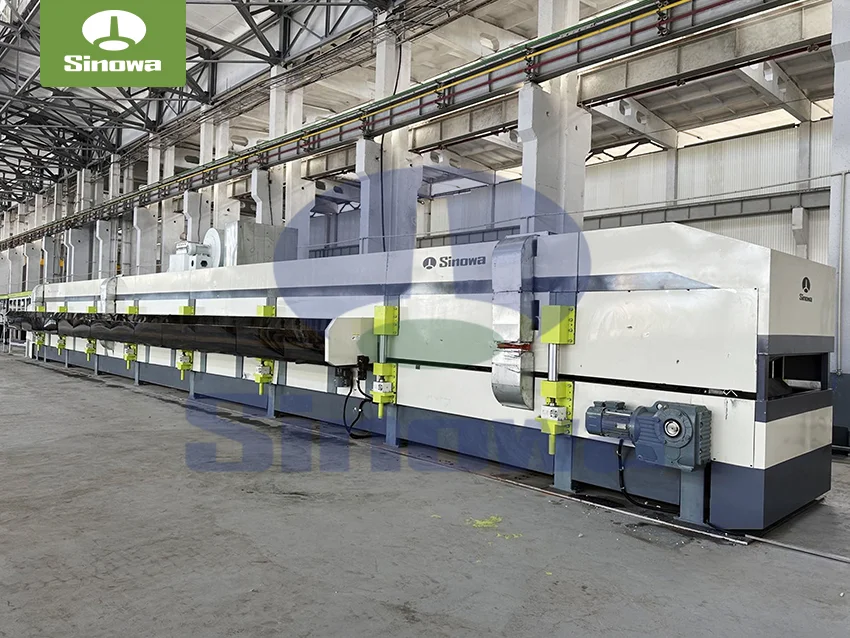
 sandwich panel line
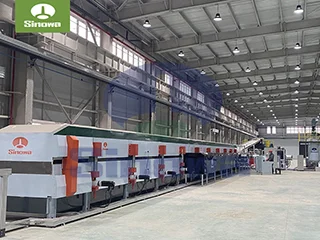
The overall structural design of the external wall insulation board production line follows modular and collaborative operational logic, with each functional subsystem independently undertaking professional production tasks while maintaining precise synchronous coordination through the central control system. The complete production system mainly consists of raw material feeding and conveying unit, automatic mixing and homogenizing unit, layered material distribution and paving unit, composite lamination and molding unit, constant-temperature curing and shaping unit, high-precision cutting and trimming unit, finished product conveying and sorting unit, and intelligent central control unit. Each modular unit is equipped with specialized mechanical structures and sensing devices, which can adapt to the production requirements of different types of insulation core materials and surface composite materials, realizing flexible adjustment of product thickness, structural layers, and overall dimensions. The modular layout not only simplifies daily equipment operation and maintenance but also facilitates subsequent functional optimization and process upgrading, enabling the production line to adapt to the iterative upgrading of building insulation material performance requirements and diverse construction application scenarios.
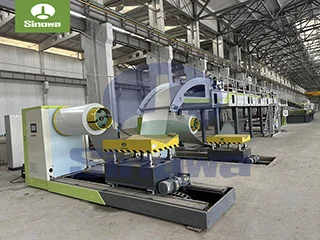
Raw material pretreatment and feeding constitute the initial and foundational stage of the entire sandwich panel assembly line production process, directly determining the uniformity and stability of subsequent product quality. In this stage, various bulk and powdery raw materials required for insulation board production are transported to the designated storage and pretreatment areas through closed conveying equipment. Loose fiber materials and granular core materials are processed through dedicated carding and scattering devices to eliminate material agglomeration and ensure the loose and uniform state of raw materials. At the same time, surface base materials used for composite molding, including flat sheet substrates and flexible protective layers, are uncoiled and leveled by professional unwinding and leveling equipment, effectively removing surface wrinkles, local deformations, and stress concentration generated during material coiling and storage. All feeding processes adopt automatic quantitative conveying modes, with real-time monitoring of material delivery volume and conveying speed through sensing devices, ensuring accurate and stable feeding of various raw materials according to preset process parameters. The closed feeding and conveying design avoids external dust pollution and material waste, maintaining a clean and stable production environment while ensuring the consistency of raw material ratio for each batch of products.
The automatic mixing and homogenizing unit is a key link to ensure the uniform performance of insulation board core materials. After precise quantitative feeding, multiple raw materials are sent into the integrated mixing equipment for full stirring and homogenization. The mixing system adopts multi-dimensional stirring structures to realize omnidirectional blending of powdery, granular, and adhesive raw materials, eliminating local uneven mixing, material stratification, and inconsistent component distribution. During the mixing process, the system automatically adjusts stirring speed, stirring duration, and material mixing sequence according to different material formulas and production process requirements, ensuring that each component is fully fused and reacts stably. For composite insulation materials requiring foaming treatment, the unit is equipped with synchronous foaming auxiliary structures, which can stably control the foaming uniformity and pore density of the core material under constant environmental conditions, forming a fine and uniform porous structure inside the insulation board. This uniform microscopic structure is the core guarantee for the product’s excellent thermal insulation, sound insulation, and lightweight performance, avoiding local performance differences caused by uneven material mixing in traditional production processes.
Layered material distribution and paving processes lay the structural foundation for the composite molding of external wall insulation boards. After homogenization treatment, the mixed core materials are evenly paved on the flattened surface base material through an automatic material distribution system. The material distribution equipment is equipped with real-time thickness monitoring devices, which can dynamically adjust the material paving thickness and paving density according to preset product specifications, ensuring consistent thickness uniformity of the insulation core layer in the full-width range. For multi-layer composite insulation boards, the insulation board production line can realize automatic layered paving of different functional materials, sequentially completing the laying of thermal insulation core layer, reinforcement mesh layer, bonding transition layer, and protective base layer. The embedded reinforcement mesh laying process adopts precise tension control technology to maintain the flat and tensioned state of the reinforcement material, effectively avoiding mesh deviation, wrinkling, and overlapping problems. The accurate superposition of multiple functional layers enables the final insulation board to have excellent structural strength, crack resistance, and impact resistance while retaining efficient thermal insulation performance, meeting the complex stress and environmental resistance requirements of external wall long-term service.
Composite lamination and integral molding are the core stages of shaping the overall structure of insulation boards. The paved multi-layer composite materials are sent into the lamination molding unit through the synchronous conveying system, where integrated pressing and compounding are completed under stable temperature and pressure conditions. The lamination system adopts segmented pressure regulation and uniform heating technology, applying balanced pressing force to the entire surface of the composite board to ensure tight bonding between different functional layers without hollowing or delamination. The constant-temperature auxiliary heating structure optimizes the bonding state of the adhesive materials between layers, accelerating the stable combination of the core material and the surface base material, and improving the overall structural compactness of the insulation board. Different from single-pressure molding equipment, the insulation sandwich panel machine continuous lamination process realizes uninterrupted compounding of plate materials, maintaining the consistency of molding pressure and temperature in the entire production cycle. This continuous molding mode not only improves production continuity but also effectively avoids structural differences between different plates caused by intermittent production, ensuring the overall structural uniformity of batch products.
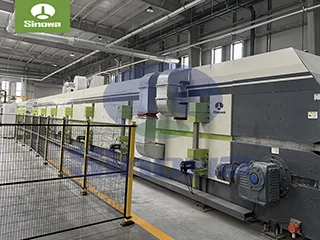
The constant-temperature curing and shaping system undertakes the key task of stabilizing the structural performance of initially molded insulation boards. After lamination and molding, the semi-finished boards are continuously transported into the multi-stage curing oven through the conveying system for gradual curing and shaping treatment. The curing system adopts a hot air circulation design, which can form a uniform and stable temperature field inside the equipment, realizing omnidirectional and consistent heating of the plates. The segmented temperature control mode is adopted in the curing process, with low-temperature preliminary shaping, medium-temperature stable curing, and natural cooling and stress relief stages set in sequence. This gradual curing process can effectively release the internal stress generated during material compounding and pressing, avoid plate deformation, warping, and cracking in the subsequent use process, and fully activate the structural stability of adhesive materials and core materials. The real-time temperature monitoring and feedback system ensures that the temperature deviation in the curing area is controlled within a tiny range, making the curing degree of each part of the plate consistent, and further improving the dimensional stability and structural durability of the finished insulation board.
High-precision cutting and edge trimming processes determine the dimensional accuracy and appearance quality of finished insulation boards. After complete curing and shaping, the continuous long plates are transported to the cutting unit for fixed-length cutting and edge finishing. The cutting system adopts high-precision servo drive technology, which can automatically adjust the cutting length and width according to production parameter settings, realizing accurate sizing of different specification products. The high-speed cutting tool structure ensures smooth and flat cutting sections without burrs, fractures, or irregular gaps, avoiding structural damage to the plate edge and ensuring the tightness of on-site assembly and installation. In addition to fixed-length cutting, the unit is also equipped with automatic edge trimming and corner finishing functions, which can trim the irregular edges generated in the molding process to make the overall outline of the plate regular and uniform. The automated cutting and trimming process replaces traditional manual cutting, greatly improving cutting efficiency while ensuring that the dimensional error of batch products is controlled within a very small range, providing high-precision supporting components for standardized external wall construction.
The finished product conveying, sorting and stacking unit is the final link of the insulated sandwich panel production line production process, realizing automatic collection and arrangement of qualified products. The cut finished insulation boards are automatically conveyed through the flat conveying structure, and defective products with abnormal appearance and unqualified dimensions are screened out through the online detection device in the conveying process. Qualified products are sent to the automatic stacking equipment, which realizes neat stacking of plates according to fixed layers and specifications through mechanical grabbing and positioning structures. The automatic stacking mode ensures uniform stacking specifications and stable placement of finished products, avoiding plate damage and deformation caused by manual stacking errors. At the same time, the orderly stacked finished products are convenient for subsequent packaging, transportation and storage, realizing seamless connection between production and subsequent warehousing and logistics links, and improving the overall operational efficiency of the production system.
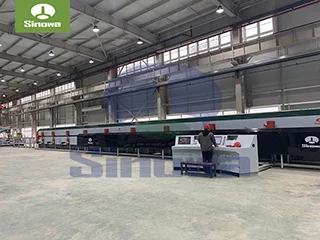
The intelligent central control system runs through the entire operation process of the insulation panel production line and is the core brain to ensure the synchronous and stable operation of each functional unit. The system integrates real-time data collection, parameter adjustment, operation monitoring, and fault early warning functions, realizing full-automatic linkage control of all production links from raw material feeding to finished product output. Operators can set production specifications, process parameters, and operation modes through the centralized operation interface, and the system will automatically adjust the operating status of each equipment unit in real time according to the set parameters. A large number of sensing devices arranged in each production link collect real-time data such as material feeding volume, mixing speed, molding pressure, curing temperature, and cutting dimensions, and feed the data back to the central control system for real-time analysis and judgment. Once abnormal parameter fluctuations or equipment operation faults are detected, the system will automatically trigger early warning prompts and implement corresponding protection measures, effectively avoiding batch product quality problems and equipment operation failures. The intelligent control mode reduces the dependence on manual experience, realizes standardized and digital production management, and greatly improves the stability and controllability of the production process.
The external wall insulation board assembly line has significant technical advantages in production flexibility and product adaptability. Through the adjustable parameter design of each functional unit, the production line can quickly switch production specifications, realizing the production of insulation boards with different thicknesses, structural layers, and functional configurations. It can adapt to the production of various types of insulation core materials and composite surface materials, covering the product needs of different climate zones and different building exterior wall structures. The continuous production mode breaks through the bottleneck of low efficiency of traditional intermittent production, realizing uninterrupted large-scale production, and the single-line production capacity can meet the mass procurement needs of large-scale construction projects. At the same time, the standardized production process makes the physical properties of the products, including thermal insulation performance, structural strength, weather resistance, and dimensional stability, maintain high consistency in batch production, which is crucial to ensure the overall thermal insulation effect and structural safety of building exterior walls.
In terms of production safety and environmental protection performance, the insulation sandwich panel production line adopts a series of optimized designs to meet the requirements of clean and safe industrial production. The entire production process adopts closed material conveying and processing structures, which effectively suppresses dust diffusion and material leakage, reduces on-site production pollution, and improves the operating environment of the production workshop. The mechanical transmission and pressing parts of the equipment are equipped with protective structures and safety induction devices, which can automatically stop running in case of abnormal operation or personnel approaching, ensuring the safety of on-site operation personnel. In addition, the precise proportioning and quantitative feeding design avoids excessive use of raw materials, reduces material waste in the production process, and improves the comprehensive utilization rate of production raw materials. The low-noise operation structure and optimized power operation mode reduce energy consumption and noise pollution in the production process, making the entire production process more energy-saving, environmentally friendly and in line with the development direction of green building material manufacturing.
Daily maintenance and standardized operation management are important guarantees to maintain the long-term stable operation of the external wall insulation sandwich panel line. The modular equipment structure facilitates daily inspection, component replacement and equipment maintenance. The key operating parts of the equipment are designed with wear resistance and durability, adapting to long-term continuous industrial operation. Regular cleaning of material residual components in the feeding, mixing and molding links can avoid material accumulation affecting subsequent production accuracy and product quality. Timely calibration of sensing devices, cutting components and pressure control units ensures the long-term accuracy of production parameters and product dimensional precision. Standardized operation procedures can avoid equipment abrasion and process errors caused by irregular operation, extend the service life of the entire production line, and maintain stable production efficiency and product quality for a long time.
With the continuous development of green building and building energy conservation industries, the application scope of external wall insulation boards is constantly expanding, and the performance requirements for insulation materials are constantly upgrading. The automated external wall insulation board assembly line, as an advanced manufacturing carrier of building energy-saving materials, provides reliable technical and equipment support for the high-quality development of the building insulation industry. Its standardized, intelligent and flexible production characteristics not only solve the problems of uneven quality, low efficiency and high consumption in traditional insulation board production but also provide diversified and high-quality insulation material products for modern architectural energy-saving transformation and new building construction. In the future, with the further innovation of material technology and intelligent manufacturing technology, the external wall insulation sandwich panel production machinery will continue to evolve towards higher intelligence, higher production efficiency and lower energy consumption, continuously empowering the upgrading of the building energy-saving material manufacturing industry and the sustainable development of the construction industry.
https://www.cnsinowa.com/sandwich-panel-machines/external-wall-insulation-board-assembly-line.html