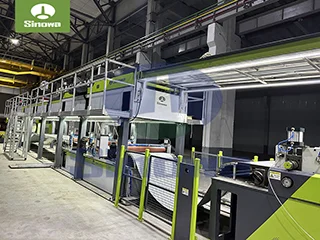
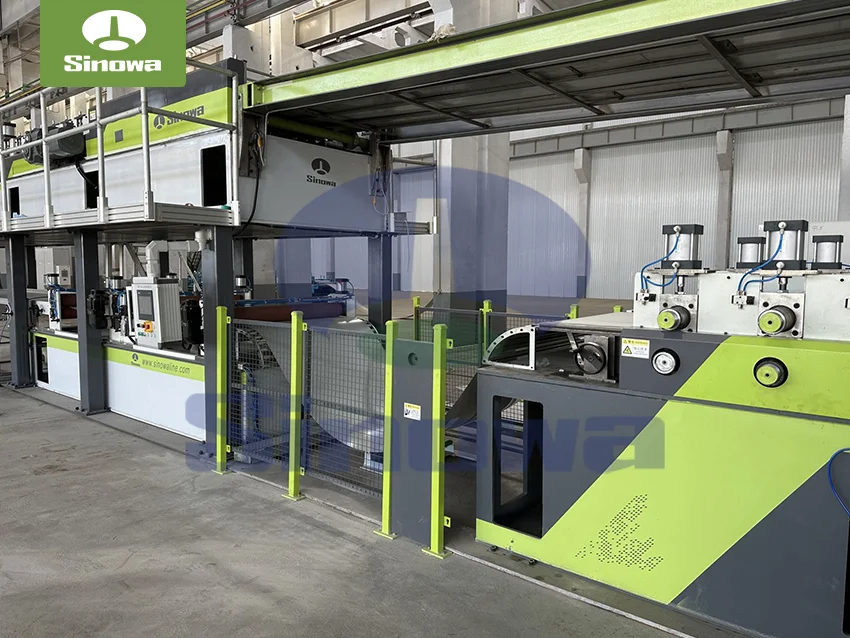
 sandwich panel machine
The overall operational logic of the cold resistant PU sandwich panel machine follows a continuous integrated production mode, integrating multiple core functional procedures into one streamlined production line to realize automated processing from raw material feeding to finished panel output. The entire production workflow features coordinated operation of mechanical transmission, fluid mixing, constant temperature foaming, pressure bonding, and fixed-length cutting systems, with every process link fine-tuned for low-temperature resistance performance of the final product. The core production principle focuses on controlling the chemical foaming reaction of polyurethane materials and the composite bonding state between the PU foam core and surface decorative layers, eliminating common defects such as uneven foam density, weak interlayer bonding, and low-temperature brittle fracture that easily occur in ordinary panel production, so that the produced panels can adapt to long-term service in subzero environments without performance degradation.
The production process of cold resistant PU sandwich panels starts with the pretreatment of surface base materials, a foundational step that directly determines the surface flatness and interlayer bonding stability of finished panels. Common surface materials applicable to the PU sandwich panel equipment include color-coated metal sheets, stainless steel plates, and embossed aluminum plates, all of which are suitable for low-temperature service scenarios after special molding and pretreatment. The machine's uncoiling and leveling unit automatically unfolds coiled base materials, eliminating material wrinkles, bending deformation, and internal stress generated during coiling and storage. Different from ordinary production equipment, this pretreatment unit is equipped with precise roller adjustment structures to ensure uniform flatness of the base material surface. It also supports micro-adjustment of feeding speed and tension to avoid material stretching or indentation defects, creating optimal surface conditions for subsequent PU foam compounding and bonding. After leveling, the base material undergoes continuous preheating treatment, which removes surface moisture and stabilizes material toughness, effectively preventing delamination and debonding caused by residual moisture in low-temperature environments after panel molding.
Following base material pretreatment is the core foam mixing and injection process, the most critical link that determines the cold resistance performance of sandwich panels. The PU sandwich panel production line adopts a high-precision proportional mixing system for polyurethane raw materials, which fully blends polyether polyol and isocyanate raw materials according to optimized low-temperature formula parameters. This system features stable flow control and uniform mixing efficiency, avoiding insufficient reaction or local uneven density caused by inconsistent raw material ratios. The precisely mixed liquid PU raw materials are continuously and evenly injected between the upper and lower surface base materials through a special injection nozzle structure. Unlike conventional injection systems, the injection module of cold resistant equipment optimizes the injection pressure and flow rate curve, enabling the liquid foam to fully spread and fill the entire interlayer space in a short time. This forms a fine and uniform closed-cell foam structure, which is the key to ensuring excellent low-temperature thermal insulation and structural stability of the panel. The closed-cell structure can effectively lock static air, greatly reduce thermal conductivity, and avoid foam shrinkage and cracking under long-term low-temperature freezing conditions.
After foam injection, the semi-finished panels enter the continuous pressing and curing stage, which realizes tight composite bonding of surface materials and PU foam cores. The PU sandwich panel line is equipped with a high-stability hydraulic pressing system that provides uniform and continuous pressure across the entire panel surface. The pressure value is dynamically adjustable according to different panel thickness specifications and material characteristics, ensuring seamless fitting between the foam core and surface layers without gaps or local pressure differences. The pressing process is synchronized with constant-temperature curing treatment, where the internal temperature of the curing channel is stably controlled within the optimal reaction range for PU foam curing. This balanced temperature environment promotes sufficient chemical cross-linking reactions of polyurethane materials, enabling the foam to expand stably, solidify rapidly, and form an integrated composite structure with the surface base materials. The curing system of cold resistant machines features more precise temperature control accuracy and better temperature uniformity than ordinary equipment, effectively solving the problems of incomplete foam curing and inconsistent internal stress distribution that lead to poor low-temperature resistance. Fully cured panels possess high interlayer bonding strength, avoiding delamination, bulging, or cracking in frequent low-temperature temperature difference alternation scenarios.
The subsequent cooling and shaping process further optimizes the dimensional stability and low-temperature adaptability of finished panels. The polyurethane sandwich panel production line is equipped with a graded cooling system that adopts a gradual cooling mode instead of rapid cooling, effectively eliminating internal stress generated during high-temperature curing and pressing. Gradual cooling allows the internal molecular structure of the PU foam to stabilize gradually, preventing residual stress from causing slow deformation or brittle damage of panels in long-term low-temperature service. During the cooling process, the equipment’s conveying system maintains a constant operating speed to ensure consistent cooling time for each part of the panel, guaranteeing uniform dimensional accuracy and structural performance of the entire panel. After complete cooling and shaping, the panels are sent to the automatic cutting unit, which performs fixed-length precision cutting according to preset dimensional parameters. The cutting mechanism runs smoothly with neat incision and no burrs, avoiding local structural damage caused by rough cutting that could reduce the low-temperature durability of panels.
The structural design of cold resistant polyurethane sandwich panel line fully considers the production stability and product performance requirements for low-temperature application scenarios, with multiple unique optimized configurations compared with traditional panel production lines. In terms of power and transmission structure, the equipment adopts reinforced transmission components and anti-fatigue mechanical structures, which can maintain stable operating efficiency during long-term continuous production and avoid mechanical wear and operational failure caused by high-load operation. The core control system adopts intelligent digital adjustment modules, which can precisely monitor and dynamically adjust key parameters such as raw material mixing ratio, injection volume, pressing pressure, curing temperature, and production speed in real time. This intelligent adjustment function enables the equipment to adapt to different raw material characteristics and production specifications, ensuring that each batch of panels maintains consistent cold resistance and structural performance. Meanwhile, the equipment is designed with efficient energy-saving structures in the curing and heating links, which optimize heat energy utilization efficiency while ensuring production quality, reducing ineffective energy consumption in the production process and realizing more environmentally friendly and efficient production operations.
The panels produced by cold resistant polyurethane sandwich panel machine have outstanding comprehensive performance advantages in low-temperature environments, making them irreplaceable in multiple professional fields. First of all, the panels have excellent low-temperature thermal insulation performance. The uniform and dense closed-cell PU foam core structure can effectively block heat conduction and air convection, maintain stable internal temperature of buildings and equipment spaces, and greatly reduce energy consumption for heating and refrigeration. In ultra-low temperature environments, the foam structure will not shrink, collapse or deform, ensuring long-term stable thermal insulation effect. Secondly, the panels have superior low-temperature mechanical toughness. Optimized formula and process make the PU foam core maintain good flexibility and impact resistance at subzero temperatures, avoiding the brittle cracking problem common to ordinary foam materials. The composite structure formed by tight bonding between the foam core and surface layers gives the panels high overall structural strength, enabling them to resist external wind pressure, snow load and mechanical impact in cold regions without deformation or damage.
In addition to thermal insulation and mechanical performance advantages, the finished panels also feature good moisture resistance, frost resistance and aging resistance. The dense closed-cell structure of polyurethane foam can effectively block moisture and water vapor penetration, preventing internal frosting, ice accumulation and structural corrosion of panels in humid and low-temperature environments. This avoids performance attenuation and service life reduction caused by moisture damage. At the same time, the optimized composite process enhances the weather resistance of the panels, enabling them to resist aging and performance degradation caused by long-term exposure to low temperature, ultraviolet radiation and temperature difference alternation, ensuring stable service performance for a long time in harsh cold-region environments. Moreover, the panels are lightweight and easy to install, which can effectively reduce the overall load of building structures, shorten construction cycles, and reduce construction difficulty and cost of cold-region engineering projects.
Cold resistant PU sandwich panel making machine serve a wide range of application scenarios, covering almost all construction and industrial fields that require low-temperature insulation and cold resistance protection. In the cold storage and refrigeration industry, the equipment produces special insulation panels for low-temperature cold storage, frozen food processing workshops, and constant-temperature logistics warehouses, providing reliable thermal insulation and structural protection for low-temperature storage environments, ensuring stable operation of refrigeration systems and reducing long-term operating energy consumption. In alpine and polar engineering construction, the panels are used for temporary construction facilities, scientific research station buildings, and equipment enclosure structures in high-latitude low-temperature regions, adapting to extreme subzero working environments and providing safe and stable working spaces for field operations.
In the field of industrial manufacturing, the sandwich panel manufacturing machine products are applied to low-temperature production workshops, constant-temperature equipment rooms, and industrial insulation enclosures in cold northern regions, ensuring stable production environment temperature and normal operation of precision equipment. In addition, the panels are also widely used in special low-temperature transportation equipment, outdoor cold-region facility enclosures, and energy-saving renovation of old cold-preservation buildings, providing diversified low-temperature insulation solutions for various industries. With the continuous development of prefabricated construction technology, cold resistant PU sandwich panels have become important lightweight enclosure materials for prefabricated low-temperature buildings, and the supporting production equipment has also become key core equipment in the low-temperature building material manufacturing industry.
With the continuous progress of mechanical automation and material processing technology, cold resistant PU sandwich panel production machine is developing towards higher automation, more precise process control, stronger production adaptability and lower energy consumption. Modern upgraded equipment further optimizes the raw material mixing and foaming system, adopting more accurate micro-flow control technology to make the PU foam reaction more sufficient and the cell structure more uniform, further improving the low-temperature resistance and thermal insulation performance of panels. The intelligent control system is more humanized, realizing one-key parameter setting, automatic fault detection and production data real-time monitoring, which reduces manual operation errors, improves production consistency, and reduces labor input. At the same time, the equipment’s modular structural design facilitates daily maintenance and parameter adjustment, enabling flexible switching of different panel specifications and meeting the diversified customized production needs of the market.
In terms of environmental protection and sustainable development, the new generation of cold resistant PU sandwich panel manufacturing line optimizes the raw material utilization rate and production process, effectively reducing raw material waste and harmful substance volatilization during production. The optimized foaming process reduces residual chemical components in finished panels, making the products more environmentally friendly and safe, and compliant with the development trend of green building materials. The efficient energy-saving design of the equipment itself reduces production energy consumption, lowers the carbon emission level of the panel manufacturing process, and provides more environmentally friendly production solutions for the low-temperature building material industry.
In practical industrial production applications, the stable operation of cold resistant polyurethane sandwich panel machinery directly determines the quality qualification rate and service performance of cold-resistant insulation panels. Scientific and standardized equipment operation and daily maintenance can effectively extend the service life of the production line and maintain long-term stable production efficiency. Regular cleaning and inspection of the raw material mixing system, injection nozzle and pressing curing unit can avoid equipment blockage, parameter deviation and mechanical wear, ensuring the stability of each production process parameter. Timely calibration of the control system and transmission structure ensures the dimensional accuracy and performance consistency of finished panels, enabling the produced cold-resistant PU sandwich panels to always maintain excellent comprehensive performance in various harsh low-temperature environments.
In conclusion, cold resistant PU sandwich panel production machine as professional and high-efficiency automated production equipment for low-temperature insulation building materials, integrate advanced mechanical manufacturing technology and material processing technology. Through precise control of the entire production process, they solve the performance defects of ordinary sandwich panels in low-temperature environments, and produce building material products with excellent cold resistance, thermal insulation, structural stability and weather resistance. With the continuous expansion of cold-region construction, cold-chain logistics and special low-temperature engineering fields, the market demand for cold-resistant PU sandwich panels will continue to grow, and the related production equipment will also achieve continuous technological innovation and performance upgrading. This type of equipment will continue to play an irreplaceable core role in the field of energy-saving insulation and cold-region construction, providing strong technical and equipment support for the high-quality development of modern low-temperature engineering and green energy-saving construction industries.
https://www.cnsinowa.com/sandwich-panel-machines/cold-resistant-pu-sandwich-panel-machine.html