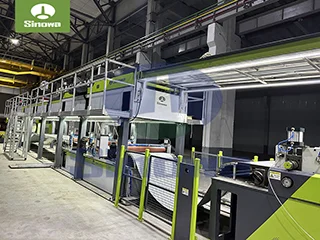
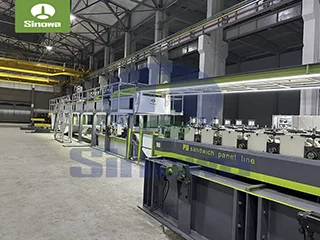
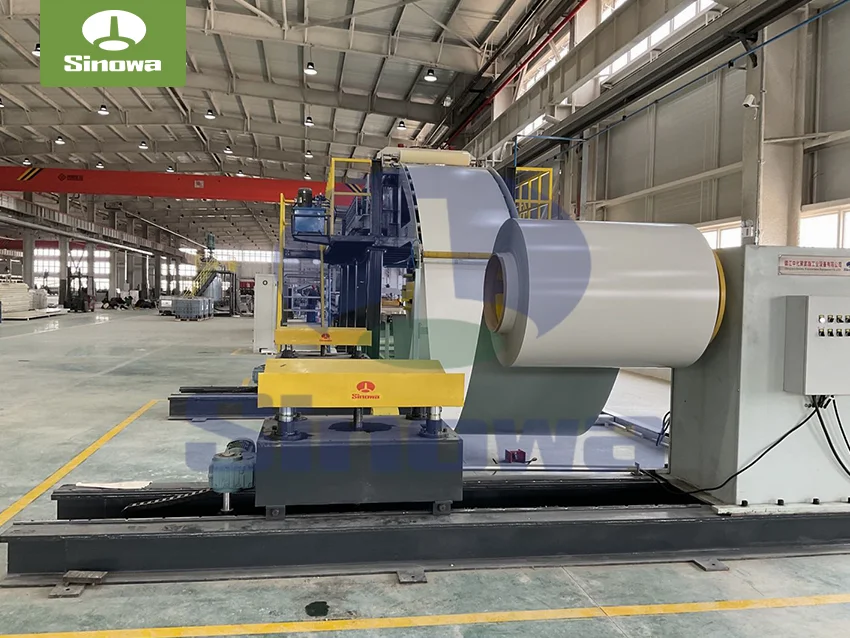
 sandwich panel machine
Different from ordinary PU sandwich panel machine designed for general factory buildings and clean rooms, cold storage dedicated polyurethane sandwich panel machine is optimized in overall structural design, parameter control system and foaming reaction modules according to the extreme operating environment of cold storage spaces. Cold storage interiors feature long-term low temperature, high air humidity and large internal and external temperature differences throughout the year, which puts forward stricter requirements on the core indicators of insulation panels including closed-cell rate, interlayer bonding strength, dimensional stability under temperature difference and long-term anti-aging performance. ordinary sandwich panel production equipment often fails to meet these rigorous indicators, as its conventional foaming density control, curing temperature setting and composite laminating pressure parameters cannot adapt to the long-term frost resistance and heat insulation needs of cold storage panels. Professional cold storage PU sandwich panel making machine adopt targeted mechanical structure upgrading and intelligent parameter adjustment logic in every production link, focusing on improving the uniformity of polyurethane foam core materials, enhancing the permanent bonding force between metal surface sheets and foam layers, and reducing the internal stress of finished panels. These targeted optimizations effectively avoid common quality defects in actual cold storage operation, such as foam layer shrinkage, panel surface deformation, interlayer peeling and cold bridge penetration, which can cause massive cold air leakage and sharp increase in cold storage power consumption. In essence, the core design logic of cold storage PU sandwich panel production machine is to balance efficient continuous production and ultra-high panel performance stability, so that each batch of finished panels can maintain consistent thermal insulation and mechanical properties under long-term alternating temperature changes.
The complete production process operated by cold storage PU sandwich panel manufacturing machine is a highly coordinated closed-loop assembly line work, covering surface material pretreatment, automatic leveling and forming, high-precision PU raw material mixing and pouring, constant-temperature foaming and laminating, segmented thermal curing, synchronous tracking cutting, edge trimming and automatic finished product stacking. All production procedures are connected seamlessly without intermittent pause, and the whole sandwich panel line operates under unified central control to eliminate manual operation errors that widely exist in semi-automatic production modes. The initial production link focuses on the pretreatment of metal surface sheets, which are the outer protective layers of sandwich panels and directly contact humid air and external temperature changes in actual cold storage application scenarios. The equipment is equipped with integrated unwinding and leveling modules to release continuous metal coil materials and eliminate internal stress generated during metal coil storage and transportation. After leveling, the metal sheets go through automatic surface cleaning units to remove residual dust, oil stains and oxide attachments on sheet surfaces. This cleaning procedure is particularly critical for cold storage panel production, because tiny impurities remaining on metal surfaces will severely weaken the bonding effect between metal sheets and polyurethane foam, leading to gradual interlayer separation after several years of cold and hot alternation in cold storage environments. Following cleaning, the metal sheets enter the preheating module for uniform low-temperature heating, which raises the surface temperature of metal materials to match the reaction temperature of polyurethane liquid raw materials, preventing incomplete foaming caused by excessive temperature difference between cold metal sheets and hot PU mixture during subsequent pouring processes.
The high-pressure foaming and mixing unit is the most critical core component of the entire cold storage PU sandwich panel machinery, determining the thermal insulation performance, density uniformity and closed-cell rate of the intermediate foam core layer. Polyurethane foam is generated through the chemical reaction between two main liquid raw materials: polyol composite materials and isocyanate materials, matched with trace additives including catalysts, environment-friendly foaming agents and stabilizers. Unlike general-purpose panel machines, this equipment adopts dual-group high-precision metering pumps with real-time flow monitoring functions to control the output proportion of all raw materials dynamically. Slight deviations in raw material ratios will directly damage the foam pore structure: excessive catalyst addition leads to rapid foaming and uneven large pores inside the core layer, while insufficient catalyst causes incomplete foaming and increased thermal conductivity of finished panels. The built-in intelligent control system of the machine automatically calibrates raw material flow in real time according to ambient temperature and humidity in the production workshop, maintaining an accurate mixing ratio throughout long-duration continuous production. After full high-pressure impact mixing inside the closed mixing head, the homogeneous polyurethane liquid mixture is evenly and quantitatively poured onto the surface of the lower metal sheet at a stable flow rate. The pouring width and thickness can be steplessly adjusted through the central control system to produce cold storage panels with different thickness specifications adapting to different regional climate conditions, ranging from conventional medium-thickness panels for temperate zone cold storage to extra-thickness enhanced insulation panels used in alpine low-temperature regions.
Right after liquid PU material pouring, the composite semi-finished panels enter the double-belt continuous laminating and foaming tunnel, another key functional module exclusive to cold storage panel production equipment. This tunnel maintains stable constant temperature and constant pressure working environments in different segmented zones to guide ordered expansion and stable forming of polyurethane foam. In the initial foaming zone, the liquid mixture expands rapidly through chemical reactions to fill the gap between upper and lower metal sheets, while the circulating steel belt of the double-belt machine applies uniform vertical pressure to avoid local bulging or depression of panel surfaces. The middle steady-pressure zone controls the foam expansion speed stably to ensure that all tiny closed pores inside the foam are uniform in size and independent from each other, maximizing the closed-cell rate of the core material. High closed-cell structure is the core advantage of cold storage PU panels, as it can effectively block moisture vapor penetration in high-humidity cold storage environments and prevent condensation frost formation inside panel interlayers that would damage insulation performance over time. The later shaping zone slowly stabilizes the overall thickness and flatness of composite panels to release internal stress generated during foam expansion. Compared with intermittent laminating equipment, the continuous double-belt structure matched with cold storage machines ensures consistent overall thickness deviation of finished panels within an extremely small range, which facilitates seamless splicing and installation of panels during on-site cold storage construction and eliminates cold bridges at splicing gaps.
After completing preliminary foaming and composite bonding in the laminating tunnel, the continuous long strip of composite panels enters the segmented curing system for deep solidification and structural reinforcement. The curing tunnel is designed with multi-section independent temperature control zones to conduct gradient temperature maintenance, avoiding panel deformation caused by rapid temperature rise or drop. During the curing process, the polyurethane foam continues slow secondary cross-linking reactions to further improve overall structural strength, interlayer peeling resistance and dimensional stability of panels. Sufficient gradient curing treatment enables finished panels to resist structural deformation even under long-term working conditions with temperature differences exceeding 40 degrees Celsius between internal cold storage space and external ambient environment. After full curing, panels are transported to the automatic cutting unit equipped with synchronous flying saw structures. The cutting tool runs synchronously with the moving speed of the panel conveyor belt during cutting, ensuring smooth cutting sections without burrs, cracks or foam layer damage. Operators can preset arbitrary cutting lengths through the human-machine interaction interface according to actual cold storage engineering design drawings, realizing flexible customization of panel sizes without stopping production lines. Follow-up automatic edge trimming devices trim redundant foam and metal edges on both sides of panels to guarantee unified overall width of finished products and improve assembly accuracy during on-site construction.
The final stage of the sandwich panel production line includes automatic conveying, finished product detection and intelligent stacking modules. The equipment integrates non-contact online detection sensors to conduct real-time sampling inspection on panel thickness, surface flatness and foam density during operation. Once unqualified products with abnormal indicators are detected, the system will automatically mark and separate them from qualified finished products without manual screening, reducing defective product rate and improving overall production yield. Qualified panels are automatically stacked by vacuum suction stacking devices, which avoid surface scratches and deformation caused by manual carrying and stacking. The whole production process from raw material feeding to finished product warehouse entry realizes full automation, greatly reducing dependence on on-site operating workers and lowering labor costs for panel manufacturing enterprises. Meanwhile, centralized digital control unifies all production parameters, fundamentally solving the problem of uneven product quality in manual and semi-automatic production modes.
Reasonable daily operation and standardized regular maintenance are essential to maintain long-term efficient and stable operation of cold storage PU sandwich panel production machinery, extend equipment service life and keep consistent finished panel quality. Daily routine maintenance focuses on cleaning residual polyurethane materials inside mixing heads, conveyor belts and laminating tunnels after daily production is completed. Residual cured PU materials will affect the precision of subsequent raw material mixing and the flatness of panel surfaces if accumulated for a long time. Operators also need to check the tightness of all transmission components and the sensitivity of temperature and pressure sensors every day to ensure real-time monitoring data is accurate. Periodic maintenance includes regular calibration of metering pump flow accuracy every month, inspection of wear degree of circulating steel belts and cutting saw blades, and replacement of vulnerable parts in time. In different seasonal environments, targeted maintenance measures are required: in high-temperature summer seasons, heat dissipation auxiliary systems of electrical control cabinets need to be enhanced to prevent equipment shutdown caused by overheating of core control components; in cold winter environments, raw material storage tanks and conveying pipelines need constant temperature insulation treatment to avoid increased fluid viscosity of polyurethane raw materials affecting mixing and pouring effects. Scientific maintenance management not only reduces unexpected equipment downtime and maintenance costs, but also ensures that the machine can always produce panels meeting cold storage engineering performance standards throughout the whole year.
The widespread application of cold storage PU sandwich panel line has brought profound optimization effects to the entire cold chain construction industry from multiple dimensions including production efficiency, building energy conservation and engineering construction cycle. In terms of building energy consumption optimization, panels produced by this equipment have extremely low thermal conductivity, which can effectively isolate heat transfer between external high-temperature air and internal low-temperature cold storage space. Stable and reliable insulation performance reduces the startup frequency and overall operating load of cold storage refrigeration units, cutting long-term operating energy consumption of cold storage buildings significantly. In terms of engineering construction efficiency, standardized finished panels produced by automated machines support rapid modular assembly on construction sites, abandoning traditional complex processes such as on-site insulation spraying and brick wall thermal insulation laying. This modular construction mode shortens the overall construction period of cold storage projects by nearly half and improves the overall airtightness and structural stability of cold storage buildings. Besides conventional food freezing storage, fresh fruit and vegetable preservation warehouses and meat processing cold storage, panels manufactured by this equipment are also widely applied in pharmaceutical low-temperature warehouses, chemical constant-temperature storage spaces and logistics transit cold chain hubs, adapting to diversified low-temperature storage scenarios with different environmental requirements.
Looking ahead, as the global industry accelerates towards green low-carbon development and intelligent manufacturing upgrading, cold storage PU sandwich panel production line will evolve in three major directions: higher intelligent automation, greener whole-process production and more precise micro-control of panel performance. Firstly, future equipment will introduce full-process intelligent linkage control and remote fault diagnosis functions. The central control system will realize autonomous adjustment of production parameters according to real-time ambient environment changes and customized panel requirements, and complete remote early warning and automatic troubleshooting of common equipment faults without on-site operation and maintenance personnel. Secondly, sandwich panel manufacturing line will further optimize foaming auxiliary materials and internal heating circulation systems to reduce comprehensive energy consumption of equipment operation, while matching more environmentally friendly foaming raw materials to lower carbon emissions in the panel manufacturing process and fit the global green building development trend. Thirdly, mechanical micro-control accuracy will be further improved to realize fine adjustment of foam pore structures at the microscopic level, developing ultra-high-performance insulation panels suitable for ultra-low temperature special cold storage and large-span integrated cold storage buildings.
In conclusion, cold storage PU sandwich panel manufacturing machinery act as a vital bridge connecting mechanical manufacturing technology and cold chain infrastructure construction. Through integrated automated mechanical design and optimized chemical reaction control technology, this series of equipment achieves stable, efficient and large-scale production of high-performance insulation panels dedicated to cold storage. With the continuous expansion of global cold chain logistics demand and the upgrading of energy-saving standards for cold storage buildings, the market demand for high-precision, high-stability cold storage polyurethane sandwich panel machine will keep growing steadily. Continuous technological iteration and structural optimization of such mechanical equipment will further promote the overall upgrading of cold storage building materials manufacturing industry, help build more energy-saving, stable and durable cold storage infrastructure, and provide solid mechanical and material support for the sustainable development of the global low-temperature logistics system.
https://www.cnsinowa.com/sandwich-panel-machines/cold-storage-pu-sandwich-panel-machine.html