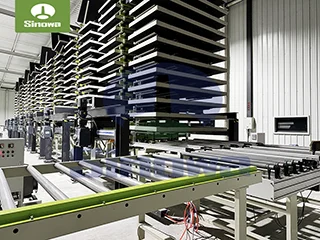
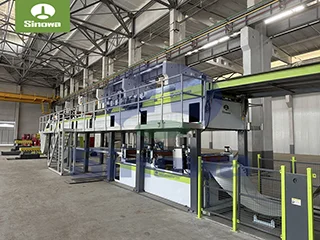
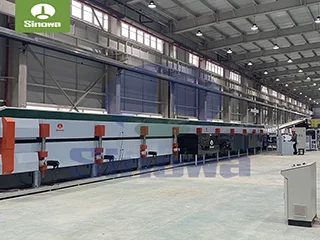
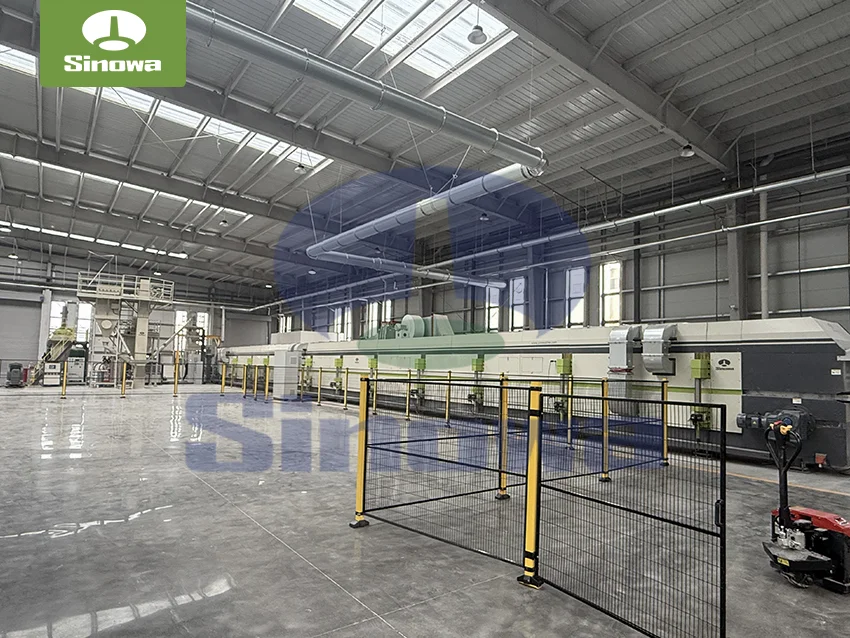
 sandwich panel line
The entire production workflow of the thermal insulation PU sandwich panel line starts with the pretreatment and feeding of surface base materials. The common surface materials for sandwich panels include metal sheets and other structural decorative substrates, which are supplied in coiled forms to adapt to continuous automated production. At the initial stage of production, the coiled base materials are uncoiled stably through a professional feeding unit, eliminating manual intervention and ensuring uniform and continuous material supply. After uncoiling, the base materials pass through a precision leveling system to remove surface wrinkles, indentations, and internal stress generated during coiling and storage. This leveling process is crucial for the subsequent composite molding, as flat and smooth base materials can ensure uniform bonding between the surface layer and the PU foam core layer, avoiding hollowing, warping, and delamination of finished panels. In addition, the continuous sandwich panel production line is equipped with a targeted surface pretreatment process, which cleans residual impurities and dust on the surface of the base materials and optimizes the surface adhesion state through physical and chemical auxiliary treatment, further enhancing the bonding firmness between the surface layer and the foam core and improving the overall durability of the sandwich panel.
Following the base material pretreatment is the precision roll forming process, which endows the flat base materials with specific structural profiles and mechanical strength. The roll forming unit of the continuous PU sandwich panel production line is composed of multiple groups of precision rolling molds and transmission shafts, which can process flat base materials into various wave shapes, concave-convex structures and customized section specifications according to production requirements. The gradual rolling forming method adopted by the equipment avoids local stress concentration caused by one-time stamping, effectively protecting the integrity of the base material structure and surface coating. Different profile designs not only enrich the structural diversity of sandwich panels but also optimize the mechanical bearing capacity and installation adaptability of the products. Panels with special profiles can better adapt to the assembly requirements of building walls, roofs, and industrial enclosure structures, improving the overall structural stability and wind resistance of the building envelope. The entire forming process operates at a stable and adjustable running speed, ensuring that each formed base material has consistent size accuracy and structural uniformity.
The PU foaming and mixing system is the core functional component of the entire thermal insulation sandwich panel production line, which directly determines the thermal insulation performance, density uniformity and structural stability of the finished products. Polyurethane foam is formed by the chemical reaction of two main liquid raw materials with the assistance of catalysts, foaming agents and surfactants. The continuous PU sandwich panel line adopts a high-precision metering and mixing device, which can accurately control the proportion of various raw materials according to the set process parameters. The raw material liquids are transported to the professional mixing head through a stable pumping system, where they undergo high-speed uniform mixing to form a homogeneous foaming liquid mixture. The precisely mixed foaming liquid is evenly sprayed and covered on the surface of the lower base material through a reciprocating sweeping nozzle, which can fully cover the effective width of the base material without material accumulation or missing spraying dead angles, ensuring the consistency of the core material thickness of each panel.
After the uniform laying of the PU foaming liquid, the insulation sandwich panel machine enters the key stages of lamination molding and constant-temperature curing. At this stage, the upper and lower formed base materials are synchronously guided into the double-layer conveyor system, and the foaming liquid is wrapped between the two surface layers to form a preliminary composite structure. With the operation of the conveyor, the foaming liquid undergoes a continuous chemical foaming and cross-linking reaction in a closed constant-temperature curing channel. The internal temperature and operating speed of the curing channel are precisely controlled by the intelligent system, creating a stable reaction environment for the foaming and solidification of the PU core material. In the process of foaming and curing, the foam gradually expands and fills the entire gap between the upper and lower base materials, and forms a tight composite integration with the surface materials after gelation and solidification. The constant-temperature curing technology effectively avoids quality defects such as uneven foam density, insufficient curing and local shrinkage caused by temperature fluctuations, ensuring that the PU core material forms a fine and uniform closed-cell structure. This dense closed-cell structure is the key to the excellent thermal insulation, heat preservation and sound insulation performance of the sandwich panel, which can effectively block heat conduction and reduce energy loss.
After the completion of lamination and curing, the continuous panel strip formed by integral composite will enter the finishing and shaping process. The continuous panel produced by the PU sandwich panel machine has an integrated structure without intermediate gaps, and the subsequent finishing process mainly includes edge trimming, fixed-length cutting and surface inspection. The high-precision trimming device of the continuous sandwich panel line can trim the uneven edges on both sides of the continuous panel to ensure that the overall width of the panel is uniform and the edges are flat and neat, which facilitates subsequent standardized installation and assembly. The fixed-length cutting unit can automatically complete accurate cutting according to customized length specifications, realizing flexible production of panels of different sizes to meet the diverse application needs of different engineering scenarios. The entire finishing process is highly automated, with stable cutting accuracy and neat incision, which will not cause deformation or damage to the panel structure and surface coating.
The automated synchronous control system runs through the entire operation process of the thermal insulation PU sandwich panel production line, which is the core guarantee for the efficient and stable operation of the equipment. All functional units such as feeding, forming, foaming, lamination, curing and cutting realize linkage coordination through the central control system. The system can uniformly adjust the operating speed, raw material ratio, curing temperature and other core process parameters according to different production requirements, realizing one-click switching of different product specifications. The highly integrated automatic control mode reduces manual operation errors, maintains the consistency of each production link, and makes the quality difference between different batches of products extremely small. At the same time, the system has real-time monitoring and self-adjustment functions, which can perceive the slight changes in production parameters in real time and make dynamic corrections, ensuring the continuous and stable operation of the polyurethane sandwich panel production line and avoiding production stagnation or product quality problems caused by parameter deviations.
The structural design of the modular unit brings excellent flexibility and maintainability to the PU sandwich panel production machinery. The entire equipment is assembled by multiple independent functional modules, each of which undertakes a single core process task and maintains precise synchronous coordination with adjacent modules. This modular design not only simplifies the overall equipment structure and reduces the difficulty of daily maintenance and fault detection, but also supports personalized equipment adjustment and function expansion according to production demands. Enterprises can adjust the configuration of individual modules according to product positioning and production scale, realizing flexible production of panels with different thicknesses, surface materials and structural specifications. Whether it is thin-sized lightweight panels for civil building decoration or thickened high-insulation panels for industrial cold storage and workshop enclosure, the polyurethane sandwich panel machine can complete efficient and standardized production through simple parameter adjustment and module matching.
The thermal insulation PU sandwich panels produced by this professional production line have outstanding comprehensive performance advantages, which are fundamentally derived from the precise process control and stable molding technology of the production equipment. First of all, the uniform closed-cell structure of the PU core material gives the panel ultra-low thermal conductivity, which can effectively isolate indoor and outdoor heat transfer, significantly reduce the energy consumption of building heating and cooling, and has remarkable energy-saving and environmental protection effects. Secondly, the integrated composite structure formed by high-pressure lamination and curing makes the surface layer and the core material tightly combined, with high overall structural strength, good compression resistance and bending resistance, and no delamination or cracking after long-term use. In addition, the finished panels have good waterproof, moisture-proof and sound insulation properties, adapting to various harsh use environments such as high humidity and large temperature difference. The smooth and flat surface of the panels also has good decorative performance, eliminating the need for secondary decoration in most application scenarios, saving construction time and engineering costs.
In terms of production efficiency and economic benefits, the continuous operation mode of the thermal insulation sandwich panel line has obvious advantages over traditional intermittent production equipment. The integrated streamlined production realizes uninterrupted feeding, processing and molding, greatly improving the unit time output of products. The high degree of automation reduces the demand for on-site operators, lowers labor costs in the production process, and improves production safety. At the same time, the precise raw material metering and uniform foaming technology reduce the waste of raw materials, improve the utilization rate of production materials, and further optimize the production cost control. The stable product quality reduces the defective rate and rework rate in the production process, ensuring the continuity and stability of enterprise production and delivery, and improving the overall production efficiency and economic benefits of the production line.
With the continuous improvement of global energy-saving and environmental protection requirements and the rapid development of modern construction and industrial manufacturing industries, the market demand for high-performance thermal insulation PU sandwich panels is constantly upgrading, which also promotes the continuous technological iteration and performance optimization of supporting production lines. Modern thermal insulated sandwich panel production line is gradually developing towards higher automation intelligence, more flexible production modes and more stable product quality control. The optimized foaming process makes the core material structure more uniform and fine, further improving the thermal insulation performance and durability of the product. The upgraded intelligent control system realizes more accurate parameter control and remote monitoring functions, making production management more efficient and convenient. The optimized mechanical structure improves the operating stability and service life of the equipment, reducing the frequency of equipment maintenance and failure shutdown.
In practical engineering applications, the sandwich panels produced by advanced PU sandwich panel line cover a wide range of fields, including modern industrial plant enclosures, cold storage and constant-temperature warehouse thermal insulation structures, public building wall and roof systems, temporary assembled buildings, and special thermal insulation and energy-saving projects. In different application scenarios, the stable performance of the panels can effectively meet the functional requirements of building thermal insulation, temperature control, wind resistance and rain protection. The standardized production realized by the professional production line ensures the interchangeability and assembly efficiency of the panels on the construction site, shortens the construction cycle of the project, and improves the overall construction quality of the building envelope. With the continuous advancement of energy-saving building concepts and green manufacturing technologies, the thermal insulation PU sandwich panel manufacturing machine, as an important equipment for producing energy-saving building materials, will play a more important role in the field of modern construction and industrial energy conservation, and continuously promote the upgrading and development of the thermal insulation building material industry.
https://www.cnsinowa.com/sandwich-panel-machines/thermal-insulation-pu-sandwich-panel-line.html