sandwich panel line
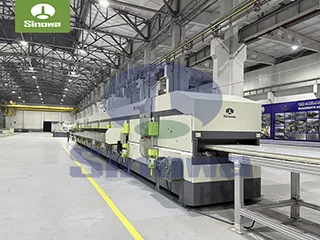
The Advanced Sandwich Panel Line usually consists of key components such as unwinding system, film cutting system, forming machine system, preheating system, high-pressure foaming system, double track system and heating system, cutting system, horizontal cooling system, palletizing system, and packaging system.
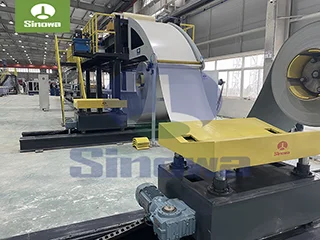
Open coil system: responsible for smoothly unfolding the steel coil raw materials and preparing for subsequent processing. The unwinding system is equipped with a high-precision tension control device to ensure that the tension of the steel coil is uniform and stable during the unfolding process, avoiding wrinkles or excessive stretching, and ensuring the stability of the quality of the sheet metal.
Film cutting system: Based on preset size parameters, the unfolded steel plate is accurately cut and covered with a protective film on the surface of the steel plate. This protective film not only prevents scratches on the surface of the steel plate during subsequent processing, but also has a certain moisture-proof and dust-proof effect, effectively improving the appearance quality and service life of the product.
Forming machine system: It is the core part of the production line, responsible for pressing steel plates into specific corrugated shapes or other design shapes. The forming machine system usually uses high-quality carbon structural steel to make the rollers and shafts of the press machine. After quenching and tempering treatment and CNC precision machining, the surface is plated with hard chromium, which has excellent comprehensive structural performance.
Preheating system: Through advanced heating technology, the steel plate is quickly and uniformly heated to a suitable temperature, generally between 50 ℃ -80 ℃. This temperature range helps to improve the adhesion between polyurethane materials and steel plates during the subsequent foaming process.
High pressure foaming system: It is a key link in the production of polyurethane insulation sandwich panels. It is equipped with advanced electronic measuring devices and automatic feeding systems, which mix the two main components of polyurethane raw materials and foaming agents according to precise ratios, and pour the mixed polyurethane solution evenly onto the bottom surface material of the sandwich panel with stable pressure.
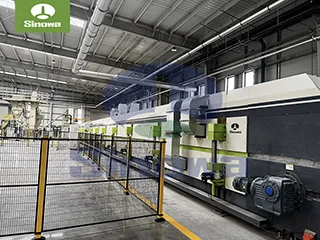
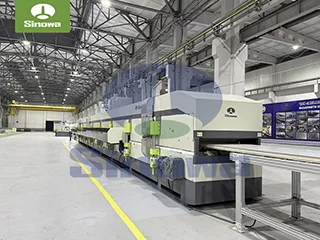
Double track system and heating system: stably support the foamed sandwich panel, allowing it to move smoothly on the production line, and provide a suitable curing environment for the sandwich panel through precise temperature control.
Cutting system: responsible for cutting the fully cured sandwich panel according to the preset length, and equipped with a milling machine to mill the edges of the panel, making the edges smoother and smoother for subsequent splicing and installation.
Horizontal cooling system: Using a combination of air and water cooling, the temperature of the cut sandwich panel is quickly reduced to room temperature to avoid deformation or performance degradation caused by excessive temperature.
Stacking system: According to the specifications and quantity of sandwich panels, they are neatly stacked in a predetermined manner for easy handling and storage in the future.
Packaging system: Professional packaging treatment is carried out on the stacked sandwich panels to ensure that they are not damaged during long-distance transportation.
Characteristics of Advanced Sandwich Panel Line
High degree of automation: From raw material feeding to finished product packaging, the entire production process is highly automated, greatly improving production efficiency.
High precision: Each system on the Advanced Sandwich Panel Line is equipped with high-precision equipment and devices to ensure the precise size and stable quality of the produced sandwich panels.
Strong adaptability: The Advanced Sandwich Panel Line can flexibly adjust production parameters and process flow according to different customer needs and order requirements, producing sandwich panels of different specifications and performance.
Energy saving and environmental protection: The Advanced Sandwich Panel Line adopts advanced energy-saving technologies and environmentally friendly materials, reducing energy consumption and emissions, and meeting the requirements of green buildings and sustainable development.
The sandwich panels produced by the Advanced Sandwich Panel Line have the advantages of lightweight, high strength, thermal insulation, waterproof and moisture-proof, fire and earthquake resistance, and are widely used in industrial plants, warehouses, sports venues, power facilities, chemical equipment, automobile manufacturing and maintenance workshops, and other fields. At the same time, with the continuous improvement of people's requirements for green buildings and energy conservation and environmental protection, the application fields of Advanced Sandwich Panel Lines will continue to expand.
The Advanced Sandwich Panel Line is one of the important equipment in modern building material production. It integrates multiple advanced technologies and has the characteristics of high automation, high precision, strong adaptability, energy conservation and environmental protection. The produced sandwich panels have a wide range of application fields and market demand.
In the evolving landscape of global modern construction and industrial infrastructure development, the demand for high-performance, energy-efficient, and structurally reliable building envelope materials has continued to rise steadily across all regions and project scales. Among the most essential and widely adopted construction materials for contemporary industrial facilities, commercial architectural complexes, cold storage warehouses, temporary modular buildings, and special environmental protection structures, sandwich panels have emerged as a core foundational component that balances structural stability, thermal insulation performance, sound reduction capability, and rapid on-site construction advantages. At the heart of the mass production and standardized manufacturing of these high-quality composite building panels lies the advanced sandwich panel line, a fully integrated and technologically sophisticated industrial production system that combines mechanical engineering innovation, automated operational control, precise material processing technology, and continuous composite forming craftsmanship. Unlike traditional intermittent production equipment and outdated manual-assisted manufacturing setups that once dominated the early development stage of sandwich panel production, modern advanced sandwich panel lines are engineered to deliver continuous, uninterrupted, and highly standardized production processes, ensuring that every finished sandwich panel produced maintains consistent structural uniformity, stable internal bonding performance, reliable long-term durability, and precise dimensional accuracy, meeting the increasingly stringent application requirements of diverse modern construction and industrial engineering scenarios. As the construction industry worldwide accelerates its transformation toward energy-saving green development, rapid modular construction, and long-life building structure design, the upgrading and popularization of advanced sandwich panel production lines have become an indispensable core link in the entire upstream and downstream industrial chain of building insulation and enclosure material manufacturing, profoundly promoting the optimization of production modes, improvement of product quality levels, and expansion of the application scope of composite sandwich building panels.
The overall operational logic and structural design of an advanced sandwich panel line revolve around the seamless integration of multiple independent functional processing units, each meticulously designed and precisely calibrated to complete a specific production segment, while all units operate in perfect synchronous coordination to form a one-stop automated production workflow from raw material input to finished product output. The entire production process starts with the feeding and unwinding of surface layer raw materials, which are mainly high-strength metal coiled materials with excellent surface flatness, corrosion resistance, and mechanical ductility. These metal coiled materials are loaded onto professional unwinding devices at the front end of the production line, which are designed with heavy-duty mechanical support structures and automatic tension adjustment functions to ensure that the coiled materials are released smoothly and evenly without uneven stretching, surface wrinkling, or edge deviation during the entire unwinding process. Stable tension control in this initial stage is extremely critical, as any subtle deformation or position deviation of the surface metal materials in the early production stage will be amplified in subsequent forming and composite processing procedures, ultimately affecting the overall flatness and dimensional standardization of the finished sandwich panels. After the unwinding process is completed, the flat metal sheet materials are automatically transported to the roll forming processing unit, one of the core functional sections that determine the external shape and structural rigidity of the final sandwich panels. The advanced roll forming unit adopts a multi-pass progressive rolling and pressing design, equipped with multiple sets of precision manufactured rollers arranged in an orderly gradient sequence. Each group of rollers is precisely adjusted according to the preset panel profile specifications, gradually pressing and shaping the flat metal sheet into the required standardized plate profile with specific rib structures, edge locking grooves, and structural reinforcing textures. This gradual cold rolling forming process avoids the structural damage and internal stress concentration caused by one-time forced forming, effectively ensuring that the metal surface layer maintains stable mechanical performance, uniform wall thickness, and neat edge dimensions after forming, laying a solid structural foundation for the subsequent composite bonding and long-term service of the sandwich panels.
While the surface metal materials undergo professional roll forming and shaping processing, the advanced sandwich panel line synchronously carries out the precise conveying, cutting, and surface pretreatment of the core insulating materials inside the sandwich panels, realizing the parallel operation of surface material processing and core material preparation to greatly improve overall production continuity and operational efficiency. Common core insulating materials matched with modern advanced production lines include multiple mainstream types with different functional characteristics, each selected according to the actual thermal insulation, fire resistance, and sound insulation needs of subsequent building projects. These core materials feature lightweight inherent properties, excellent thermal resistance coefficients, good sound absorption and noise reduction effects, and stable chemical inertness, ensuring that the finished sandwich panels can effectively reduce building energy consumption, isolate external noise interference, and adapt to various complex external environmental conditions for long-term use. The core material processing unit of the production line is equipped with automatic material conveying equipment and precision fixed-length cutting components, which can accurately cut the bulk or coiled core materials into standard specifications matching the size of the formed metal surface layers. In addition to fixed-length cutting, this unit also completes simple surface finishing treatment on the core materials, removing surface dust, debris, and uneven burrs generated during cutting, ensuring that the contact surfaces between the core materials and the upper and lower metal surface layers are flat and clean. This detailed pretreatment work is crucial for enhancing the subsequent composite bonding effect, as a smooth and clean bonding contact surface can maximize the bonding area between the core material and the surface metal layer, avoiding hollow bonding, local degumming, and poor composite firmness caused by impurities or uneven contact surfaces. For production lines configured with foaming composite processing functions, the core material processing link also includes an automatic high-precision foaming and mixing system, which accurately controls the proportional mixing and reaction injection of foaming raw materials, ensuring that the foamed core material forms a uniform and dense internal pore structure after reaction and solidification, thereby optimizing the thermal insulation performance and overall compression resistance of the finished sandwich panels.
The composite laminating and bonding integration stage is undoubtedly the most critical core process in the entire operation of the advanced sandwich panel line, directly determining the overall structural firmness, service life, and comprehensive mechanical performance of the finished sandwich panels. After the upper and lower metal surface layers are roll-formed and the core insulating materials are precisely processed and pretreated, all materials are synchronously transported to the automatic laminating and composite pressing area in strict accordance with the preset production rhythm and positioning accuracy requirements. The production line is equipped with a high-precision automatic gluing system, which can evenly and quantitatively coat high-performance environmental protection adhesive materials on the inner contact surfaces of the upper and lower metal layers and the upper and lower surfaces of the core material. The gluing process adopts intelligent quantitative control and uniform spraying technology, ensuring that the adhesive coating thickness on each bonding surface is consistent and the distribution is uniform without local glue accumulation or missing coating. Uniform adhesive application not only ensures the initial bonding strength between different material layers but also avoids quality problems such as uneven stress distribution and local aging acceleration caused by inconsistent glue volume during long-term use of the panels. After the completion of the gluing operation, the metal surface layers and the core material are accurately aligned and assembled into a preliminary composite whole, which then enters the multi-roller continuous compression molding device for constant temperature and constant pressure composite curing treatment. This compression molding device maintains stable and consistent pressure and temperature parameters throughout the composite process, allowing the adhesive to fully react and solidify under optimal environmental conditions, forming a permanent and stable bonding structure between the metal layers and the core material. The continuous compression design ensures that the entire surface of the composite panel is evenly stressed, effectively preventing panel warping, surface unevenness, and internal delamination defects that are prone to occur in traditional batch pressing production methods. Through this precise composite laminating process, the originally independent metal surface materials and insulating core materials are integrated into a unified composite structural whole, combining the high mechanical strength and weather resistance of the metal material with the excellent thermal insulation and sound insulation performance of the core material, forming the unique comprehensive performance advantages of sandwich panels.
After the completion of composite bonding and initial curing, the integrated continuous sandwich panel semi-finished product enters the automatic fixed-length cutting and edge finishing processing link, an important process that ensures the finished panels meet standardized dimensional specifications and neat appearance quality. The advanced sandwich panel line is equipped with high-speed precision automatic cutting equipment, which can automatically identify production parameters and preset size requirements, and perform fixed-length cutting on the continuous long-strip composite panels without manual measurement and auxiliary operation. The cutting equipment adopts high-precision transmission and positioning technology, with extremely small dimensional error in the cutting process, ensuring that the length and width of each finished panel are completely consistent, which facilitates standardized packaging, transportation, and rapid on-site installation of subsequent products. At the same time of cutting, the edge finishing device synchronously completes trimming, deburring, and edge smoothing treatment on the cut edges of the panels, removing sharp burrs and uneven cutting residues generated during cutting, making the panel edges neat and smooth. This edge finishing treatment not only improves the overall appearance quality of the finished sandwich panels but also avoids safety hazards such as scratch damage to construction personnel during on-site installation, and ensures the tightness and sealing effect of the lap joints between adjacent panels during building enclosure construction. For production lines that need to produce sandwich panels with special edge sealing and locking structures, this processing link is also equipped with professional edge rolling and shaping components, which can complete integrated edge locking and sealing processing on the panel edges, further enhancing the overall structural tightness and wind resistance performance of the assembled building enclosure structure.
The intelligent automatic control and real-time quality monitoring system is an indispensable core supporting part of the modern advanced sandwich panel line, distinguishing it from traditional low-efficiency and low-precision ordinary production equipment. The entire production line adopts a centralized integrated automatic control mode, with all functional processing units connected through a unified intelligent control platform. Production personnel only need to set basic production parameters such as panel size, material specifications, and production speed on the control terminal at the initial stage of production, and the entire subsequent unwinding, forming, feeding, gluing, composite pressing, cutting, and finishing processes can be completed automatically without frequent manual intervention. The control system has real-time operation data monitoring and automatic fault early warning functions, which can dynamically monitor the operating status, operating speed, temperature and pressure parameters, and material conveying status of each processing unit in real time. Once abnormal conditions such as equipment operation jitter, parameter deviation, or material conveying blockage occur in any link, the system will automatically send out early warning prompts and take corresponding automatic protection measures such as deceleration operation or temporary shutdown to avoid equipment failure expansion and mass production of defective products. In addition, the built-in quality detection sensors of the production line can conduct real-time online detection on the flatness, bonding thickness, dimensional accuracy, and surface quality of the semi-finished and finished panels during the production process, automatically screening out unqualified products and recording production quality data. This real-time intelligent monitoring and automatic control mode not only greatly reduces the labor input required for production operations and reduces the impact of human operational errors on product quality but also effectively improves the overall production stability and product qualification rate, realizing refined and intelligent management of the entire production process.
One of the most prominent advantages of the advanced sandwich panel line is its strong production flexibility and multi-material adaptive production capacity, which can meet the diversified production needs of different types of sandwich panels for different application scenarios. The production line adopts a modular functional unit design, and each core processing module can be slightly adjusted and adaptively modified according to different core material types, metal surface layer specifications, and panel structural design requirements. This means that the same advanced production line can seamlessly switch between producing different series of sandwich panels without large-scale equipment transformation and replacement. Whether it is lightweight panels for temporary modular construction, high-efficiency thermal insulation panels for cold storage and constant-temperature workshops, sound insulation and noise reduction panels for industrial factory buildings and municipal public facilities, or special weather-resistant panels for outdoor enclosure structures, the production line can complete efficient and standardized production through simple parameter adjustment and module adaptation. This multi-functional adaptive production characteristic enables sandwich panel manufacturing enterprises to flexibly respond to the changing market demand of the construction industry, quickly adjust product production proportions according to market project orders, avoid production line equipment idle and resource waste, and effectively improve the overall production operation efficiency and market competitiveness of manufacturing enterprises. At the same time, the continuous production mode of the advanced production line greatly improves production efficiency compared with the traditional intermittent production mode. The uninterrupted synchronous operation of each processing link eliminates the waiting and handling time between different production processes, realizing long-term continuous and stable production output and effectively meeting the large-scale and centralized procurement demand of major construction engineering projects.
In addition to efficient and standardized production capabilities, the advanced sandwich panel line also incorporates energy-saving operation design and low-consumption production concepts in overall structural and process design, conforming to the global green building and low-carbon industrial development trend. All mechanical transmission components of the production line are optimized with energy-saving structural design, reducing mechanical friction resistance and invalid energy consumption during equipment operation. The temperature and pressure control systems used in the composite curing and foaming reaction links adopt precise intelligent regulation technology, which can automatically adjust operating energy consumption according to actual production volume and process requirements, avoiding long-term high-load operation and unnecessary energy waste of equipment. At the same time, the production process of the advanced production line does not require high-temperature and high-pressure harsh production conditions, and the whole production process is carried out under mild and stable environmental conditions, which not only reduces energy consumption and production operation costs but also avoids the generation of excessive industrial waste and harmful emissions in the production process. The adhesive materials and foaming raw materials matched with the production line are all environmentally friendly and low-pollution types, which will not produce harmful substances and peculiar smells during use and subsequent long-term service, meeting the green environmental protection requirements of modern building material production and building engineering construction. This energy-saving and environmentally friendly production feature not only helps sandwich panel manufacturing enterprises reduce production operating costs and realize low-carbon production operations but also ensures that the produced sandwich panels meet the green building material selection standards of various modern construction projects, promoting the coordinated development of the building material manufacturing industry and ecological environmental protection.
The long-term stable operation performance and convenient daily maintenance design of the advanced sandwich panel line are also important factors that make it widely recognized and applied in the industry. The main body of the production line is made of high-strength and wear-resistant industrial steel materials, with a robust and stable overall structural design, strong compression resistance, vibration resistance, and impact resistance, and can maintain long-term stable continuous operation in high-intensity industrial production environments without structural deformation and equipment aging failure. All key mechanical components and transmission parts are designed with wear resistance and corrosion resistance, with long service life and low replacement frequency of wearing parts, reducing the long-term equipment maintenance and replacement costs for manufacturing enterprises. At the same time, the overall structural layout of the production line follows the convenient maintenance design concept, with reasonable layout of each functional module and reserved professional maintenance operation space. Daily equipment inspection, regular lubrication maintenance, simple fault troubleshooting, and wearing parts replacement can be completed quickly by maintenance personnel without complex disassembly and long-term production shutdown, effectively reducing production downtime caused by equipment maintenance and improving the overall continuous operation rate of the production line. For long-term production and operation, this reliable operational stability and convenient maintenance management mode can help manufacturing enterprises maintain stable production output for a long time, avoid production delays and order delivery delays caused by equipment failures, and establish a stable and reliable production and operation system.
With the continuous advancement of global construction industrialization, modular construction, and building energy conservation upgrading, the market demand for high-quality sandwich panels will continue to grow, and the technical upgrading and iterative optimization of advanced sandwich panel lines will also continue to deepen. In the future, such production lines will further integrate more digital intelligent management technologies, realizing remote production data monitoring, automatic production parameter optimization, and intelligent production scheduling management, and further reducing manual operation and management intervention in the production process. At the same time, with the continuous innovation of new building insulation and composite materials, the adaptive production capacity of advanced sandwich panel lines for new environmentally friendly core materials and new high-strength surface materials will be further improved, promoting the continuous upgrading of the comprehensive performance of sandwich panel products. As the core production equipment in the field of modern building enclosure and thermal insulation materials, the advanced sandwich panel line will continue to play an irreplaceable important role in promoting the high-quality development of the construction material manufacturing industry, accelerating the popularization and application of green energy-saving buildings, and supporting the efficient and standardized construction of various modern industrial and civil construction projects. Through continuous technological innovation and production process optimization, advanced sandwich panel production equipment will continue to lead the iterative upgrading of the sandwich panel manufacturing industry, create more efficient, greener, and higher-quality composite building material products for the global construction industry, and lay a solid foundation for the sustainable development of modern construction engineering.
https://www.cnsinowa.com/sandwich-panel-machines/advanced-sandwich-panel-line.html