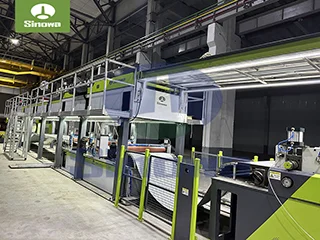
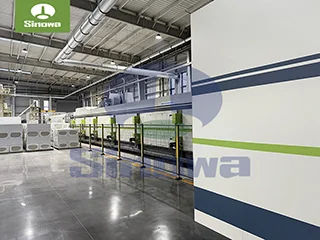
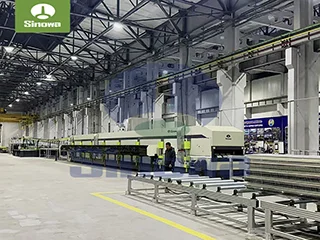
sandwich panel machine
A complete sandwich panel machine system is a highly integrated automated production unit that combines mechanical transmission, automatic control, material conveying, precision molding, and post-processing functions. Unlike traditional single-function processing equipment, this production line realizes continuous and streamlined production from raw material feeding to finished product output, covering all key links including raw material pretreatment, automatic batching, uniform mixing, composite pressing, constant-temperature curing, fixed-length cutting, and finished product finishing. The overall structural design of the equipment follows the principles of industrial efficiency and operational stability, with each functional module closely coordinated and mutually matched to avoid production discontinuity and quality fluctuations caused by mismatched equipment parameters. The core design concept of modern sandwich panel machines focuses on balancing production efficiency, product diversity, operational stability, and energy-saving performance, enabling the equipment to adapt to the diversified production needs of different core materials, surface materials, and panel specifications.
The basic composition of a standard sandwich panel production line includes multiple core functional modules, each undertaking an independent and indispensable production task. The raw material processing and feeding module is the starting point of the entire production process, responsible for the automatic conveying, sorting, and precise proportioning of various raw materials required for panel production. This module can adapt to different types of core materials such as foam materials, rock wool, glass wool, and lightweight inorganic aggregates, as well as various metal and non-metal surface materials. Through mechanical quantitative feeding and automatic adjustment of feeding speed, it ensures the uniformity of raw material dosage in each production cycle, laying a solid foundation for the consistent thickness, density, and performance of finished sandwich panels. The precision of raw material feeding directly affects the overall quality of composite panels; unstable feeding volume will lead to uneven internal structure of the panels, local thickness deviation, and even attenuation of thermal insulation and mechanical properties in subsequent use.
Following the feeding link is the material mixing and composite pretreatment module, which mainly completes the uniform mixing of auxiliary materials, adhesives, and functional additives, as well as the surface pretreatment of surface plates. In the composite molding process of sandwich panels, the bonding firmness between the surface layer and the core material is the key to determining the structural stability and service life of the panel. This module adopts a rotating stirring structure with adjustable speed to fully mix various auxiliary materials, ensuring that the adhesive components are evenly distributed without precipitation or stratification. At the same time, it completes the preliminary leveling and surface cleaning of the surface plates to remove impurities and irregular parts on the material surface, so that the surface layer and core material can achieve full contact and tight fitting in the subsequent pressing process. The scientific pretreatment process effectively avoids common quality problems such as degumming, bulging, and delamination of finished panels during long-term use, and significantly improves the overall structural strength and weather resistance of the panels.
The core functional module of the continuous sandwich panel production line is the composite pressing and thermal forming system, which is the key link to realize the integral molding of sandwich panels. This system adopts a multi-stage pressing and constant-temperature heating integrated design, which can apply uniform and stable pressure to the composite structure of surface plate and core material, and cooperate with graded temperature control to complete the curing and molding of adhesive materials. The pressure and temperature parameters in the pressing process can be dynamically adjusted according to different core material characteristics and panel thickness specifications, which can not only ensure that the core material is fully compounded without loose gaps, but also avoid structural deformation and performance damage of the core material caused by excessive pressure or excessive temperature. The advanced pressing structure design realizes full coverage of pressing force, eliminates the problem of uneven stress on the edge and middle of the panel, and ensures that the compactness and flatness of each position of the finished panel reach a unified standard. Compared with intermittent manual pressing and single-stage mechanical pressing in traditional processes, the continuous pressing and molding technology of modern sandwich panel machines greatly improves production continuity and product yield, and effectively reduces the rate of defective products caused by human operation errors.
After the completion of thermal pressing and preliminary curing, the semi-finished panels will enter the constant-temperature curing and cooling module for structural stabilization treatment. The newly molded sandwich panel has not yet completed the full curing reaction of internal adhesives, and the internal structural stress has not been completely released. If it is directly cut and shaped, it is easy to produce dimensional deviation, surface warping, and internal structural looseness. The professional curing and cooling system provides a constant-temperature and humidity-stable environment for semi-finished products, through slow cooling and static curing, to fully release the internal stress of the panel, complete the final curing of the bonding layer, and stabilize the overall structural performance of the panel. The curing time and cooling rate can be intelligently adjusted according to the thickness of the panel, the type of core material, and the ambient temperature, ensuring that the mechanical strength, bonding stability, and dimensional accuracy of the finished panel meet the requirements of industrial application standards. This link is crucial to improving the long-term service stability of sandwich panels, enabling the panels to maintain stable performance in complex environments such as high temperature, low temperature, and humidity alternation.
The fixed-length cutting and finishing module is the final processing link of finished products, responsible for cutting the continuously molded long-strip panels into standard-sized finished products and trimming the edges and surfaces. This module is equipped with high-precision automatic cutting components and intelligent sizing systems, which can set arbitrary cutting lengths according to customer usage requirements and realize fast and accurate fixed-length cutting. The cutting tool adopts wear-resistant and high-hardness structural design, which can keep the cutting edge smooth and flat for a long time, without burrs, cracks, or edge collapse, ensuring the neatness and flatness of the panel section. At the same time, the edge trimming function can trim the irregular edges generated in the molding process to make the overall dimensions of the finished panel more standardized and the assembly matching degree higher. The automatic counting and sorting function matched with the cutting module can realize automatic sorting and stacking of finished panels, reducing manual handling links and further improving the overall automation level of the production line.
The entire production process of the sandwich panel making machine is controlled by an integrated intelligent control system, which centrally regulates the operating parameters, operating speed, and coordination rhythm of each functional module. The control system has a humanized operation interface, which can realize one-key start and stop of the production line, parameter presetting, and automatic operation. Operators can adjust production speed, panel thickness, cutting size, heating temperature, and other core parameters according to production needs, and the system can automatically complete parameter matching and synchronous adjustment of each link. In the production process, the system can monitor the operating status of key components in real time, automatically identify abnormal parameters such as abnormal feeding speed, insufficient pressing pressure, and excessive temperature deviation, and trigger early warning and automatic protection mechanisms to avoid equipment failure and mass production of defective products. The intelligent control mode not only reduces the technical threshold of equipment operation and the dependence on skilled workers, but also ensures the consistency and standardization of each batch of products, realizing standardized large-scale production.
Modern sandwich panel production machine has significant comprehensive advantages in production performance and application value compared with traditional production equipment. In terms of production efficiency, the continuous streamlined production mode completely breaks the limitations of traditional intermittent production. The whole process from raw material input to finished product output is completed automatically, which greatly shortens the single-piece production cycle and can realize long-term uninterrupted mass production. While improving production capacity, the equipment effectively reduces manual intervention links, reduces labor input in production, sorting, and detection links, and lowers the labor cost of unit products. In terms of product quality, the full mechanical and automatic production mode avoids product quality differences caused by human operation errors, realizes precise control of panel thickness, compactness, bonding strength, and dimensional accuracy, and makes the performance of each batch of finished panels more stable and reliable.
In terms of equipment applicability, the optimized structural design enables the sandwich panel manufacturing machine to support the production of multiple types of sandwich panels. By adjusting equipment parameters and replacing simple auxiliary components, it can adapt to different core materials such as polyurethane foam, polystyrene foam, rock wool, and glass wool, and can produce composite panels with different surface materials and different thickness specifications. This multi-functional adaptation enables a single production line to meet the diversified product needs of the market, helping production enterprises enrich product categories and expand market coverage without investing in multiple sets of equipment. At the same time, the equipment has good scalability, and subsequent functional modules can be added according to production development needs to realize the upgrading of production processes and product performance, with long-term use value.
Energy conservation and environmental protection are also important advantages of modern sandwich panel machine design. The equipment optimizes the heating and heat preservation structure, adopts efficient heat insulation and heat recovery design, reduces heat loss during the heating and molding process, and effectively reduces energy consumption per unit of product. In terms of material utilization, the precise automatic batching system can accurately control the dosage of raw materials, avoid raw material waste caused by excessive feeding, and the edge trimming and leftover material recovery structure can realize the reuse of leftover materials generated in the production process, greatly improving the overall utilization rate of raw materials. In addition, the fully enclosed production structure reduces the overflow of dust and debris during production, optimizes the production workshop environment, and meets the environmental protection production requirements of modern industrial processing enterprises.
Sandwich panels produced by high-performance sandwich panel line has a wide range of application scenarios, covering multiple fields of modern construction, industrial manufacturing, and special engineering. In the field of industrial factory building construction, such panels are widely used in the enclosure walls, roofs, and partition walls of steel structure factories. With their lightweight characteristics, they can reduce the overall load of the building structure, and their excellent thermal insulation and heat preservation performance can effectively reduce the energy consumption of factory temperature regulation. At the same time, the panels have good wind resistance, pressure resistance, and weather resistance, which can adapt to long-term outdoor use in different climatic environments and reduce the maintenance cost of factory buildings.
In the field of cold storage and constant-temperature workshop construction, the high-efficiency thermal insulation performance of sandwich panels makes them the preferred building material. The composite structure of lightweight core material and compact surface layer can effectively block heat transfer, maintain the stable internal temperature of cold storage and constant-temperature workshops, and reduce the operating load of refrigeration and constant-temperature equipment, achieving the effect of energy saving and consumption reduction. In addition, the smooth and flat surface of the panel is easy to clean and maintain, and the overall structure is tight, which can avoid the penetration of external moisture and dust, and meet the high cleanliness and high sealing requirements of cold storage, food processing workshops, and pharmaceutical production workshops.
Modular prefabricated buildings are another key application scenario for sandwich panel products. With the rapid development of temporary construction facilities, mobile housing, and integrated modular buildings, sandwich panels have become the core enclosure material for prefabricated houses due to their advantages of light weight, high strength, convenient installation, and short construction cycle. The standardized finished panels produced by sandwich panel machines can be directly assembled on site, eliminating the complex on-site construction links of traditional building materials, greatly shortening the project construction cycle, and improving the construction efficiency of temporary housing, engineering dormitories, emergency rescue houses, and other facilities.
In addition, sandwich panels are also widely used in transportation infrastructure construction, indoor decoration, fire-proof partition engineering, and other fields. In transportation facilities such as highway toll stations, railway station auxiliary buildings, and airport temporary facilities, the lightweight and fast-installation characteristics of the panels can meet the requirements of rapid construction and convenient later maintenance. In indoor decoration and partition engineering, the diversified surface styles and lightweight and thin-thickness characteristics of the panels can realize flexible space division and beautiful decoration effects, while having good sound insulation and heat preservation functions to improve indoor comfort. In fire-proof partition and thermal insulation engineering of industrial buildings, rock wool and glass wool core sandwich panels produced by professional equipment have excellent fire-proof and heat insulation performance, which can effectively improve the safety performance of building structures.
When selecting a suitable sandwich panel machineru, enterprises and investors need to comprehensively consider multiple factors such as production demand, product positioning, site conditions, and long-term development planning. First of all, it is necessary to clarify the types and specifications of sandwich panels to be produced, select equipment with matching functional modules and parameter ranges according to the types of core materials and surface materials, and ensure that the equipment can meet the production requirements of target products. For enterprises focusing on mass production of conventional standard panels, they can choose fully automated continuous production lines with high production efficiency and stable operation; for enterprises with diversified and customized production needs, they can select multi-functional equipment with strong parameter adjustment ability and wide adaptation range.
The structural stability and durability of the equipment are also key factors in equipment selection. High-quality sandwich panel machines adopt thickened and reinforced mechanical structures and high-precision transmission components, which can maintain stable operating performance after long-term high-load operation, reduce equipment failure rate and downtime loss, and extend the overall service life of the equipment. At the same time, the convenience of equipment maintenance and after-sales support should be considered. Equipment with a modular structural design is more convenient for daily maintenance and component replacement, which can effectively reduce the difficulty and cost of later equipment maintenance.
In terms of operational performance, attention should be paid to the automation level and intelligent degree of the equipment. High-degree automated equipment can reduce manual operation links, improve production efficiency and product consistency, while intelligent monitoring and early warning functions can realize real-time control of the production process, facilitate production management and quality control. In addition, the energy-saving performance and environmental protection indicators of the equipment cannot be ignored. Equipment with efficient energy-saving design and low consumption operation characteristics can effectively reduce the long-term operating energy consumption cost for enterprises, and meet the increasingly strict industrial environmental protection production standards.
With the continuous progress of industrial manufacturing technology and the continuous upgrading of market demand, the development trend of sandwich panel equipment is gradually moving towards higher intelligence, higher efficiency, more energy conservation, and stronger customization. In terms of intelligent upgrading, the equipment will realize more precise automatic parameter adjustment and intelligent fault diagnosis, and can linkage with factory production management systems to realize digital management of the whole production process, further improve production refinement and management efficiency. In terms of production efficiency, the optimized mechanical transmission structure and upgraded control system will further improve the continuous production speed and product forming accuracy, and reduce the defective product rate to a greater extent.
In terms of energy conservation and environmental protection, the new generation of sandwich panel machines will adopt more efficient heat recovery systems and low-power operation components, further reduce production energy consumption and material waste, and realize greener and more low-carbon production. At the same time, the equipment will strengthen the customized production capacity, realize the flexible production of multi-specification, multi-performance, and multi-style sandwich panels, and meet the personalized and diversified market demand. In addition, the equipment will be more adaptable to new environmental protection and functional materials, which can support the production of new high-performance sandwich panels with fire resistance, heat insulation, sound absorption, and corrosion resistance, and drive the upgrading and iteration of the entire sandwich panel material industry.
For production and investment enterprises, purchasing a high-quality sandwich panel machine is a long-term strategic investment, which is directly related to production efficiency, product quality, market competitiveness, and economic benefits. Excellent sandwich panel production equipment can help enterprises achieve standardized and large-scale production, stabilize product quality, reduce comprehensive production costs, and quickly respond to market demand changes. In the context of the booming global prefabricated construction and energy-saving building material industry, the market demand for high-performance sandwich panels will continue to rise, and the market prospect of supporting sandwich panel production equipment is very broad.
In conclusion, the sandwich panel machine, as the core equipment of the modern building composite material industry, has irreplaceable important value in improving production efficiency, optimizing product quality, expanding product categories, and reducing operating costs. Its highly automated production process, stable operating performance, wide product adaptation range, and good energy-saving and environmental protection effects make it widely used in many industrial and construction fields. With the continuous innovation and upgrading of equipment technology, sandwich panel machines will play a more important role in the field of building material production, provide more efficient and reliable technical support for the development of prefabricated buildings and energy-saving building industries, and create stable and long-term economic benefits for production enterprises.
https://www.cnsinowa.com/sandwich-panel-machines/sandwich-panel-machine-for-sale.html