sandwich panel machine
The development of sandwich panel production machine is closely tied to the evolution of the construction industry and composite material technology. In the early stages of the composite building material industry, the production of sandwich panels relied heavily on simple manual or semi-mechanical auxiliary equipment. The production process was cumbersome, requiring a large number of workers to participate in material laying, gluing, pressing, and cutting processes. The production efficiency was low, and the consistency of product quality was difficult to guarantee. The thickness uniformity of panels, the bonding firmness between layers, and the flatness of surface layers often had obvious deviations, which greatly limited the application scope of sandwich panels. With the continuous progress of industrial automation technology and the increasing stringent requirements for building material quality in various countries, traditional semi-manual production methods can no longer meet the market demand for large-scale, standardized, and high-quality sandwich panels. Driven by market demand and technological innovation, fully automated sandwich panel production machines have gradually replaced traditional simple equipment. Through the integration of intelligent control systems and precision mechanical structures, these machines have achieved precise control over every production link, fundamentally improving production efficiency and product stability. At present, modern sandwich panel production machines have developed into integrated production lines covering raw material feeding, surface layer processing, core material arrangement, gluing composite, constant temperature curing, fixed-length cutting, and finished product conveying, forming a closed-loop production system with a high degree of automation.
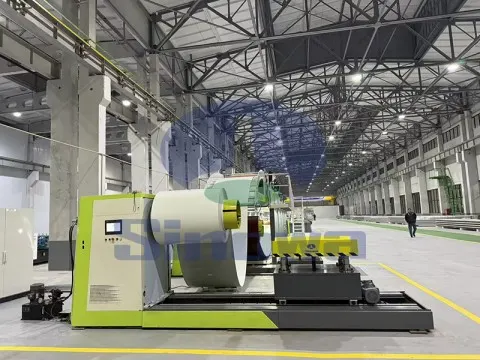
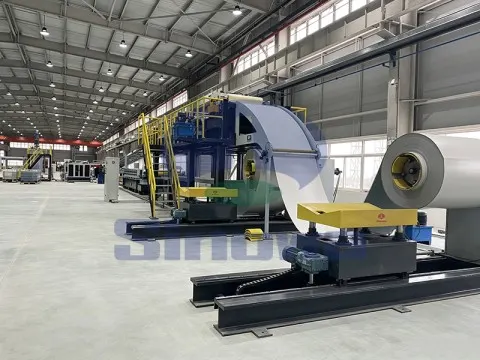
The overall structural design of a sandwich panel machine follows the principles of rational mechanical layout, stable operation, and convenient maintenance. The complete production line can be divided into multiple interconnected functional systems according to production links, and each system contains specialized mechanical components and auxiliary devices to complete specific production tasks. The raw material conveying system is the starting part of the entire production line, undertaking the transportation and preliminary arrangement of surface substrates and core materials. For metal surface sandwich panels, the raw material conveying system is equipped with unwinding devices to place coiled metal sheets. These unwinding structures adopt a stable rotating support design, which can slowly and evenly release metal coils under the drive of transmission motors, avoiding material deformation and wrinkling caused by uneven tension during feeding. Meanwhile, the system is equipped with tension adjustment components to dynamically control the feeding speed of raw materials, ensuring that the flatness of the surface substrate remains stable in the conveying process. For non-metal surface raw materials such as fiber cement boards and plastic plates, the conveying system uses roller conveyor sets with adjustable spacing to realize horizontal and stable transportation of plate-shaped raw materials, and the surface of the conveying rollers is treated with anti-slip and wear-resistant processes to prevent scratches on the surface of raw materials.
The core material processing and laying system is a key functional unit that determines the internal structure quality of sandwich panels. Common core materials in the market include rock wool, polyurethane foam, polystyrene foam, and other lightweight porous materials. Different core materials have different physical characteristics, so the internal structure of the processing system needs to be adaptively adjusted according to material attributes. For block-shaped rigid core materials, the system is equipped with material sorting and trimming devices to cut and arrange bulk core materials into regular specifications that match the surface plates, ensuring the neat splicing of core materials and avoiding hollow gaps inside the panels. For foamed core materials that need on-site foaming and molding, the system is equipped with raw material mixing and spraying components, which can accurately mix chemical raw materials according to a fixed ratio and evenly spray the foaming raw materials between the two surface layers. During the foaming process, the system controls the foaming speed and expansion range through temperature and pressure monitoring modules to ensure that the core material forms a uniform and dense porous structure. In addition, the laying system is designed with an anti-offset positioning structure, which can limit the lateral displacement of core materials during high-speed production, so that the core materials and surface layers maintain a precise overlapping state, laying a foundation for the overall structural uniformity of finished panels.
The gluing and composite pressing system is the core functional module to realize the bonding between surface layers and core materials, and its working performance directly affects the bonding strength and service life of sandwich panels. This system mainly includes glue spraying devices, glue layer homogenizing components, and high-pressure composite pressing structures. The glue spraying device adopts an intelligent quantitative gluing design, which can evenly coat the inner surface of the surface substrate with adhesive materials. Different from manual gluing methods, the automatic gluing structure can accurately control the glue application amount per unit area, avoiding quality problems such as insufficient bonding caused by too thin glue layers or material waste and glue overflow caused by too thick glue layers. After the completion of glue spraying, the glue layer homogenizing components such as scraping rollers will smooth the adhesive layer to ensure that the glue layer has no bubbles, wrinkles, and uneven thickness. Subsequently, the raw materials coated with adhesive and embedded with core materials will be sent to the pressing area. The pressing structure adopts a multi-group roller pressing or flat hydraulic pressing design. By applying stable and uniform mechanical pressure, the surface layers and core materials are closely fitted. During the pressing process, the pressure value can be adjusted according to the material hardness and panel thickness to prevent excessive pressure from crushing the porous core material or insufficient pressure from causing weak bonding between layers.
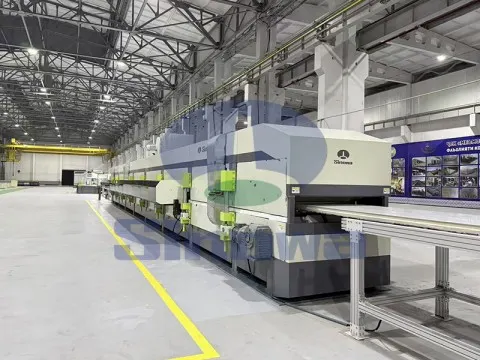
The heating and constant temperature curing system is an indispensable part to accelerate the curing of adhesives and enhance the structural stability of composite panels. Most adhesives used in sandwich panel production require a certain temperature environment to complete the chemical curing reaction. The curing system is composed of a sealed heat preservation bin, heating components, and temperature sensing and adjusting modules. The interior of the heat preservation bin is equipped with high-temperature resistant thermal insulation materials to reduce heat loss and improve energy utilization efficiency. The heating components adopt distributed heating layout, which can form a uniform temperature field inside the bin and avoid local overheating or low temperature. In the actual production process, the system can set different curing temperature ranges according to the characteristics of adhesives and core materials. For thermosetting adhesives, the temperature is controlled within a medium-temperature range to ensure that the adhesives undergo sufficient cross-linking reactions; for composite panels containing easily deformable foam materials, the curing temperature is appropriately reduced to prevent the core material from thermal deformation. The temperature sensing modules distributed in different positions inside the bin can monitor the real-time temperature data and feed it back to the control terminal. The system automatically adjusts the heating power to keep the internal temperature fluctuation within a tiny range, ensuring the consistency of the curing effect of each batch of panels.
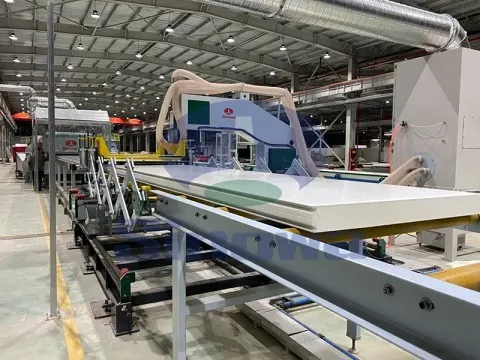
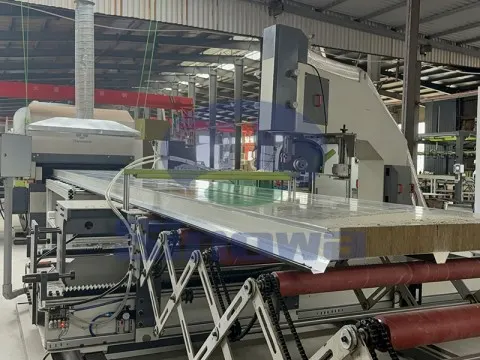
The fixed-length cutting and shaping system undertakes the finishing processing of semi-finished panels, realizing the dimensional standardization of finished products. After curing and molding, the continuous long-strip composite panels need to be cut into specified lengths according to market demand. This system is equipped with high-precision length measuring sensors and intelligent cutting execution components. Before cutting, the measuring sensors will record the conveying distance of the panels in real time. When the panels reach the preset length, the system automatically triggers the cutting mechanism. The cutting components adopt high-speed rotating alloy cutting blades or hydraulic shearing structures. For metal surface sandwich panels, the alloy blades with high hardness are used to ensure smooth cutting sections without burrs and metal curling; for non-metal composite panels, flexible shearing structures are adopted to avoid material cracking and edge damage. In addition to fixed-length cutting, this system also has edge trimming and grooving functions. The edge trimming device can polish the uneven edges of the panels to make the outline neat; the grooving structure can process assembly grooves on the edges of the panels according to usage requirements, facilitating the splicing and installation of subsequent engineering construction. All cutting and shaping actions are automatically completed by mechanical transmission, without manual marking and auxiliary cutting, which greatly improves the dimensional accuracy of finished panels.
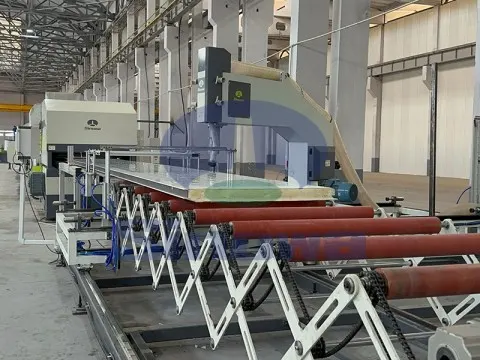
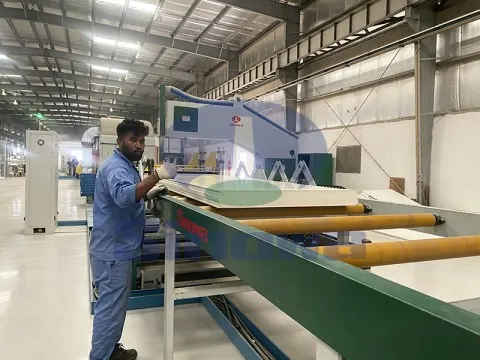
The finished product conveying and stacking system is the terminal link of the production line, responsible for the output, temporary storage, and neat stacking of finished sandwich panels. The system is composed of low-speed mute conveyor rollers, buffering transition platforms, and automatic stacking mechanical arms. The cured and cut finished panels are transported to the buffering transition platform through the conveyor rollers. The platform has a damping and anti-collision design to avoid surface scratches and structural damage caused by rigid collision of panels during transportation. The automatic stacking mechanical arm is equipped with flexible clamping components, which can stably grab single or multiple panels according to the panel specifications. The mechanical arm adjusts the stacking angle and position through the intelligent control program to arrange the panels neatly on the storage rack. Compared with manual stacking, the automatic stacking structure can maintain consistent stacking spacing and height, reduce the occupation of storage space, and effectively avoid safety risks such as panel dumping and worker collision in the manual stacking process. At the same time, the system is equipped with a counting module to automatically record the number of finished products, providing accurate data statistics for subsequent inventory management and sales distribution.
The intelligent control system is the brain of the entire sandwich panel production machine, coordinating the synchronous operation of all functional systems. Modern production machines generally adopt programmable logic controllers as the core control components, equipped with human-computer interaction touch screens and data transmission modules. Operators can complete parameter setting, equipment debugging, and production monitoring through the touch screen. The adjustable parameters include raw material feeding speed, glue application amount, pressing pressure, curing temperature, cutting length, and stacking quantity. The system has an automatic sensing and feedback function. Multiple sensors distributed in various links of the production line can monitor real-time data such as material tension, processing temperature, operating pressure, and conveying speed. Once abnormal data such as excessive temperature, material jamming, and pressure deviation are detected, the control system will immediately send an early warning signal and automatically trigger the emergency protection mechanism to suspend the operation of faulty components, preventing equipment damage and unqualified product production. In addition, the control system supports production data recording. It can store the daily output, parameter changes, and fault records of the equipment, providing data support for subsequent production optimization and equipment maintenance.
The complete production flow of a sandwich panel production machine presents a continuous streamlined operation mode, and all links are closely connected without redundant intermediate processes. At the initial stage of production, workers place coiled or plate-shaped raw materials on the feeding device of the conveying system. After the equipment is started, the raw materials are slowly and evenly transported to the processing station under the drive of the transmission motor. The surface substrate first passes through the surface pretreatment device to remove dust, oil stains, and oxide layers on the surface, improving the adhesion between the substrate and the adhesive. Then, the substrate enters the gluing area, and the automatic glue spraying device evenly coats the adhesive on the inner surface of the substrate. After the glue layer is smoothed, the core material is accurately laid between the two upper and lower surface layers through the core material laying system to complete the preliminary composite assembly of the panels.
The assembled semi-finished composite panels are sent to the pressing system. Under the action of constant pressure, the gaps between layers are eliminated to form a preliminary bonded whole. Subsequently, the panels are transported to the sealed curing bin. According to the preset temperature parameters, the panels complete the adhesive curing and structural stabilization process in a constant temperature environment. After curing, the panels with stable overall structure enter the cutting and shaping area. The system completes fixed-length cutting, edge trimming, and grooving according to the customized specifications. The processed finished panels are transported to the terminal stacking system, and the mechanical arms automatically complete stacking and sorting. The entire production process does not require manual intervention except for the initial raw material placement and regular equipment inspection. The continuous production mode greatly shortens the production cycle of a single panel and realizes the large-scale manufacturing of composite panels.
Sandwich panel production machines have outstanding technical characteristics in structural design, production performance, and energy consumption control, which distinguish them from traditional composite material processing equipment. In terms of structural stability, the main frame of the equipment is made of high-strength alloy steel through integral welding and aging treatment. This manufacturing process reduces the internal stress of the frame, enabling the equipment to maintain stable structural performance during long-term high-load operation and avoiding mechanical vibration and component deformation caused by long-time operation. The transmission parts of the equipment adopt sealed protective design, which can isolate dust, moisture, and corrosive substances in the production environment, reduce the wear degree of transmission gears and bearings, and extend the service life of mechanical components.
In terms of production flexibility, modern sandwich panel production machines have strong adaptability to raw materials and product specifications. By replacing simple auxiliary molds and adjusting operating parameters, the same production line can process sandwich panels with different core materials, different surface layer thicknesses, and different overall specifications. It can not only produce thin lightweight panels used for interior decoration but also manufacture thick high-strength panels suitable for industrial factory buildings. The adjustable processing range enables the equipment to meet the diversified procurement needs of different customers in the construction market. In terms of processing accuracy, the equipment adopts micron-level sensing and positioning components. The error of panel cutting length is controlled within a tiny range, and the uniformity of glue layer thickness and pressing pressure is strictly guaranteed. The high-precision processing capability ensures that the dimensional deviation and performance difference of each batch of finished panels are minimized, which is conducive to the standardized application of panels in large-scale engineering projects.
In terms of energy consumption and environmental protection performance, the optimized structural design of sandwich panel production machines effectively reduces energy waste. The heating curing system adopts circulating heat preservation technology to reduce heat loss, and the motor components adopt frequency conversion speed regulation technology. The operating power can be automatically adjusted according to the production load, avoiding excessive energy consumption caused by the continuous high-power operation of the motor. At the same time, the equipment is equipped with a waste recycling device, which can collect leftover materials generated by cutting and trimming. These recycled waste materials can be reprocessed and reused after crushing, reducing the waste rate of raw materials. In the gluing link, the closed glue spraying structure is adopted to prevent the volatile gas of adhesives from diffusing into the external environment, which not only optimizes the production working environment but also reduces the impact of production activities on the surrounding ecological environment.
The daily operation and maintenance management of sandwich panel production machines is an important measure to ensure long-term stable operation of equipment and prolong service life. In terms of standardized operation, operators need to receive professional pre-job training to be familiar with the functional attributes of each system and the setting method of operating parameters. Before the equipment is started every day, it is necessary to conduct a comprehensive inspection of key components, including checking whether the transmission parts are short of lubricating oil, whether the sensing sensors are sensitive, whether the heating pipeline is blocked, and whether the cutting blades are worn. After confirming that there is no abnormal condition, the equipment can be started for idle running test. The formal production can be carried out after the equipment runs smoothly for a period of time.
During the formal production process, operators need to monitor the operating state of the equipment in real time through the control terminal. They should pay attention to whether there are abnormal vibration, noise, and temperature rise of the equipment. Once material jamming, glue leakage, and parameter deviation are found, the production should be suspended in time for troubleshooting. It is forbidden to disassemble and adjust the operating components in the running state to avoid mechanical safety accidents. After the daily production work is completed, the staff need to cut off the power supply of the equipment and clean the residual dust, adhesive residues, and raw material debris on the surface of each component. The cutting blades and pressing rollers should be specially cleaned and maintained to avoid residual adhesive from solidifying and affecting the processing accuracy of subsequent production.
In terms of regular maintenance, the equipment needs to be comprehensively maintained every fixed production cycle. The maintenance content includes replacing aging sealing parts, supplementing lubricating oil for transmission bearings, calibrating sensing sensors, overhauling heating components, and testing emergency protection devices. For components with high wear degree such as cutting blades and conveying rollers, regular wear detection is required, and severely worn parts should be replaced in a timely manner to avoid affecting product quality. In addition, the control system needs regular data sorting and program debugging to clear redundant data and optimize the operation logic of the control program, ensuring that the intelligent response speed of the system remains efficient and stable. Scientific and standardized maintenance management can not only reduce the failure rate of equipment and avoid production interruption losses caused by faults but also effectively extend the service life of the production line and reduce the long-term operation cost of the enterprise.
Sandwich panel production machines are widely used in multiple industrial and construction fields, covering civil buildings, industrial engineering, special facility construction, and other scenarios. In the field of industrial factory buildings, a large number of metal surface rock wool sandwich panels are used for the enclosure structures of factory buildings. These panels have excellent fire resistance and thermal insulation performance. The production machines can efficiently manufacture large-area and high-strength factory building panels to meet the construction needs of large-span industrial plants. In the cold storage and fresh-keeping warehouse industry, polyurethane sandwich panels with low thermal conductivity are the main building materials. The production equipment can adjust the foaming density of the core material according to the low-temperature operation requirements of cold storage, produce panels with ultra-low thermal conductivity, and reduce the energy consumption of cold storage temperature control.
In the field of temporary construction facilities such as mobile construction dormitories and emergency rescue houses, lightweight and easy-to-install polystyrene sandwich panels are widely used. The production machine has flexible parameter adjustment functions, which can rapidly produce lightweight thin plates suitable for temporary buildings. The neat splicing structure of the panels simplifies the on-site installation process and shortens the construction cycle of temporary facilities. In the interior decoration and partition engineering of civil buildings, non-metal sandwich panels with sound insulation and decoration functions are adopted. The production equipment can process decorative patterns on the panel surface through auxiliary grooving and embossing structures, improving the aesthetic performance of the panels while ensuring the sound insulation effect. In addition, in special scenarios such as pharmaceutical workshops and dust-free purification workshops, the production machine can produce antibacterial and dust-proof composite panels by adjusting the formula of raw materials, meeting the high environmental cleanliness requirements of special production workshops.
From the perspective of industrial economic value, the popularization and application of sandwich panel production machines have optimized the production mode of the composite building material industry. The traditional manual and semi-automatic production mode has problems such as high labor cost, low output, and unstable product quality. The fully automated production line reduces the number of on-site operators, lowers the labor input cost of enterprises, and realizes continuous production without interruption. The standardized production process reduces the rate of defective products, improves the utilization rate of raw materials, and effectively controls the production cost of a single panel. For downstream construction enterprises, standardized sandwich panels reduce the difficulty of on-site construction, shorten the engineering construction cycle, and indirectly reduce the overall construction cost of projects. The mutual benefit and win-win situation between upstream production enterprises and downstream application enterprises promotes the healthy and sustainable development of the entire composite building material industry chain.
Looking at the future development trend, sandwich panel production machines will evolve in the directions of higher intelligence, greener environmental protection, and broader processing adaptability. In terms of intelligent upgrading, the equipment will be integrated with internet of things technology and big data analysis technology. The control system can realize remote real-time monitoring, fault intelligent diagnosis, and production data cloud storage. Managers can master the operating state of the equipment and production progress through mobile terminals, realizing remote intelligent management of the production line. The equipment will also introduce automatic mold replacement and intelligent parameter matching functions. After inputting the panel specification requirements, the system can automatically match the optimal operating parameters and complete mold adjustment, further reducing the difficulty of equipment operation.
In terms of green environmental protection optimization, future production machines will further reduce energy consumption and pollutant emissions. The heating system will adopt more efficient heating materials to improve thermal energy utilization efficiency, and the motor transmission structure will be further optimized to reduce mechanical friction energy consumption. The waste recycling system will be upgraded to realize the full recycling of cutting leftovers and waste gas generated in the production process. The adhesive spraying link will adopt more environmentally friendly water-based adhesive coating technology to completely eliminate the pollution risk of volatile harmful gases. In terms of processing adaptability, the equipment will break through the limitation of single composite structure. It can process multi-layer composite panels with more complex structures, and realize the integrated production of functional panels with fire resistance, sound insulation, antibacterial, and anti-corrosion properties to meet the increasingly diversified high-end market demand.
In conclusion, sandwich panel production machines are essential core equipment in the modern composite building material manufacturing industry. With scientific and reasonable structural composition, perfect production flow, and excellent processing performance, they provide reliable technical support for the mass production of high-quality sandwich panels. From raw material conveying to finished product stacking, each functional system of the equipment cooperates efficiently to realize automatic, standardized, and intelligent production. At present, this kind of equipment has been widely used in various construction fields, bringing significant economic benefits to production enterprises and application industries. With the continuous progress of mechanical manufacturing technology and intelligent control technology, sandwich panel production machines will continue to complete technological iteration and performance upgrading. In the future, they will develop towards higher efficiency, lower energy consumption, and stronger adaptability, continuously promote the innovative development of the composite building material industry, and make greater contributions to the high-quality development of the global construction industry.
Sinowa is a professional manufacturer of sandwich panel machine in china, we provide diversified and high-performance sandwich panel production lines, including fully automatic continuous PU sandwich panel line and customized special lines to meet mass production and personalized order demands. These sandwich panel lines support processing multiple foam core materials, such as PU, PIR, mineral wool, rock wool and glass wool, covering different insulation and fireproof standards.
Featuring stable operation, high efficiency, energy saving and easy maintenance, our PU sandwich panel line deliver sandwich panels with excellent thermal insulation, fire resistance, sound insulation and lightweight durability. The finished panels are widely applied in industrial workshops, warehouse roofing and wall cladding, cold storage insulation, serving global construction and industrial insulation markets.
https://www.cnsinowa.com/sandwich-panel-machines/sandwich-panel-production-machine.html