 sandwich panel machine
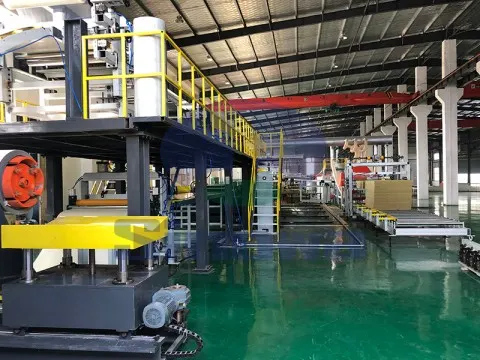
The evolution of building envelope requirements has reshaped the landscape of construction material manufacturing, pushing the boundaries of what traditional production equipment can achieve. Modern buildings, whether commercial high-rises, industrial warehouses, residential complexes, or public infrastructure, demand envelope systems that deliver multifunctional performance: they must withstand extreme weather conditions, minimize energy loss for heating and cooling, block external noise pollution, and provide unparalleled fire protection to safeguard occupants and assets. Rockwool sandwich panels, composed of a dense rockwool core sandwiched between rigid outer facing sheets, excel in meeting these demands, making them a preferred material for architects, engineers, and construction professionals worldwide. The production machine responsible for creating these panels is not merely a set of standalone tools but a fully synchronized, continuous production line that orchestrates every stage of the manufacturing process, from raw material handling to final product finishing, ensuring seamless operation and uncompromising quality control.
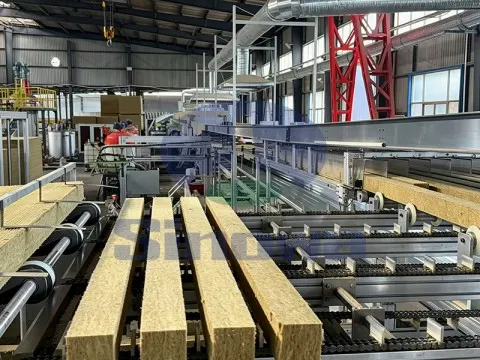
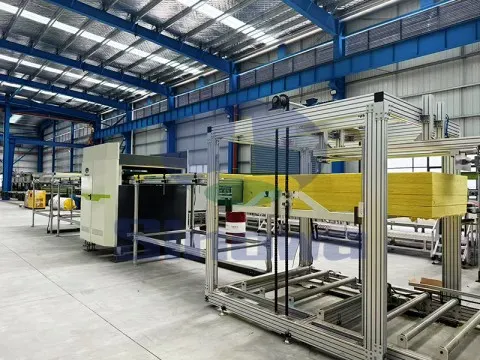
A comprehensive rockwool sandwich panel production machine is engineered with a modular, integrated design, encompassing several interconnected core systems that work in tandem to deliver efficient and reliable output. The first critical component is the raw material handling and preparation system, which manages the intake, storage, and pretreatment of key raw materials, including rockwool core boards and metal facing coils. This system is designed to ensure the uniform quality of input materials, with mechanisms to unroll, level, and clean metal facing sheets, as well as to cut, position, and align rockwool core materials to precise dimensions. Proper pretreatment of raw materials is foundational to the integrity of the final sandwich panel, as it eliminates surface impurities, ensures consistent material density, and lays the groundwork for strong, durable bonding between the core and outer layers.
Following raw material preparation, the production process advances to the forming and profiling stage, where the metal facing sheets are shaped into the desired profile through precision roll forming technology. This segment of the machine features a series of calibrated roll stations that gradually bend and form flat metal coils into standardized or custom profiles, ranging from flat sheets for wall envelopes to corrugated designs for roofing applications. The roll forming system operates with high precision, maintaining tight tolerances to ensure a perfect fit between the upper and lower facing sheets, as well as consistent panel dimensions across the entire production run. This level of accuracy is essential for seamless on-site installation, as it eliminates gaps, reduces material waste, and enhances the overall structural integrity of the building envelope.
The next and most vital phase of production is the bonding and lamination process, where the rockwool core is securely bonded to the profiled metal facing sheets to create the sandwich structure. This stage relies on a precision adhesive application system that evenly distributes specialized bonding agents across the inner surfaces of the metal facings, ensuring full coverage without excess runoff or uneven coating. The rockwool core, precisely positioned by automated handling mechanisms, is then sandwiched between the two facing layers, and the composite assembly passes through a controlled pressure and temperature curing zone. This curing process activates the adhesive, creating a permanent, high-strength bond that unifies the three layers into a single, rigid panel. The machine’s ability to maintain consistent pressure and temperature throughout this stage is critical, as it directly impacts the panel’s structural strength, thermal performance, and long-term durability; variations in these parameters can compromise bonding integrity, leading to delamination or reduced performance over time.
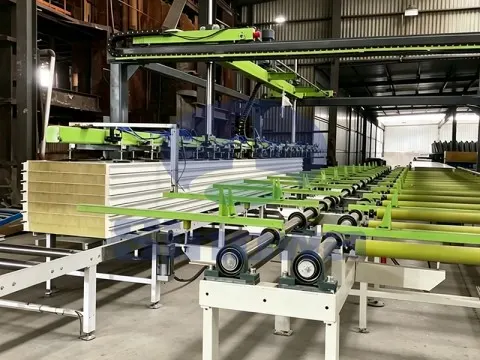
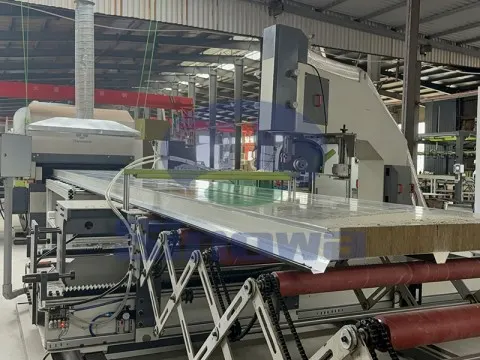
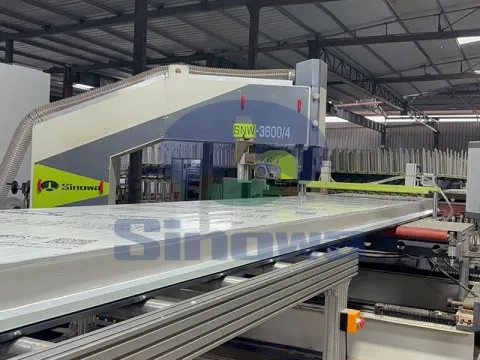
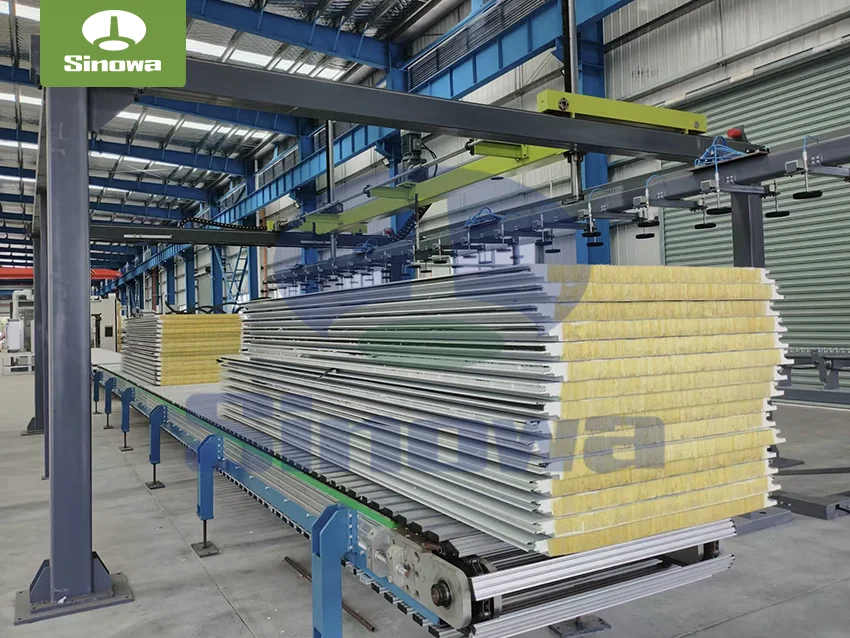
After the lamination and curing process, the continuous panel strip moves to the precision cutting and sizing system, a highly automated component that trims the continuous panel to custom lengths and widths based on project-specific requirements. Equipped with advanced cutting mechanisms and digital control systems, this part of the machine ensures clean, burr-free cuts with minimal material loss, adhering to strict dimensional specifications. The cutting system operates in sync with the production line’s speed, enabling non-stop, continuous production without interruptions, which significantly boosts overall manufacturing efficiency. Once cut to size, the finished panels are transferred to a stacking and handling system, which gently arranges the panels for storage, packaging, or direct shipment to construction sites, preventing surface damage and ensuring the panels remain in pristine condition until installation.
A defining feature of modern rockwool sandwich panel production machines is their advanced automated control system, which serves as the central nervous system of the entire production line. This integrated control framework monitors and regulates every operational parameter in real time, including line speed, adhesive flow rate, curing temperature and pressure, roll forming tension, and cutting dimensions. Operators can easily adjust settings via intuitive control interfaces to accommodate different panel thicknesses, facing materials, core densities, and profile designs, making the machine highly adaptable to diverse production needs. The automated system also enhances operational safety by reducing manual intervention, minimizing the risk of human error, and enabling remote monitoring and troubleshooting. Additionally, it optimizes resource consumption, regulating energy usage and adhesive application to reduce waste, lower operational costs, and align with sustainable manufacturing practices.
The technical advantages of this specialized production machine extend far beyond automation and precision, directly translating to superior quality and performance in the final rockwool sandwich panels. By standardizing the production process, the machine eliminates inconsistencies that are common in manual or semi-automated manufacturing, ensuring every panel meets uniform quality benchmarks for density, bonding strength, thermal conductivity, and fire resistance. The continuous, streamlined production flow also drastically increases output capacity, allowing manufacturers to meet large-scale project demands within tight deadlines without sacrificing quality. Furthermore, the machine’s robust construction and durable components ensure long service life, with minimal maintenance requirements, making it a cost-effective and reliable asset for building material producers.
The impact of high-quality rockwool sandwich panels produced by this advanced machinery on building envelope performance cannot be overstated. Rockwool, as a core material, is inherently non-combustible, providing exceptional fire resistance that meets stringent building safety codes; it effectively slows the spread of flames and limits smoke emission, a critical factor in protecting building occupants during fire emergencies. In terms of thermal insulation, the dense fibrous structure of rockwool traps air pockets, reducing heat transfer through the building envelope and significantly lowering energy consumption for heating and cooling systems. This thermal efficiency not only reduces utility costs for building owners but also aligns with global efforts to reduce carbon emissions and combat climate change. Additionally, the fibrous composition of the rockwool core delivers excellent sound absorption, minimizing airborne noise transmission between interior spaces or from external sources, creating quieter, more comfortable indoor environments for residential, commercial, and industrial applications.
Beyond performance benefits, rockwool sandwich panels manufactured with this production machine offer unparalleled versatility in building envelope design and application. They are suitable for a wide range of construction projects, from low-rise residential buildings and mid-rise commercial structures to large industrial facilities, cold storage warehouses, and agricultural buildings. The panels are lightweight yet structurally robust, reducing the overall load on the building’s foundation and supporting structures, which simplifies construction and reduces material costs. Their easy installation process speeds up project timelines, as the panels can be quickly mounted and secured, requiring fewer labor hours compared to traditional building envelope materials. Moreover, the outer facing sheets can be customized with various finishes, colors, and textures, allowing architects to achieve aesthetically pleasing designs without compromising on functional performance, blending practicality with visual appeal in modern construction.
As the global construction industry continues to prioritize sustainability, energy efficiency, and building resilience, the role of the rockwool sandwich panel production machine becomes increasingly central. Governments and regulatory bodies worldwide are implementing stricter standards for building energy performance and fire safety, driving greater demand for high-quality rockwool sandwich panels and the advanced machinery used to produce them. Manufacturers that invest in this state-of-the-art production equipment gain a competitive edge in the market, as they can deliver premium, compliant building envelope materials that meet evolving industry demands. Additionally, ongoing advancements in mechanical engineering, automation technology, and material science are continuously enhancing the capabilities of these production machines, with innovations focused on further improving efficiency, reducing environmental impact, and expanding the range of panel designs and specifications available.
Sustainability is also a key focus in the development and operation of rockwool sandwich panel production machines. Modern systems are designed to minimize waste generation, with precision cutting and material handling processes reducing scrap material to a minimum; any residual waste can often be recycled or repurposed, aligning with circular economy principles. The machine’s energy-efficient design lowers power consumption during operation, reducing the carbon footprint of the manufacturing process. Furthermore, the rockwool sandwich panels themselves are environmentally friendly, as rockwool is made from natural volcanic rock and recycled mineral materials, and the panels are fully recyclable at the end of their service life. This cradle-to-cradle sustainability makes both the production machine and the final product aligned with the global shift toward green construction practices.
In conclusion, the rockwool sandwich panel production machine is an indispensable cornerstone of the modern building envelope manufacturing sector, bridging technological innovation and practical construction needs to deliver high-performance, sustainable building materials. Its integrated, automated design streamlines production, ensures consistent quality, and enhances operational efficiency, while the panels it produces offer unmatched fire resistance, thermal insulation, sound absorption, and structural versatility. As the construction industry continues to evolve, with a growing emphasis on safety, energy efficiency, and environmental responsibility, this advanced production machinery will remain a key driver of progress, enabling the widespread adoption of high-quality rockwool sandwich panels that redefine the standards for building envelope performance. For manufacturers, architects, and construction professionals alike, investing in and utilizing this cutting-edge production equipment is not only a strategic business decision but also a commitment to building safer, more efficient, and more sustainable infrastructure for the future.
Looking ahead, further advancements in automation, artificial intelligence, and smart manufacturing will continue to refine rockwool sandwich panel production machines, introducing even greater levels of precision, adaptability, and sustainability. Real-time data analytics will enable predictive maintenance, minimizing downtime and optimizing production flow, while customizable production settings will cater to increasingly specialized building envelope requirements. As urbanization accelerates and the need for resilient, energy-efficient buildings grows, the demand for these advanced production systems will only intensify, solidifying their position as a vital component of the global construction supply chain. Ultimately, the rockwool sandwich panel production machine stands as a testament to the power of engineering innovation in shaping the future of construction, delivering materials that not only meet current industry needs but also pave the way for a more sustainable and resilient built environment.
Sinowa is a professional manufacturer of sandwich panel machine in china, we provide diversified and high-performance sandwich panel production lines, including fully automatic continuous PU sandwich panel line and customized special lines to meet mass production and personalized order demands. These sandwich panel lines support processing multiple foam core materials, such as PU, PIR, mineral wool, rock wool and glass wool, covering different insulation and fireproof standards.
Featuring stable operation, high efficiency, energy saving and easy maintenance, our PU sandwich panel line deliver sandwich panels with excellent thermal insulation, fire resistance, sound insulation and lightweight durability. The finished panels are widely applied in industrial workshops, warehouse roofing and wall cladding, cold storage insulation, serving global construction and industrial insulation markets.
https://www.cnsinowa.com/sandwich-panel-machines/rockwool-sandwich-panel-production-machine-for-building-envelope.html