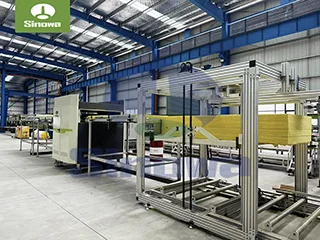
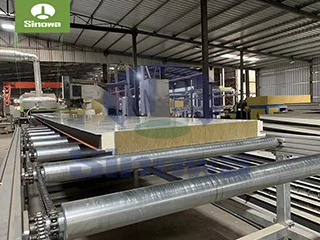
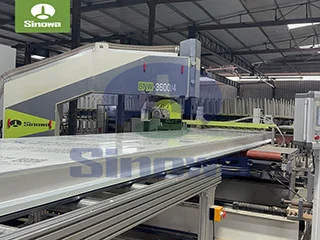
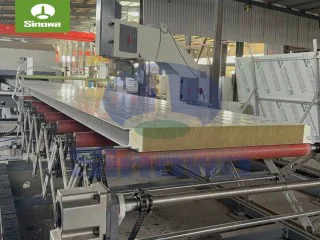
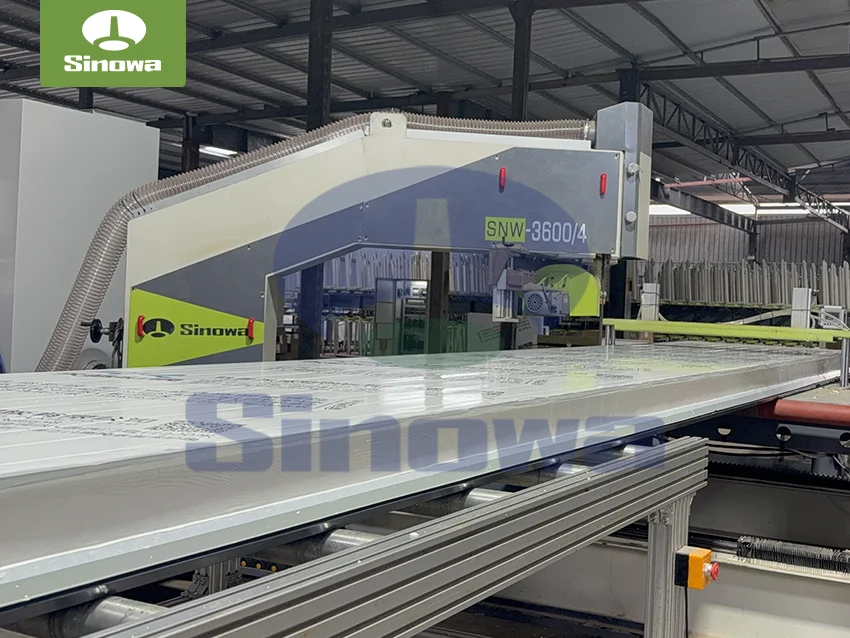
 sandwich panel line
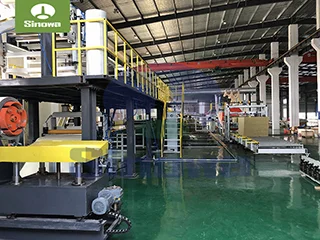
The overall design of the rock wool sandwich panel production line adheres to the concept of integrated automation and modular combination, which effectively breaks the limitations of traditional manual and semi-automatic panel manufacturing modes. Different from simple manual assembly equipment, this production line connects raw material pretreatment, core material molding, surface material processing, composite bonding, fixed-size cutting and post-processing stacking into an uninterrupted production chain. The entire production process relies on mechanical transmission and intelligent linkage control to minimize manual intervention, which not only optimizes production continuity but also ensures the uniformity and consistency of finished panel quality. In the actual industrial production scenario, the production line can adapt to different production batches, realizing flexible switching between small-batch customized production and large-batch standardized mass production, thus meeting the diversified material demands of different construction engineering scenarios.
The basic structural composition of the rock wool sandwich panel line can be divided into multiple functional modules with independent responsibilities and mutual coordination, covering raw material feeding mechanism, surface material processing unit, rock wool core material shaping system, glue coating composite mechanism, constant temperature curing system, fixed-size cutting unit and finished product sorting and stacking device. Each module has precise mechanical parameters and operating logic to form a closed-loop production system. The raw material feeding part is responsible for the orderly release of metal surface plates and rock wool raw materials. The metal surface plates are usually coiled materials, and the feeding mechanism is equipped with an automatic unwinding and leveling structure to eliminate the bending stress of metal coils and ensure the flatness of subsequent composite surfaces. The rock wool raw material feeding device adopts a sealed conveying structure to avoid the scattering of rock wool fibers during transportation, which maintains a clean production environment and ensures the stable transportation of bulk rock wool raw materials.
The surface material processing unit is a key link to optimize the appearance and service performance of the sandwich panel. After the metal coil is unwound and leveled, it will enter the rolling and embossing mechanism. Through the extrusion of precision profiling rollers, the surface of the metal plate forms regular and stable groove structures. These structural grooves can effectively enhance the mechanical bite force between the metal surface layer and the rock wool core material, avoiding the delamination phenomenon caused by insufficient bonding strength in the later use of the panel. Meanwhile, the surface processing unit is equipped with a surface cleaning structure, which removes dust, oil stains and oxide attachments on the surface of the metal plate through physical wiping and air drying treatment. A clean and smooth bonding surface can significantly improve the adhesion effect of the adhesive, laying a solid foundation for the long-term structural stability of the composite panel. All rolling parameters and cleaning procedures in this unit are mechanically locked, which can maintain consistent processing accuracy for a long time.
As the functional core of the finished panel, the molding quality of rock wool core material directly determines the thermal insulation and fire resistance performance of the product. The rock wool core material shaping system in the production line adopts optimized fiber arrangement and compression molding technology. The loose rock wool raw materials are transported to the pendulum cotton distribution mechanism, which evenly spreads the rock wool fibers in a layered manner. Different from the traditional single-layer settlement paving method, the pendulum laying process makes the rock wool fibers form a three-dimensional cross-distributed structure. This structural arrangement effectively improves the overall compression resistance and tensile strength of the rock wool layer, and avoids the performance difference in different directions caused by single-layer fiber orientation. After paving, the rock wool layer will pass through the graded compression roller group. By adjusting the gap between the rollers, the rock wool is compressed to a fixed thickness and uniform density, eliminating internal voids and ensuring the consistent thermal insulation performance of each section of the core material.
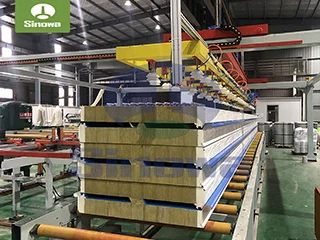
The glue coating and composite mechanism is the central connection part of the entire sandwich panel production line, undertaking the important task of bonding the metal surface layer and the rock wool core material. The production line uses high-efficiency polymer adhesives suitable for building composite materials. The automatic glue spraying device can quantitatively and evenly coat the adhesive on the inner surface of the metal plate. The glue spraying amount is controlled by mechanical calibration to avoid excessive glue overflow or insufficient glue coating. After the glue coating is completed, the upper and lower metal plates and the middle rock wool core material are accurately aligned and sent to the composite pressing area. The composite pressing mechanism adopts multi-group synchronous pressure rollers, which apply uniform static pressure to the composite board. Under stable pressure, the adhesive fully infiltrates the tiny gaps between the metal plate and rock wool fibers to form a tight composite structure. The whole composite process maintains a constant transmission speed to prevent dislocation and wrinkling of the plate caused by uneven transmission speed.
The constant temperature curing system is an indispensable post-composite processing link, which aims to accelerate the curing reaction of the adhesive and enhance the interlayer bonding firmness of the sandwich panel. The curing furnace of the production line adopts a closed thermal insulation structure, and the internal temperature presents a gradient distribution state. The low-temperature area at the inlet gently heats the composite plate to activate the molecular activity of the adhesive, while the middle constant temperature area maintains the optimal curing temperature to promote the cross-linking reaction of the adhesive components. The tail cooling area slowly reduces the plate temperature to balance the internal stress generated by thermal extrusion. Compared with natural curing, the intelligent constant temperature curing mode shortens the curing cycle, and the gradient temperature control avoids the quality defects such as adhesive embrittlement and plate deformation caused by excessive local temperature. After curing, the integration degree between the surface layer and the core material of the panel is significantly improved, and the structural stability can adapt to complex outdoor temperature changes.
The fixed-size cutting unit realizes the standardized shaping of finished panels, which is the key to realize the unified specification of industrial products. This unit is equipped with high-speed precision cutting saws, which are divided into longitudinal cutting and transverse cutting structures. Longitudinal cutting is responsible for trimming the edges of the continuously transmitted composite plate to remove the uneven parts on both sides and ensure the consistent width of the plate. Transverse cutting completes the fixed-length cutting according to the preset dimensional parameters. The cutting action is synchronized with the plate transmission speed to realize dynamic cutting without stopping. The cutting blade is made of wear-resistant special materials, which can keep the cutting section flat and smooth for a long time without burrs and cracks. Meanwhile, the cutting unit is equipped with a waste recovery and diversion structure, which collects the trimmed edge materials in a centralized manner to facilitate subsequent recycling and realize resource utilization.
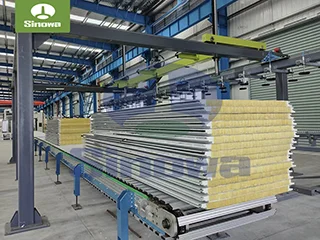
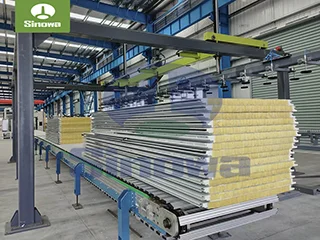
The last link of the sandwich panel line is the finished product sorting and stacking device. The cut panels are transported to the sorting platform through the conveyor belt. The mechanical sensing structure identifies the qualified state of the panels, and automatically screens out individual products with surface defects and dimensional deviations. The qualified finished panels are stacked neatly by the mechanical stacking arm according to the fixed stacking sequence. The stacking mechanism has adjustable stroke and pressure protection functions to avoid surface indentation and plate damage caused by excessive extrusion during stacking. The stacked finished products are compact in structure and convenient for later transportation and storage. The whole stacking process is automated without manual carrying, which reduces the labor cost and also avoids the surface pollution and scratch problems caused by manual contact.
Compared with the traditional intermittent production equipment for rock wool foam sandwich panels, the modern integrated production line has prominent technological advantages in production efficiency, product performance and operation stability. In terms of production efficiency, the continuous assembly line operation mode eliminates the waiting time between different processing procedures. All functional modules are linked synchronously, and the single-line continuous operation capacity is far higher than that of semi-automatic equipment. In terms of product performance control, the production line adopts mechanical unified calibration in all links from raw material compression to glue coating thickness and cutting size. The error range of key parameters such as plate thickness and density is controlled within a tiny range, which effectively solves the problem of uneven product quality in manual production. In terms of operation stability, the transmission system of the production line adopts synchronous servo control, which can maintain stable operating speed under long-term load operation, reduce equipment vibration and mechanical failure rate, and extend the continuous working cycle of the equipment.
In the actual production operation, the sandwich panel manufacturing line is equipped with a perfect process monitoring and adjustment system to realize refined production management. The internal sensing components of each functional module can real-time collect operating data such as transmission speed, pressing pressure, curing temperature and glue spraying flow. The data is transmitted to the centralized control terminal to form a visual production data interface. When abnormal parameters such as excessive temperature and uneven feeding occur, the system will automatically trigger the early warning mechanism and carry out micro-adjustment of operating parameters. In addition, the production line has a humanized parameter setting function. Production personnel can adjust the compression density of rock wool, plate thickness, cutting length and other parameters according to the usage scenarios of finished products, so as to produce sandwich panels with different thermal insulation strength and structural hardness to meet the material needs of industrial plants, public buildings, cold storage and other different places.
From the perspective of industrial application value, the rock wool foam sandwich panel production line promotes the standardized and large-scale development of the building thermal insulation material industry. The finished panels produced by the line have excellent physical properties. The rock wool core material has excellent fire resistance and sound absorption performance, which can effectively block heat conduction and reduce noise transmission. The metal surface layer has good compression resistance and corrosion resistance, adapting to harsh outdoor weather conditions. The composite structure formed by efficient bonding has strong wind resistance and structural stability, which can maintain stable performance in long-term use. These advantages make the panels widely used in building enclosure structures, interior partition walls, thermal insulation roofs and other parts. Driven by the production line, the production cost of high-performance sandwich panels is effectively controlled, making energy-saving and fire-resistant building materials popularized in more construction projects.
With the continuous improvement of industrial environmental protection standards and building energy-saving requirements, the upgrading and optimization of rock wool foam sandwich panel production lines have become an inevitable development trend. The future equipment optimization direction will focus on energy conservation, emission reduction and intelligent upgrading. In terms of energy saving, the curing furnace will adopt more efficient heat circulation technology to reduce heat loss and lower equipment energy consumption. In terms of environmental protection, the production line will further optimize the fiber sealing structure to completely avoid the diffusion of rock wool fibers and reduce industrial dust pollution. In terms of intelligence, the equipment will realize automatic identification of raw material quality and self-adaptive adjustment of process parameters, and complete unmanned operation of the whole production process through intelligent linkage. In addition, the production line will expand the compatibility of raw materials, realizing the composite production of diversified core materials and surface materials, and enriching the product application types.
In conclusion, the rock wool sandwich panel machine is a highly integrated and intelligent industrial production system, which integrates mechanical transmission, physical molding, chemical bonding and intelligent control technologies. Through the orderly cooperation of multiple functional modules, it completes the whole process from raw material processing to finished product output. The production line not only improves the production efficiency and product quality of rock wool foam sandwich panels, but also reduces manual dependence and production comprehensive consumption. With the continuous development of the construction industry towards energy saving, environmental protection and industrialization, this type of production line will continuously iterate and upgrade in technology and structure, providing more reliable, efficient and environmentally friendly production solutions for the building composite material industry, and making important contributions to the optimization of modern building energy-saving systems and the improvement of building safety performance.
https://www.cnsinowa.com/sandwich-panel-machines/rock-wool-foam-sandwich-panel-production-line.html