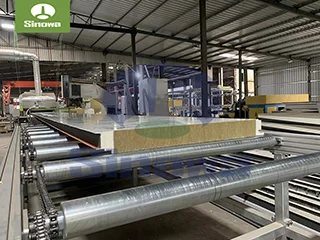
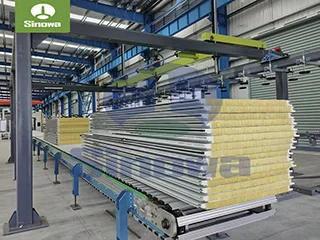
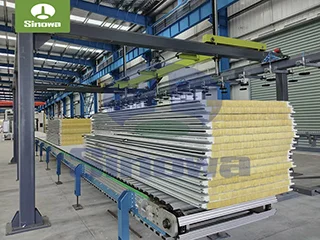
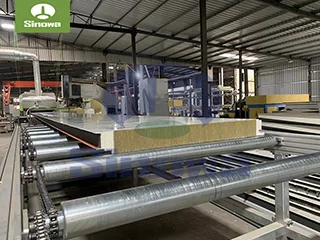
sandwich panel line
The Rockwool Insulation Board Production Line mainly consists of a feeding system, a melting system, a fiber making system, a forming system, a curing system, a cutting system, and an environmental protection treatment system. These systems work together to complete the entire process from raw material input to finished product output.
Production Process Flow
Raw material preparation: Crush natural rocks such as basalt into small pieces and mix them with a certain proportion of auxiliary materials such as coke to ensure the stability and uniformity of the raw materials.
High temperature melting: Put the mixed raw materials into a furnace and melt them into magma at a high temperature of 1400-1600 degrees Celsius. This step is a crucial step in the production of rock wool, requiring strict control of melting temperature and time.
Centrifugal fiber making: Molten magma is stretched into fibers by high-speed centrifugal force or high-pressure airflow through a centrifuge or blowing device. The diameter and length of fibers have a significant impact on the thermal insulation performance of rock wool.
Molding and solidification: The fibers are formed into cotton felt through equipment such as cotton collectors and pendulum cotton machines, and then additives such as binders are applied and solidified in a curing oven. This step determines the shape and size of the rock wool product.
Cutting and packaging: According to customer needs, the solidified rock wool products are cut into different sizes and packaged. The cutting process needs to ensure the accuracy of the product and the flatness of the edges.
FEATURES
Vertical wire technology: By using a vertical wire pendulum to swing the cotton cloth machine back and forth above the inclined conveying mechanism, combined with a gourd roller folding mechanism to form an up and down staggered pressing, some rock wool fibers are arranged vertically.
This technology significantly improves the compressive strength of the product.
Intelligent control: Integrating pressure sensors and visual monitoring devices to build a closed-loop control system, achieving high-precision detection of melt weight and rapid adjustment of production line speed. This technology has improved the automation level and production efficiency of the production line.
Environmental protection and energy conservation: The exhaust gas treatment system adopts a combination process of cyclone dust removal and activated carbon adsorption, and the dust emission concentration is controlled at a low level. At the same time, the waste recycling device can crush the cut scraps and mix them back into the production line, achieving the recycling of resources.
Rock wool insulation material has excellent properties such as fire prevention, insulation, thermal insulation, and sound absorption, and is widely used in fields such as building energy conservation, industrial insulation, shipbuilding, and agricultural soilless cultivation. In terms of building energy efficiency, rock wool is used as an important material for exterior wall insulation systems, roof insulation systems, etc; In terms of industrial insulation, rock wool can be used for insulation of large equipment and pipelines; In the shipbuilding industry, rock wool is used as insulation material for ship cabins; In agriculture, rock wool is used as a substrate material for soilless cultivation.
The Rockwool Insulation Board Production Line is an efficient, energy-saving, and environmentally friendly industrial production system, and its products have broad application prospects in multiple fields.
Rockwool insulation board production line is a set of continuous and integrated equipment designed to convert natural mineral raw materials into high-performance insulation boards with excellent thermal, acoustic and fire-resistant properties. This production line operates through a series of precise and coordinated processes, each of which plays a crucial role in determining the final quality and performance of the rockwool insulation boards. Unlike other insulation material production systems, the rockwool production line is characterized by its high degree of automation, stable production efficiency, and ability to adapt to different raw material compositions, making it widely used in various industrial and construction fields. To fully understand the value and application potential of rockwool insulation boards, it is essential to explore the structure of their production line, the performance characteristics of the finished products, the different types available, and their diverse applications across multiple industries.
The structure of a rockwool insulation board production line is a complex but well-organized system, consisting of several core functional sections that work together seamlessly to complete the entire production process from raw material processing to finished product packaging. The first section is the raw material handling and feeding system, which is responsible for storing, crushing, and mixing the raw materials. The main raw materials used in rockwool production are natural minerals such as basalt, dolomite, and diabase, which are rich in silicon, aluminum, and calcium oxides. These raw materials are transported to the production site by closed conveyors and stored in indoor silos to avoid moisture absorption and contamination. Before entering the melting furnace, the raw materials are crushed into small particles of uniform size and mixed in a specific proportion to ensure the stability of the melting process and the quality of the final fibers. The feeding system is equipped with precise weighing devices to control the amount of raw materials entering the furnace, ensuring consistent production parameters and reducing material waste.
The melting section is the core part of the rockwool insulation board production line, where the mixed raw materials are melted at extremely high temperatures to form a homogeneous molten mass. The melting furnace is typically a cupola or a gas pool furnace, both of which are designed to withstand high temperatures and ensure efficient melting. The cupola is equipped with a cooling water circulation system to prevent overheating and ensure operational safety, as well as a hot air system that preheats the furnace to improve energy efficiency. It adopts a single-row, multi-air eye structure with an air volume control valve for easy operation and temperature regulation. The pool furnace, on the other hand, is built with high-quality refractory materials, and natural gas is sprayed into the pool to heat the raw materials to the melting point. The melting temperature usually reaches above 1450℃, which is sufficient to convert the solid minerals into a molten lava-like substance. During the melting process, impurities in the raw materials are separated and removed, ensuring the purity of the molten mass and the subsequent quality of the fibers.
Following the melting section is the fiberization system, which converts the molten mass into fine, flexible fibers—the key component of rockwool insulation boards. The main equipment in this section is a four-roller centrifuge, which is the core device for producing rockwool fibers. The molten mass flows from the melting furnace into the centrifuge, where it is subjected to high-speed rotation. Under the action of centrifugal force, the molten mass is thrown out through small holes on the centrifuge rollers, forming thin fibers. At the same time, a high-pressure air stream is blown into the fiberization chamber to stretch and cool the fibers, making them more slender and flexible. During this process, a small amount of binder, dust-proof oil, and water repellent are sprayed onto the fibers to improve their adhesion, water resistance, and dust-proof performance. The binder helps the fibers bond together to form a stable structure, while the dust-proof oil reduces dust generation during subsequent processing and use, and the water repellent enhances the board's resistance to moisture absorption.
After fiberization, the fibers enter the cotton collection and laying section, where they are collected and formed into a uniform cotton layer. The cotton collection box adopts a vertical cotton collection function, where the fibers thrown by the centrifuge are blown onto a conveyor belt by negative pressure air to form an initial felt. The conveyor belt then transports the initial felt to a swinging cotton laying machine, which evenly spreads the fibers to form a cotton layer of uniform thickness. The swinging motion of the laying machine ensures that the fibers are distributed evenly, both horizontally and vertically, which significantly improves the density uniformity and mechanical strength of the final insulation board. Some advanced production lines adopt a three-dimensional laying method, which further enhances the fiber distribution and the overall performance of the board by overlapping the cotton layers at different angles.
The next section is the curing and forming section, where the cotton layer is bonded and shaped into a rigid insulation board. The cotton layer is sent to a curing oven, where it is heated to a specific temperature (usually between 180℃ and 220℃) for a certain period of time. During the curing process, the binder in the cotton layer undergoes a chemical reaction, bonding the fibers firmly together to form a stable, rigid structure. The curing oven is designed with a double-layer thermal insulation structure to ensure uniform temperature distribution and stable curing effect. After curing, the board is sent to a cooling zone to reduce its temperature to room temperature, which prevents deformation and ensures dimensional stability. The cooling zone is equipped with a forced ventilation system to accelerate the cooling process and improve production efficiency.
The final sections of the production line are the cutting and packaging systems. The cooled insulation board is transported to a cutting machine, which cuts it into boards of specific dimensions according to customer requirements. The cutting machine is equipped with high-precision blades to ensure clean cuts and accurate dimensions, with minimal material waste. After cutting, the boards are inspected for quality to remove any products with defects such as uneven thickness, cracks, or insufficient density. The qualified boards are then sent to the packaging system, where they are wrapped in waterproof packaging materials to prevent moisture absorption and damage during transportation and storage. The packaging system can be automated to improve packaging efficiency and ensure consistent packaging quality.
The performance of rockwool insulation boards produced by this production line is determined by the combination of the production process and the material properties, making them stand out among other insulation materials. One of the most prominent performance characteristics of rockwool insulation boards is their excellent thermal insulation performance. The fibers in the board form a porous structure with numerous small air pockets, which effectively block the transfer of heat through conduction, convection, and radiation. The thermal conductivity of rockwool insulation boards is typically between 0.034 and 0.042 W/(m·K), which is much lower than that of traditional building materials such as concrete and brick. This excellent thermal insulation performance allows rockwool boards to reduce heat loss in buildings and industrial equipment, thereby improving energy efficiency and reducing energy consumption. In fact, it is estimated that using 1 ton of rockwool insulation board in building insulation can save at least the equivalent of 1 ton of oil in energy per year.
Another key performance characteristic of rockwool insulation boards is their outstanding fire resistance. Since the main raw materials are inorganic minerals, rockwool insulation boards are non-combustible and have a high fire resistance rating. They can withstand high temperatures above 1000℃ without melting, burning, or releasing harmful gases. In the event of a fire, rockwool boards do not promote flame spread or produce smoke or burning droplets, which helps to slow down the spread of fire and protect the structure of buildings and equipment. This fire resistance makes rockwool insulation boards an ideal choice for applications where fire safety is a critical requirement, such as high-rise buildings, industrial workshops, and power plants.
Rockwool insulation boards also exhibit excellent sound absorption and noise reduction performance. The porous structure formed by the interweaving fibers can effectively absorb sound waves, converting sound energy into heat energy and reducing the transmission of noise. This performance is particularly valuable in buildings and industrial environments where noise control is important, such as residential buildings, offices, hospitals, and factories. The sound absorption coefficient of rockwool insulation boards varies depending on their density and thickness, but generally ranges between 0.5 and 0.9, making them effective at reducing both high-frequency and low-frequency noise.
In addition to thermal insulation, fire resistance, and sound absorption, rockwool insulation boards also have good moisture resistance and chemical stability. The water repellent added during the fiberization process ensures that the boards have a high hydrophobic rate, usually reaching 99.9%, and a very low water absorption rate. Even in environments with high relative humidity, the volume moisture absorption rate of rockwool boards is less than 0.2%, and the mass moisture absorption rate is less than 0.3%, which prevents the boards from absorbing moisture and losing their insulation performance. Rockwool insulation boards are also chemically stable, with a pH value of 7-8 (neutral or weakly alkaline), which means they do not corrode metal materials such as carbon steel, stainless steel, and aluminum. They are also free from harmful substances such as asbestos, CFC, HFC, and HCFC, making them safe and environmentally friendly. They do not promote the growth of mold or bacteria, and have been recognized as non-carcinogenic by international cancer research authorities.
The mechanical performance of rockwool insulation boards is also worth noting. Depending on their density, rockwool boards can have different levels of compressive strength and tensile strength. High-density rockwool boards have good compressive strength, which allows them to withstand a certain amount of pressure without deformation, making them suitable for applications such as floor insulation and roof insulation. The flexibility of the fibers also gives the boards a certain degree of toughness, allowing them to be cut and installed easily without breaking. However, it should be noted that rockwool insulation boards have relatively low strength compared to some other building materials, so they need to be properly protected during installation and use to avoid damage.
Based on their production process, density, and application requirements, rockwool insulation boards can be divided into several different types, each with its own unique characteristics and suitable applications. The first type is the rigid rockwool insulation board, which is the most common type of rockwool board. It has a high density (usually between 120 and 200 kg/m³) and good rigidity, making it suitable for exterior wall insulation, roof insulation, and floor insulation. Rigid rockwool boards are often used in commercial and residential buildings as continuous insulation, providing a uniform insulation layer around the building envelope to improve energy efficiency. They can also be used in industrial equipment insulation, such as pipelines and tanks, to reduce heat loss.
The second type is the semi-rigid rockwool insulation board, which has a lower density (between 80 and 120 kg/m³) than rigid boards. It is more flexible and easier to cut and install, making it suitable for cavity wall insulation, curtain wall insulation, and other applications where the board needs to fit into irregular spaces. Semi-rigid rockwool boards have good sound absorption performance and are often used in interior wall insulation and noise control projects, such as in offices, schools, and hospitals. They can also be used in perimeter fire containment systems to provide fire protection.
The third type is the flexible rockwool insulation board, which has the lowest density (below 80 kg/m³) and is highly flexible. It is mainly used for insulation of curved surfaces, such as pipelines, ducts, and equipment with irregular shapes. The flexible rockwool board can be easily wrapped around the surface of the object to be insulated, ensuring full contact and good insulation effect. It is also used in sound absorption projects, such as in theaters, concert halls, and recording studios, where high-quality sound absorption is required.
Another type of rockwool insulation board is the water-repellent rockwool board, which is specially treated to enhance its moisture resistance. This type of board is suitable for outdoor applications or environments with high humidity, such as exterior wall insulation in rainy areas, basement insulation, and insulation of equipment in humid workshops. The water-repellent treatment ensures that the board does not absorb moisture, maintaining its insulation performance and service life. Some water-repellent rockwool boards also have anti-corrosion properties, making them suitable for use in marine environments, such as ship insulation.
In addition, there are special-purpose rockwool insulation boards, such as fire-blocking rockwool boards and high-temperature-resistant rockwool boards. Fire-blocking rockwool boards are designed to prevent the spread of fire through gaps and openings in buildings, such as wall penetrations, construction joints, and floor openings. They have a high fire resistance rating and can effectively block the passage of fire and smoke. High-temperature-resistant rockwool boards are designed to withstand extremely high temperatures (above 600℃) and are used for insulation of high-temperature equipment, such as boilers, furnaces, and industrial kilns. These boards maintain their structural stability and insulation performance even in high-temperature environments, ensuring the safe operation of the equipment.
The wide range of performance characteristics and types of rockwool insulation boards make them applicable to a variety of industries and scenarios. The most common application field is the construction industry, where rockwool insulation boards are used for thermal insulation, fire protection, and sound insulation in both residential and commercial buildings. In residential buildings, they are used for exterior wall insulation, roof insulation, floor insulation, and interior wall insulation, helping to improve the energy efficiency of the building and create a comfortable living environment. Exterior wall insulation with rockwool boards can reduce heat loss in winter and heat gain in summer, reducing the energy consumption of heating and air conditioning systems. In commercial buildings, such as office buildings, shopping malls, and hotels, rockwool insulation boards are used to improve the comfort of the indoor environment and reduce noise pollution, as well as to meet fire safety requirements.
The industrial sector is another important application field for rockwool insulation boards. In industrial production, a large amount of heat is generated by equipment such as boilers, furnaces, pipelines, and tanks. Rockwool insulation boards are used to insulate these equipment, reducing heat loss and improving energy efficiency. They also help to protect the equipment from high temperatures, extending its service life. In addition, rockwool insulation boards are used for noise control in industrial workshops, reducing the impact of industrial noise on the surrounding environment and the health of workers. The marine industry also uses rockwool insulation boards for ship insulation, as they are non-combustible, water-resistant, and corrosion-resistant, making them suitable for the harsh marine environment. They are used to insulate the hull, cabins, and equipment on ships, ensuring the comfort of the crew and the safe operation of the ship.
The power industry is another major user of rockwool insulation boards. Power plants, whether thermal power plants, nuclear power plants, or hydropower plants, require a large amount of insulation materials to insulate boilers, pipelines, turbines, and other equipment. Rockwool insulation boards are used in these applications due to their excellent thermal insulation and fire resistance performance, helping to improve the efficiency of power generation and ensure the safe operation of the equipment. In addition, rockwool insulation boards are used in the insulation of power transmission lines and transformers, reducing energy loss during power transmission.
The automotive industry also uses rockwool insulation boards for sound insulation and thermal insulation in vehicles. They are installed in the engine compartment, interior walls, and floor of cars, trucks, and other vehicles to reduce noise from the engine and the external environment, as well as to maintain a comfortable temperature inside the vehicle. Rockwool insulation boards are lightweight and non-combustible, making them an ideal choice for automotive insulation, as they do not add excessive weight to the vehicle and can improve the safety of the vehicle in the event of a fire.
In addition to these major application fields, rockwool insulation boards are also used in other areas, such as in the insulation of refrigeration equipment, where they help to maintain low temperatures and reduce energy consumption. They are also used in the construction of tunnels and subways, providing thermal insulation and fire protection for the tunnel structure. In the agricultural sector, rockwool insulation boards are used in greenhouses to maintain a stable temperature, promoting the growth of crops. They are also used in the insulation of livestock housing, improving the living environment of livestock.
The widespread application of rockwool insulation boards is closely related to their excellent performance, environmental friendliness, and cost-effectiveness. Compared to other insulation materials, such as organic insulation materials, rockwool insulation boards have better fire resistance and durability, and do not release harmful substances, making them more environmentally friendly and safe. They also have a long service life, usually between 20 and 30 years, which reduces the need for frequent replacement and maintenance, thereby reducing the overall cost of use. In addition, the raw materials used in rockwool production are natural minerals, which are abundant and renewable, making the production process more sustainable.
In conclusion, the rockwool insulation board production line is a sophisticated and efficient system that converts natural mineral raw materials into high-performance insulation boards through a series of coordinated processes. The structure of the production line, including the raw material handling, melting, fiberization, cotton collection, curing, cutting, and packaging sections, ensures the stable production of high-quality rockwool boards. The finished rockwool insulation boards exhibit excellent thermal insulation, fire resistance, sound absorption, moisture resistance, and chemical stability, making them suitable for a wide range of applications in the construction, industrial, marine, power, automotive, and agricultural sectors. With the increasing emphasis on energy conservation, environmental protection, and fire safety, the demand for rockwool insulation boards is expected to continue to grow, and the technology of the production line will continue to improve, making rockwool insulation boards an even more important material in the future of insulation and fire protection.
https://www.cnsinowa.com/sandwich-panel-machines/rockwool-insulation-board-production-line.html