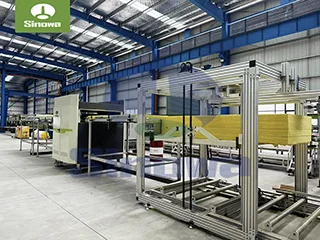
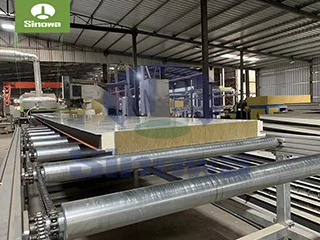
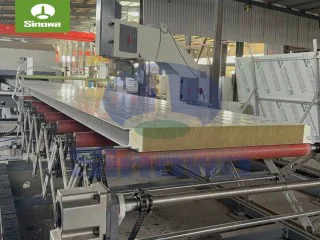
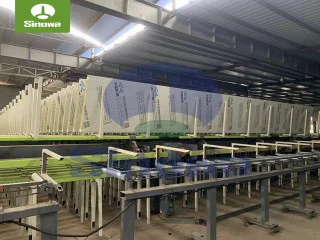
sandwich panel machine
The operation of rock wool sandwich panel production line starts with standardized raw material preparation and intelligent batching, which is the primary link determining the basic performance of finished panels. The main raw materials applied in the system are natural inorganic minerals with stable physical and chemical properties, which are proportioned according to fixed process parameters to ensure the uniformity of subsequent melting and fiber forming. The system is equipped with closed raw material storage and conveying units, which can automatically screen and pretreat raw materials to remove impurity particles that may affect product quality. Raw materials with unqualified moisture content will go through drying and constant temperature treatment to maintain stable physical state before entering the melting stage. The automated batching module adopts precise metering and multi-stage mixing modes, realizing accurate proportion matching of different raw materials. This standardized pretreatment process avoids performance fluctuations caused by uneven raw material mixing, effectively guaranteeing the basic density, fiber fineness, and structural stability of rock wool panels in subsequent production links.
High-temperature melting systems serve as the core thermal processing unit in the entire production workflow, undertaking the task of converting solid mineral raw materials into homogeneous molten liquid. The rock wool sandwich panel line operates in a closed high-temperature environment, with internal temperature parameters stably maintained within the optimal range for mineral raw material melting, ensuring that raw materials are completely melted into viscous and uniform liquid without excessive high-temperature decomposition or invalid energy consumption. The closed structural design of the melting unit effectively isolates external air interference, avoids oxidation of molten materials, and reduces the generation of impurity sediments. During continuous operation, the system maintains stable feeding and discharging speeds, enabling the molten liquid to be output in a constant flow state. This stable melting process is crucial for subsequent fiber forming, as uniform molten fluidity directly determines the consistency of fiber diameter, length, and structural uniformity, which further affects the thermal insulation and mechanical properties of finished rock wool panels.
Fiber forming systems are the key functional modules that determine the porous structural characteristics of rock wool panels. The molten mineral liquid output from the melting unit is continuously delivered to high-speed centrifugal spinning equipment, which is the core component of fiber forming. Under the action of high-speed rotating rollers, the viscous molten liquid is evenly thrown and stretched to form fine and flexible inorganic fibers with uniform diameter. In the fiber forming process, the rock wool sandwich panel machine is equipped with precision atomization spraying units, which evenly spray a moderate amount of thermosetting adhesive and functional auxiliary agents on the surface of newly formed fibers. These auxiliary substances do not change the inherent inorganic characteristics of rock wool fibers but can enhance the bonding performance between fibers and endow the finished products with excellent water repellency and structural stability. The entire fiber forming process is carried out in a negative-pressure closed space, which not only ensures the orderly collection of fibers but also avoids fiber floating and material loss, realizing efficient and clean fiber production.
After fiber forming, the production system enters the cotton collection and uniform laying stage, which directly affects the flatness and overall uniformity of rock wool panel blanks. The collected loose fibers are transported to the pendulum laying unit, which adopts reciprocating pendulum laying technology to spread fibers evenly in the forming mold. Different from single-direction laying, the pendulum laying mode can form a staggered and stacked fiber structure, effectively improving the overall structural density uniformity and mechanical tensile strength of the panel. The system is equipped with thickness monitoring and adjustment devices in the laying process, which can dynamically adjust the fiber laying amount according to the preset panel thickness parameters, avoiding local thickness deviation of the blank. After laying, the loose fiber blanks will go through preliminary pre-pressing treatment, which preliminarily compacts the loose fiber structure, eliminates internal gaps, and shapes the primary outline of the rock wool panel, creating favorable conditions for subsequent curing and forming processes.
Curing and thermoforming systems are critical links for finalizing the structural stability of rock wool panels. The pre-pressed fiber blanks are continuously sent to the constant-temperature curing unit, where the internal thermosetting adhesive undergoes polymerization and curing reaction under specific temperature and pressure environments. The internal temperature and pressure of the curing system are distributed evenly without local overheating or pressure deviation, ensuring that the adhesive inside each part of the panel blank reacts fully and uniformly. Through the curing process, discrete fibers are closely bonded into an integral porous plate structure, which greatly improves the overall rigidity, compression resistance, and structural stability of the panel. The curing time and temperature parameters are intelligently matched according to the panel thickness and density standards, realizing accurate control of the curing degree. After curing, the preliminary formed rock wool panels have stable structural performance, fixed overall dimensions, and no loose fiber falling off, meeting the basic structural requirements of finished products.
Cooling and shaping modules follow the curing process, responsible for eliminating internal structural stress and stabilizing the physical state of panels. High-temperature panels discharged from the curing unit will be gradually cooled through a layered circulating cooling system. The graded cooling mode avoids product deformation or structural cracks caused by rapid temperature difference, effectively locking the stable porous structure formed during curing. During the cooling process, the system conducts real-time monitoring of panel flatness and structural shrinkage, and fine-tunes the cooling speed and air volume according to the detected data to ensure consistent dimensional stability of each batch of products. After complete cooling, the internal stress of the panels is fully released, and the physical properties such as density, thickness, and flatness tend to be stable, laying a foundation for subsequent precise cutting and finishing processing.
Precision cutting and trimming systems are responsible for standardizing the external dimensions of rock wool panels and removing irregular edge parts. The rock wool board production line adopts automated fixed-length cutting and edge trimming equipment, which can accurately identify the contour and size of panel blanks and complete fixed-size cutting according to preset production standards. The high-precision transmission and positioning structure ensures that the cutting error is controlled within a tiny range, realizing consistent dimensional accuracy of finished panels. In the cutting process, the supporting dust collection and waste recycling units operate synchronously, collecting leftover edge materials and fiber debris generated by cutting. These recycled materials can be reprocessed and put back into the raw material circulation system after crushing and screening, realizing resource recycling and reducing material waste. After cutting and trimming, the rock wool panels have neat edges, standard dimensions, and uniform overall appearance, meeting the application requirements of different engineering scenarios.
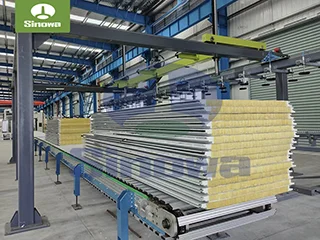
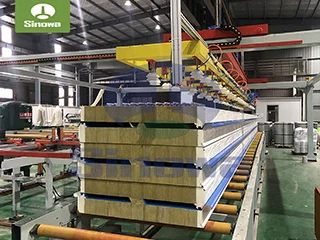
For composite rock wool sandwich panels, the production system is also equipped with integrated surface layer composite functional modules, realizing the integrated molding of metal surface layers and rock wool core materials. The surface layer raw materials are automatically uncoiled, leveled, and corrected by the front-end equipment of the composite system to ensure the flatness and smoothness of the surface layer base material. The precision glue coating unit evenly coats high-performance adhesive on the inner surface of the surface layer, with uniform glue amount and no missing coating or accumulation, ensuring reliable bonding strength between the surface layer and the core material. The rock wool core materials after cutting and shaping are evenly laid between the upper and lower surface layers through the automatic filling system, adopting staggered laying technology to optimize the fiber stress structure, which significantly improves the overall compressive strength and bending resistance of the composite panel. After composite lamination, the panels go through secondary pressing and shaping to ensure tight fitting between layers, no internal gaps, and stable overall composite structure.
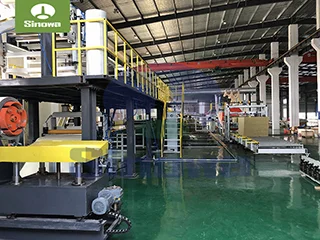
Intelligent control and operation management systems run through the entire production process of rock wool panels, being the core guarantee for stable and efficient system operation. The rockwool insulation panel production line adopts centralized automatic control logic, realizing unified regulation and real-time monitoring of batching, melting, fiber forming, laying, curing, cutting, and other all links. Operators can set production parameters through the control terminal, and the system will automatically adjust the operating state of each module according to the preset standards. The real-time data monitoring function can track key parameters such as melting temperature, spinning speed, curing time, and panel thickness in real time. Once parameter deviation or equipment abnormal operation is detected, the system will automatically trigger adjustment or early warning mechanisms to avoid defective products. The intelligent linkage between various functional modules eliminates unbalanced operation rhythm of single equipment, realizes continuous and uninterrupted assembly line production, and effectively improves production efficiency and product qualification rate.
Environmental protection and auxiliary processing systems are essential supporting components of modern rock wool sandwich panel production machine, realizing green and low-consumption production. In the high-temperature melting link, the flue gas purification unit operates synchronously to filter and purify the waste gas generated in the production process, removing particulate impurities and harmful components to ensure that the exhaust gas meets clean emission standards. The whole production process adopts closed operation design, which effectively reduces fiber dust diffusion and maintains a clean production environment. The waste water generated by equipment cooling and atomization spraying is recycled and treated through the circulating water system, realizing repeated utilization and reducing water resource consumption. In addition, the system is equipped with noise reduction and vibration damping devices for operating equipment, which reduces production noise and mechanical vibration, realizing environmentally friendly and civilized production while ensuring stable equipment operation.
The overall performance and operational characteristics of rock wool board production systems determine the core advantages of finished rock wool panels in industrial applications. The standardized and continuous production mode ensures that the finished products have uniform fiber structure, stable density, and consistent thermal insulation and fire resistance performance. The inorganic fiber structure formed by high-temperature melting and centrifugal spinning gives the panels excellent non-combustible performance, while the porous internal structure endows the products with good sound absorption and heat insulation effects. Through the precise control of the production system, the rock wool panels have good structural stability and weather resistance, and can maintain stable physical and chemical performance for a long time in complex temperature and humidity environments. At the same time, the modular integrated design of the production system makes the production process flexible and adjustable, which can adapt to the production and processing of rock wool panels with different thicknesses, densities, and specifications, meeting the diversified application needs of construction engineering, industrial equipment insulation, pipeline protection, and other fields.
In the actual production and operation process, the daily maintenance and parameter optimization of the production system are crucial to maintaining long-term stable operation. Regular cleaning and maintenance of melting equipment, spinning rollers, laying devices, and curing units can avoid equipment aging and blockage, ensuring the stability of product quality. According to different raw material characteristics and production requirements, fine-tuning the operating parameters of each module can further optimize the fiber forming effect and panel structural performance. The systematic and standardized production mode not only improves the automation level of rock wool panel manufacturing but also reduces the impact of human operation errors on product quality, realizing large-scale, high-efficiency, and high-quality production of rock wool panels. With the continuous upgrading of industrial manufacturing technology, rock wool sandwich panel machinery is gradually developing towards higher intelligence, lower energy consumption, and more precise control, continuously optimizing product performance and promoting the further popularization and application of rock wool insulation materials in various industrial fields.
https://www.cnsinowa.com/sandwich-panel-machines/systems-for-rock-wool-production.html