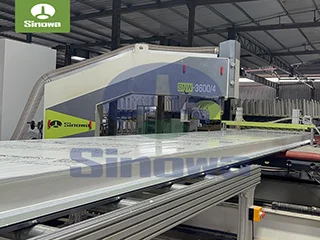
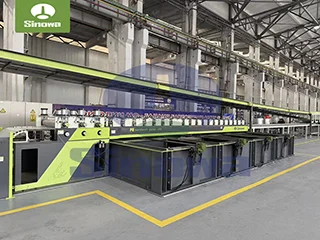
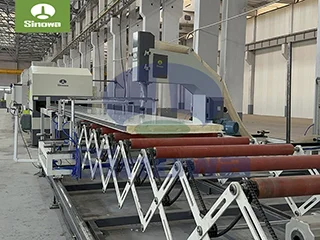
sandwich panel line
The insulation board production line is an industrial equipment used to manufacture energy-saving and environmentally friendly wall materials. There are various types, and according to different classification standards, there can be the following main types:
Classified by production process
Traditional Craft Production Line
Characteristics: It may use more traditional molding and curing processes, such as manual laying and mixing.
Applicable scenarios: Suitable for small-scale production or situations with low automation requirements.
Automated production line
Features: Highly automated, integrating processes such as sizing, laying, and re pressing, with high production efficiency and stable product quality.
Applicable scenarios: Large scale production where production efficiency and product quality need to be improved.
Classified by product type
Inorganic Permeable Plate Production Line
Product features: Using inorganic materials as the main raw material, a board with thermal insulation properties is formed through infiltration technology.
Application areas: Widely used in building walls, roof insulation and other fields.
Silicon insulation board production line
Product features: Made mainly of siliceous materials, it has excellent thermal insulation and fire resistance properties.
Application field: Suitable for buildings with high requirements for insulation and fire resistance performance.
Composite insulation board production line
Product features: We produce composite insulation boards that combine insulation, strength, and durability, usually using a PLC fully automatic control system.
Application areas: Mainly used for building exterior wall insulation, cold storage insulation and other fields.
Soft layer phenolic insulation board production line
Product features: Polymer modified mortar is used to continuously wrap phenolic insulation board, which has excellent fire and thermal insulation performance.
Application areas: Suitable for building interior and exterior walls, air conditioning ducts, indoor ceilings, and other fields.
Classified by raw materials
Industrial waste utilization production line
Characteristics: Using industrial waste such as phosphogypsum and lightweight steel slag as raw materials, resource utilization is achieved through variable frequency steam pressure forming technology.
Environmental significance: It meets the requirements of modern society for environmental protection and energy conservation, and is conducive to reducing the pollution of industrial waste to the environment.
New material production line
Features: New thermal insulation materials are used as raw materials, such as polyurethane, phenolic foam, etc., with better thermal insulation performance and fire resistance.
Application prospects: With the continuous development of new material technology, this type of production line will have a wider range of application prospects.
Insulation board production lines are integral equipment clusters in the manufacturing of thermal insulation materials, playing a crucial role in meeting the growing demand for energy conservation and environmental protection across various industries, especially construction, industrial storage, and pipeline engineering. These production lines vary significantly in design, process flow, and functional characteristics, primarily differentiated by the raw materials used, production techniques, and the types of insulation boards they produce. Each type of production line is tailored to specific material properties and application requirements, ensuring that the final products possess the necessary thermal insulation, fire resistance, moisture resistance, and mechanical strength. Understanding the different types of insulation board production lines, their working principles, and their unique features is essential for manufacturers to select the most suitable equipment, optimize production efficiency, and meet market demands.
One of the most common types of insulation board production lines is the mineral wool insulation board production line, which focuses on processing inorganic mineral materials into high-performance insulation boards. The core raw materials for this type of production line include natural rocks such as basalt and diabase, as well as industrial slags, which are rich in silicon dioxide, aluminum oxide, and other components that ensure the final product’s high temperature resistance and chemical stability. The production process of the mineral wool insulation board production line typically starts with raw material preparation, where the selected rocks and slags are crushed into particles with a diameter of no more than 5 centimeters, and impurities such as metal blocks and soil are removed to ensure the purity of the raw materials. The crushed raw materials are then mixed in a specific ratio and transported to a melting furnace, where they are heated to a high temperature between 1400 and 1600 degrees Celsius to form a molten magma. The molten magma is then converted into fine fibers through either centrifugation or blowing methods: the centrifugation method uses high-speed rotating centrifugal rollers (with a rotational speed of no less than 3000 revolutions per minute) to throw the magma into fine fibers with a diameter of 4 to 7 micrometers, while the blowing method uses high-pressure air or steam to blow the magma through a nozzle into fibers, which is more cost-effective but produces thicker fibers (8 to 12 micrometers). After fiber formation, the fibers are sucked into a cotton collection chamber under negative pressure to form a uniform fiber mat. A binder, usually phenolic resin accounting for 3% to 5% of the total weight, is sprayed onto the fiber mat, and some products also require the addition of water repellents such as silicones to achieve a water repellency rate of no less than 98%. The fiber mat is then transported to a curing furnace through a crawler conveyor, where it is cured at a temperature of 180 to 220 degrees Celsius for 10 to 30 minutes, allowing the binder to cross-link and solidify to form a rigid mineral wool board blank. After cooling, the blank is cut into standard sizes using circular saws or water jets, and optional surface treatments such as grooving, glass fiber mesh lamination, or aluminum foil coating can be performed to enhance the board’s bonding performance, crack resistance, or moisture resistance. The mineral wool insulation board production line is characterized by its ability to produce products with excellent fire resistance, reaching Class A non-combustible standards, making it suitable for high-fire-risk scenarios such as public buildings, industrial workshops, and fire barriers. Additionally, the use of industrial slags in the raw materials realizes waste recycling, aligning with the concept of environmental protection.
Another widely used type is the foam insulation board production line, which is divided into several sub-types based on the core raw materials, including phenolic foam, foamed cement, and polystyrene foam insulation board production lines. The phenolic foam insulation board production line uses phenolic resin, curing agents, and foaming agents as core raw materials, adopting processes such as pouring mixing, continuous coating, and heating curing to produce insulation boards. The production process begins with raw material metering and mixing, where phenolic resin, curing agents, foaming agents, and other additives are accurately measured and mixed uniformly in a high-speed mixer to form a homogeneous slurry. The slurry is then continuously poured onto a base material or into a mold, and heated to a specific temperature to initiate foaming and curing reactions. The foaming process forms a closed-cell structure inside the board, which endows the product with excellent thermal insulation performance and fire resistance—phenolic foam does not release toxic smoke when burned, making it ideal for buildings with high fire safety requirements, such as hospitals, schools, and commercial complexes. The phenolic foam insulation board production line can also be equipped with different surface treatment modules to produce composite boards with non-woven fabrics, aluminum foil, or color steel surfaces, expanding its application scope.
The foamed cement insulation board production line is an inorganic insulation board production line that uses ordinary cement and fly ash as main raw materials, supplemented by foaming agents and foam stabilizers. The production process of this line is relatively simple and environmentally friendly: first, cement, fly ash, and other solid raw materials are mixed dry in a mixer for 30 seconds, then a certain amount of warm water is added for wet mixing for 2 minutes, followed by the addition of foaming agents and mixing for 8 to 15 seconds to form a foamed slurry. The slurry is then poured into molds for foaming, which takes about 3 to 5 minutes, and then left to stand for initial curing. After the board blank has achieved initial strength through initial curing, it is demolded and cut into the required specifications. The final products need to undergo a curing period of no less than 7 days to ensure their mechanical strength and thermal insulation performance. The foamed cement insulation board production line adopts full-automatic wet cutting technology, which avoids dust pollution caused by dry cutting, and the use of fly ash realizes the recycling of industrial waste, reducing production costs and environmental impact. The products produced by this line have high fire resistance and good compatibility with building materials, making them suitable for external wall insulation of civil buildings and industrial buildings.
The polystyrene foam insulation board production line is further divided into expanded polystyrene (EPS) and extruded polystyrene (XPS) insulation board production lines. The EPS insulation board production line uses polystyrene beads as raw materials, which are first pre-foamed to a certain volume, then aged to stabilize the foam structure, and finally placed into molds for secondary foaming and curing to form insulation boards. The production line is equipped with pre-foaming machines, aging silos, mold clamping machines, and curing ovens, which ensure the uniformity of the foam structure and the stability of product performance. EPS insulation boards have good thermal insulation performance and light weight, making them widely used in ordinary civil building exterior wall insulation and roof insulation. The XPS insulation board production line, on the other hand, adopts an extrusion process: polystyrene resin, foaming agents, and other additives are heated and melted in an extruder, then extruded through a die to form a continuous board with a closed-cell structure. The extrusion process ensures that the board has a dense structure, high compressive strength, and excellent moisture resistance, making it suitable for ground insulation, roof insulation, and insulation of industrial equipment and cold storage. Both EPS and XPS insulation board production lines can adjust the formula and process parameters to improve the flame retardant performance of the products, meeting different market requirements.
Polyurethane (PU) insulation board production lines, including PU sandwich panel production lines, are another important type, mainly used for producing composite insulation boards with polyurethane as the core material. These production lines are widely applied in low-temperature storage, exterior wall insulation, and central air conditioning duct insulation. The PU insulation board production line adopts a modular design, with core components including uncoiling and preprocessing systems, forming and foaming systems, curing and cutting systems, and stacking auxiliary systems. The uncoiling machine unfolds the metal panel coil, connects it into a sheet through a sewing machine, and processes it through a preprocessing line for cleaning and drying, then the panel forming machine presses it into the required shape. The foaming platform is the core part of the production line: a high-pressure foaming machine mixes polyurethane black and white materials in a specific ratio and injects them between the upper and lower panels, and a double-track press accurately controls the board thickness and density to ensure uniform and dense foam. After full curing and shaping in the aging area, the edge trimmer and tracking cutting saw process the board edges and length respectively, and the stacking machine automatically stacks the finished products, realizing fully automated operation throughout the process. According to the production mode, PU insulation board production lines can be divided into continuous and intermittent types: continuous production lines have high production efficiency, suitable for mass production of standardized products, while intermittent production lines are more suitable for small-batch and customized product processing, with flexible adjustment of process parameters. In addition, according to the foaming medium, they can be divided into two-component foaming and multi-component pentane foaming production lines, where pentane foaming technology has outstanding environmental performance. The production line can also be compatible with various surface materials such as color steel plates, plastic-coated plates, and stainless steel plates, realizing the production of different types of composite insulation boards by replacing the panel processing module.
Wood fiber insulation board production lines are designed for processing organic wood fibers into flexible or rigid insulation boards, driven by the increasing demand for environmentally friendly insulation materials and rising energy costs. The raw materials of this type of production line are mainly defibrated wood chips, which are processed into organic fibers and mixed with thermoplastic bicomponent fibers or other binders to form insulation boards with physical properties equal to or better than those of inorganic fiber insulation materials, while consuming moderate energy. The production process includes wood chip storage and preparation, wood fiber production (using refiners), wood fiber drying (using flash tube dryers), fire retardant metering, fiber mixing, board forming, curing, cutting, and packaging. Key components such as the fiber metering and mixing area and the flexible heating oven system enable the production of a wide range of products with different specifications. The wood fiber insulation board production line is characterized by its use of renewable resources, making the products environmentally friendly and biodegradable, suitable for interior insulation of buildings, sound insulation, and other fields. The production capacity of such lines can range from 3,500 to 10,000 kilograms per hour, with product thickness ranging from 40 to 300 millimeters and density from 40 to 60 kilograms per cubic meter, which can be adjusted according to customer requirements.
In addition to the above main types, there are also special insulation board production lines, such as aerogel insulation board production lines and vermiculite insulation board production lines. Aerogel insulation board production lines use aerogel, a new type of nanomaterial with Class A1 fire resistance, hydrophobicity, and inorganic properties, as the core raw material. The production process involves mixing aerogel with binders and other additives, then pressing and curing to form insulation boards with extremely low thermal conductivity, suitable for high-end insulation scenarios such as aerospace, precision equipment, and high-rise buildings. Vermiculite insulation board production lines use vermiculite as the main raw material, mixed with cement, binders, and other materials, and processed through pressing and curing. The products have good fire resistance, heat insulation, and sound insulation performance, suitable for industrial kilns, pipelines, and other high-temperature insulation occasions.
Regardless of the type, modern insulation board production lines are developing towards automation, environmental protection, and multi-functionality. Most production lines are equipped with an automated control system, which solidifies process indicators such as raw material ratio, mixing parameters, forming temperature, and cutting size into programs, reducing manual intervention, ensuring the consistency of batch product performance, and improving production efficiency. In terms of environmental protection, the production lines adopt closed structures in the raw material processing stage to reduce dust emission, optimize power configuration in the mixing and forming stages to reduce energy consumption, and use environmentally friendly additives and foaming agents to minimize environmental impact. The modular design of the production lines allows for flexible configuration of equipment modules, enabling manufacturers to switch between different types of insulation board production by adjusting equipment configuration and process parameters, improving equipment utilization and adapting to the diversified market demands.
The application scope of different insulation board production lines is closely related to the performance of the products they produce. Mineral wool insulation board production lines are mainly used in public buildings, industrial workshops, and fire barriers due to their excellent fire resistance. Foam insulation board production lines are widely used in civil buildings, industrial buildings, and building renovation projects, with different sub-types adapting to different fire safety and thermal insulation requirements. PU insulation board production lines are mainly applied in low-temperature storage, central air conditioning ducts, and other fields, while wood fiber insulation board production lines are suitable for interior insulation and sound insulation. Special insulation board production lines such as aerogel and vermiculite are used in high-end or special insulation scenarios, expanding the application boundary of insulation materials.
In conclusion, the types of insulation board production lines are diverse, each with its own unique characteristics, process flows, and application fields. The choice of production line depends on factors such as raw material supply, product performance requirements, production scale, and market demand. With the continuous advancement of science and technology and the increasing emphasis on energy conservation and environmental protection, insulation board production lines will continue to optimize their processes and performance, developing towards higher efficiency, more environmental protection, and stronger adaptability. This will not only promote the development of the insulation material industry but also provide strong support for the global energy conservation and environmental protection cause, contributing to the construction of a sustainable and low-carbon society.
https://www.cnsinowa.com/sandwich-panel-machines/types-of-insulation-board-production-line.html