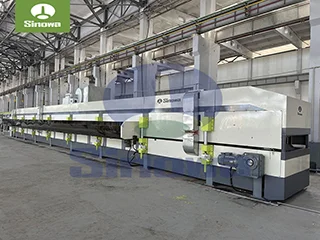
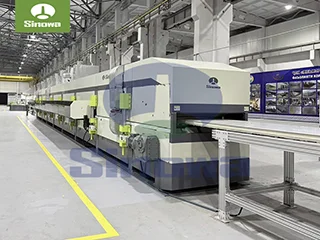
sandwich panel line
The overall structural design of a complete isolation sandwich panel line follows the logic of streamlined production, realizing seamless connection from raw material pretreatment to finished product output. The entire production system consists of multiple interconnected functional modules, each undertaking independent processing tasks while maintaining collaborative operation. The raw material conveying module is the starting point of the entire production process, which is responsible for the orderly transportation and preliminary sorting of surface base materials and internal isolation core materials. Common surface layer raw materials include metal flat sheets and inorganic composite plates with smooth surfaces and high structural strength, while the isolation core materials mostly adopt porous lightweight substances with excellent heat and sound insulation effects. This module is equipped with stable transmission structures and precise feeding adjustment components, which can control the feeding speed and raw material layout accuracy according to preset production parameters, avoiding raw material deviation or accumulation during transportation and laying a foundation for subsequent composite processing.
Following the conveying module is the surface pretreatment unit, an essential link to enhance the bonding performance between the surface layer and the core material. During the production process, the surface of the base material is prone to have tiny dust, oil stains and oxide layers, which will reduce the bonding tightness between layers and cause delamination defects of finished panels in severe cases. The pretreatment unit completes surface cleaning through physical polishing and air purification technologies, and carries out uniform micro-texture treatment on the cleaned surface. This treatment can increase the contact friction between the base material and the adhesive, effectively improving the durability of the composite structure. In addition, this unit can also adjust the surface drying degree according to the ambient humidity, maintaining the surface activity of the base material and ensuring the stability of the subsequent gluing process.
The gluing and compounding module is the core functional section of the entire sandwich panel production line, which determines the bonding firmness and overall uniformity of the sandwich panel. The system adopts an automatic circulating gluing structure to evenly apply high-viscosity composite adhesive on the inner surface of the surface base material. Different from manual gluing methods, the automated gluing device can accurately control the adhesive coating thickness and distribution density, eliminating uneven gluing and glue overflow problems. After the gluing operation is completed, the equipment automatically lays the processed isolation core material between the two layers of surface base materials, and completes primary fitting through flexible pressing components. In this process, the internal positioning correction structure will continuously monitor the alignment degree of each material layer, fine-tune the material position in real time, and ensure that the surface layer and the core material maintain a completely overlapping structure without lateral deviation, so as to guarantee the neat appearance and uniform stress of the finished panel.
The pressing and curing section undertakes the task of stabilizing the composite structure of the panels, which is a key process to shape the physical properties of isolation sandwich panels. The isolation sandwich panel machine is equipped with a sealed constant-temperature pressing chamber, which creates a stable high-temperature and high-pressure internal environment. Under the combined action of constant temperature and uniform pressure, the adhesive between the material layers undergoes physical curing and chemical cross-linking reactions, gradually forming a high-strength adhesive layer. The internal pressure balance system of the pressing chamber can avoid local excessive compression of the lightweight core material, prevent the core structure from collapsing and deforming, and retain the porous isolation structure to the greatest extent. Meanwhile, the intelligent temperature control component dynamically adjusts the internal temperature according to the thickness and core material type of the panels, matching the optimal curing conditions for different raw materials. After a certain period of constant temperature curing, the bonding strength between layers reaches the design standard, and the overall structure of the panel becomes compact and stable.
After the pressing and curing process, the semi-finished panels will be sent to the cutting and trimming module for precision shaping. The continuous composite panels produced by the sandwich panel assembly line have redundant edges and irregular sizes, which need to be processed to meet unified application specifications. This module adopts numerical control cutting technology, with high-precision cutting tools and fixed positioning brackets. Before cutting, the detection system automatically identifies the panel size and edge contour, generates cutting data through algorithm calculation, and completes fixed-length cutting and edge trimming in an automated manner. The cutting speed can be adjusted synchronously with the production rhythm of the front-end process to ensure the continuity of production. In addition, the trimming function can remove excess adhesive and broken raw material residues on the panel edges, making the panel edges smooth and flat, which is convenient for subsequent assembly and installation operations. For panels requiring special installation structures, the equipment can also complete shallow grooving and edge chamfering according to processing requirements, enriching the application adaptability of finished products.
The cleaning and cooling module is arranged after the cutting process, mainly to optimize the surface state and internal stability of the panels. The freshly cured panels retain residual internal temperature, and rapid temperature change will cause inconsistent thermal expansion and contraction of different material layers, leading to subtle structural cracks. The isolation sandwich panel machinery adopts a graded natural cooling mode, which gradually reduces the panel temperature through circulating cold air flow to ensure uniform heat dissipation inside and outside the panels. At the same time, the dust removal and cleaning device uses high-pressure airflow and soft brushing components to remove surface dust, cutting debris and adhesive residues, keeping the panel surface smooth and clean. This link not only improves the appearance quality of finished products, but also eliminates potential quality hazards caused by residual impurities, and further enhances the weather resistance of the panels in long-term use.
The final stage of the production process is finished product inspection and orderly stacking. The automated detection system conducts multi-dimensional quality inspection on the cooled panels, covering appearance flatness, dimensional deviation, interlayer bonding tightness and surface integrity. The system uses high-precision sensing components to scan the panel surface to identify tiny defects such as depressions, bubbles and scratches that are difficult to distinguish by human eyes. For unqualified products, the sorting device will automatically separate them from the qualified product pipeline to avoid mixing defective products into the finished product stack. Qualified panels will be transported to the stacking area by the conveying device, and the intelligent stacking mechanism will complete layered and orderly stacking according to fixed specifications. The stacking process maintains uniform spacing between panels to prevent surface friction and extrusion damage, providing convenient conditions for subsequent transportation and storage.
In terms of operational performance, the isolation sandwich panel manufacturing line has significant advantages in production automation and resource utilization. The entire production process realizes integrated intelligent control, and the central control system can synchronously monitor the operating parameters of each functional module, including conveying speed, gluing volume, pressing temperature, cutting size and other data. When abnormal parameter fluctuations occur, the system will trigger automatic adjustment instructions to correct the operating state of the equipment, reducing manual intervention frequency. The highly automated operation mode not only improves production continuity, but also reduces human error caused by manual operation, effectively stabilizing product quality consistency. In terms of resource consumption, the sandwich panel production machine adopts a closed-loop raw material recovery structure, which can collect cutting scraps and residual raw materials generated during processing. After simple sorting and crushing treatment, these recycled materials can be reused in the production of low-density core materials, realizing cyclic utilization of resources and reducing raw material waste.
The structural optimization design of the sandwich panel manufacturing line also takes into account the convenience of daily maintenance and space layout. Each functional module adopts an independent detachable structure, and the connecting parts are equipped with standardized assembly components. When local equipment fails or needs regular maintenance, the staff can quickly disassemble and replace the faulty parts without affecting the normal operation of other modules. The internal transmission structure of the equipment is optimized with a low-wear design, which reduces the friction loss between mechanical parts during long-term operation and extends the service life of the production line. In addition, the production line is equipped with a sound insulation and dust reduction structure. The closed processing space can effectively reduce mechanical operation noise and processing dust, improving the on-site production environment and meeting the basic requirements of modern industrial production for environmental protection.
Isolation sandwich panels produced by this type of continuous sandwich panel line have stable and excellent comprehensive performance. The composite structure formed by high-temperature pressing has strong interlayer bonding force, which is not easy to delaminate under external force extrusion and temperature change. The internal porous core material can effectively block heat conduction and sound wave transmission, giving the panels good thermal insulation and sound absorption capabilities. Meanwhile, the compact surface layer structure can resist external moisture and corrosive substances, adapting to complex application environments such as humid and low-temperature areas. These performance characteristics make the panels suitable for various application scenarios, including temporary building enclosures, industrial plant partition walls, cold storage thermal insulation structures and public building decoration layers.
With the continuous development of building material technology, the upgrading direction of isolation sandwich panel manufacturing machine is gradually leaning towards intelligence, energy conservation and diversification. In terms of intelligent upgrading, the production line will introduce more high-precision sensing and data analysis technologies to realize real-time monitoring and predictive maintenance of equipment operating status, further reducing equipment failure rates. In terms of energy conservation optimization, the heating and pressing system will adopt energy-saving heating materials and heat circulation structures to reduce energy consumption during production. In terms of production diversification, the modular combination structure of the production line can be adjusted according to production demands, realizing switching production of panels with different thicknesses, core materials and surface processes, and meeting the personalized customization needs of the market.
In conclusion, the isolation sandwich panel manufacturing line is a comprehensive industrial production system integrating multiple advanced technologies. Through standardized and streamlined production processes, it efficiently completes the manufacturing of high-performance composite panels. From raw material conveying to finished product stacking, each processing link is scientifically designed to ensure production efficiency and product quality. With the continuous growth of the global green building market and the continuous improvement of industrial construction standards, this sandwich panel plant will continuously complete technological iteration and structural optimization. It will provide more reliable material production guarantees for the construction industry, and occupy an important position in the field of building composite material manufacturing with its efficient production capacity, stable operation performance and good environmental protection benefits.
https://www.cnsinowa.com/sandwich-panel-machines/isolation-sandwich-panel-manufacturing-line.html