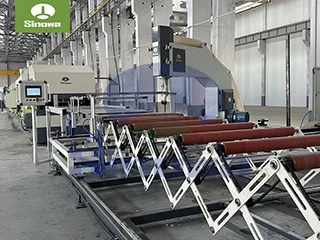
sandwich panel line
The overall structural design of an insulated panel line follows the sequential logic of raw material input, intermediate processing, molding treatment and finished product output, and each functional module maintains an independent operating state while realizing interlocking linkage through intelligent transmission systems. From the perspective of core functional layout, the entire production line can be divided into raw material pretreatment module, automatic batching and mixing module, continuous molding and composite module, constant temperature curing module, precise cutting and shaping module, surface finishing module and finished product sorting and conveying module. Every module is equipped with targeted mechanical structures and auxiliary control components to cope with the physical characteristics of different raw materials and the molding requirements of panel products. In the actual production arrangement, the spatial layout of each module is optimized according to the fluidity of materials and the transfer rhythm of semi-finished products, which effectively reduces the material transfer distance between processes and avoids production stagnation caused by unreasonable spatial planning. This integrated layout mode not only improves the overall continuity of production, but also reduces the manual intervention frequency in the production process, laying a structural foundation for large-scale and stable production of insulated panels.
Raw material pretreatment is the initial key link of the entire insulated panel production process, and its processing quality directly determines the uniformity and structural stability of subsequent composite panels. The raw materials involved in insulated panel manufacturing are diverse, including inorganic lightweight aggregate, organic foam raw materials, fiber reinforcement materials, metal base materials and adhesive composite materials. Different types of raw materials have distinct physical properties such as particle size, viscosity and density, so targeted pretreatment procedures are required. For granular raw materials, the pretreatment module is equipped with screening and grinding structures to screen out impurity particles with excessive particle size and uneven texture, and crush oversized raw materials to ensure the consistency of raw material particle fineness. For flake and strip base materials such as metal plates and fiber plates, the pretreatment process includes surface dedusting, surface smoothing and tension adjustment. The surface dedusting structure removes floating dust and particulate attachments on the surface of the base material through high-pressure air flow and static adsorption technology to avoid the isolation of impurities between composite layers. The smoothing structure polishes the rough surface of the base material to enhance the bonding adhesion between the base material and the thermal insulation core material. In addition, some raw materials with hygroscopic characteristics need to be dried at a constant temperature in the pretreatment stage to control the internal moisture content within a reasonable range, preventing bubbles and delamination defects caused by moisture evaporation during subsequent high-temperature composite processing. The whole pretreatment process operates in a closed space, which not only ensures the purification degree of raw materials, but also reduces the diffusion of dust and harmful particles to the external production environment.
After the completion of raw material pretreatment, the materials will be transported to the automatic batching and mixing module through the closed conveying pipeline. This module is the core link to realize the scientific proportioning of composite raw materials, and it relies on high-precision metering components to complete the quantitative feeding of different raw materials. In the production process, the system sets the feeding proportion of each raw material according to the performance requirements of the target panel products. The metering structure adopts real-time weight sensing technology to monitor the feeding quality of raw materials dynamically, and automatically corrects the feeding speed to avoid proportion deviation caused by material density fluctuation. After the completion of batching, multiple raw materials enter the integrated mixing equipment for homogeneous mixing. The internal structure of the mixing equipment is equipped with multi-angle rotating stirring blades, which can carry out three-dimensional stirring and shearing of raw materials. In the mixing stage of inorganic cementitious raw materials, dry mixing is carried out first to fully mix powdery raw materials, and then quantitative water is injected for wet mixing to adjust the viscosity and fluidity of the mixed slurry. For organic foaming raw materials, auxiliary foaming agents and stabilizers are added at a fixed time node during the mixing process to control the foaming reaction rate. The stirring speed and stirring time are intelligently regulated according to the raw material formula, so as to ensure that all components are evenly fused without chemical stratification and physical precipitation. The mixed raw materials form a stable composite slurry or mixed matrix, which provides a uniform raw material foundation for the subsequent molding process.
The continuous molding and composite module is the central functional area of the insulated sandwich panel line, undertaking the tasks of matrix shaping, multi-layer composite and structural compression of semi-finished panels. The mixed raw materials are evenly poured into the molding cavity through the quantitative discharging structure, and the internal vibration and extrusion components of the molding equipment work synchronously to discharge the tiny bubbles mixed in the matrix and make the internal structure of the raw materials compact. For sandwich insulated panels, the molding process adopts the one-time composite molding technology of multi-layer materials. The surface base material is continuously laid on the conveying platform, and the thermal insulation core material matrix is evenly covered on the inner side of the base material. Then another layer of surface protective material is attached to form a sandwich composite structure. During the composite process, the constant-pressure rolling structure applies uniform vertical pressure to the composite board body, so that the bonding interface between layers is closely fitted. The pressure value is dynamically adjusted according to the thickness and material hardness of the panel to avoid structural damage such as surface depression and core material crushing caused by excessive pressure. In the molding stage of high-temperature resistant insulated panels, the molding cavity is equipped with gradient heating components to complete the preliminary curing of the composite matrix, which accelerates the solidification reaction of the adhesive components and enhances the bonding firmness between composite layers. The entire molding process maintains a continuous linear operation state, and the conveying speed of the board body matches the discharging and composite rhythm, realizing seamless connection between processes and effectively improving the continuous production capacity of the production line.
The constant temperature curing module is an indispensable post-molding processing link for insulated panels, which aims to optimize the internal molecular structure of the initially molded panels and improve the overall mechanical strength and structural stability. The newly molded semi-finished panels have incomplete internal chemical reaction and unstable physical structure, and are prone to deformation, cracking and layer separation under the influence of external temperature and vibration. The curing module builds a closed constant-temperature and constant-humidity space, and adjusts the internal environmental parameters according to the material characteristics of different panels. For cement-based inorganic insulated panels, the curing space maintains a moderate temperature and high humidity environment to promote the complete hydration reaction of cementitious materials and form a dense internal crystalline structure. For organic foam composite panels, low-temperature slow curing is adopted to avoid internal structural defects caused by excessive thermal expansion. During the curing process, the semi-finished panels are placed on the layered conveying support, and the circulating air flow system inside the curing room ensures that the temperature and humidity of each position are consistent, realizing synchronous curing of batch panels. The curing time is intelligently controlled by the system, and the equipment automatically judges the curing completion state according to the real-time monitoring data of panel hardness and structural compactness. After curing, the internal stress of the panels is completely released, and the comprehensive physical properties such as compression resistance, bending resistance and thermal insulation are significantly improved.
The precise cutting and shaping module is responsible for dimensional calibration and edge finishing of cured semi-finished panels. Due to the slight dimensional deviation generated in the continuous molding process, it is necessary to rely on high-precision cutting equipment to complete fixed-length cutting and edge trimming. This module adopts servo-driven cutting components, which can receive digital size parameters input by the system to realize automatic positioning and fixed-point cutting. The longitudinal cutting structure adjusts the cutting width according to the production requirements, and the transverse cutting structure completes the fixed-length segmentation of the continuous board body. The cutting tool is made of high-hardness wear-resistant materials, with smooth cutting edges and no burrs, which avoids structural damage to the panel section. In addition to basic cutting operations, the shaping function also includes edge rounding and groove processing of the panel. For building exterior wall insulated panels, the edge rounding treatment can prevent stress concentration and edge cracking during installation and use; for assembled industrial panels, the reserved groove processing realizes the rapid splicing and assembly between panels. All cutting and shaping processes are completed in a closed processing space, and the dust collection system synchronously collects the cutting debris to keep the production environment clean and reduce material waste.
The surface finishing module focuses on optimizing the appearance performance and external protection ability of insulated panels. After cutting and shaping, the surface of the panels may have tiny scratches, uneven textures and residual cutting dust, which need to be processed through surface finishing procedures. The internal functional components of the module include surface dedusting, leveling coating, surface curing and anti-corrosion treatment. The high-pressure air circulation device first removes residual debris and floating dust on the panel surface to ensure the flatness of the coating base. Then the automatic spraying and rolling coating equipment evenly applies protective coatings on the panel surface. Different coating materials are selected according to the application scenarios of the panels, including weather-resistant coatings for outdoor building panels and anti-corrosion coatings for industrial equipment insulation panels. After coating, the constant-temperature drying structure accelerates the film-forming reaction of the coating to form a dense protective film on the panel surface. This film can effectively isolate the erosion of external humid air, corrosive gas and ultraviolet radiation, and extend the service life of the insulated panels. For decorative integrated insulated panels, the surface finishing module is also equipped with texture printing and color calibration structures to realize diversified surface decoration effects and meet the personalized aesthetic requirements of different application scenarios.
The finished product sorting and conveying module is the final link of the entire production line, covering quality screening, automatic sorting and orderly stacking of finished panels. The finished panels after surface finishing are transported to the detection station along the conveying track, and the non-destructive detection components complete multi-dimensional quality inspection. The detection items include surface flatness, dimensional tolerance, internal compactness and bonding uniformity between composite layers. The system automatically marks qualified and unqualified products according to the detection data. Qualified finished panels are transported to the stacking area through the intelligent conveying mechanism, and the mechanical stacking equipment carries out layered and coded stacking according to the specification parameters of the panels to ensure the stability of the stacked structure. Unqualified semi-finished products are independently sorted and transported to the reprocessing area, and the defective parts are cut and recycled to realize secondary utilization of raw materials. The whole sorting and stacking process is automatically completed by mechanical equipment, which reduces the damage rate of finished panels caused by manual handling and improves the neatness and standardization of finished product storage.
In terms of technical operation logic, the insulated sandwich panel production line takes the automatic control system as the core operation brain to realize the collaborative operation of all functional modules. The central control system collects real-time operating data of each equipment component through sensor groups, including raw material feeding speed, mixing temperature, molding pressure, curing environmental parameters and cutting size data. The system builds a digital operation model to dynamically compare the real-time operating parameters with the preset standard parameters. Once parameter deviation is detected, the system will automatically issue adjustment instructions to complete the intelligent correction of operating parameters without manual intervention. In addition, the system is equipped with an abnormal early warning mechanism. When equipment jamming, raw material interruption and temperature abnormality occur, the system will automatically trigger the early warning signal and suspend the operation of the faulty module, and the linkage protection structure will avoid the diffusion of faulty problems to prevent large-scale product quality defects and equipment failure. The human-computer interaction interface simplifies the operation logic, and the staff can complete production parameter setting, equipment operation monitoring and production data statistics through simple instruction input, which reduces the professional threshold of equipment operation.
The mechanical structure of the insulated panel line has excellent adaptability and can realize flexible adjustment according to different production demands. By replacing molding molds, adjusting raw material proportioning parameters and modifying operation rhythm, the same production line can manufacture insulated panels with different thicknesses, densities and structural forms. In terms of raw material compatibility, the production line can be compatible with multiple thermal insulation core materials such as organic polymer foaming materials, inorganic fiber materials and lightweight cementitious materials, covering diversified product types from low-density thermal insulation panels to high-strength load-bearing insulated panels. In terms of production rhythm adjustment, the production line can switch between batch low-speed production and continuous high-speed production according to market order demand, realizing flexible production scheduling. This high adaptability enables the insulated panel line to adapt to the changing market demand of the thermal insulation material industry and improve the comprehensive utilization rate of production equipment.
In the actual production and application process, the daily maintenance and scientific management of the insulated panel line are crucial to extend the service life of the equipment and maintain stable production efficiency. The daily maintenance work mainly includes surface cleaning of mechanical components, lubrication of transmission bearings, tightness inspection of connecting parts and calibration of metering detection components. The residual raw material attachments on the surface of mixing and molding equipment need to be cleaned regularly to avoid material solidification affecting the processing accuracy. The transmission bearings and rotating parts are regularly coated with high-performance lubricants to reduce mechanical friction loss and abnormal noise during operation. The connecting bolts and fixed supports of each module are inspected periodically to prevent structural loosening caused by long-term vibration. The metering sensors and cutting positioning components are calibrated every fixed cycle to ensure the accuracy of raw material proportioning and product size. In addition, the production environment management should be standardized. The production workshop maintains constant temperature and dryness to avoid moisture corrosion and low-temperature embrittlement of metal equipment components. The ventilation and dust removal system operates continuously to reduce the accumulation of dust particles inside the equipment and prevent circuit failure caused by dust covering electrical components.
From the perspective of industrial development value, the popularization and optimization of insulated panel lines have profoundly changed the production mode of the thermal insulation material industry. Traditional thermal insulation material production mostly adopts decentralized processing technology, with low production efficiency, unstable product quality and high manual operation cost. The integrated insulated panel line realizes the closed and continuous production of raw materials to finished products, which significantly improves the single-line production capacity. The unified parameter control standard eliminates the quality difference between different batches of products, realizing the standardized production of insulated panels. In terms of energy consumption control, the optimized structural design reduces the heat loss and power waste in the production process, and the recycling structure realizes the secondary utilization of defective products and cutting scraps, reducing the comprehensive production cost. In addition, the automated production mode reduces the number of on-site operators, lowers the safety risk of manual operation in high-temperature and dust-containing production environments, and improves the safety level of industrial production.
In the context of global energy conservation and green manufacturing, the technological upgrading direction of insulated panel lines is closely combined with environmental protection and low-carbon concepts. The new generation of production lines adopts energy-saving driving components to reduce the comprehensive power consumption of equipment operation. The closed raw material conveying structure avoids the volatilization and diffusion of harmful substances in raw materials, reducing the pollution degree to the atmospheric environment. In terms of raw material application, the upgraded production line can be compatible with a variety of recycled environmental protection raw materials, realizing the recycling of industrial solid waste and renewable resources. At the same time, the digital intelligent upgrading of the production line is accelerating. More intelligent sensing components and data analysis systems are applied to the production process to realize real-time monitoring and predictive maintenance of equipment operating status. The big data platform records production parameters and product performance data for a long time, providing data support for subsequent process optimization and product performance upgrading.
In different application industrial scenarios, the production parameters of insulated panel lines need to be pertinently adjusted to meet the differentiated performance requirements of products. For building energy-saving exterior wall panels, the production line increases the proportion of lightweight thermal insulation raw materials, optimizes the foaming density of the core material, and improves the thermal insulation and heat preservation performance of the panels. At the same time, the surface coating process is enhanced to strengthen the weather resistance and anti-aging ability of the panels to adapt to complex outdoor atmospheric environments. For cold storage and low-temperature storage space panels, the production line adjusts the composite bonding process to enhance the air tightness and low-temperature resistance of the panels, avoiding structural embrittlement and layer separation in long-term low-temperature environments. For industrial high-temperature equipment insulation panels, high-temperature resistant inorganic raw materials are selected, and the curing sintering temperature of the production line is increased to improve the high-temperature structural stability of the panels. This differentiated production regulation capability makes the insulated panel line widely applicable in multiple industrial fields and expands the market coverage of insulated panel products.
In conclusion, the insulated panel line is a systematic and intelligent manufacturing system integrating raw material processing, composite molding, precision processing and finished product detection. Its complete internal module structure, scientific operation logic and flexible production characteristics provide reliable technical support for the large-scale and standardized production of insulated panels. With the continuous progress of material science, mechanical manufacturing technology and digital control technology, the insulated panel line is developing towards higher automation level, lower energy consumption, stronger adaptability and more intelligent detection. In the future, with the continuous improvement of global energy conservation standards and the expansion of thermal insulation material application scenarios, the insulated panel line will further release industrial value, promote the high-quality development of the building thermal insulation and industrial insulation material industry, and provide more efficient and environmentally friendly material solutions for modern industrial construction and building energy conservation. The in-depth research and technical optimization of insulated panel lines will also lay a solid foundation for the innovation and iteration of composite thermal insulation materials, driving the entire industry to move towards greenization, intelligence and high efficiency.
https://www.cnsinowa.com/sandwich-panel-machines/insulated-panel-line.html