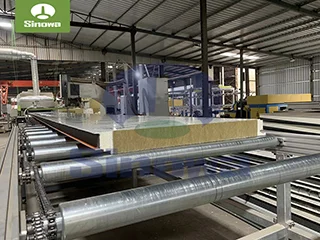
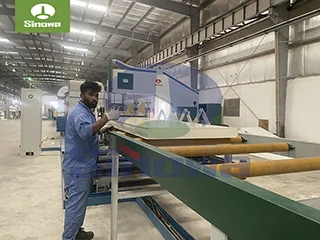
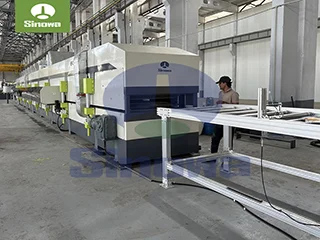
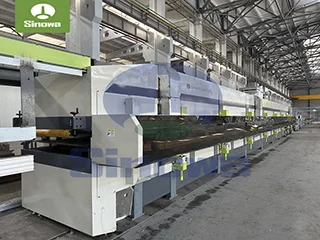
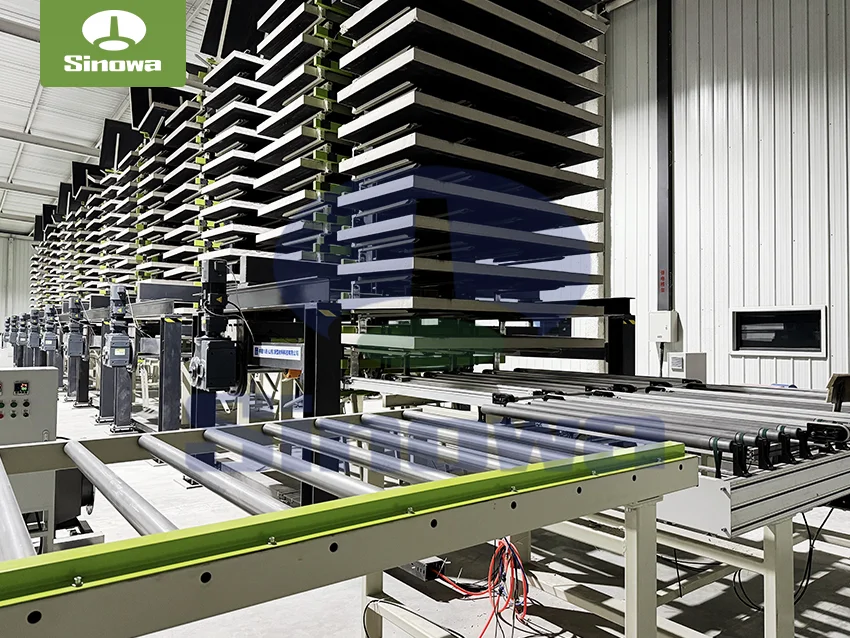
 sandwich panel line
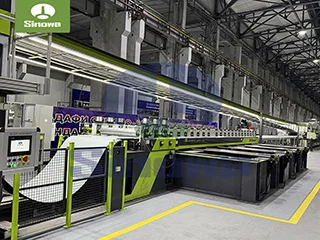
The entire operational logic of the PU sandwich panel production line for warehouse partitions follows a continuous and synchronized automated workflow, with all functional units closely coordinated to avoid intermittent production errors and dimensional deviations that affect panel assembly performance. The production process starts with the feeding and preprocessing of surface base materials, which are usually metal sheets with moderate thickness and flatness, selected to provide sufficient surface strength and anti-deformation capability for warehouse partition walls. The coiled base materials are placed on the automatic decoiling unit, which achieves steady and uniform material output through mechanical damping and speed regulation structures. This unit effectively avoids material wrinkling, stretching, and uneven tension that often occur in manual feeding, laying a foundation for the flatness and dimensional consistency of subsequent panel molding. After uncoiling, the base materials pass through a multi-stage leveling and trimming mechanism to eliminate surface irregularities and edge burrs generated during coil production, ensuring that the upper and lower surface materials of each sandwich panel maintain consistent thickness and edge straightness throughout the continuous production process.
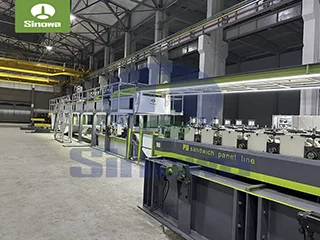
Following base material preprocessing is the roll forming procedure, a critical step that shapes flat sheet materials into the standardized profile structures required for warehouse partition installation. Warehouse partition panels need precise edge groove and buckle structures to realize seamless splicing during on-site assembly, improving the overall airtightness and structural integrity of the partition wall. The roll forming system adopts multi-group progressive rolling units, which gradually bend and press the flat sheets into preset profile shapes through orderly arranged roller groups. Each rolling station maintains precise spacing and pressure control to ensure uniform material stress distribution, preventing local thinning or structural deformation of the sheets. The modular design of the forming system allows flexible adjustment of panel width and profile specifications, enabling the production line to adapt to different warehouse partition design requirements, including conventional straight wall panels, corner connecting panels, and special-sized partition accessories commonly used in warehouse functional zoning.
After the surface materials are fully formed and shaped, the production process enters the core foaming and filling stage of polyurethane insulation core material, which directly determines the thermal insulation, sound absorption, and structural bonding performance of warehouse partition panels. The polyurethane core material is formed by the chemical reaction and foaming expansion of two-component liquid raw materials, which are stored in sealed temperature-controlled tanks inside the production line. The supporting constant-temperature system maintains the raw materials at the optimal reaction temperature all year round, avoiding unstable foaming density caused by temperature fluctuations, which would lead to inconsistent insulation performance or loose core structure of the panels. The high-precision metering and mixing system of the production line accurately proportion the two liquid components according to fixed process parameters, and completes uniform stirring and mixing in the dynamic mixing chamber to initiate a stable foaming reaction.
The uniformly mixed polyurethane liquid is continuously and evenly injected into the closed cavity between the pre-formed upper and lower surface materials through a precise injection system. Different from general building sandwich panels, warehouse partition panels require higher core material compactness and uniform cell structure to resist slight vibration and airflow impact generated by frequent cargo handling and equipment operation in warehouses. The polyurethane sandwich panel production line adopts segmented pressure maintaining and foaming control technology in the injection and expansion stage, allowing the polyurethane liquid to expand slowly and fill the entire cavity without generating hollow gaps or uneven density areas. The fine and closed cell structure formed after complete curing can effectively block heat conduction and air circulation, enabling warehouse partition walls to achieve excellent thermal insulation and temperature control effects, which is crucial for constant-temperature storage warehouses, finished product storage areas, and equipment isolation zones that require stable environmental temperature.
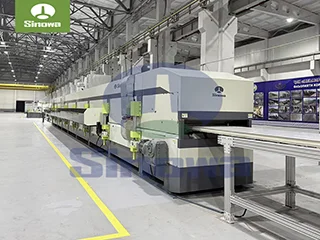
The double-belt laminating and curing system is the key functional unit to realize integrated molding of sandwich panels and ensure firm bonding between the core material and surface layers. After polyurethane injection, the composite plate body enters the closed double-belt conveying and heating curing area, where constant pressure and constant temperature environments are maintained throughout the process. The balanced pressure applied by the upper and lower belt bodies ensures that the expanding foam core material is closely bonded to the inner surface of the metal sheets without delamination or local bulging. The graded heating system sets different temperature gradients according to the foaming and curing cycle of polyurethane materials, realizing staged reaction, expansion, and solidification of the core material. This scientific curing process avoids incomplete internal reaction caused by rapid high-temperature heating or slow molding efficiency caused by low-temperature curing, ensuring that each batch of panels has consistent bonding strength, core hardness, and overall flatness.
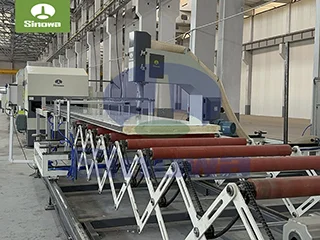
After completing curing and preliminary cooling, the continuously molded long-size sandwich panels enter the precise cutting and finishing stage. The automatic tracking and cutting system of the polyurethane sandwich panel line conducts fixed-length cutting according to the customized size requirements of warehouse partition projects. The high-speed cutting tool adopts smooth cutting technology to ensure flat and burr-free panel end faces, avoiding secondary trimming work on site. Meanwhile, the edge finishing unit automatically polishes and shapes the cut panel edges, further optimizing the assembly tolerance of the panels. For warehouse partition panels, precise dimensional tolerance control is essential, as tiny errors in length, width, and flatness will be amplified during large-area splicing, affecting the overall sealing and aesthetic effect of the partition wall. The production line realizes real-time monitoring of cutting size through intelligent sensing devices, automatically correcting minor deviations in the production process to ensure that all finished panels meet unified dimensional standards.
Subsequent to cutting and finishing, the finished panels are transported to the cooling and stacking area through the automatic conveying system. The graded cooling conveyor structure allows the panels to complete natural heat dissipation and stress release in an orderly manner, eliminating internal stress generated during high-temperature molding and preventing panel warping or deformation after long-term use. The automatic stacking system neatly arranges the qualified finished panels according to uniform specifications, realizing orderly collection of finished products and laying a foundation for later packaging, transportation, and on-site construction. The entire process from raw material feeding to finished product stacking is completed in a fully automated closed cycle, effectively reducing manual intervention errors and greatly improving production efficiency and product stability compared with traditional intermittent production equipment.
The structural design and process configuration of the PU sandwich panel production line are highly targeted to the actual application scenarios of warehouse partition panels. Warehouses have unique environmental characteristics compared with ordinary office and civil buildings: the internal space is large, the functional zoning is complex, and the partition walls need to bear long-term dust erosion, frequent personnel and equipment activity impact, and variable temperature and humidity changes. Therefore, the panels produced by this professional production line have outstanding comprehensive performance advantages. The integrated composite structure formed by high-strength surface layers and high-compactness PU core material has excellent overall rigidity, which can effectively resist local impact and avoid deformation and damage of partition walls during daily warehouse operation. At the same time, the closed-cell PU core material has low water absorption and good moisture resistance, which can prevent mildew, corrosion and performance attenuation of the partition wall in humid warehouse environments, ensuring long-term stable use effect.
In terms of production flexibility, the modular functional unit design of the PU sandwich panel line enables it to meet the diversified customization needs of warehouse partition engineering. Different warehouses have different functional positioning: some need heat insulation partitions for cold storage and constant-temperature storage areas, some need sound insulation partitions for office isolation areas in the warehouse area, and some need lightweight and easy-to-disassemble partition panels for temporary functional zoning. By adjusting the foaming density, core material thickness, and surface material specifications through the central control system, the production line can rapidly switch production parameters to manufacture partition panels with different insulation grades, sound insulation effects, and structural strengths. This flexible production mode greatly improves the matching degree between products and engineering needs, avoiding resource waste caused by single product specifications, and provides efficient material support for personalized warehouse space planning.
The automated intelligent control system runs through the entire production process of the equipment, realizing integrated management of process parameters, equipment operation status, and product quality monitoring. The central control terminal uniformly adjusts key parameters such as feeding speed, rolling pressure, foaming ratio, curing temperature, and cutting size. All production data can be recorded in real time, which is convenient for production traceability and process optimization in the later stage. During continuous operation, the system can automatically identify abnormal conditions such as unstable raw material supply, parameter deviation, and equipment jitter, and implement early warning and self-protection mechanisms to avoid batch unqualified products caused by equipment failure or parameter drift. This intelligent control mode ensures the long-term stable and reliable operation of the production line, and maintains the consistency of large-batch produced warehouse partition panels, which is an indispensable core advantage for large-scale warehouse construction and renovation projects.
In terms of production efficiency and energy consumption control, the optimized structural layout of the PU sandwich panel machine realizes high-efficiency continuous production while reducing unnecessary energy loss. The synchronized operation of all functional units avoids waiting time and energy waste caused by mismatched working procedures. The circulating heating and heat preservation system of the curing area makes full use of waste heat, reducing the overall energy consumption of the production process. For large-scale warehouse partition material procurement demand, the high-efficiency continuous production capacity of the equipment can quickly complete batch production tasks, shorten the material supply cycle, and effectively cooperate with the progress of warehouse construction and renovation projects. At the same time, the stable product yield of the automated production line reduces the generation of defective products, lowers the comprehensive production cost, and provides cost-effective high-quality panel materials for warehouse space partition construction.
The warehouse partition panels produced by this professional continuous PU sandwich panel production line also have outstanding construction and application advantages in practical engineering. The standardized and unified product size and precise splicing structure enable rapid assembly on site, greatly shortening the construction cycle of warehouse partition walls. The lightweight composite structure of the panels reduces the load-bearing pressure on the warehouse building main body, which is safe and reliable for both new warehouse construction and old warehouse renovation. In addition, the smooth and flat surface of the panels is easy to clean and maintain, adapting to the daily dust cleaning and environmental management needs of warehouse operation. The excellent weather resistance and structural stability of the panels ensure that the partition wall will not be deformed, cracked or aged in a short time under long-term warehouse operation conditions, reducing the frequency of later maintenance and replacement, and improving the overall operational efficiency of the warehouse.
With the continuous upgrading of modern warehouse management and construction standards, the requirements for functional refinement, environmental adaptability and construction efficiency of partition wall materials are constantly improving. The professional continuous PU sandwich panel line for warehouse partitions keeps pace with the development needs of the industry through continuous process optimization and structural upgrading. Its automated, standardized and flexible production mode solves many pain points in the traditional production of warehouse partition panels, such as uneven product quality, single specification, low production efficiency and poor engineering adaptability. As a key special equipment for warehouse supporting building materials production, it provides reliable technical and equipment support for the standardized construction, efficient renovation and intelligent upgrading of modern warehouses, and promotes the continuous improvement of the overall quality and functional level of warehouse space partition systems.
https://www.cnsinowa.com/sandwich-panel-machines/pu-sandwich-panel-production-line-for-warehouse-partition-panels.html