 sandwich panel line
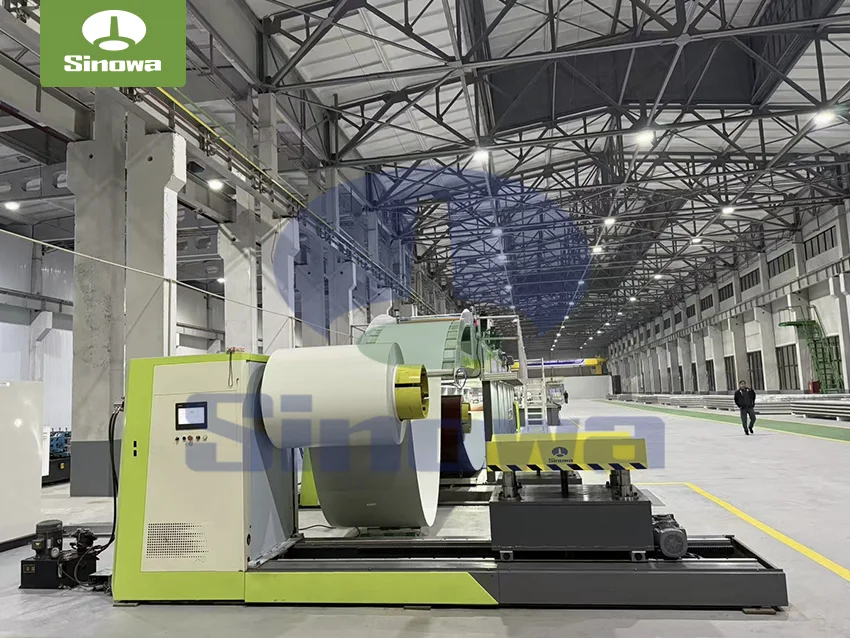
The overall operation logic of the polyurethane sandwich panel continuous production line follows the integrated processing concept of continuous material conveying, synchronous process matching, and closed-loop quality control, with every production link closely connected and coordinated in rhythm to ensure that each panel produced maintains consistent structural parameters, uniform foaming density, and reliable composite bonding strength. At the initial stage of the entire production process, the line undertakes the continuous unwinding and preliminary processing of upper and lower surface base materials, which are usually metal sheets or other flexible and rigid decorative and protective base materials with good weather resistance and mechanical strength. The surface material unwinding part is designed with precise tension adjustment structures, which can effectively avoid material deviation, wrinkling, and stretching deformation during the high-speed continuous conveying process. Through automatic tension balancing and real-time material deviation correction functions, the surface materials are kept flat and in a stable conveying state all the time, laying a solid foundation for the subsequent accurate composite processing and ensuring that the appearance flatness and overall dimensional accuracy of the finished sandwich panels meet the basic production requirements. After unwinding, the surface materials will go through preliminary leveling and surface pre-treatment processes to remove surface dust, impurities and oil stains that may affect the bonding effect, optimizing the surface contact state between the base materials and the polyurethane foam core layer, and enhancing the long-term bonding firmness between the core material and the surface layers.
The core functional section of the continuous PU sandwich panel production line focuses on the accurate proportioning, high-pressure mixing and continuous pouring of polyurethane raw materials, which directly determines the thermal insulation performance, compressive strength, dimensional stability and overall service life of the final sandwich panels. Polyurethane foam is formed by the chemical reaction between two main raw material components, and the continuous production line is equipped with professional raw material storage and automatic proportioning supply systems to realize stable storage, constant temperature regulation and precise quantitative conveying of various raw materials. The raw material supply link strictly controls the mixing ratio of different components through precision drive and metering structures, avoiding product performance fluctuations caused by manual proportioning errors. After accurate metering, the raw materials are transported to the high-pressure mixing and pouring equipment, where the components are fully and uniformly mixed under high-pressure conditions to ensure that the chemical reaction of foaming and curing can proceed stably and evenly in the subsequent filling process. The mixed polyurethane raw materials are continuously and evenly poured between the upper and lower surface materials that are being conveyed synchronously, with the pouring speed and pouring volume automatically matched with the conveying speed of the surface materials, so that the raw materials can completely fill the cavity between the upper and lower base materials without material shortage, accumulation or uneven distribution, ensuring that the thickness and density of the polyurethane core layer of each position of the sandwich panel are consistent and uniform.
Following the raw material pouring process, the continuous composite laminating and initial curing section becomes a key link to shape the overall structure of the polyurethane sandwich panel and realize the preliminary bonding and forming of the core layer and surface layers. After the polyurethane mixed raw materials are poured in place, the upper and lower surface materials carrying the foaming raw materials enter the continuous laminating equipment synchronously, where stable pressure and appropriate temperature are applied from both upper and lower directions to promote the rapid foaming, expansion and initial curing reaction of the polyurethane materials. The pressure control in the laminating process is kept within a stable and reasonable range all the time, which can not only ensure that the polyurethane foam is closely bonded to the inner surface of the upper and lower base materials without gaps or debonding, but also prevent excessive pressure from causing excessive compression of the foam core layer and damaging the internal foam pore structure, thus maintaining the excellent thermal insulation and mechanical properties of the polyurethane material. The temperature regulation system in the laminating and curing area works in linkage with the production conveying speed, dynamically adjusting the environmental temperature according to different production speeds and product specifications, so that the polyurethane foaming and curing reaction can reach the optimal state. In this process, the polyurethane materials complete foaming expansion, internal pore forming and preliminary solidification molding, and the upper and lower surface materials and the foam core layer are initially compounded into an integrated whole structure, realizing the preliminary shaping of the sandwich panel and avoiding structural deformation or layer separation in the subsequent conveying and processing links.
After initial composite forming, the semi-finished polyurethane sandwich panels enter the continuous constant-temperature curing tunnel for deep curing treatment, which is an essential process to ensure the long-term structural stability and bonding reliability of the finished products. Although the polyurethane materials have completed preliminary curing and shaping in the laminating section, the internal chemical reaction of the foam core layer has not been fully completed, and the bonding strength between the core layer and the surface layers needs a certain period of constant temperature maintenance to reach the designed standard. The curing tunnel of the continuous production line adopts a fully enclosed structural design with uniform internal temperature distribution and no local temperature difference, providing a stable constant-temperature curing environment for the semi-finished panels during continuous conveying. The conveying speed inside the curing tunnel is consistent with the overall production rhythm of the front-end process, ensuring that each semi-finished panel can obtain sufficient and consistent curing time regardless of production batch and product specifications. Through deep constant-temperature curing, the internal molecular structure of the polyurethane foam is more stable, the internal stress generated during foaming and laminating is fully released, the bonding force between the core layer and the surface materials is further enhanced, and problems such as later panel deformation, core layer shrinkage and layer debonding in the use process are effectively avoided. The length and internal temperature parameters of the curing tunnel can be adaptively adjusted according to different panel thicknesses and application requirements, meeting the curing production demands of polyurethane sandwich panels with various specifications.
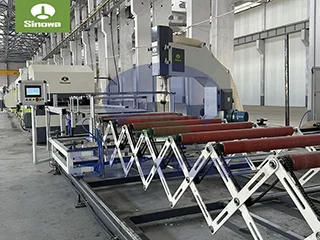
After the completion of deep curing, the continuous conveyed semi-finished integral panels enter the fixed-size cutting and edge trimming section, which processes the continuous long-strip integral panels into finished sandwich panels that meet the required dimensional specifications and edge quality requirements. The cutting part of the production line adopts automatic synchronous cutting technology, and the cutting equipment runs synchronously with the panel conveying speed, realizing dynamic fixed-size cutting without stopping the production line, which greatly improves the overall production continuity and processing efficiency compared with the traditional intermittent static cutting mode. Before cutting, the edge trimming device first trims the two sides of the continuous long-strip panels to ensure that the two side edges of the panels are flat and smooth with consistent width dimensions, removing the irregular edge parts generated in the front-end laminating and curing process and ensuring the neat and beautiful appearance of the finished panels and convenient subsequent installation and assembly. The fixed-size cutting equipment accurately cuts the long-strip panels into panels of different lengths according to the set production parameters, with high cutting dimensional accuracy and smooth cutting sections without burrs, cracks or material damage. The entire cutting and edge trimming process is automatically controlled by the production line system, without manual measurement and auxiliary operation, effectively reducing human error and ensuring that the dimensional consistency of each batch of finished panels is maintained at a high level.
The final stage of the entire production process is automatic stacking and finished product output, which realizes automatic collection, neat arrangement and centralized output of the cut finished polyurethane sandwich panels, completing the whole closed-loop process from raw material input to finished product stacking. The automatic stacking structure is equipped with precise positioning and automatic alignment devices, which can accurately place each finished panel in a set position according to the stacking sequence and stacking requirements. Through synchronous mechanical positioning and dynamic position correction functions, the stacking accuracy of the panels is maintained at a high level, the stacked panels are neat and orderly without dislocation, inclination or messy stacking, which is convenient for subsequent handling, storage and transportation of finished products without secondary manual sorting and arrangement. The stacking speed is fully matched with the front-end cutting and production rhythm, realizing uninterrupted continuous production and automatic stacking connection, avoiding production line stagnation caused by manual stacking speed limitation. Meanwhile, the stacking part can adaptively adjust the stacking mode and stacking quantity according to different panel specifications and production batch requirements, meeting the flexible production and storage demands of different production orders.
The prominent advantage of the polyurethane sandwich panel production line lies in its excellent flexible production performance and stable quality control capability, which can adapt to the production and manufacturing of sandwich panels with different thicknesses, different surface material types and different structural configurations without complicated equipment transformation and long-term production line debugging. The entire production line adopts linkage control of mechanical transmission and intelligent regulation systems, and all production process parameters including surface material conveying speed, raw material proportioning ratio, pouring volume, laminating pressure, curing temperature, cutting size and stacking parameters can be adjusted and set according to actual production demands. This flexible adjustment feature enables the production line to quickly switch between different product specifications, effectively responding to the personalized and diversified order demands of the market, and solving the problem of single production function and difficult specification switching of traditional production equipment. In actual production operation, the production line can realize real-time monitoring of all production links, automatically track the operating state of each equipment section and the production quality state of products, and automatically adjust process parameters in case of slight parameter fluctuations, ensuring that the product quality of each production batch is stable and consistent, and reducing the defective rate and material waste in the production process.
In terms of production operation and maintenance management, the structural design of the polyurethane sandwich panel line fully considers the practical demands of long-term continuous industrial production, with reasonable overall structural layout, compact connection between various functional sections, and convenient daily maintenance and component replacement. The key transmission and processing components are designed with wear resistance and durability in mind, adapting to long-term uninterrupted high-load production operation and reducing the frequency of equipment failure and shutdown maintenance. The daily production operation of the equipment is simple and convenient, with centralized operation and parameter regulation settings, requiring only a small number of operators to complete the overall production monitoring and simple equipment operation work, greatly reducing labor input and production labor costs compared with traditional production modes. In addition, the continuous production mode effectively improves the utilization rate of production raw materials, reduces the loss of polyurethane raw materials and surface base materials in the production process, improves the overall production yield, and creates better production and operation benefits for production enterprises.
With the continuous advancement of global building energy conservation policies and the continuous expansion of the application fields of thermal insulation and enclosure materials, the market demand for high-quality polyurethane sandwich panels will continue to grow steadily, and the continuous polyurethane sandwich panel production line, as the core production equipment for such products, will also face higher requirements in terms of production efficiency, product adaptability, intelligent production level and energy-saving and environmental protection performance. In the future, the continuous production line will further develop towards higher intelligent integration, more energy-saving operation and stronger flexible production capacity, continuously optimizing the production process flow and mechanical structure design, improving the automation and intelligent management level of the entire production process, reducing energy consumption in the production process, and further improving the stability and diversification of product production. Relying on the efficient and stable production support of the continuous production line, polyurethane sandwich panels will be more widely used in modern industrial construction, civil building energy-saving transformation, cold chain logistics storage, special industrial anti-corrosion and thermal insulation projects and other fields, providing reliable high-performance material guarantee for the high-quality development of the construction and thermal insulation industry.
https://www.cnsinowa.com/sandwich-panel-machines/polyurethane-sandwich-panel-continuous-production-line.html