 sandwich panel line
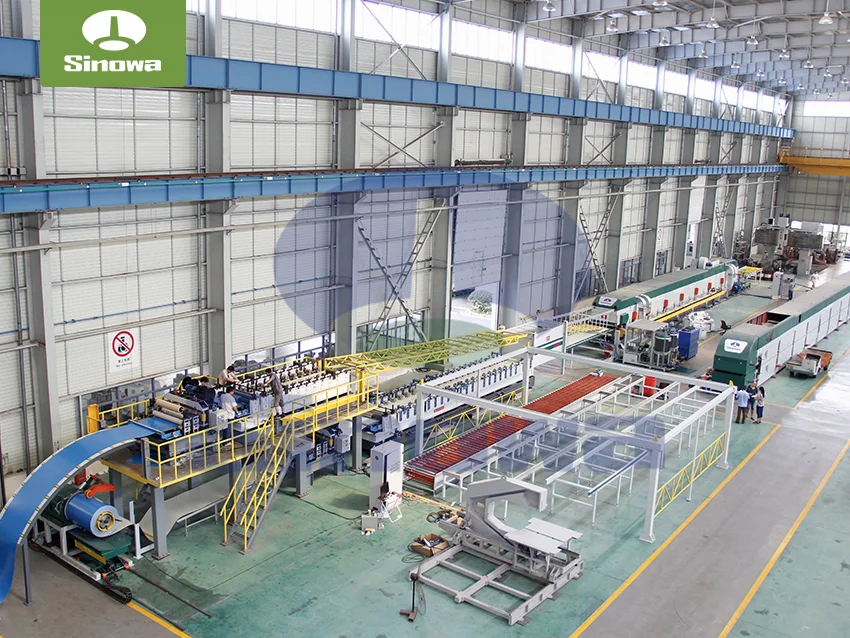
To understand the operational value and industrial significance of the fully automatic polyurethane sandwich panel production line, it is first necessary to clarify the basic structural composition and functional division of each core equipment unit inside the entire system. The whole production line can be divided into several core functional modules according to the production sequence and processing links, including surface material unwinding and feeding module, surface material pretreatment and roll forming module, polyurethane raw material precise metering and high-pressure mixing pouring module, double-belt laminating and continuous foaming curing module, fixed-length cutting and edge trimming processing module, finished product conveying cooling and flipping adjustment module, and automated finished product stacking and temporary storage module. Each module undertakes irreplaceable key processing tasks in the overall production process, and the coordinated linkage between modules is realized through a centralized intelligent control system, which uniformly regulates the operating speed, processing temperature, working pressure, and material feeding proportion of each equipment unit, avoiding production quality fluctuations and processing rhythm disorders caused by manual operation differences. All mechanical structures of the production line are designed and manufactured according to industrial continuous operation standards, with wear-resistant and corrosion-resistant structural parts adopted in long-term friction and material contact positions, and stable transmission components configured in power transmission links, ensuring that the production line can adapt to long-term uninterrupted industrial production scenarios and maintain stable operating state under different external environmental temperature and humidity conditions.
The surface material unwinding and feeding module is the starting link of the entire polyurethane sandwich panel production machine, mainly responsible for orderly releasing and preliminary guiding the metal coil raw materials used for the upper and lower surfaces of the sandwich panel. In actual production, the common surface raw materials are various coated metal coils with good surface flatness and strong weather resistance, which are stored in a coiled state before processing to facilitate transportation and storage. The unwinding equipment in this module is equipped with stable coil bearing and tension adjusting structures, which can effectively control the unwinding tension of metal coils during the feeding process, preventing problems such as surface material deviation, wrinkling, and uneven stretching that easily occur during high-speed feeding. During the unwinding process, the surface material will pass through a series of guiding and correcting auxiliary structures, which can automatically fine-tune the feeding position of the metal coil to ensure that the upper and lower surface materials maintain parallel and consistent feeding tracks in the subsequent forming and composite processing links. This link may seem simple, but it directly affects the overall dimensional accuracy and composite flatness of the final sandwich panel. Once the surface material feeding is unstable or deviates, it will lead to inconsistent thickness of the polyurethane foam core layer in the subsequent composite process, uneven bonding between the core material and the surface material, and even edge warping and deformation of the finished panel, affecting the overall use effect and installation efficiency of the product in engineering projects. Therefore, the unwinding and feeding module is designed with real-time tension monitoring and deviation correction auxiliary functions, which can dynamically adjust the operating state according to the actual feeding situation of the surface material and lay a good foundation for the stable progress of subsequent processing links.
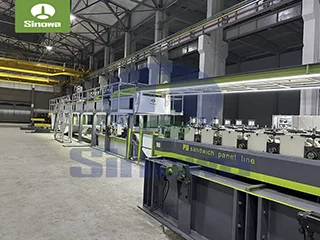
After completing unwinding and preliminary feeding, the metal surface material will enter the surface material pretreatment and roll forming module, which is a key processing link to shape the flat metal coil into the required structural profile of the sandwich panel. Different polyurethane sandwich panels used for wall enclosure, roof covering, and cold storage interior walls have different edge structures and overall cross-sectional shapes, which need to be completed through continuous roll forming processing. This module is composed of multiple groups of rolling forming units arranged in sequence, and each group of rolling units is equipped with precision-shaped rolling dies. The flat metal coil is gradually pressed and bent through the sequential action of multiple rolling dies, and slowly formed into the required corrugated or flat structural profile without damaging the surface coating and structural strength of the metal material. Before formal roll forming, the surface material will also go through simple surface cleaning and preheating treatment procedures to remove dust, oil stains and other attachments on the surface of the metal coil, ensuring that the subsequent polyurethane foam core material can form a firm and reliable bonding interface with the metal surface. The preheating treatment can adjust the surface temperature of the metal material to the optimal range required for polyurethane foaming and bonding, avoiding the problem of insufficient bonding fastness caused by excessive temperature difference between the metal surface and the polyurethane raw material during subsequent composite foaming. The roll forming process adopts gradual forming processing logic, which prevents the metal material from generating internal stress and surface cracking due to one-time excessive bending, ensures the structural stability and surface integrity of the formed surface material, and makes the formed surface material perfectly match the subsequent laminating and composite processing specifications.
The polyurethane raw material precise metering and high-pressure mixing pouring module is the core functional unit that determines the thermal insulation performance, structural compactness and bonding quality of the polyurethane sandwich panel core layer. The raw materials required for the preparation of rigid polyurethane foam core are mainly two kinds of liquid chemical raw materials with different chemical characteristics, which need to be stored in independent sealed storage tanks with constant temperature and pressure control functions before use. These two raw materials need to be transported to the high-pressure mixing head of the foaming equipment through precision metering pumps according to the fixed proportion required for chemical foaming reaction. The metering and conveying system of the production line has high-precision flow regulation and monitoring functions, which can accurately control the conveying flow and proportion of each raw material in real time, avoiding product quality problems such as insufficient foaming reaction, uneven foam density, and poor core layer compactness caused by inaccurate raw material proportioning. After entering the mixing head, the two liquid raw materials are fully mixed under high-pressure instantaneous stirring action, so that the chemical components of the two raw materials are evenly fused and ready for subsequent foaming reaction. The mixed liquid polyurethane raw material is evenly poured on the surface of the lower formed metal surface material through the automatic pouring device of the production line, and the pouring range and pouring amount are precisely controlled according to the thickness specification of the produced sandwich panel. The whole mixing and pouring process is carried out in a fully automated closed state, which not only ensures the uniformity and stability of raw material mixing, but also avoids the impact of external environmental factors on the chemical foaming reaction process, ensuring that the polyurethane foam can form a uniform and dense porous thermal insulation structure after subsequent foaming and curing.
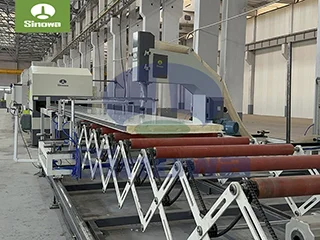
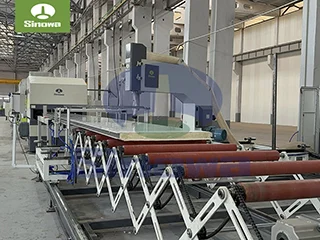
The double-belt laminating and continuous foaming curing module is the key processing link to realize the composite bonding of upper and lower metal surface materials and polyurethane foam core material and complete the foaming shaping and solidification of the core layer. After the lower metal surface material is paved with the mixed polyurethane liquid raw material, it will be synchronously fed into the double-belt laminating equipment together with the upper formed metal surface material. The double-belt laminating equipment is composed of upper and lower circulating conveyor belt structures with adjustable spacing and pressure, which can clamp the upper and lower surface materials and the intermediate polyurethane raw material layer as required and maintain stable pressing pressure and conveying speed. After entering the laminating equipment, the liquid polyurethane raw material begins to undergo chemical foaming reaction, gradually expand in the closed space between the upper and lower surface materials, and fully fill the gap between the two surface materials. Under the dual action of the pressing pressure of the double-belt laminator and the set curing temperature, the polyurethane foam completes foaming expansion, structural shaping and initial solidification bonding in a relatively short time, forming a tight integrated composite structure with the upper and lower metal surface materials. The internal temperature and pressure of the laminating area are kept within the optimal reaction range required for polyurethane foaming and curing through the centralized control system, and the conveying speed of the double-belt is matched with the foaming reaction speed of polyurethane in real time, ensuring that the foam can fully react and solidify without excessive expansion or insufficient curing. This link determines the overall bonding strength between the core material and the surface material, the uniformity of the core layer foam structure, and the overall flatness and thickness consistency of the sandwich panel. Only by maintaining stable temperature, pressure and speed parameters in the laminating and curing process can the produced sandwich panels have long-term structural stability and excellent thermal insulation performance, and avoid quality problems such as core layer hollowing, delamination between layers, and uneven panel thickness.
After completing foaming curing and composite shaping in the double-belt laminating module, the continuous long-strip composite panel will enter the fixed-length cutting and edge trimming processing module for finishing and sizing processing. The polyurethane sandwich panel produced by continuous production is in an uninterrupted long strip state after leaving the laminating and curing area, and needs to be cut into standard fixed-length finished panels according to the specifications required by actual engineering orders. The cutting equipment adopted by the production line is automated precision sawing equipment, which can automatically identify the set cutting length and complete fast and stable fixed-length cutting without stopping the production line, realizing non-stop continuous production and cutting integration. During the cutting process, the equipment can ensure that the cutting section of the sandwich panel is flat and smooth, without burrs, core material fragmentation and edge damage, ensuring that the end face of the finished panel meets the installation and docking requirements of engineering construction. In addition to fixed-length cutting, this module is also equipped with edge trimming and finishing functions, which can trim the redundant edge parts of the composite panel formed in the laminating process, make the overall dimensional specification of the panel more accurate, and ensure the consistency of the edge structure of each finished panel. The cutting and trimming process is equipped with dust and debris collection and cleaning auxiliary structures, which can timely collect the foam debris and metal scraps generated during processing, keep the production environment clean and tidy, and avoid debris accumulation affecting the normal operation of subsequent production equipment and the surface quality of finished panels.
The finished product conveying cooling and flipping adjustment module undertakes the important task of stabilizing the structural performance of the initially cut sandwich panels and adjusting the panel posture for subsequent stacking and storage. The sandwich panel just cut and formed still has residual temperature inside, and the internal polyurethane foam curing reaction has not been completely finished. It needs to be transported through the cooling conveying roller table for a certain period of natural cooling and secondary curing, so that the internal chemical reaction of the polyurethane core material is fully completed, the structural strength of the core material and the bonding fastness between layers are further improved, and the problem of panel deformation or performance attenuation caused by rapid stacking before complete curing is avoided. During the conveying and cooling process, the production line can adjust the conveying speed according to the production rhythm and ambient temperature, ensuring that each panel has sufficient cooling and curing time. For sandwich panels with different use requirements and installation directions, the flipping equipment in this module can automatically adjust the placement posture of the panels, turn the panels to the required upper and lower surface directions, and facilitate subsequent automated stacking and on-site transportation and installation. The conveying and flipping process adopts stable mechanical transmission mode, which can avoid collision, friction and surface scratch damage of the finished panels during handling, effectively protect the surface coating integrity and structural stability of the finished products, and ensure that the quality of the panels delivered to the stacking link is fully qualified.
The automated finished product stacking and temporary storage module is the final link of the entire polyurethane sandwich panel line, responsible for orderly stacking the cooled and adjusted qualified finished panels into standard material stacks, facilitating subsequent centralized storage, transportation and outbound delivery. This module is composed of automated stacking mechanical structures and temporary storage conveyor platforms, which can automatically grab, lift and stack the finished panels according to the set stacking specifications and quantity standards. The stacking process maintains stable and accurate operation, ensuring that each panel is stacked neatly and orderly, without skew, collision or extrusion deformation between panels. After the completion of stacking, the finished panel stacks are placed in the temporary storage area of the production line, waiting for subsequent packaging and outbound transportation. The automated stacking mode reduces manual handling links, reduces labor investment in the final stage of production, and avoids panel damage and stacking irregularities caused by manual handling. At the same time, the temporary storage area is reasonably planned to ensure smooth circulation of finished products, coordinate the production rhythm of the front-end production processing link and the back-end product delivery link, and ensure the continuous and efficient operation of the entire production line without backlog of finished products or production interruption.
The centralized intelligent control system runs through all functional modules of the polyurethane sandwich panel machine and is the core brain to coordinate the synchronous operation of all equipment units. The control system adopts integrated electrical control design, which can uniformly set, adjust and monitor all operating parameters of the production line, including raw material metering proportion, unwinding feeding speed, roll forming pressure, foaming curing temperature and pressure, laminating conveying speed, cutting length specification, stacking quantity and other key production parameters. Production operators can complete all production parameter setting and production state monitoring through the centralized operation interface, and the system has real-time data feedback and abnormal state early warning functions. When abnormal conditions such as unstable raw material supply, equipment operation failure, parameter deviation exceeding the standard occur in any link of the production line, the system will automatically send out early warning prompts and take corresponding protective adjustment measures to avoid large-scale unqualified product production and equipment failure expansion. In the actual production process, the control system can also record production operation data in real time, including daily production output, product specification distribution, equipment operating state, parameter adjustment records and other information, which is convenient for production management personnel to carry out production scheduling, product quality tracking and equipment daily maintenance management, and improve the overall standardized management level of production work.
The daily maintenance and regular maintenance management of the polyurethane sandwich panel production machinery is an important guarantee to maintain long-term stable operation of the equipment, ensure consistent product production quality, and extend the service life of the production line equipment. The daily maintenance work mainly includes daily cleaning of each equipment unit, inspection of raw material storage tank reserves, checking whether the tension of the unwinding module is normal, whether the rolling forming die is worn or damaged, whether the mixing head of the foaming system is blocked or not, whether the temperature and pressure sensing components of the laminating module work normally, and whether the cutting and stacking equipment runs smoothly. Daily maintenance work needs to be completed in a standardized manner before and after daily production, timely handling minor abnormal problems found, avoiding small faults accumulating into large equipment failures affecting production progress. Regular maintenance work includes regular lubrication of transmission components, regular calibration of precision metering and cutting components, regular inspection and maintenance of electrical control circuits and hydraulic power systems, regular cleaning and maintenance of foaming mixing and pouring structures, and regular detection of temperature and pressure control accuracy. Through scientific and standardized maintenance management, the production line can always be kept in a good operating state, the occurrence rate of equipment failure can be reduced, the continuity and stability of production can be ensured, and the production quality of polyurethane sandwich panels can be kept stable for a long time.
With the continuous development of modern construction industry and cold chain logistics industry, the market demand for polyurethane sandwich panels with different specifications and performance requirements is constantly upgrading, which also promotes the continuous optimization and upgrading of the structural design and process configuration of polyurethane sandwich panel manufacturing lines. Modern production lines have been able to adapt to the production and processing needs of multiple types of sandwich panels, including wall panels for industrial and civil building enclosure, roof panels with waterproof and wind-resistant structural design, special thermal insulation panels for cold storage and constant temperature warehouses, and composite enclosure panels for special environmental protection engineering facilities. By simply adjusting the operating parameters of the control system and replacing a small number of forming dies, the same production line can complete the switching production of different specifications and different types of sandwich panels, with strong production flexibility and market adaptability. In the actual industrial production and application process, the polyurethane sandwich panel production line not only improves the production efficiency of composite thermal insulation panels, but also ensures the stability and consistency of product quality, provides reliable material support for the efficient construction and long-term safe operation of various engineering projects, and plays an important role in promoting the standardized development and high-quality upgrading of the modern thermal insulation building materials industry.
In the actual production operation process, the operation and parameter debugging of the polyurethane sandwich panel production equipment need to be reasonably adjusted according to the external ambient temperature and humidity, raw material batch characteristics, and product specification requirements. Different seasonal environmental changes will affect the chemical reaction speed of polyurethane foaming raw materials and the temperature control effect of the curing area, so the production personnel need to fine-tune the foaming temperature, laminating pressure and conveying speed of the production line according to the actual environmental conditions to ensure that the foaming curing effect and composite bonding quality of the core material always remain in the optimal state. For sandwich panels with different core layer thicknesses and different surface material types, the metering proportion of polyurethane raw materials, pouring amount and forming pressure of the production line also need to be adjusted correspondingly to match the production processing requirements of different products. Only by combining professional operation debugging technology with standardized production management can the production line give full play to its production performance, produce polyurethane sandwich panels that meet various engineering application standards, and meet the diverse market demand for thermal insulation composite panels in different construction fields.
https://www.cnsinowa.com/sandwich-panel-machines/polyurethane-sandwich-panel-production-line.html