sandwich panel line
The overall structural composition of a composite polyurethane sandwich panel production line follows a modular and collaborative design logic, with each functional unit undertaking independent processing tasks while maintaining precise synchronous operation. The front-end part of the production line is dominated by the material feeding and pre-forming system, which mainly completes the unwinding, flattening, and profiling of surface layer materials. Coiled metal materials, as the common surface layer of sandwich panels, are stably released through automatic unwinding equipment, avoiding material deviation and tension fluctuation during feeding. After unwinding, the sheet materials pass through multiple groups of roller sets to eliminate surface wrinkles and internal stress, achieving complete flatness. Subsequently, the continuous profiling process shapes the flat sheets into customized structural profiles, meeting the assembly and installation requirements of different application scenarios. This pre-forming process is designed with high dimensional accuracy, and the rolling gap and forming angle of each roller can be finely adjusted to adapt to different sheet thicknesses and panel structural specifications.
Following the surface material processing procedure is the preheating treatment unit, a key pre-process to enhance the bonding performance between the surface layer and the polyurethane core material. Long-term industrial practice shows that low-temperature surface materials will cause uneven foaming and insufficient bonding strength of polyurethane raw materials, while reasonable preheating can activate the surface state of the sheet, accelerate the molecular combination between the foam layer and the surface material, and significantly improve the overall structural firmness of composite panels. The preheating system adopts uniform temperature distribution design, which can maintain a constant and stable heating temperature within the processing range, avoiding local overheating or underheating that affects material performance. The temperature parameters are dynamically matched with the production line operating speed to ensure that each batch of surface materials can reach the optimal temperature state required for foaming composite processing.
The foaming and composite forming system is the core functional module of the entire polyurethane sandwich panel line, determining the thermal insulation performance, structural density, and comprehensive quality of finished polyurethane sandwich panels. Polyurethane composite foaming relies on the reaction of two-component chemical raw materials, which are transported to the high-precision mixing system through independent metering and pumping equipment. The metering system maintains strict proportion control of raw materials, ensuring that the mixing ratio of different components is kept within the optimal reaction range. After full high-pressure mixing in the professional mixing head, the liquid polyurethane raw materials form a uniform reactive mixture, which is evenly sprayed on the surface of the preheated lower sheet through a mobile spraying device. The spraying process realizes full coverage and uniform thickness distribution, effectively preventing hollow gaps, uneven density, and local thin layers inside the core material.
Immediately after the completion of raw material spraying, the upper surface sheet is precisely aligned and covered with the lower sheet through the automatic positioning and lamination mechanism, forming a closed composite structure with the polyurethane liquid layer sandwiched in the middle. The assembled composite structure is then sent to the double-belt pressing and curing system for integrated forming and curing treatment. The double-belt pressing equipment provides stable and continuous pressing force, maintaining a fixed spacing between the upper and lower belts to control the overall thickness of the sandwich panel accurately. Meanwhile, the internal heating system of the pressing section creates a constant-temperature curing environment, which promotes the continuous foaming, expansion, and solidification of polyurethane materials. In this process, the polyurethane mixture undergoes complex chemical cross-linking reactions, gradually expanding to fill the entire gap between the upper and lower sheets, and forming a dense and uniform foam core layer after complete curing. The synchronous operation of pressing and heating ensures that the foam structure is stable without deformation or collapse, and the core material is tightly bonded to the surface sheets to form an integrated composite structure.
The operational stability of the polyurethane sandwich panel machine in the composite curing stage is crucial to product quality consistency. Slight fluctuations in line speed, curing temperature, or pressing pressure may lead to differences in foam density, inconsistent bonding strength, or structural deformation of panels. Therefore, the entire production process is equipped with a real-time parameter monitoring and automatic adjustment system, which can dynamically correct operating parameters according to production status changes. When the production line speed is adjusted, the system will synchronously optimize raw material spraying volume, heating temperature, and pressing pressure to ensure that the foaming reaction and curing process always maintain the best state. This intelligent parameter matching mechanism effectively reduces the defective rate caused by process parameter deviation and improves the overall yield of continuous production.
After completing the curing and forming process, the continuous long-size composite panels enter the cooling and shaping stage. The newly formed polyurethane sandwich panels still retain residual temperature, and the internal foam structure is not completely stabilized. The automatic cooling conveyor system adopts graded natural cooling and air-assisted cooling modes to gradually reduce the panel temperature, avoiding structural deformation, surface warping, or internal stress concentration caused by rapid temperature change. The extended cooling conveying path ensures that each part of the long panel can achieve balanced heat dissipation, making the internal foam structure more stable and the bonding performance between layers more reliable. The cooling process also further optimizes the surface flatness of the panels, laying a foundation for subsequent precise cutting and finishing processing.
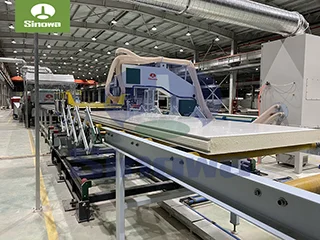
The fixed-length cutting system is responsible for cutting continuous long panels into standard finished products of specified sizes. Equipped with high-precision tracking and positioning devices, the cutting mechanism can automatically identify the processing position and complete stable and fast cutting according to preset size parameters. The cutting process adopts a smooth cutting mode to ensure flat and neat panel sections without burrs, cracks, or foam peeling, maintaining the integrity of the composite structure at the cutting end. The system supports flexible switching of different cutting sizes, which can meet the personalized size requirements of different application scenarios and realize flexible production of diversified products. After cutting, the finished panels are transported to the sorting and stacking area through the conveying system.
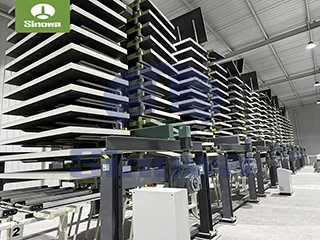
The final stage of the production process is automatic sorting, stacking and auxiliary finishing. The automated stacking equipment neatly arranges the cut qualified panels according to fixed specifications, realizing orderly collection of finished products and facilitating subsequent transportation and storage. At the same time, the supporting finishing unit can complete simple surface inspection and defect screening, eliminating individual products with surface scratches, uneven thickness, or poor bonding, and ensuring that all delivered finished products meet consistent quality standards. The entire post-processing process is highly automated, reducing manual intervention, improving production efficiency, and avoiding quality fluctuations caused by human operation errors.
Compared with discontinuous intermittent production equipment, the continuous PU sandwich panel production line has outstanding advantages in production efficiency and product stability. The fully streamlined production mode realizes uninterrupted feeding, forming, foaming, curing, and cutting, greatly improving the unit time output of panels. More importantly, the closed and automated production environment avoids the interference of human factors on the production process, making the thickness, density, bonding strength, and thermal insulation performance of each batch of panels highly consistent. The precise process control system can effectively control the foaming uniformity of polyurethane core materials, ensuring that the panels have excellent thermal insulation, sound insulation, and pressure resistance, and can maintain stable structural performance in different temperature and humidity environments for a long time.
The PU sandwich panel production line also has strong production flexibility and scene adaptability. By adjusting the formula ratio of polyurethane raw materials, operating parameters of the pressing system, and feeding specifications of surface materials, it can produce sandwich panels with different core material densities, different surface layer thicknesses, and different structural strengths. In addition to conventional metal surface materials, the equipment can also adapt to the processing of various flexible and rigid decorative surface materials, realizing the diversified production of composite panels. This flexible production feature enables the production line to meet the differentiated product demands of construction thermal insulation, industrial plant enclosure, cold storage thermal insulation, medical clean rooms, and other fields, and has a wide range of industrial application values.
In terms of production energy consumption and environmental protection performance, modern composite PU sandwich panel line has achieved significant optimization. The improved heating and curing system reduces invalid heat loss and improves energy utilization efficiency in the production process. The closed raw material conveying and spraying system avoids the volatilization and waste of chemical raw materials, reduces the generation of residual materials, and realizes clean and environmentally friendly production. The polyurethane foam produced by the optimized process has a stable molecular structure, no harmful substance precipitation, and good environmental protection and durability, which conforms to the development trend of green building materials and industrial energy conservation.
With the continuous upgrading of industrial manufacturing technology, composite PU sandwich panel machine is developing towards higher automation, higher precision, and stronger intelligence. The real-time data collection and analysis system can monitor the operating status of each functional unit, process parameter changes, and product quality indicators in real time, realize intelligent early warning and fault diagnosis of equipment, and reduce equipment failure rate and production downtime. The synchronous linkage control between multiple units further optimizes the production rhythm, realizes the precise matching of material supply, reaction processing, and finished product output, and greatly improves the refined level of industrial production.
In the field of modern building energy conservation and industrial lightweight manufacturing, polyurethane composite sandwich panels have become indispensable key materials by virtue of their lightweight, high strength, excellent thermal insulation and convenient construction characteristics. As the core manufacturing equipment of such building materials, the composite polyurethane sandwich panel production line determines the basic performance and application quality of finished panels. Its efficient and stable production capacity, flexible product adaptation ability, and environmentally friendly production mode provide strong technical support for the large-scale popularization and high-quality application of polyurethane sandwich panels. In the future, with the continuous innovation of material formula and mechanical manufacturing technology, the production line process will be further optimized, promoting the continuous improvement of the comprehensive performance of composite sandwich panels and expanding their application boundaries in more industrial fields.
https://www.cnsinowa.com/sandwich-panel-machines/composite-polyurethane-sandwich-panel-production-line.html