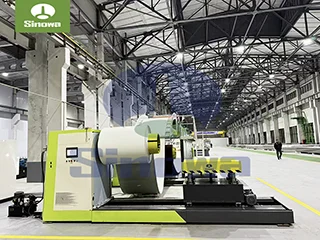
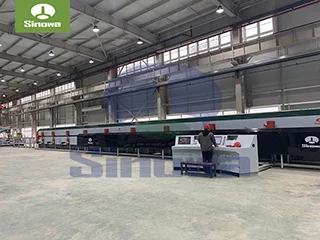
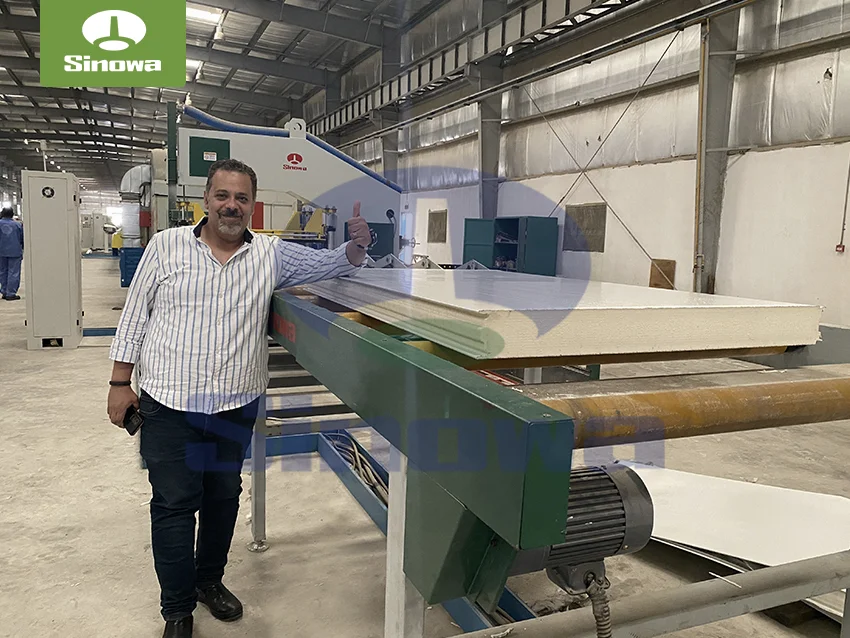
 sandwich panel line
The structure of a cost effective PU foam production line is a systematic integration of multiple functional units, each playing a critical role in ensuring the smooth operation of the production process and the stability of product quality. The core components typically include a raw material handling system, mixing system, foaming system, shaping system, curing system, cutting system, and control system, with optional auxiliary units such as waste recycling systems to further improve cost efficiency. The raw material handling system is responsible for storing, conveying, and preprocessing key raw materials, including polyols, isocyanates, catalysts, foaming agents, and surfactants—all of which directly affect the final properties of PU foam. This system is equipped with independent storage tanks for different raw materials to avoid cross-contamination, and precision conveying pumps to ensure accurate dosage of each component, with measurement errors controlled within ±0.5% to maintain formulation stability. Some advanced handling systems also include preheating or cooling modules to adjust the temperature of raw materials to the optimal range (usually 20-40℃), as temperature fluctuations can significantly impact the foaming reaction.
The mixing system is the heart of the production line, as it determines the uniformity of raw material blending, which in turn affects the cellular structure and performance of the foam. Cost effective production lines often adopt high-speed dispersion mixers or dynamic mixing heads, capable of achieving rapid and thorough mixing of multiple components within 0.8 to 30 seconds depending on the foam type. The mixing speed can be adjusted between 500 and 3000 rpm to adapt to different raw material viscosities and formulation requirements, ensuring that catalysts, foaming agents, and surfactants are evenly distributed in the base material. For multi-component formulations, the system supports simultaneous processing of up to 12 different raw materials, enabling the production of complex and functional PU foams. The foaming system is where the chemical reaction between polyols and isocyanates occurs, triggered by catalysts, leading to the formation of gas bubbles and the expansion of the mixture. This system can be designed for either continuous or batch foaming processes, with modular structures that allow for easy switching between different production modes. The foaming process is closely monitored to control parameters such as reaction temperature, pressure, and foaming time—key factors that influence the density and porosity of the foam.
The shaping system works in conjunction with the foaming system to give the foam its desired form. Depending on the application scenario, this system may include mold casting equipment, conveyor belts for continuous sheet foaming, or extrusion molding devices. Mold casting is suitable for producing custom-shaped foam products, such as automotive parts or special-shaped insulation components, while continuous sheet foaming is ideal for mass-producing foam boards, mats, or rolls. The curing system is essential for stabilizing the foam structure, as PU foam requires a certain period of curing to complete the chemical reaction and achieve its final mechanical properties. Cost effective production lines typically use tunnel ovens or continuous curing chambers with temperature-controlled environments (80-150℃ for initial curing, followed by room-temperature aging) to accelerate the curing process while ensuring uniform curing. The curing time can be adjusted according to the foam thickness and formulation, usually ranging from 5 minutes to several hours, with subsequent room-temperature aging for 24-72 hours to further stabilize product performance.
The cutting system is responsible for trimming the cured foam into standard sizes or custom shapes, equipped with precision cutting tools such as circular knives, band saws, or laser cutters. These tools ensure high cutting accuracy, with dimensional tolerances controlled within ±0.1mm, meeting the strict size requirements of different applications. The control system is the brain of the entire production line, adopting programmable logic controllers (PLC) and touch screen interfaces for intuitive operation and real-time monitoring. It integrates parameter control, process recording, and fault alarm functions, allowing operators to adjust production parameters (such as mixing ratio, foaming temperature, and cutting speed) according to production needs, and track production data for quality management and process optimization. Some advanced control systems also incorporate AI algorithms and digital twin technology to realize intelligent parameter optimization, reducing human intervention and improving production stability. Auxiliary systems such as waste recycling units collect and process foam scraps generated during cutting, which can be crushed and reused as raw material additives, reducing waste and lowering raw material costs— a key feature of cost effective production lines.
The performance of cost effective PU foam production lines is characterized by high efficiency, stability, flexibility, and energy conservation—all of which contribute to their cost-saving advantages. Efficiency is reflected in both production speed and resource utilization: continuous production lines can achieve a daily output of several tons to dozens of tons, depending on the configuration, while batch production lines are suitable for small-batch, multi-variety production with quick changeover between formulations. The precision of the mixing and metering systems ensures that the foaming reaction is stable, reducing product defects and improving yield, with scrap rates controlled below 0.4% in advanced lines. Stability is another core performance indicator, as consistent product quality is essential for reducing rework and improving customer satisfaction. These production lines are designed with high-quality components and sealed structures to minimize equipment failure rates and ensure long-term stable operation, with modular designs that facilitate maintenance and reduce downtime.
Flexibility is a key advantage of cost effective PU foam production lines, allowing manufacturers to adjust production parameters and switch between different foam formulations quickly. This adaptability enables the production of various types of PU foam, from flexible to rigid, and from low-density to high-density, meeting the diverse needs of different industries. For example, by adjusting the ratio of raw materials and foaming parameters, the same production line can produce high-resilience foam for furniture, slow-rebound memory foam for bedding, and rigid foam for building insulation. The modular design also allows for future expansion or customization, such as adding new functional units to produce flame-retardant, anti-static, or waterproof PU foams, without the need for full line replacement—reducing long-term investment costs. Energy conservation and environmental protection are increasingly important performance indicators for modern production lines, and cost effective PU foam production lines integrate multiple energy-saving technologies to reduce operational costs and meet global "double carbon" requirements. These include heat recovery systems that reuse waste heat from the curing process for raw material preheating, energy-efficient motors and pumps to reduce power consumption, and closed-loop systems to collect and treat volatile organic compounds (VOCs), ensuring emissions meet environmental standards (VOC concentration below 20 mg/m³ in advanced lines). Compared with traditional production lines, cost effective models can reduce comprehensive energy consumption by more than 30%, with unit product energy consumption as low as 120-140 kg of standard coal per ton—well below the 2025 national energy efficiency benchmark of ≤130 kg of standard coal per ton.
Cost effective PU foam production lines can be classified into different types based on production process, foam density, and application scenarios, each with distinct characteristics and scope of application. Based on the production process, the main types are continuous production lines and batch production lines. Continuous production lines are suitable for large-scale, mass production of standard PU foam products, such as foam sheets, rolls, and continuous blocks. They feature high production efficiency, stable product quality, and low labor intensity, as most processes are automated. The production process is uninterrupted, from raw material feeding and mixing to foaming, curing, and cutting, making them ideal for manufacturers with high and stable demand. These lines are widely used in the production of furniture foam, building insulation foam, and packaging foam, where large output and consistent quality are required.
Batch production lines, by contrast, are designed for small-batch, multi-variety production, allowing for frequent switching between different foam formulations and product types. They have a more flexible production rhythm, with each batch size adjustable according to order requirements, making them suitable for manufacturers that produce custom products or specialized foam varieties, such as automotive interior foam, medical foam, and industrial sealing foam. Batch lines are also more cost-effective for small and medium-sized enterprises (SMEs) with limited production scale, as they require lower initial investment and can adapt to changing market demands quickly. Based on the density and hardness of the produced foam, cost effective production lines can be divided into flexible PU foam production lines, rigid PU foam production lines, and semi-rigid PU foam production lines. Flexible PU foam production lines focus on producing foam with high elasticity, open-cell structure, and soft touch, with density ranging from 10 to 100 kg/m³. The foam produced is widely used in cushioning and comfort applications, such as sofa cushions, mattress filling, and pillow cores. These lines are equipped with mixing systems that emphasize uniform bubble formation and rebound performance, with surfactants added to stabilize the open-cell structure and prevent bubble collapse.
Rigid PU foam production lines produce foam with a closed-cell structure, high hardness, and low thermal conductivity, suitable for insulation and structural applications. The density of rigid PU foam is usually between 20 and 100 kg/m³, with excellent compressive strength and thermal insulation performance—making it ideal for building insulation, refrigeration equipment insulation, and pipeline insulation. These production lines require precise control of the foaming reaction to ensure the formation of a dense closed-cell structure, with physical foaming agents such as cyclopentane or carbon dioxide commonly used to improve insulation performance. Semi-rigid PU foam production lines produce foam with properties between flexible and rigid foam, featuring moderate elasticity and hardness, and good wear resistance. This type of foam is widely used in automotive interiors (such as instrument panels and door panels), sports equipment, and packaging materials that require both cushioning and structural support.
The applications of cost effective PU foam production lines are closely linked to the types of PU foam they produce, covering a wide range of industries including construction, furniture, automotive, packaging, medical, and industrial manufacturing. In the construction industry, rigid PU foam produced by these lines is widely used for building exterior insulation, roof insulation, and interior wall insulation due to its excellent thermal insulation performance and light weight. It helps reduce building energy consumption for heating and cooling, meeting global energy conservation and emission reduction requirements. Flexible PU foam is used for interior decoration materials such as wall panels and floor mats, while semi-rigid foam is used for sealing and sound insulation in doors and windows. The construction industry is one of the largest markets for PU foam, and cost effective production lines enable manufacturers to meet the large-scale demand for insulation materials while controlling costs.
In the furniture and bedding industry, flexible PU foam is the core material for sofa cushions, mattress filling, chair padding, and pillow cores. High-resilience foam produced by cost effective lines offers excellent rebound performance and durability, ensuring long-term comfort for furniture products, while slow-rebound memory foam provides personalized support by adapting to the shape of the human body—ideal for high-end mattresses and pillows. These production lines enable furniture manufacturers to produce foam with customized hardness, density, and rebound performance, meeting the diverse needs of consumers for comfort and quality. The ability to switch between formulations quickly also allows manufacturers to respond to trends in the furniture market, such as the growing demand for eco-friendly and hypoallergenic foam.
The automotive industry is another key application field for cost effective PU foam production lines, as PU foam is widely used in automotive interiors and exteriors to improve comfort, safety, and energy efficiency. Flexible foam is used for seat cushions, backrests, and headrests, providing cushioning and comfort for passengers, while semi-rigid foam is used for instrument panels, door panels, and ceiling liners, offering structural support and sound insulation. Rigid PU foam is used for automotive body insulation and lightweight components, helping reduce vehicle weight and improve fuel efficiency. Cost effective production lines can adapt to the strict quality requirements of the automotive industry, producing foam with consistent performance, flame retardancy, and low VOC emissions—meeting the industry’s safety and environmental standards. The modular design of these lines also allows for the production of custom-shaped foam components tailored to different vehicle models.
In the packaging industry, PU foam (especially flexible and semi-rigid foam) is widely used for shockproof packaging of fragile products such as electronic equipment, glassware, and precision instruments. Its excellent cushioning performance can effectively absorb impact energy during transportation, reducing product damage. Rigid PU foam is used for thermal insulation packaging of refrigerated goods, maintaining the temperature stability of perishable items such as food and pharmaceuticals during transportation. Cost effective production lines enable packaging manufacturers to produce foam packaging materials of different sizes and shapes, adapting to the diverse packaging needs of various industries. The ability to recycle foam scraps also helps reduce packaging waste, aligning with the global trend of green packaging.
The medical industry uses specialized PU foam produced by cost effective lines, such as hypoallergenic, antibacterial, and breathable foam for medical mattresses, cushions, and wound dressings. These foams are non-toxic, non-irritating, and have good biocompatibility, ensuring safety for medical use. The precision and stability of the production lines ensure that the foam meets the strict quality standards of the medical industry, with consistent pore size and breathability. In industrial manufacturing, PU foam is used for sealing, sound insulation, and vibration reduction in equipment, such as industrial seals, sound insulation panels, and vibration-damping pads. Cost effective production lines can produce industrial-grade foam with high wear resistance, corrosion resistance, and temperature resistance, adapting to the harsh working environments of industrial equipment.
https://www.cnsinowa.com/sandwich-panel-machines/cost-effective-pu-foam-production-line.html