sandwich panel line
The entire operation logic of the PU foaming production line is built on the inherent chemical reaction characteristics of polyurethane materials. The core production principle relies on the exothermic chemical reaction between two fundamental liquid raw materials, polyol and isocyanate, with the assistance of various functional additives. During the reaction process, gas is continuously generated to form dense and uniform tiny bubbles, while the chemical cross-linking reaction constructs a stable three-dimensional network structure, ultimately transforming the liquid mixed raw materials into porous, solid foam materials. Every functional unit of the foaming line is designed to precisely regulate each link of this chemical and physical transformation process, eliminating unstable factors caused by environmental changes and manual intervention, and standardizing the foaming effect of each batch of products.
The front-end raw material supply and metering system serves as the foundation of high-quality foam production, determining the basic performance and structural uniformity of finished foam products. The system is equipped with multiple independent temperature-stabilized storage tanks to separately store core raw materials and functional additives, avoiding premature mixing and invalid reactions between different components. Core raw materials include polyol and isocyanate, while supporting additives cover catalysts, surfactants, blowing agents, and colorants, each undertaking unique functional roles in the foaming process. Catalysts adjust the reaction rate of chemical cross-linking and gas generation to prevent excessive reaction speed from causing bubble rupture or too slow reaction leading to uneven foam expansion. Surfactants stabilize the bubble structure during foaming, ensuring uniform bubble size distribution and avoiding large holes or hollow defects inside the foam. Blowing agents control the expansion ratio and density of the foam, directly affecting the softness, hardness, and thermal insulation performance of finished products.
After raw material storage, high-precision metering devices accurately extract various raw materials and additives according to the preset production formula. The metering process adopts stable volumetric or gravimetric metering modes, achieving extremely high precision in proportion control. Slight deviations in the ratio of core raw materials will directly lead to changes in foam performance: insufficient cross-linking reaction will result in low foam hardness and poor structural stability, while excessive reaction will cause the foam to become brittle and prone to cracking. The automated metering system of the foam core sandwich panel line can maintain stable proportion output for a long time, effectively avoiding product quality fluctuations caused by manual batching errors, and providing reliable basic conditions for subsequent mixing and foaming processes.
The high-speed mixing unit is the key link to realize uniform raw material reaction and determine the consistency of foam microstructure. All raw materials measured in strict proportions are transported to the closed mixing chamber through independent conveying pipelines. The internal high-speed stirring structure of the mixing chamber fully homogenizes different liquid components in an extremely short time, ensuring that additives are evenly dispersed in the core raw materials without local concentration differences. The closed mixing environment effectively isolates external air and temperature interference, prevents premature gas escape and local invalid reactions, and ensures that the chemical reaction starts synchronously after the raw materials are evenly mixed. The mixing speed and time can be adjusted adaptively according to different foam formulas, matching the reaction characteristics of different raw material combinations to achieve the optimal mixing state.
After uniform mixing, the liquid composite material is continuously and stably coated on the surface of the base material or conveyed to the foaming molding station through the reciprocating mobile pouring mechanism. This link realizes quantitative and fixed-point pouring through mechanical transmission control, ensuring consistent pouring thickness and coverage area each time, which lays a foundation for the uniform thickness and flat surface of the final foam products. For composite foam products requiring substrate fitting, the pouring system can realize synchronous coating on the upper and lower layers of the base material, making the foam layer closely combined with the base material in the subsequent foaming process and improving the overall bonding fastness of composite products.
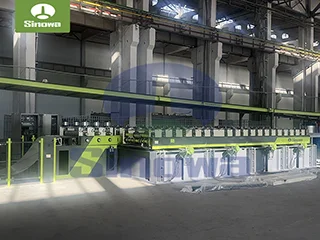
The foaming and curing system is the core functional area where liquid materials are transformed into solid foam structures, and it is also the most critical part affecting product performance and molding quality. The poured liquid material enters the closed constant-temperature molding channel, and the internal temperature of the channel is divided into multiple gradient control sections to realize staged foaming and curing. In the initial foaming stage, the temperature is moderately controlled to promote the gentle progress of the chemical reaction, enabling the gas generated by the reaction to slowly expand and form uniform and dense bubble structures. Too fast temperature rise will cause rapid gas expansion and bubble rupture, resulting in loose foam structure and poor compactness; too slow temperature rise will lead to insufficient expansion, increased foam density, and reduced elasticity and thermal insulation performance.
With the continuous advancement of the material in the molding channel, the cross-linking reaction gradually deepens, and the foam structure is initially formed. The middle curing section maintains a stable constant-temperature environment to promote the complete solidification of the polyurethane network structure, fixing the formed bubble structure and avoiding shrinkage, deformation, or collapse of the foam after molding. The later slow cooling section gradually reduces the internal temperature of the foam, releases the internal stress generated during the reaction and expansion process, and further stabilizes the overall structure of the foam. The entire foaming and curing process is carried out synchronously with the operation of the conveyor system, and the stable and adjustable conveyor speed ensures that each section of the foam obtains consistent reaction and curing time, realizing continuous and uninterrupted molding production.
Different types of foam products can be produced by adjusting the operating parameters of the PU foam production line. When producing flexible foam products used for cushions, mattresses, and soft packaging, the PU sandwich panel production line adopts a low-density expansion formula and softer reaction parameters, forming a foam structure with high elasticity, good toughness, and uniform soft pores. When producing rigid foam products applied to building thermal insulation, equipment heat preservation, and structural support, the system adjusts the raw material ratio and curing temperature to increase the cross-linking density of the foam, forming a high-hardness, high-compactness, and low-heat-conduction foam structure with excellent structural stability and thermal insulation performance. Semi-rigid foam products needed for special industrial scenarios are produced through medium proportion and parameter adjustment, balancing elasticity and support performance to meet diversified application requirements.
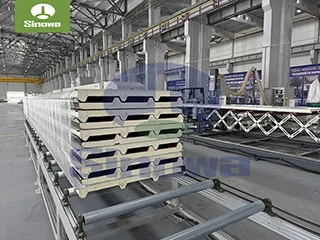
The automated post-processing unit of the PU sandwich panel line completes the final shaping and finishing of foam products, realizing the transformation from continuous foam blanks to standardized finished products. After the foam is completely cured and shaped, the continuous foam strip is conveyed to the cutting and trimming station. The precision cutting device carries out fixed-length cutting and edge trimming according to the preset size parameters, removing irregular edge materials to ensure that the size and shape of each finished product meet the production standards. The cutting speed is synchronized with the front-end foaming and conveying speed, realizing online continuous cutting without stopping production, which greatly improves the overall production efficiency.
In addition to fixed-length cutting, the post-processing area also includes natural aging and sorting functions. The initially cut foam products will undergo a period of natural placement to completely release the residual internal stress generated during the production process, further stabilizing the product size and performance and avoiding subsequent shrinkage or deformation. The automated sorting mechanism screens products according to structural uniformity, surface flatness, and dimensional accuracy, separating qualified products from defective products to ensure the consistency of the quality of outgoing products. Some production lines are also equipped with dust removal and surface finishing devices to optimize the surface smoothness of foam products and improve the overall appearance quality.
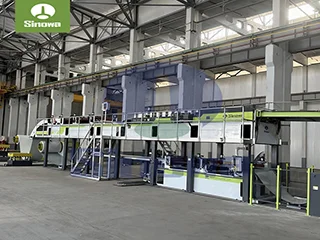
The modern polyurethane sandwich panel production line adopts a highly modular and integrated structural design, with all functional units closely coordinated and operated synchronously. The entire production process from raw material feeding, metering, mixing, pouring, foaming, curing to cutting and sorting is automatically controlled by the central system, with minimal manual participation. Operators only need to set production formulas and parameter thresholds through the control terminal, and the system can realize self-operation, real-time monitoring of operating status, and automatic adjustment of abnormal parameters. This intelligent control mode not only reduces labor intensity and labor costs but also fundamentally avoids quality problems caused by manual misoperation.
In terms of production stability, the polyurethane sandwich panel line has excellent anti-interference and consistency capabilities. The closed production environment isolates the influence of external temperature, humidity, and air flow on the foaming reaction, ensuring that the chemical reaction conditions of each batch of products are consistent. The real-time monitoring system tracks key parameters such as raw material ratio, mixing speed, curing temperature, and conveying speed in real time, and automatically fine-tunes the parameters when slight deviations occur, always maintaining the production process in the optimal stable state. Therefore, the foam products produced by the continuous foaming line have more uniform density, more consistent pore structure, and more stable mechanical properties than those produced by traditional intermittent equipment.
In terms of production efficiency and resource utilization, the continuous operation mode of the PU sandwich panel machine has obvious advantages. The uninterrupted streamlined production eliminates the standby and debugging time of intermittent production, greatly improves the unit time output, and is suitable for large-scale and batch industrial production. At the same time, the precise metering and fully enclosed mixing and pouring structure effectively reduces the waste of raw materials, avoids raw material volatilization and residue loss in the traditional open production process, and improves the utilization rate of chemical raw materials. The standardized production process also reduces the generation of defective products, further improving the overall production yield and economic benefits.
With the continuous upgrading of material application requirements, the performance regulation capability of polyurethane sandwich panel machine is also constantly optimized. The adjustable formula and parameter system of modern production lines can meet the personalized production needs of different industries. By adjusting the types and proportions of additives, it can produce foam products with flame retardant, antibacterial, shock absorption, sound insulation, and low-temperature resistance functions, expanding the application scope of polyurethane foam materials. The flexible parameter adjustment function enables the same production line to switch between multiple product types, realizing multi-purpose use of one machine and improving the flexibility and applicability of production equipment.
In practical industrial application, the PU foaming manufacturing line has become a key equipment to promote the iterative upgrading of polyurethane material industry. It breaks through the quality instability and low efficiency bottlenecks of traditional manual and semi-automatic production, realizes the standardized, large-scale and intelligent production of foam materials, and provides high-quality and consistent basic materials for many downstream industries. The stable foam products produced by the line have excellent thermal insulation, shock absorption, sound insulation, buffering and structural stability, and can adapt to complex and diverse usage environments, effectively supporting the development of construction energy conservation, home manufacturing, industrial packaging, transportation equipment and other fields.
Looking at the development trend of manufacturing industry, PU foaming line is evolving towards higher precision, higher intelligence and more energy-saving operation. The continuous optimization of metering and mixing technology further improves the microscopic uniformity of foam structure. The upgrading of intelligent control system realizes more accurate process prediction and fault self-diagnosis. The optimized design of temperature control and conveying structure reduces energy consumption in the production process and improves the environmental protection level of production. As a core manufacturing equipment in the new material industry, PU sandwich panel production machine will continue to play an important role in promoting the high-quality development of polyurethane material manufacturing and supporting the innovative application of downstream industrial chains.
https://www.cnsinowa.com/sandwich-panel-machines/pu-foaming-line.html