 sandwich panel machine
A professional sandwich panel machine for construction is a complete automated production line designed specifically for the continuous compounding and forming of different surface metal substrates and various core insulation materials, abandoning the backward manual semi-automatic processing mode that relied on scattered single machines and manual auxiliary handling in the early stage. The fundamental design logic of the equipment focuses on realizing the integrated completion of multiple production processes in one continuous streamlined operation, including raw material unwinding, surface material leveling, continuous rolling forming, core material automatic feeding, precise glue coating and bonding, high-pressure composite pressing, fixed-length cutting, automatic stacking and finished product output. Unlike ordinary single-function metal rolling equipment or simple material bonding machinery, construction-oriented sandwich panel production equipment takes full account of the harsh outdoor service environment of building panels and the high-standard structural requirements of building enclosure structures, adopting reinforced mechanical frame structures, high-precision transmission systems and stable synchronous control configurations. These core design features ensure that every produced sandwich panel maintains consistent overall dimensions, uniform bonding strength and neat edge sealing effect, avoiding common quality problems such as uneven plate surface deformation, inconsistent thickness, weak internal bonding and messy plate end cutting that often occur in traditional simple production processes. The equipment can flexibly adapt to the production and processing needs of sandwich panels with different specifications, different surface layer styles and different core material types, fully meeting the diversified material demand of different construction scenarios and different building functional design requirements.
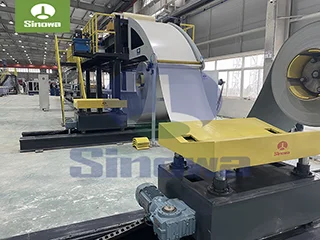
The overall structural layout of a complete sandwich panel production line follows a modular integrated design concept, with each functional module closely connected and coordinated with each other to form a closed and efficient production cycle, and each independent module undertakes its own dedicated production tasks without mutual interference, ensuring the continuity and stability of the entire production process. The front-end part of the whole production line is the raw material unwinding and feeding module, which is responsible for placing coiled metal surface materials and various bulk or roll-shaped core insulation materials, and is equipped with automatic material guiding and tension adjusting devices. This module can effectively maintain the stable conveying state of raw materials during high-speed production, prevent material deviation, winding and uneven feeding, and lay a solid foundation for the subsequent precise processing procedures. After the raw materials are unwound and sent out, they enter the leveling and trimming module, which eliminates the internal mechanical stress of the metal coil caused by long-term winding and storage through multiple groups of precision flattening rollers, ensuring that the surface metal plate is flat and smooth without local bending or uneven radian. At the same time, the edge trimming device in this link can trim the two sides of the metal surface material to ensure consistent width of each batch of plates, avoiding the problem of inconsistent plate size affecting subsequent on-site assembly and installation.
The rolling forming module is one of the core functional components of the entire sandwich panel line, directly determining the surface shape, structural strength and installation matching accuracy of the final finished sandwich panels. This module is composed of multiple groups of high-strength alloy forming rollers arranged in an orderly manner, which can gradually roll and bend the flat metal plate into various required structural profiles according to the preset production parameters, including common wall panel flat profiles, roof panel corrugated profiles and special-shaped edge closing profiles for building connection. All forming rollers are processed with high-precision machining technology and undergo strict surface anti-wear and anti-corrosion treatment, which can maintain long-term stable forming accuracy even after long-term continuous high-load operation, and will not produce roller surface wear or deformation that affects product quality. The transmission part of the rolling forming module adopts a rigid welded frame structure matched with high-precision reduction drive components, which can effectively resist the vibration and mechanical pressure generated during the rolling process, ensuring that each metal plate is formed in place at one time without secondary deformation or rebound. The equipment control system can freely adjust the rolling speed and forming progress according to production needs, realizing flexible switching between mass continuous production and small-batch customized production, and adapting to the diverse order needs of the construction market.
Following the rolling forming process, the core material automatic laying and high-efficiency glue coating composite module constitutes the key link to realize the composite forming of sandwich panels and determine the overall bonding quality and thermal insulation performance of the products. In this production stage, different types of thermal insulation and fireproof core materials are automatically and evenly laid between the upper and lower layers of formed metal plates through a special quantitative feeding device, ensuring that the core material is fully covered without gaps, missing materials or uneven thickness distribution. The automatic glue coating system evenly sprays high-performance environmental protection composite adhesive on the bonding surface between the metal plate and the core material according to the preset proportion and coating thickness, realizing seamless bonding between different materials. The entire glue coating process adopts precise quantitative control technology to avoid excessive glue coating causing material waste and plate surface glue overflow, or insufficient glue coating leading to weak bonding and easy delamination of finished panels. After the completion of glue coating and core material laying, the semi-finished plates enter the high-pressure composite pressing equipment, which uses uniform mechanical pressure to fully press the upper and lower metal surfaces and the middle core material together, so that the adhesive can fully react and solidify in a stable pressure environment, forming an integrated composite structure with strong overall adhesion and good structural integrity.
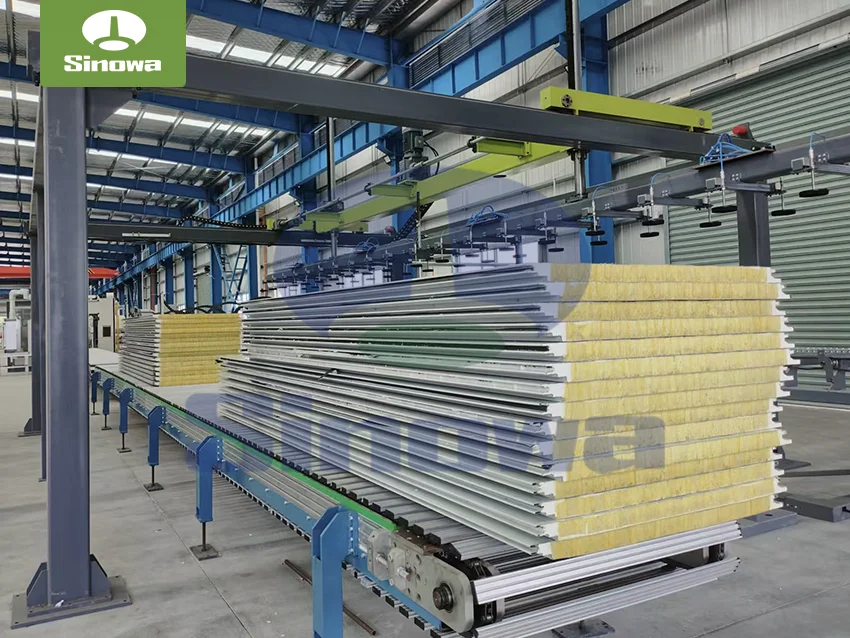
The fixed-length cutting and edge finishing module is responsible for cutting the continuously produced long composite plates into finished sandwich panels that meet the actual engineering size requirements, and carrying out fine trimming and edge sealing treatment on the cut plate ends to ensure neat and smooth plate edges without burrs, cracks or deformation. This module is equipped with high-precision numerical control positioning and fast cutting actuating devices, which can complete fixed-length cutting instantly according to the size parameters set by the operator in advance. The positioning accuracy of the cutting process is controlled within a tiny error range, ensuring that the length of each finished panel is consistent and the dimensional deviation meets the construction engineering application standards. The edge finishing and edge sealing process can effectively seal the exposed core material at the plate ends, preventing external moisture, dust and corrosive substances from penetrating into the interior of the sandwich panel, avoiding core material dampness, deterioration and reduced thermal insulation performance, and greatly extending the overall service life of the panels in complex outdoor construction environments. After the completion of cutting and edge finishing, the finished sandwich panels are automatically transported to the final automatic stacking and discharging module, which realizes neat stacking and automatic arrangement of finished products through mechanical positioning and automatic alignment devices, with millimeter-level stacking accuracy for each plate, eliminating the need for time-consuming and labor-intensive manual stacking and arrangement operations.
The core control system of modern sandwich panel production machine adopts programmable logic control technology matched with intuitive touch screen operation interface, realizing full automation and intelligent management of the entire production process from raw material feeding to finished product stacking. Operators only need to input production parameters such as plate specification, production speed, cutting size and material proportioning on the touch screen in the early stage of production, and the equipment can automatically complete all subsequent production links without frequent manual intervention and manual parameter adjustment. The built-in synchronous induction and monitoring devices of the equipment can real-time monitor the operating status of each functional module, the feeding speed of raw materials, the bonding pressure of composite links and the cutting positioning accuracy during the production process. Once abnormal conditions such as material jamming, parameter deviation or equipment overload occur in any link, the system will automatically issue a prompt and take automatic shutdown protection measures to avoid equipment damage, production safety accidents or large-scale production of defective products. This intelligent control mode not only greatly reduces the number of on-site production operators and lowers the labor management cost of production enterprises, but also effectively avoids product quality fluctuations caused by manual operation errors, ensuring the stability and consistency of the quality of each batch of sandwich panels.
The application of professional sandwich panel manufacturing machine has brought profound changes to the production and application of building enclosure materials, and its comprehensive advantages are fully reflected in improving production efficiency, stabilizing product quality, reducing comprehensive production costs and adapting to green building development needs. In terms of production efficiency, the fully automated continuous production mode of the equipment can realize uninterrupted batch production of sandwich panels, with far higher daily output than the traditional scattered manual processing mode, which can quickly meet the large-scale material supply demand of major construction projects and effectively shorten the material preparation cycle of engineering construction. In terms of product quality stability, the unified mechanical processing and intelligent parameter control mode make the dimensional accuracy, bonding firmness and surface flatness of each finished panel reach a high unified standard, avoiding quality differences between different batches and different individual products, and making on-site assembly and construction more convenient and efficient with better overall installation effect. In terms of economic cost control, the automated production mode reduces manual labor input, reduces material waste rate through precise quantitative feeding and glue coating control, and lowers the later maintenance and rework costs caused by product quality problems, bringing stable and long-term economic benefits to production and construction enterprises.
In actual construction engineering applications, sandwich panels produced by professional sandwich panel making machine have extremely wide adaptability and can meet the diverse functional needs of different types of buildings in different regions and different usage environments. In industrial construction projects such as factory workshops, production workshops and logistics warehouses, these panels are used as factory wall enclosures and roof materials, with excellent thermal insulation, heat preservation, wind resistance and pressure resistance, which can create a stable internal production and storage environment and reduce the energy consumption of building temperature regulation. In commercial construction projects such as shopping malls, exhibition halls and office buildings, the panels are used as internal partition walls and local external wall enclosure materials, with beautiful and diverse surface effects, good sound insulation and fireproof performance, which can meet the dual needs of building functional use and interior and exterior decoration. In temporary construction facilities such as construction site dormitories, emergency rescue houses and temporary office buildings, the lightweight and easy-to-install characteristics of sandwich panels enable rapid assembly and disassembly of buildings, realizing rapid construction and convenient relocation and reuse. In cold northern regions and hot southern regions, sandwich panels with different core material configurations produced by the equipment can meet the thermal insulation and heat insulation needs of buildings in different climatic environments, effectively reducing building energy consumption and conforming to the development concept of green low-carbon buildings.
Daily operation maintenance and regular equipment inspection and maintenance are important guarantees to ensure the long-term stable operation of sandwich panel machinery, maintain continuous production efficiency and prolong the service life of mechanical equipment. Daily maintenance work mainly includes cleaning the surface dust and residual adhesive impurities of each functional module after daily production, checking whether the feeding device and transmission parts are smooth and unobstructed, and confirming whether the control system parameters are restored to the initial state. Regular maintenance work includes regular lubrication of transmission bearings and reduction components, regular inspection and tightening of connecting bolts of each mechanical frame, regular calibration of forming roller position and cutting positioning accuracy, and regular inspection and maintenance of the glue coating system and electrical control circuit. Scientific and standardized maintenance management can effectively reduce equipment failure rate, avoid production interruption caused by equipment failure, ensure the continuity of production work, and keep the production equipment in the best operating state for a long time. Good equipment maintenance not only reduces the later equipment repair and replacement cost, but also ensures that the quality of produced sandwich panels is always in a qualified and stable state, creating reliable production conditions for long-term operation and development of production enterprises.
With the continuous advancement of prefabricated construction industrialization and the continuous upgrading of green building development requirements, the development trend of sandwich panel manufacturing line for construction is gradually moving towards higher automation intelligence, stronger multi-material compatibility, more energy-saving and environmentally friendly production processes and more flexible customized production capacity. In the future, such production equipment will further integrate more advanced intelligent sensing and remote monitoring technology, realizing remote real-time monitoring, fault early warning and remote parameter debugging of equipment operating status, making equipment management and production scheduling more convenient and efficient. At the same time, the equipment will be further optimized in structural design and power consumption configuration, reducing energy consumption and noise pollution in the production process, and adapting to the higher environmental protection production standards of the construction material industry. With the continuous innovation and upgrading of sandwich panel machine technology and equipment, the performance of construction sandwich panels will continue to be optimized, and the application scope in the construction field will be further expanded, providing more efficient, environmentally friendly and reliable material support for the high-quality development of the entire construction industry and the continuous upgrading of prefabricated building construction modes.
https://www.cnsinowa.com/sandwich-panel-machines/sandwich-panel-machine-for-construction.html