sandwich panel line
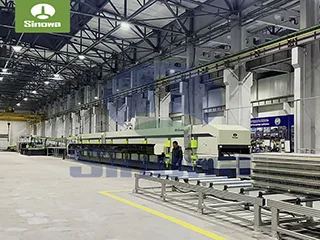
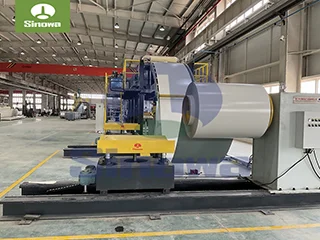
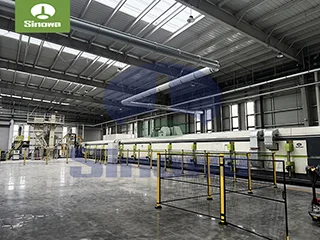
The overall structural design of the composite sandwich panel production line adopts a modular integrated layout, with all functional units operating in synchronous linkage to form a closed-loop continuous production workflow. The front-end part of the line focuses on raw material sorting and preprocessing, covering the unwinding, leveling, trimming, and surface pretreatment of sheet facing materials, as well as the quantitative feeding, shaping, and arrangement of various core materials. Facing materials commonly adapted by the production line include metal sheets and non-metal composite plates, which are processed to remove surface wrinkles, burrs, and irregular deformations through multi-group leveling roller sets, ensuring flat and uniform surface conditions for subsequent composite bonding. The core material processing unit is compatible with multiple lightweight insulation materials, including foam polymer materials and inorganic fiber materials. Different core materials correspond to independent feeding and shaping mechanisms, which can adjust feeding thickness, width, and arrangement density according to production specifications to meet the performance requirements of different application scenarios. All preprocessing links are equipped with automatic conveying and deviation correction devices to avoid material offset and stacking errors during transmission, laying a foundation for the precision molding of subsequent composite structures.
Glue spraying and composite laying is a key intermediate link in the entire production process, which directly determines the bonding firmness and overall structural stability of sandwich panels. The automated glue spraying system adopts uniform atomization spraying technology, which can precisely control the glue output, spraying range, and coating thickness according to the material type and panel specifications. The system realizes full coverage and no dead-angle spraying on the bonding surface of facing materials and core materials, avoiding excessive glue accumulation or local missing coating that may cause hollowing and delamination of finished panels. For flexible foam core materials, the composite sandwich panel line is equipped with vibration leveling structures, which can eliminate internal voids generated during core material laying, optimize the compactness of the intermediate layer, and further improve the thermal insulation and sound insulation performance of finished products. After glue coating and core material laying, the multi-layer composite structure is initially laminated and positioned by guide roller sets to ensure the alignment accuracy of upper and lower facing materials and intermediate core materials, preventing lateral deviation and layer misalignment in the subsequent pressing and curing process.
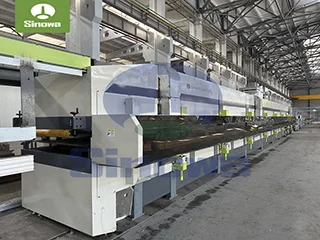
The composite pressing and heating curing unit serves as the core functional section of the entire sandwich panel manufacturing line, undertaking the permanent bonding and integral shaping of multi-layer composite structures. The pre-laminated semi-finished panels are stably conveyed into the closed pressing space composed of upper and lower circulating pressing belts, where constant pressure and graded heating treatment are implemented. The pressing system maintains uniform and stable pressure distribution across the entire panel surface through hydraulic linkage regulation, ensuring close fitting between layers without damaging the structural integrity of lightweight core materials. The heating curing section adopts segmented temperature control design, with temperature parameters adjusted in real time according to the thermal characteristics of adhesive materials and core materials. Low-temperature preheating is adopted in the front section to accelerate adhesive infiltration, constant-temperature curing in the middle section to complete molecular bonding between materials, and slow cooling in the rear section to eliminate internal stress generated during molding. For foam-type core materials, this process also completes secondary foaming and solidification of the core body under controlled temperature and pressure conditions, enabling the core material to form a uniform and dense cellular structure and achieve tight integration with the outer facing materials. The entire curing and pressing process runs continuously without intermittent pause, greatly improving production continuity and efficiency compared with traditional batch pressing equipment.
The precision cutting and edge finishing module is responsible for final sizing and structural trimming of continuously molded long-strip composite panels. After the cured integrated panel is conveyed out of the pressing and curing unit, the high-precision tracking cutting system automatically identifies the set length parameters and implements stable and fast fixed-length cutting. The cutting mechanism adopts high-speed rotary cutting tools with stable operation, which can ensure flat and smooth cutting sections without burrs, cracks, or layer separation. In addition to fixed-length cutting, the edge finishing function trims the edges of the panel to eliminate irregular residual materials and tiny gaps generated during composite molding, optimizing the overall flatness and assembly accuracy of the panel. For panels used in special enclosure scenarios, the unit can also complete simple edge folding and notch processing according to set parameters, facilitating subsequent on-site assembly and installation of finished panels. All cutting and finishing actions are automatically controlled by the system, with real-time feedback of dimensional data to ensure that the dimensional error of each finished panel is controlled within a tiny range and maintain consistent product batch accuracy.
The rear-end processing system of the composite sandwich panel machine includes automatic cleaning, stacking, and auxiliary conveying functions, forming a complete closed-loop production process. After cutting and finishing, the surface and edge residual glue and debris of the panels are automatically cleaned by the cleaning device to ensure the neat appearance of finished products. The qualified panels are stably stacked by the automatic stacking mechanism according to specified layers and specifications, avoiding panel surface scratches and structural damage caused by manual stacking. The stacked finished products are conveyed to the finished product storage area through the roller table system, realizing automatic docking with subsequent storage and transportation links. The entire rear-end processing process reduces manual intervention, effectively avoids product damage and quality fluctuations caused by human operation, and improves the overall tidiness and standardization of production operations.
Modern composite sandwich panel making machine feature highly flexible and intelligent adjustable performance, which can adapt to the diversified production needs of multiple panel specifications. The system parameters such as panel thickness, width, length, and core material density can be quickly adjusted through the central control system, realizing rapid switching between different product types without large-scale equipment replacement and mold adjustment. This flexible production capability enables the production line to meet the customized demands of different industries, ranging from conventional building exterior wall panels and interior partition panels to special functional panels for cold storage insulation and industrial purification spaces. Meanwhile, the composite sandwich panel production machine is equipped with a real-time operation monitoring system, which can track and record key data such as material feeding speed, pressing pressure, curing temperature, and cutting accuracy in real time. Once abnormal parameters are detected, the system will trigger automatic adjustment and early warning prompts, effectively reducing the occurrence of defective products and improving the stability of continuous production.
In terms of production performance advantages, the automated composite sandwich panel machinery has achieved significant improvements in production efficiency, product quality stability, and resource utilization compared with traditional production modes. The continuous assembly line operation mode eliminates the waiting and docking time of each discrete process in traditional production, greatly improving unit time output. The full-process mechanical and automatic control replaces manual operation in key links, realizing standardized control of each production process, so the structural strength, thermal insulation performance, and dimensional accuracy of each batch of products maintain high consistency. In terms of resource saving, the precise glue spraying control system avoids excessive glue waste, and the quantitative feeding mechanism of core materials reduces raw material loss, effectively improving the comprehensive utilization rate of production materials. In addition, the closed heating and pressing structure reduces heat loss during production, realizing energy-saving and environmentally friendly production operation and reducing the comprehensive operating cost of production enterprises.
The products manufactured by the composite sandwich panel production machinery have excellent comprehensive performance and wide application value. Relying on the integrated composite molding process, the finished panels have the advantages of light weight, high structural strength, good thermal insulation and sound insulation effects, and convenient installation. The composite structure formed by special process bonding has strong peel resistance and compression resistance, not easy to delaminate and deform during long-term use, and can adapt to complex outdoor and indoor use environments. Lightweight panel characteristics reduce the self-weight of building structures, effectively lowering the load-bearing pressure of buildings and engineering facilities, while the excellent thermal insulation performance can reduce the energy consumption of building temperature regulation, achieving the effect of energy conservation and emission reduction. These product advantages make the production line widely applicable in the production of building enclosure panels, cold storage insulation panels, industrial factory partition panels, temporary building wall and roof panels, and purification engineering special panels, covering multiple fields of civil construction, industrial manufacturing, and cold chain logistics.
With the continuous upgrading of building material industry standards and the increasing market demand for high-performance lightweight composite panels, composite sandwich panel manufacturing lines are developing towards higher intelligence, higher integration, and stronger adaptability. The new generation of production systems further optimizes the modular structure, realizing more compact equipment layout and smaller floor space on the premise of ensuring production efficiency. The intelligent control system is more precise, which can realize automatic matching of process parameters according to different raw material ratios and product performance requirements, further improving product customization capability and production flexibility. At the same time, the production line continuously optimizes the energy-saving structure and dust and debris recovery device in the production process, further reducing energy consumption and production waste, and improving the green production level of the equipment. In the future, with the continuous innovation of composite material technology and manufacturing technology, the composite sandwich panel production equipment will further expand its material adaptation range and product functional types, providing more efficient and reliable production support for the high-quality development of the lightweight building material industry.
https://www.cnsinowa.com/sandwich-panel-machines/composite-sandwich-panel-manufacturing-line.html