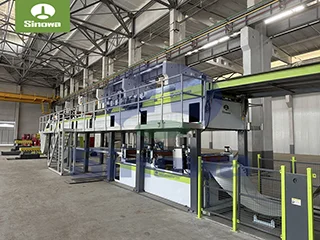
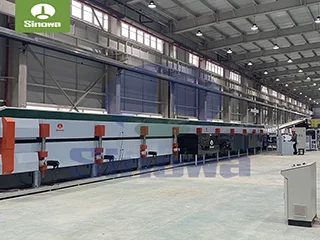
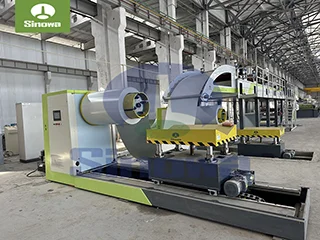
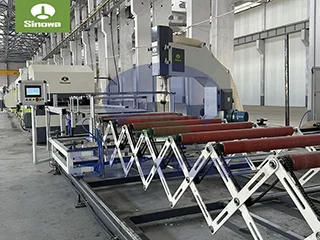
sandwich panel machine
Sandwich Panels Plant can be divided into foam Sandwich Panels Plant and rock wool Sandwich Panels Plant according to the type of filler, which are mainly used in industrial fields such as mobile board room production workshop.
The Sandwich Panels Plant is mainly composed of basic components such as fixed conveyor frames, guide rollers, and support rollers, and integrates three functional units: coating system, extrusion device, and collection module.
Glue application system: includes a glue storage tank, observation window, dust cover, and sponge application pad. The glue solution is accurately sprayed through a through-hole application tube, and the observation window design facilitates real-time monitoring of the uniformity of the glue application.
Squeezing device: Adopting a combination structure of a first buffer spring and a pressure roller, the tightness of the interlayer bonding of the composite plate is ensured through adaptive adjustment of spring pressure, and the special texture on the surface of the pressure roller enhances friction.
Collecting components: equipped with a second buffer spring and a clamping plate linkage mechanism to achieve flexible connection of the composite board after the cutting process, reducing the risk of surface scratches on the board.
In recent years, Sandwich Panels Plant has made multiple improvements and innovations in technology, such as:
Optimization of the main conveyor roller material: High density rubber material is used, which increases the friction coefficient by 42% compared to traditional metal rollers, effectively avoiding the phenomenon of slip during sheet conveying.
Material Conveyor Rack Upgrade: Upgraded to 304 stainless steel material, with corrosion resistance increased by more than three times, extending the service life of equipment in humid environments.
Add a buffer storage rack in the cutting area: absorb the impact force of the falling board through a hydraulic damping system, and reduce the damage rate of the board to below 0.3% during the collection process.
At present, there are multiple brands and suppliers in the Sandwich Panels Plant market, with varying product performance and prices. Consumers should consider their own needs and budget when making choices, and choose brands and suppliers with high cost-effectiveness and good after-sales service.
The production of sandwich panels has become an integral part of the modern construction and manufacturing industries, driven by the growing demand for efficient, durable, and sustainable building materials. A sandwich panels plant is a specialized facility designed to manufacture these composite panels, which consist of two outer facings and a central core, bonded together to create a structure that offers superior strength, insulation, and versatility. These plants integrate advanced technology, precise engineering, and strict quality control measures to produce panels that meet the diverse needs of various end-use sectors, from industrial warehouses and commercial buildings to residential homes and specialized facilities like cold storage units. As the global focus on energy efficiency and sustainable construction intensifies, the role of sandwich panels plants has become increasingly important, adapting to new materials, production methods, and market demands to deliver high-performance products.
A typical sandwich panels plant operates on a continuous or semi-continuous production line, where each stage of the manufacturing process is carefully coordinated to ensure consistency, efficiency, and quality. The production process begins with the preparation of raw materials, which are selected based on the intended application of the panels. The outer facings, often referred to as skins, can be made from a variety of materials, including metal sheets, fiber-reinforced plastics, and composite materials. Metal skins, such as those made from steel or aluminum, are particularly popular due to their durability, strength, and resistance to environmental factors. These skins are typically supplied in coils, which are loaded into the plant’s uncoiling units at the start of the production line. Before processing, the coils are inspected for any defects, such as scratches, dents, or inconsistencies in thickness, to ensure that the final product meets the required standards. The uncoiling units feed the metal sheets into a series of profiling machines, which shape the skins into the desired profile—whether flat, corrugated, or custom-designed—to enhance their structural integrity and aesthetic appeal.
The central core of the sandwich panel is the key component that provides insulation, lightweight properties, and structural support. The choice of core material depends on the specific requirements of the application, such as thermal insulation, fire resistance, sound absorption, and load-bearing capacity. Common core materials include polyurethane foam, mineral wool, extruded polystyrene, and expanded polystyrene, each offering unique benefits. Polyurethane foam, for example, is known for its excellent thermal insulation and lightweight properties, making it ideal for cold storage and energy-efficient buildings. Mineral wool, on the other hand, provides superior fire resistance and sound absorption, making it suitable for industrial facilities and public buildings where safety is a top priority. In some cases, plant operators may also use bio-based core materials, such as those made from agricultural residues like rice husk, wheat straw, or wood strands, as part of the industry’s shift toward more sustainable practices. These bio-based cores not only reduce reliance on non-renewable resources but also offer competitive structural performance, making them a viable alternative to traditional materials.
Once the outer skins and core material are prepared, the next stage in the production process is bonding. This critical step ensures that the skins and core are securely attached to form a single, cohesive panel. The bonding process typically involves the application of a high-performance adhesive, which is carefully dosed and evenly distributed onto the inner surfaces of the outer skins. Advanced sandwich panels plants use automated glue spraying systems to ensure uniform coverage, preventing issues such as blistering, delamination, or weak bonding. After the adhesive is applied, the skins are fed into a double belt press, where they are brought together with the core material under controlled temperature and pressure. The double belt press consists of two parallel conveyors that apply consistent pressure and heat, allowing the adhesive to cure and the core to expand (in the case of foam cores) to form a tight, durable bond. The temperature and pressure settings in the press are carefully calibrated based on the type of adhesive and core material, ensuring that the bond is strong enough to withstand the rigors of transportation, installation, and long-term use.
After bonding, the continuous panel is fed into a cutting station, where it is trimmed to the desired length using precision cutting tools, such as band saws or disk blades. Many modern plants use flying saw machines with 180-degree rotating mechanisms, which allow for accurate cutting even at high line speeds, reducing waste and improving efficiency. The cut panels are then transferred to a cooling station, where they are allowed to cool slowly to ensure that the adhesive fully cures and the panel retains its shape. Once cooled, the panels may undergo additional processing steps, such as the application of protective films to prevent scratches during transportation, or the addition of edge seals to enhance insulation and water resistance. Some plants also offer custom finishing options, such as painting or coating the outer skins, to meet specific aesthetic or functional requirements.
Quality control is a fundamental aspect of operations in any sandwich panels plant, run through every stage of the production process. From the inspection of raw materials to the final testing of finished panels, strict quality control measures are implemented to ensure that the products meet or exceed industry standards. Raw materials are tested for their physical and chemical properties, such as thickness, strength, thermal conductivity, and fire resistance. During production, automated systems monitor key parameters, such as line speed, temperature, pressure, and adhesive dosage, making real-time adjustments to maintain consistency. Finished panels are subjected to a series of tests, including bending tests, compression tests, thermal insulation tests, and water tightness tests, to verify their structural integrity and performance. Panels that fail to meet the required standards are rejected and recycled, minimizing waste and ensuring that only high-quality products leave the plant.
The efficiency and productivity of a sandwich panels plant are influenced by several factors, including the type of production line (continuous or discontinuous), the level of automation, and the optimization of the production process. Continuous production lines are ideal for large-scale manufacturing, offering high output rates and consistent quality. These lines can produce up to several million square meters of panels per year, with line speeds reaching up to 15 meters per minute. Discontinuous production lines, on the other hand, are more flexible, allowing for the production of custom-sized panels or small batches, making them suitable for specialized applications. Many modern plants are adopting advanced automation technologies, such as robotics, computer numerical control (CNC) systems, and artificial intelligence (AI) monitoring, to improve efficiency, reduce human error, and lower production costs. Automation also allows for better control over the production process, ensuring that each panel meets the exact specifications of the customer.
The application of sandwich panels produced by these plants is diverse, spanning multiple industries and sectors. In the construction industry, sandwich panels are widely used for walls, roofs, and partitions in industrial buildings, warehouses, logistics centers, and commercial structures. Their lightweight nature reduces the overall weight of the building, lowering construction costs and simplifying installation. The excellent thermal insulation properties of sandwich panels also help to reduce energy consumption for heating and cooling, making buildings more energy-efficient and environmentally friendly. In the cold storage and refrigeration industry, sandwich panels with polyurethane or extruded polystyrene cores are essential, as they provide superior thermal insulation to maintain low temperatures while minimizing energy loss. These panels are also used in the construction of cold chain facilities, such as refrigerated warehouses and transport vehicles, ensuring the safe storage and transportation of perishable goods.
Sandwich panels are also used in specialized applications, such as clean rooms, healthcare facilities, and agricultural buildings. Clean rooms, which require strict control over dust, temperature, and humidity, rely on sandwich panels with smooth, non-porous surfaces that are easy to clean and disinfect. Healthcare facilities, such as hospitals and clinics, use sandwich panels for their fire resistance, sound absorption, and hygienic properties, creating a safe and comfortable environment for patients and staff. In the agricultural sector, sandwich panels are used to construct greenhouses, livestock barns, and storage facilities, as they are durable, weather-resistant, and provide good insulation to protect crops and animals from extreme temperatures. Additionally, sandwich panels are increasingly being used in modular construction, where prefabricated panels are assembled on-site to create fast, efficient, and cost-effective buildings. This method of construction reduces construction time by up to 60% compared to traditional methods, making it ideal for emergency housing, temporary structures, and large-scale residential projects.
The global market for sandwich panels is growing steadily, driven by increasing demand for energy-efficient buildings, rapid urbanization, and the expansion of industrial and commercial sectors. According to market research, the global sandwich panels market is projected to grow at a significant compound annual growth rate (CAGR) in the coming years, with the Asia-Pacific region leading the market due to its booming construction industry and large-scale infrastructure projects. This growth is creating new opportunities for sandwich panels plants, which are expanding their production capacities, adopting new technologies, and developing innovative products to meet the evolving needs of the market. One of the key trends in the industry is the shift toward sustainable and eco-friendly materials, with many plants investing in the development of bio-based cores and recyclable materials to reduce their environmental impact. This includes the use of renewable resources, such as kenaf fiber, jute, and hemp, for the production of outer skins and cores, as well as the adoption of energy-efficient production processes to reduce carbon emissions.
Another important trend in the sandwich panels industry is the integration of smart technologies into the production process and the finished products. Some plants are incorporating sensors into the panels during production, allowing for real-time monitoring of temperature, humidity, and structural performance once the panels are installed. This technology helps building owners and operators to detect potential issues early, reducing maintenance costs and improving the longevity of the building. Additionally, the use of digital twins in sandwich panels plants is becoming more common, allowing operators to simulate the production process, optimize parameters, and predict potential problems before they occur. This digitalization of the production process improves efficiency, reduces waste, and ensures that the plant can adapt quickly to changes in market demand.
Despite the many advantages of sandwich panels plants, there are also challenges that the industry faces. One of the main challenges is the volatility in the prices of raw materials, such as metal, foam, and adhesives, which can impact production costs and profit margins. Plant operators must carefully manage their supply chains, source materials from reliable suppliers, and explore alternative materials to mitigate the impact of price fluctuations. Another challenge is the need to comply with increasingly strict environmental regulations, which require plants to reduce their carbon footprint, minimize waste, and use eco-friendly materials and processes. This has led many plants to invest in renewable energy sources, such as solar and wind power, to power their operations, as well as in waste recycling programs to reduce the amount of material sent to landfills.
The skilled labor shortage is another challenge facing sandwich panels plants, as the operation of advanced production equipment requires trained and experienced personnel. To address this, many plants are investing in training programs for their employees, as well as in automation technologies to reduce reliance on manual labor. Additionally, the industry is working to attract new talent by promoting the opportunities for career growth and innovation in the field of composite materials manufacturing.
Looking to the future, sandwich panels plants are poised to play an even more important role in the global construction and manufacturing industries. As the demand for sustainable, energy-efficient, and cost-effective building materials continues to grow, plants will continue to innovate, adopting new technologies, materials, and production methods to meet these needs. The development of new core materials, such as advanced foams and bio-based composites, will further enhance the performance and sustainability of sandwich panels, making them an even more attractive option for a wide range of applications. Additionally, the expansion of modular construction and the growing focus on smart buildings will create new opportunities for sandwich panels plants, driving growth and innovation in the industry.
In conclusion, a sandwich panels plant is a complex and specialized facility that plays a critical role in the production of high-performance composite materials. From the preparation of raw materials to the final inspection of finished panels, every stage of the production process is designed to ensure quality, efficiency, and consistency. These plants are adapting to the changing market demands, embracing sustainability, and integrating advanced technologies to deliver products that meet the diverse needs of the construction, industrial, and commercial sectors. As the global push for sustainable development and energy efficiency continues, sandwich panels plants will remain at the forefront of innovation, providing solutions that are not only functional and durable but also environmentally friendly. The future of the industry is bright, with new opportunities for growth, innovation, and the development of even more advanced sandwich panel products that will shape the buildings of tomorrow.
https://www.cnsinowa.com/sandwich-panel-machines/sandwich-panels-plant.html