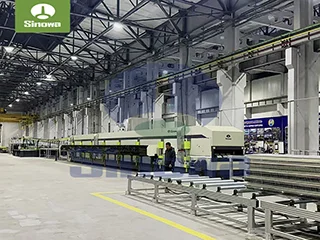
sandwich panel line
An Efficient Sandwich Panel Line typically consists of multiple components, including an unwinding system, a laminating and cutting system, an inner core material processing system, a composite and molding system, a curing and cutting system, a quality control system, and an automation and control system. These systems work together to ensure efficient operation of the production line and product quality.
Technology and Features
Highly automated: The Efficient Sandwich Panel Line adopts advanced automation control system, realizing the full process automation from raw material unwinding to finished product cutting and stacking. This greatly improves production efficiency and reduces labor costs.
Continuous production: The Efficient Sandwich Panel Line adopts a continuous production method, avoiding the waiting time in traditional intermittent production and further improving production efficiency.
Multifunctionality: The efficient continuous sandwich panel production line can produce sandwich panels of various specifications, including cores and panels of different thicknesses and materials. Meanwhile, the production line can also be customized according to customer needs to meet diverse market demands.
High precision: The efficient sandwich panel automatic production line adopts high-precision processing equipment and testing instruments to ensure the dimensional accuracy and surface quality of the products.
Energy saving and environmental protection: The high-efficiency sandwich panel continuous production line fully considers the requirements of energy saving and environmental protection in the design process, adopts advanced energy-saving technologies and environmentally friendly materials, and reduces energy consumption and environmental pollution.
Efficient Sandwich Panel Lines are widely used in various fields such as construction, cold chain, transportation, and agriculture. In the field of architecture, sandwich panels are used as wall, roof, and partition materials, with advantages such as lightweight, high strength, insulation, and sound insulation. In the field of cold chain, sandwich panels are used as cold storage panels with good insulation performance. In addition, sandwich panels are also used in fields such as transportation facilities and agricultural greenhouses.
With the rapid development of the construction industry and the increasing demand for building material performance, the market demand for Efficient Sandwich Panel Lines is also constantly increasing. In the future, Efficient Sandwich Panel Lines will pay more attention to technological innovation and intelligent development, improve production efficiency and product quality, while reducing energy consumption and environmental pollution to meet the diverse needs of the market.
When choosing an Efficient Sandwich Panel Line manufacturer, factors such as the manufacturer's scale, technical strength, production experience, and after-sales service need to be considered. Large scale and technically strong manufacturers are usually able to provide better products and services to meet the diverse needs of customers. At the same time, the manufacturer's production experience and after-sales service are also very important considerations, which are related to the stable operation and subsequent maintenance of the production line.
The Efficient Sandwich Panel Line has many advantages and plays an important role in modern building materials production. With the continuous advancement of technology and the continuous development of the market, Efficient Sandwich Panel Lines will usher in broader application prospects.
The modern construction and industrial manufacturing sectors are undergoing a profound shift toward sustainable, high-performance, and time-efficient building envelope solutions, driving unprecedented demand for composite structural materials that balance structural stability, thermal insulation, and installation convenience. Among these essential building components, sandwich panels have emerged as a foundational material for diverse construction projects, ranging from large-scale industrial warehouses and cold storage facilities to commercial buildings, residential prefabricated structures, and temporary modular construction units. At the heart of reliable and large-volume sandwich panel manufacturing lies the efficient sandwich panel line, a fully integrated and continuously operating production system engineered to streamline every stage of panel fabrication, from raw material feeding and surface sheet forming to core material compounding, adhesive bonding, thermal curing, final shaping, and finished product output. Unlike traditional fragmented production setups that rely on excessive manual intervention, disjointed processing stages, and inconsistent operational parameters, a well-designed efficient sandwich panel line unifies all production procedures into a seamless continuous workflow, eliminating production bottlenecks, reducing unnecessary material waste, stabilizing product structural uniformity, and significantly boosting overall production throughput to meet the ever-growing market demand for standardized and customized sandwich panel products. The core value of this advanced production line lies not only in its ability to mass-produce qualified sandwich panels steadily but also in its inherent flexibility, energy-saving performance, and intelligent operational controllability, enabling manufacturers to adapt rapidly to changing market requirements, optimize long-term production costs, and maintain consistent product quality across every batch of finished panels without compromising on structural durability or functional performance.
The overall structural layout and operational logic of an efficient sandwich panel line are scientifically planned based on the physical characteristics of raw materials, the bonding mechanism of composite structures, and the mechanical requirements of finished sandwich panels, with every functional unit precisely coordinated to achieve synchronous and orderly operation throughout the entire production cycle. The entire production system can be divided into several interconnected functional modules, each undertaking specific production tasks and linked together through automated conveying and transmission mechanisms to ensure zero interruption in material transportation and processing transition. The initial stage of the production process centers on the raw material unwinding and preliminary leveling module, which serves as the starting point for the entire panel manufacturing workflow. Metal surface sheets, the outer protective and structural layers of sandwich panels, are stored in large coiled forms to facilitate continuous feeding, and the unwinding equipment in this module is designed with stable hydraulic driving structures to ensure slow, uniform, and tension-controlled release of metal coils without causing surface deformation, wrinkling, or uneven stretching of the metal sheets. Maintaining stable tension during the unwinding process is extremely critical, as any irregular tension fluctuation will lead to inconsistent flatness of subsequent formed sheets, directly affecting the overall thickness uniformity and bonding tightness of the final composite sandwich panels. After unwinding, the metal sheets immediately enter the automatic leveling and straightening unit, which is equipped with multiple sets of precision arranged leveling rollers to eliminate the internal mechanical stress generated during metal coil winding and storage. This preliminary leveling process corrects subtle curvatures and surface irregularities on the metal sheets, ensuring that the surface materials entering the subsequent roll forming stage maintain perfect flatness and consistent thickness foundation, laying a solid prerequisite for precise profile forming and reliable later composite bonding work.
Following the preliminary leveling treatment, the flat metal sheets proceed to the roll forming and surface pretreatment module, a key stage that determines the external profile and surface adaptability of the finished sandwich panels. This module adopts a multi-pass progressive rolling process, utilizing a series of precisely calibrated forming rollers arranged in an orderly gradient to gradually shape the flat metal sheets into the required panel profiles with various grooves, ridges, and edge structures. The progressive rolling design avoids one-time excessive extrusion deformation of the metal material, effectively preventing surface cracking, edge warping, and structural fatigue of the metal sheets, and ensuring the dimensional accuracy and structural regularity of each formed panel profile. Each group of forming rollers in this module is finely adjusted and synchronized through unified control logic, ensuring that the forming speed of the upper and lower metal sheets remains completely consistent throughout the processing process, thus avoiding relative displacement and position deviation between the two surface materials during subsequent composite processing. In addition to profile forming, this stage also includes basic surface cleaning and auxiliary film laminating processes as needed, removing surface dust, oil stains, and impurities generated during metal processing to ensure that the adhesive applied in the subsequent bonding stage can form a tight and durable bonding interface between the metal surface sheets and the intermediate core material. The surface pretreatment work eliminates potential weak bonding points caused by surface contaminants, effectively enhancing the overall structural integrity and long-term service stability of the composite sandwich panels, and preventing delamination, peeling, and other quality problems that may occur during the long-term use of the panels in complex external environments.
While the metal surface sheets are undergoing roll forming and surface pretreatment, the intermediate core material processing and automatic conveying module operates synchronously in coordination, realizing the perfect docking of core material supply and surface sheet forming rhythm. The core materials used for sandwich panel production cover a variety of lightweight and high-insulation materials, each with different physical properties and processing requirements, and the efficient sandwich panel line is designed with strong compatibility to adapt to different core material types without major equipment modification. The core material processing unit is responsible for automatic cutting, trimming, and shaping of the bulk core materials, cutting the raw core materials into standardized specifications and sizes that match the formed metal surface sheets, and trimming irregular edges and excess parts to ensure the overall dimensional consistency of the core material layers. After processing, the core materials are automatically transported to the composite docking position through a special conveying device, with the conveying speed and docking position precisely synchronized with the running speed of the upper and lower metal surface sheets. This synchronous coordination ensures that the core material can be accurately placed between the two layers of metal sheets without offset, inclination, or misalignment, laying a good foundation for the subsequent integrated composite bonding process. The entire core material processing and conveying process is fully automated, requiring no manual handling or position adjustment, which not only greatly reduces manual labor input and avoids human error affecting product accuracy but also effectively improves the continuity and efficiency of the overall production line operation, ensuring that the core material supply rhythm always matches the high-speed production pace of the surface material processing.
The adhesive coating and integrated composite pressing module represent the core functional stage of the entire efficient sandwich panel line, directly determining the bonding strength, overall compactness, and structural durability of finished sandwich panels. Before the metal surface sheets and core material enter the composite pressing area, a high-precision automatic adhesive spraying and coating system evenly applies a quantitative and uniform layer of adhesive on the inner surfaces of both the upper and lower metal sheets and the upper and lower contact surfaces of the core material. The adhesive application system is equipped with precise flow control and spraying adjustment functions, which can automatically adjust the adhesive coating amount and coating uniformity according to different core material types, panel thickness specifications, and actual production environmental conditions. This precise adhesive coating technology avoids the problems of excessive adhesive waste caused by uneven manual gluing, insufficient local bonding strength due to too little adhesive, and internal bubble generation caused by uneven adhesive distribution. After the completion of adhesive coating, the upper and lower metal sheets and the intermediate core material are accurately aligned and sent into the high-pressure composite pressing unit together, where a stable and uniform pressing force is applied through multiple groups of pressing rollers and hydraulic pressing structures. The continuous and balanced pressure exerted in this process promotes the tight fitting of all composite layers, squeezes out residual air between the bonding interfaces, and ensures that the adhesive is fully infiltrated into the tiny gaps between the metal sheets and the core material, forming a solid and integrated composite structure as a whole. The pressure parameters of the composite pressing unit can be flexibly adjusted according to different panel thicknesses and material characteristics, ensuring that each type of sandwich panel can achieve the best bonding effect without causing excessive compression deformation of the lightweight core material or damage to the metal surface profiles.
Subsequent to composite pressing and preliminary bonding shaping, the initially formed sandwich panels enter the thermal curing and constant temperature shaping module, an essential link to accelerate adhesive curing and stabilize the overall structural shape of the panels. Although the composite pressing process completes the preliminary fitting and bonding of all layers, the adhesive needs a certain temperature and time to complete the chemical reaction and form stable bonding performance, and the overall composite structure also needs a constant temperature environment to eliminate internal stress and maintain fixed dimensional stability. The thermal curing unit of the efficient sandwich panel line adopts a scientific and uniform temperature distribution design, with the internal temperature evenly distributed in all areas of the curing furnace body, avoiding local overheating or insufficient temperature that may lead to inconsistent adhesive curing degree. The panels move forward at a constant and stable speed inside the curing furnace, ensuring that each part of every sandwich panel obtains the same curing time and temperature conditions, so that the adhesive can be fully cured evenly, forming a high-strength and durable bonding interface between all composite layers. At the same time, the constant temperature shaping process can effectively fix the overall thickness and structural shape of the sandwich panels, preventing panel deformation, warping, and thickness deviation caused by internal stress release after leaving the pressing unit. The temperature and running speed of the curing module can be intelligently adjusted according to different adhesive formulas and production speed requirements, balancing the curing effect and production efficiency, and ensuring that the panels can reach the required structural strength and shape stability in the shortest possible curing cycle without affecting subsequent processing procedures.
After completing thermal curing and constant temperature shaping, the fully formed and structurally stable sandwich panels enter the automatic fixed-length cutting, edge trimming and finishing processing module, which is responsible for converting continuous long-strip composite panels into finished products with standardized and customizable dimensional specifications. The efficient sandwich panel line is equipped with a high-precision automatic cutting system that can accurately measure and set the cutting length according to different customer order requirements, realizing automatic fixed-length cutting of continuous panels without stopping the production line. The non-stop cutting design avoids production interruption caused by intermittent cutting operation, effectively maintaining the continuous and efficient operation rhythm of the entire production line and greatly improving overall production efficiency. After fixed-length cutting, the edge trimming and finishing equipment automatically trims the excess edges and uneven parts of the cut panels, calibrates the overall dimensional accuracy of the panels, and polishes the edge positions to ensure that the finished sandwich panels have neat edges, accurate overall dimensions, and smooth surface appearance. This finishing processing not only improves the aesthetic quality of the finished products but also ensures the assembly accuracy of the panels during on-site construction and installation, facilitating seamless splicing and installation between panels and improving the overall construction efficiency of engineering projects. All cutting and finishing processes are automatically controlled by the system, with high processing accuracy and stable operation effect, avoiding dimensional errors and edge damage problems caused by manual cutting and trimming.
Intelligent real-time quality monitoring and automatic operation control systems run through the entire operation process of the efficient sandwich panel line, becoming an important guarantee for stable production quality and long-term efficient operation. The entire production line adopts a centralized integrated control mode, with all functional modules interconnected through a unified control system, realizing synchronous linkage operation and coordinated parameter adjustment between each processing unit. The system is equipped with real-time thickness monitoring, running speed detection, pressure parameter feedback, and defect detection functions, which can continuously monitor key production indicators such as panel thickness uniformity, bonding pressure stability, curing temperature consistency, and surface forming quality during the entire production process. Once abnormal parameter fluctuations or potential product quality defects are detected, the control system will automatically send early warning prompts and make real-time fine-tuning of relevant equipment operating parameters, avoiding the mass production of defective products. The real-time quality monitoring function replaces traditional post-production manual sampling inspection, realizing online full-process quality control, greatly improving the timeliness and comprehensiveness of quality management, and effectively reducing the defective product rate and subsequent rework costs. In addition, the control system has a simple and intuitive operation interface, which is convenient for production operators to set production parameters, adjust production specifications, and view real-time production data, reducing the difficulty of equipment operation and shortening the operator training cycle.
In terms of energy consumption control and environmentally friendly production operation, the efficient sandwich panel line is designed with optimized energy-saving structures and low-consumption operation modes, adapting to the current global development trend of green construction and low-carbon manufacturing. All driving motors and heating units of the production line adopt energy-saving optimized design, which can automatically adjust power output according to actual production load, avoiding long-term no-load operation and invalid energy waste. The thermal curing furnace is equipped with effective heat preservation and heat recovery structures, reducing heat loss during the curing process and improving heat energy utilization efficiency, thus effectively reducing overall production energy consumption and long-term production operation costs. At the same time, the entire production process of the sandwich panel line is carried out in a closed and orderly operating environment, with no excessive dust, waste gas, or noise pollution generated during processing. The residual materials and edge materials generated during cutting and trimming can be centrally recycled and reused, realizing effective utilization of production resources and reducing production material waste and environmental pressure. The environmentally friendly and energy-saving design not only enables manufacturers to meet relevant green production requirements but also reduces daily production operating costs, improving the overall economic and environmental benefits of sandwich panel production and processing operations.
The outstanding advantages of the efficient sandwich panel line in production continuity, operational flexibility, quality stability, and cost controllability make it an indispensable core production equipment in the current sandwich panel manufacturing industry. In actual industrial production and market application, this advanced production line can quickly switch production specifications according to different project needs, producing sandwich panels with different thicknesses, core material types, and surface profile styles to meet the diverse application needs of different construction scenarios and engineering projects. Whether it is large-scale batch production of standard wall and roof sandwich panels for industrial plants and logistics warehouses, or customized production of special insulation and fireproof sandwich panels for cold storage, clean rooms, and special industrial buildings, the efficient sandwich panel line can maintain stable and efficient production output and reliable product quality. With the continuous development of the construction industry toward prefabrication, modularization, and greenization, the market demand for high-quality and high-performance sandwich panels will continue to rise, and the importance of efficient and automated sandwich panel production equipment will become more prominent. By adopting an efficient sandwich panel line, sandwich panel manufacturing enterprises can not only improve production efficiency, reduce production costs, and stabilize product quality but also enhance their market competitiveness, better adapt to market changes and industry development trends, and provide high-quality and reliable composite building materials for the construction of various modern engineering projects.
https://www.cnsinowa.com/sandwich-panel-machines/efficient-sandwich-panel-line.html