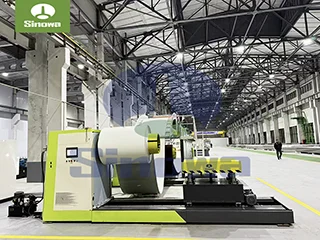
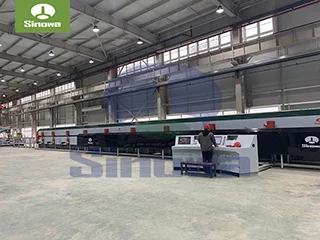
sandwich panel machine
Before starting any formal production work with the PU sandwich panel machine, comprehensive and meticulous pre-production preparation and full-condition inspection of the entire production line must be completed, which is the primary prerequisite to ensure the smooth progress of subsequent production and avoid various abnormal faults during equipment operation. The first step of pre-production preparation is the sorting and inspection of all production raw materials required for processing, including metal surface substrates used for the upper and lower layers of sandwich panels, polyurethane foaming raw materials, auxiliary chemical materials for foaming reaction and bonding assistance, and edge sealing and protective auxiliary materials for panel finishing. Operators need to check the surface integrity of the surface substrates to ensure there is no obvious deformation, surface scratch, rust spot, oil stain or edge damage on the substrates, because any surface defect of the substrates will directly affect the subsequent laminating and bonding effect with the PU foaming core material, resulting in poor surface flatness of finished panels and weak bonding fastness between layers. At the same time, it is necessary to confirm that all polyurethane foaming raw materials are stored in a dry and constant-temperature storage environment in accordance with basic storage requirements, with no raw material deterioration, component precipitation or mixing failure caused by long-term storage or improper temperature control, and check the compatibility and proportion matching of various auxiliary materials to ensure that the raw material ratio required for foaming reaction can meet the basic molding and performance standards of sandwich panels. After the raw material inspection is completed, operators need to conduct a full mechanical inspection of each component of the PU sandwich panel machine production line, covering the uncoiling feeding structure, roll forming mechanism, preheating auxiliary system, high-pressure foaming injection device, double-belt laminating and pressing system, fixed-length cutting mechanism, cooling shaping system and finished product stacking and conveying structure. It is necessary to carefully check whether the connecting parts of each transmission component are firm, whether the fastening bolts and connecting fasteners of key mechanical structures are loose or falling off, whether the rotating rollers, conveying belts and transmission chains of the conveying and forming parts are worn, aged or deviated in operation position, and whether there is foreign matter accumulation or sundry blockage inside the equipment operation gap and material conveying channel. In addition, the inspection of power supply, pneumatic transmission and hydraulic control systems of the equipment cannot be ignored, operators need to check whether the power connection lines are in good contact with no aging damage or leakage hidden danger, whether the pneumatic and hydraulic pipelines are well connected with no air leakage or liquid leakage, and whether the pressure indicating parts of each control system are in the normal standby range, ensuring that all power and power support systems can respond stably after the equipment is started.
After completing all pre-production raw material preparation and equipment comprehensive inspection and confirming that all links meet the standby production conditions, the next core step is equipment preheating operation and no-load trial debugging, which is a key link to eliminate potential hidden troubles of equipment operation and lay a foundation for accurate setting of production parameters. The PU sandwich panel machine needs a certain preheating period before formal production, especially for the preheating system of the laminating molding part and the foaming injection system, stable and appropriate temperature conditions are essential for the smooth progress of polyurethane foaming reaction and the firm bonding between core material and substrate. Operators need to start the equipment power supply and each auxiliary control system in a fixed sequential order, instead of starting multiple core systems in a disorderly and concentrated manner, so as to avoid instantaneous power impact and system operation disorder caused by simultaneous startup of multiple devices. After the system is started, keep the equipment in no-load standby state for a period of time to make all mechanical transmission parts, heating components and control circuits run stably and reach the basic working temperature and operating state. During the no-load standby process, operators need to carefully observe the operation state of each part of the equipment, listen to whether there is abnormal friction sound, impact sound or harsh vibration noise during the operation of mechanical components, observe whether the operation speed of each transmission structure is uniform and stable without sudden stop, sudden speed change or jitter deviation, and check whether the temperature rise of the heating system is uniform and whether the pressure data of the pneumatic and hydraulic systems is stable within the preset standard range. If any abnormal operation phenomenon is found during the no-load standby process, the equipment must be shut down immediately for inspection and troubleshooting, and formal parameter debugging and production operation can only be carried out after all abnormal problems are completely solved and the equipment returns to normal standby state. After the no-load standby is stable and no abnormal conditions are confirmed, operators need to set and adjust core production parameters according to the required specifications, thickness, thermal insulation performance and structural strength of the produced sandwich panels, including equipment operating speed, foaming material injection flow rate, laminating pressing pressure, preheating and molding temperature, and fixed-length cutting size parameters. Each parameter adjustment needs to be carried out slowly and finely in combination with actual production demand, avoiding one-time large-scale parameter adjustment which may cause equipment operation mismatch and unbalanced foaming reaction. After the parameters are initially set, conduct short-time no-load trial operation again to verify whether the parameter matching of each system is reasonable, whether the equipment action coordination is accurate and in place, and ensure that all parameter settings are in the best state suitable for the current production task.
After the completion of equipment preheating and parameter debugging and all standby work are ready, the PU sandwich panel machine can be officially started for formal continuous production operation, and standardized operation and real-time dynamic monitoring must be adhered to throughout the whole production process to ensure stable production rhythm and consistent finished product quality. At the initial stage of formal production, operators need to slowly send the surface substrate into the uncoiling and feeding part of the equipment, and guide the substrate to pass through the roll forming mechanism, preheating area, foaming injection position and double-belt laminating structure in sequence according to the production line operation direction, ensuring that the substrate feeding position is accurate, the conveying is smooth and there is no deviation, wrinkling or stacking dislocation during the conveying process. When the substrate runs to the foaming injection station, the high-pressure foaming injection system will uniformly spray the fully mixed polyurethane raw materials between the upper and lower layers of the substrate according to the preset flow rate and proportion, and the polyurethane materials will undergo rapid chemical foaming reaction immediately after injection to form a uniform and dense thermal insulation core layer. In this process, operators need to keep an eye on the foaming state of the core material in real time, observe whether the foaming range is uniform, whether the foaming density is consistent, and whether there is local insufficient foaming, excessive foaming or uneven core material distribution, and fine-tune the injection flow rate and raw material ratio parameters in a timely manner according to the actual foaming situation to ensure that the core material meets the structural performance requirements. Subsequently, the substrate with the foaming core material will enter the double-belt laminating and pressing system, and under the stable pressing pressure and constant temperature environment set by the equipment, the upper and lower substrates are tightly compounded with the PU foaming core material to form an integrated sandwich panel structure, realizing firm bonding between layers and overall structural shaping. In the laminating and pressing link, operators need to monitor the pressing pressure and operating speed of the laminating system in real time to avoid product quality problems such as weak bonding, core material dislocation and panel surface unevenness caused by unstable pressure or mismatched speed.
With the continuous operation of the production line, the initially formed sandwich panel will be continuously conveyed to the cooling shaping area and fixed-length cutting position for subsequent processing procedures. The cooling shaping link is crucial for the final solidification and structural stability of the PU foaming core material, and the finished panel can only maintain stable hardness, flatness and bonding fastness after sufficient cooling and solidification. Operators need to ensure that the cooling system operates stably during this process, avoid too fast or too slow cooling speed which may affect the internal structural shaping of the core material, and prevent quality defects such as panel deformation and core material cracking caused by unreasonable cooling treatment. After cooling and shaping, the continuous long-strip sandwich panel will be automatically cut into the required fixed length by the equipment cutting mechanism according to the preset size parameters. During the cutting operation, it is necessary to ensure that the cutting position is accurate, the cutting section is flat and neat, and there is no edge collapse, burr or dimensional deviation of the panel. After cutting, the finished sandwich panels will be automatically conveyed to the finished product stacking area through the conveying system, and the stacking structure will neatly stack the qualified finished panels to facilitate subsequent handling and storage. Throughout the continuous production process, operators must not leave the production post without permission, and need to regularly patrol each key operation section of the production line, regularly check the operation wear of equipment components, the consumption of raw materials, and the quality state of semi-finished and finished products, and make real-time production operation records, including equipment operation time, parameter adjustment conditions, raw material consumption and daily production output, so as to provide data support for subsequent equipment maintenance and production arrangement.
In addition to standardized operation in the production process, daily maintenance and standardized shutdown management in the use of PU sandwich panel machine are also important parts of correct equipment use, which directly affect the service life and long-term stable operation performance of the equipment. When the daily production task is completed or production needs to be suspended for a long time, operators must follow the standardized shutdown sequence to shut down the equipment, instead of directly cutting off the main power supply to force shutdown. The correct shutdown procedure is to first stop the raw material feeding and foaming injection system, then gradually reduce the operating speed of the production line, stop the conveying and laminating operation after all semi-finished products in the equipment are completely processed and conveyed out of the production line, then turn off the heating system and hydraulic and pneumatic control systems in sequence, and finally cut off the main power supply of the equipment. After the equipment is completely shut down and the temperature of each component drops to the normal temperature state, comprehensive cleaning and daily maintenance of the equipment must be carried out in a timely manner. The cleaning work mainly includes cleaning the residual polyurethane raw materials, foaming residues and sundry dirt inside the foaming injection device and the production line conveying channel, wiping the surface of mechanical components and control parts to keep the equipment clean and tidy, and removing the accumulated sundries and waste materials around the equipment to ensure the production environment is neat and orderly. The daily maintenance work includes regularly checking the lubrication state of each transmission bearing, rotating roller and chain component, adding professional lubricating oil in time to reduce mechanical friction and wear, checking the wear degree of vulnerable parts of the equipment regularly, replacing aging and damaged parts in a timely manner, and checking the tightness of all connecting pipelines and fasteners to ensure that the equipment is in good mechanical state for the next production use. At the same time, operators need to regularly summarize the equipment operation faults and problems encountered in daily use, record the fault causes and troubleshooting methods, and form a complete equipment use and maintenance file, which is convenient for subsequent equipment management and maintenance work, and effectively avoids small faults accumulating into major equipment failures affecting production.
In the long-term use process of PU sandwich panel machine, adhering to standardized operation habits and scientific maintenance management concepts is far more important than simply pursuing production speed and output. Many equipment failures and product quality problems in actual production are not caused by equipment quality defects, but by irregular daily operation, neglected pre-production inspection, untimely maintenance and random parameter adjustment by operators. Every operator who engages in the operation of PU sandwich panel machine must establish a safe and standardized operation awareness, strictly abide by the whole process operation procedures from pre-production preparation, formal production operation to post-production shutdown maintenance, earnestly implement every operation and inspection detail, and always take equipment stable operation and product quality stability as the core work goal. Only by standardizing every operation link in the use of the equipment, doing a good job in every maintenance and inspection work, can the PU sandwich panel machine always maintain efficient and stable production operation state, effectively extend the overall service life of the equipment, reduce enterprise production and maintenance costs, produce high-quality and high-performance PU sandwich panel products that meet the needs of various construction projects, and create stable and reliable production benefits for building material production enterprises in the long-term production and operation process.
https://www.cnsinowa.com/sandwich-panel-machines/how-to-use-pu-sandwich-panel-machine.html