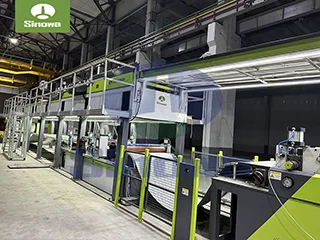
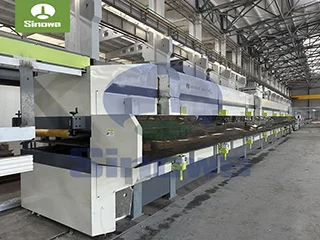
sandwich panel line
The overall structural design of a sandwich panel assembly line follows the logic of continuous industrial production, with all functional units arranged in a linear and streamlined layout to ensure unobstructed material transportation and seamless connection between processing procedures. The entire production system can be divided into multiple interrelated functional modules according to the production sequence, including raw material pretreatment module, surface layer feeding module, core material processing module, adhesive coating module, composite pressing module, curing and shaping module, fixed-length cutting module, surface finishing module and finished product conveying module. Each module is equipped with independent driving and sensing components, and all modules are coordinated through a centralized control system to achieve synchronous operation. The modular design not only simplifies the daily maintenance and component replacement work of the production line, but also endows the equipment with flexible adjustment capabilities, enabling it to adapt to the production requirements of sandwich panels with different thicknesses, surface materials and core material types.
Raw material pretreatment serves as the initial link of the entire production process, laying a solid foundation for the subsequent composite molding of sandwich panels. The raw materials involved in production mainly include metal flat sheets for outer layers, organic or inorganic foam materials for inner cores, and high-performance polymer adhesives for bonding. For metal surface materials, common raw materials are smooth metal coils with uniform thickness. Before entering the formal assembly process, these coil materials need to undergo surface pretreatment to remove oil stains, oxide layers and floating impurities generated during metal rolling and storage. The pretreatment process includes physical cleaning and surface smoothing. Mechanical brushing devices are used to polish both sides of the metal coil to eliminate tiny burrs and uneven protrusions on the surface, while circulating cleaning agents are sprayed to dissolve surface oil contaminants. After cleaning, the metal sheets are dried through constant-temperature air-drying equipment to ensure no residual moisture remains on the surface, because moisture will seriously affect the bonding strength between the metal layer and the core material, and even cause delamination defects during long-term use. In addition, the flatness and thickness of metal sheets are precisely detected by online sensing equipment during the pretreatment stage, and unqualified raw materials with excessive thickness deviation or surface depressions are automatically screened out to avoid affecting the overall quality of finished products.
The feeding and unwinding unit is responsible for the stable supply of surface layer materials, and its operating stability is crucial to maintain the continuity of production. This unit is mainly composed of coil unwinding racks, tension control devices and guiding correction mechanisms. The metal coils are fixed on the unwinding racks through mechanical clamping structures, and the racks are equipped with hydraulic lifting components to facilitate the rapid replacement of raw material coils. During the unwinding process, the tension sensor monitors the stretching state of the metal sheet in real time. When the sheet is too loose or over-tensioned, the system will automatically adjust the rotating speed of the unwinding motor to keep the metal sheet in a constant tension state. This tension control technology effectively prevents the metal sheet from wrinkling, stretching or deviating during transportation. The guiding correction mechanism adopts an infrared sensing structure to identify the lateral offset of the sheet. Once the offset exceeds the preset range, the correction roller group will automatically deflect to push the sheet back to the central conveying track, ensuring that the upper and lower surface layers can be accurately aligned in the subsequent composite process. For non-metal surface materials such as fiber-reinforced plates, the feeding unit is equipped with customized clamping and conveying structures to adapt to the hardness and friction characteristics of different materials.
Core material processing and feeding is a key link that determines the thermal insulation and shock absorption performance of sandwich panels. Common core materials include closed-cell foam materials, inorganic fiber cotton and lightweight granular fillers. Different from the continuous supply of coiled surface materials, most core materials are supplied in sheet or block form, so the processing unit is equipped with cutting, shaping and densification equipment. Bulk core materials are firstly sent to the trimming device to cut off irregular edges, so that the geometric dimensions of each core material block maintain a unified standard. For porous core materials with loose internal structure, mechanical rolling and compacting treatment is required to optimize the internal pore distribution, reduce the void ratio, and enhance the overall compression resistance of the core layer. In addition, the surface of the core material needs to be polished to increase surface roughness. The properly roughened surface can improve the contact area between the core material and the adhesive, thereby strengthening the bonding effect. After processing, the core materials are arranged at equal intervals by an automatic arranging machine, and are accurately transported to the middle position of the upper and lower surface layers through a synchronous conveying mechanism, realizing the precise docking of the three layers of materials.
Adhesive coating technology is the core process to realize the composite integration of sandwich panels, and the coating uniformity and adhesive dosage directly affect the bonding durability of finished products. The assembly line is equipped with an automatic gluing system, which includes adhesive storage tanks, constant-temperature stirring devices, quantitative conveying pumps and roller coating assemblies. The adhesive is stored in a sealed tank, and the internal temperature is kept within a stable range through a heating and heat-preserving structure to prevent the adhesive from solidifying or deteriorating due to temperature changes. The stirring blades inside the tank keep rotating at a low speed to avoid component precipitation and ensure the uniformity of the adhesive composition. Driven by the quantitative pump, the adhesive is evenly transported to the coating rollers. The gap between the upper and lower coating rollers can be accurately adjusted according to the material permeability and production requirements to control the coating thickness. In the formal coating process, the metal surface layer passes through the gap of the coating rollers, and a uniform adhesive film is formed on the inner surface. For core materials with strong water absorption, double-sided gluing treatment is adopted to further enhance the bonding tightness. The entire gluing process is carried out in a closed dust-proof space to prevent floating dust from adhering to the adhesive surface and causing bonding defects.
Composite pressing is the molding stage of sandwich panels, which completes the close fitting and preliminary bonding of surface layers and core materials. The pressing unit is composed of multi-group pressing roller sets, hydraulic pressure regulating systems and temperature auxiliary components. After the glued surface materials and core materials are accurately assembled, they enter the pressing area at a constant conveying speed. The pressing rollers are arranged symmetrically up and down, and the vertical spacing between the rollers corresponds to the designed thickness of the finished panel. The hydraulic system provides stable and continuous pressing force, which acts evenly on the surface of the composite board to squeeze out the residual air between layers and make the adhesive fully infiltrate into the tiny gaps of the material surface. Different pressing pressures are set according to the hardness of core materials: low-pressure pressing is adopted for soft porous core materials to avoid internal structural collapse, while medium and high pressure is applied for rigid inorganic core materials to eliminate interlayer gaps. Some advanced assembly lines are equipped with constant-temperature pressing structures. Appropriate temperature can accelerate the molecular movement of the adhesive, shorten the initial curing time, and improve the production efficiency while ensuring the flatness of the board surface.
Curing and shaping is an essential process to stabilize the structural performance of sandwich panels. After preliminary pressing, the interlayer adhesive has not completed the chemical curing reaction, and the composite structure is prone to deformation and delamination under external force. Therefore, the semi-finished panels need to be transported to the constant-temperature curing channel for continuous maintenance. The interior of the curing channel is divided into multiple temperature control sections, with the temperature gradually rising from the inlet to the middle section and then slowly decreasing. This gradient temperature change mode can avoid structural cracks caused by excessive temperature difference and thermal expansion and contraction. During the curing process, the conveying speed of the panels is kept low and stable, so that each position of the panel can obtain sufficient curing time. With the gradual completion of the cross-linking reaction of the adhesive molecules, the bonding strength between layers is continuously improved, and the overall rigidity and shape stability of the panel are enhanced. In order to avoid surface scratches during curing, the supporting rollers in the curing channel are wrapped with high-temperature resistant flexible materials. Meanwhile, the dust isolation structure is adopted to keep the internal environment clean, ensuring that the surface of the finished panel is smooth and free of impurity attachments.
Fixed-length cutting and edge trimming processes realize the size standardization of finished sandwich panels. After curing and shaping, the continuous long-strip composite boards are transported to the cutting unit. This unit is equipped with high-precision servo cutting systems and circular saw blades made of wear-resistant alloy materials. Before cutting, the laser ranging sensor measures the conveying length of the panel in real time, and sends positioning signals to the control system. When the panel reaches the preset cutting size, the conveying mechanism temporarily maintains a stable speed, and the cutting tool cuts vertically along the set cutting line. The cutting speed and blade rotating speed are matched intelligently to ensure smooth and burr-free cutting sections. For the edge parts of the panel, the edge trimming device is used to cut off the uneven margins on both sides, so that the width of each finished panel is completely consistent. In addition, the cutting unit is equipped with a scrap recovery structure, which collects the cut leftover materials through negative pressure adsorption, realizing centralized recycling of waste materials and reducing material waste. All cutting parameters can be adjusted through the control terminal to adapt to different customized size requirements.
Surface finishing and quality inspection constitute the final processing and screening links of the production line. After cutting, the surface of individual panels may have tiny adhesive residues and cutting burrs, so the finishing unit uses flexible polishing tools to perform fine grinding on the panel surface and cutting sections to optimize surface smoothness. At the same time, anti-scratch protective films are automatically pasted on both sides of the panels to avoid surface abrasion during transportation and stacking. The online quality inspection system runs synchronously with the finishing process, including visual inspection, flatness detection and thickness measurement. The high-definition industrial camera captures the surface image of the panel, and the intelligent algorithm identifies surface defects such as depressions, cracks and uneven coating. The ultrasonic thickness gauge detects the thickness of different positions of the panel to judge whether the internal structure is uniform. Panels that meet the quality standards are automatically sent to the finished product stacking area through the conveying roller table, while unqualified products are marked and separately transported to the reprocessing area for subsequent repair or recycling.
The automatic control system is the brain of the entire sandwich panel assembly line, realizing the centralized management and intelligent scheduling of all functional units. The system takes programmable logic controllers as the core, and is connected with various sensors, execution motors and regulating valves through signal lines. The human-computer interaction terminal displays the operating parameters of each module in real time, including conveying speed, pressing pressure, curing temperature, adhesive flow rate and cutting size. Production technicians can input production parameters on the touch screen to complete the switching of production specifications, and the system will automatically synchronously adjust the operating state of each equipment to realize unmanned parameter setting. In terms of safety control, the system is equipped with abnormal signal feedback mechanisms. When equipment jamming, material breakage or temperature abnormality occurs, the system will immediately trigger an alarm and automatically stop the operation of related units to prevent equipment damage and production safety accidents. In addition, the control system has a data storage function, which records daily production output, qualified product rate and equipment operating status, providing data support for production management and equipment maintenance.
The auxiliary supporting system ensures the long-term stable and efficient operation of the assembly line, covering power supply, pneumatic transmission, heat dissipation and dust removal structures. The power supply system adopts low-voltage stable power distribution to avoid voltage fluctuation affecting the operating accuracy of precision sensors and servo motors. The pneumatic transmission system provides power for small clamping, lifting and adjusting components, with the advantages of fast response and low energy consumption. The circulating heat dissipation device is installed on the surface of high-power operating equipment to dissipate heat generated by mechanical friction and circuit operation in a timely manner, preventing equipment aging caused by long-term high-temperature operation. The dust removal system uses negative pressure ventilation to collect dust and debris generated during cutting and polishing, keeping the production workshop clean and reducing the impact of dust on equipment operation and product quality. All auxiliary systems are designed with energy-saving logic, which can automatically reduce energy consumption during equipment standby, effectively reducing the comprehensive production energy consumption.
The reasonable layout and environmental adaptability of the sandwich panel line are important factors affecting production efficiency. In terms of spatial layout, the production line arranges processing units according to the material conveying sequence, with short connecting channels between adjacent units to reduce material conveying distance and space occupation. The bottom of the equipment is equipped with shock-absorbing bases to reduce vibration transmission during high-speed operation, avoiding mutual interference between different equipment. In terms of environmental adaptation, the key mechanical components are treated with anti-rust and anti-corrosion coatings to adapt to humid and dusty production environments. The sealing structure is adopted at the joint of each module to prevent dust and moisture from entering the equipment interior and damaging precision parts. The production line can normally operate within a certain temperature and humidity range, and the internal temperature and humidity can be adjusted appropriately according to the external environmental changes to ensure the stability of the adhesive curing reaction and material processing quality.
Daily maintenance and fault diagnosis are crucial to extend the service life of the sandwich panel assembly line and maintain stable production capacity. Daily maintenance work includes surface cleaning of equipment, lubrication of transmission bearings, inspection of pipeline tightness and calibration of sensing components. The residual adhesive and metal debris on the equipment surface need to be cleaned regularly to avoid solidified impurities affecting the operating flexibility of mechanical parts. The transmission bearings and gears are coated with high-temperature resistant lubricating oil to reduce friction loss and noise during operation. The staff regularly checks the air pressure pipelines and adhesive conveying pipelines to prevent material leakage caused by pipeline aging and loosening. For temperature sensors and displacement sensors, regular calibration is carried out to ensure the accuracy of monitoring data. In terms of fault diagnosis, the control system has a built-in fault code database. When equipment fails, the corresponding fault code is displayed on the interaction terminal, and the system gives targeted maintenance suggestions. Common faults such as material deviation, uneven gluing and insufficient pressing force can be quickly located and eliminated through manual debugging.
With the continuous upgrading of industrial manufacturing technology, the development trend of sandwich panel production line is gradually moving towards high automation, intelligent optimization and green environmental protection. In terms of automation, the degree of manual intervention in the production process is continuously reduced. The automatic coil replacement system and intelligent material sorting system realize unattended continuous production, effectively improving production efficiency and reducing labor costs. In terms of intelligent optimization, the production line introduces machine vision and artificial intelligence algorithms to realize real-time identification and automatic adjustment of material defects, further improving the product qualification rate. The adaptive parameter matching technology enables the equipment to automatically adjust processing parameters according to different raw material characteristics, expanding the application range of production materials. In terms of green production, the new generation assembly line optimizes the adhesive circulation system to reduce adhesive volatilization and waste. The waste material crushing and recycling device realizes the secondary utilization of leftover materials, and the noise reduction structure effectively reduces the operating noise of the equipment, meeting the environmental protection requirements of modern industrial production.
In practical industrial application, the sandwich panel assembly line has strong production flexibility and can meet the production needs of multiple types of panels. It can produce lightweight thermal insulation panels for building enclosures, fire-resistant isolation panels for industrial workshops, and moisture-proof decorative panels for indoor spaces by replacing raw materials and adjusting production parameters. The panels produced by the assembly line have consistent structural performance, stable bonding strength and excellent surface flatness, which can adapt to complex application environments such as high temperature, low temperature and humid corrosion. Compared with traditional manual and semi-mechanical production methods, the automated assembly line has obvious advantages in production efficiency, product consistency and production cost control, which greatly promotes the large-scale popularization and application of sandwich panels in construction, logistics, medical treatment and industrial manufacturing fields.
In conclusion, the sandwich panel assembly line is a comprehensive industrial production system integrating mechanical manufacturing, chemical technology and intelligent control. Each functional module in the production line cooperates closely to complete the whole process from raw material pretreatment to finished product stacking. Through precise mechanical transmission, stable chemical bonding and intelligent parameter control, the assembly line realizes standardized and high-efficiency production of sandwich panels. With the continuous progress of material science and mechanical manufacturing technology, the structural design of the sandwich panel assembly line will be more optimized, the automation level will be further improved, and the production performance will be more stable. It will continue to provide reliable equipment support for the development of the composite building material industry, and make important contributions to the upgrading of modern construction engineering and industrial manufacturing industries. In the future, with the increasing demand for energy-saving and environmental-friendly building materials in the market, the technological innovation and application promotion of sandwich panel assembly lines will also usher in a broader development space, continuously promoting the high-quality development of the entire industrial chain.
https://www.cnsinowa.com/sandwich-panel-machines/sandwich-panel-assembly-line.html