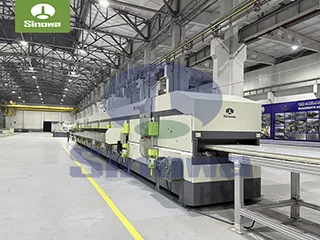
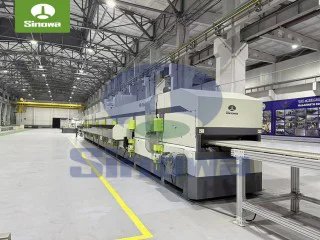
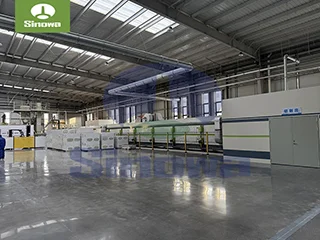
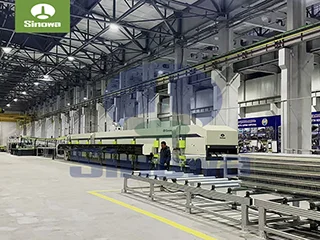
sandwich panel line
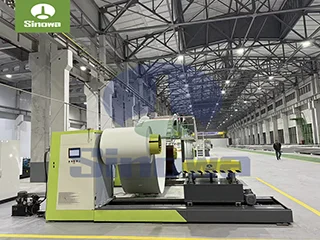
The overall operational logic of a foam core sandwich panel line revolves around the synchronous coordination of raw material delivery, chemical foaming reaction, mechanical composite molding, and post-processing finishing, with every functional unit closely linked to form a closed-loop continuous production system. The entire manufacturing process starts with the preparation of surface layer materials and foam core raw materials. Surface layer materials, usually metal sheets or other rigid decorative and protective substrates, undergo pre-treatment processes such as uncoiling, leveling, and surface cleaning to remove surface impurities, eliminate internal stress generated during material coiling, and ensure flat and smooth surface conditions for subsequent composite bonding. This pre-treatment step is essential for improving the fitting tightness between the surface layer and foam core, as uneven surfaces or residual stains will directly weaken the interfacial bonding effect, leading to delamination or structural instability of the finished panels in long-term use.
In the foam raw material processing section, the PU foam production line adopts independent storage and conveying structures for different liquid raw material components. Various foam precursor materials are stored in sealed tanks with constant temperature maintenance functions to avoid component deterioration or viscosity changes caused by temperature fluctuations, which could affect the foaming reaction effect. The core of this link lies in the precision metering and dynamic mixing system, which uses variable-frequency drive metering devices to accurately control the output ratio of each raw material component according to preset production parameters. The proportional matching of raw materials directly determines the key performance indicators of the foam core, including foam density, cell structure uniformity, thermal insulation performance, and compression resistance. After precise proportioning, all raw materials are transported to a high-speed mixing unit for full homogeneous blending, ensuring that catalyst, foaming agent, and base materials are evenly fused at the molecular level, laying a foundation for uniform and stable foaming reactions.
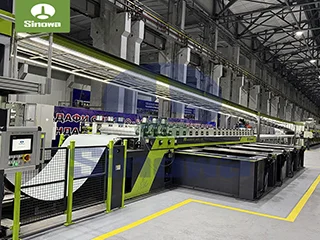
Once fully mixed, the fluid foam composite is quickly transported to the oscillating coating gantry system, which achieves uniform linear spraying and pouring of the mixed material between the upper and lower surface layers that are continuously conveyed at a constant speed. The gantry's reciprocating oscillating movement effectively avoids local accumulation or sparse distribution of foam materials, ensuring that the thickness of the foam core in the initial molding stage maintains consistent uniformity in both horizontal and vertical directions. As the surface layers carrying the foam raw materials enter the double-belt pressing and curing unit, the foaming reaction proceeds rapidly under the dual action of appropriate temperature and mechanical pressure. The closed space formed by the upper and lower circulating belts of the double-belt device acts as a continuous moving mold, restricting the free expansion of the foam and guiding the foam to expand evenly in the set thickness range.
During the curing and compounding process inside the double-belt unit, the foam material completes three key physical and chemical changes: rapid expansion to fill the entire interlayer space, solidification and molding through cross-linking reactions, and tight bonding with the inner surface of the upper and lower layers. The constant-temperature control system of the continuous sandwich panel line maintains a stable reaction environment inside the curing channel, preventing excessive or insufficient reaction caused by temperature deviation. Excessively high temperature will lead to rapid foaming and premature surface solidification, resulting in hollow interiors and loose cell structures of the foam core; while excessively low temperature will slow down the reaction speed, cause incomplete foaming, reduce foam expansion rate, and increase material density, which not only affects the lightweight advantage of the product but also weakens thermal insulation and shock resistance. Reasonable temperature matching and pressure maintaining parameters enable the foam core to form a closed-cell uniform structure, and form a seamless integrated bonding state with the surface layers, effectively improving the overall structural integrity and load-bearing capacity of the sandwich panel.
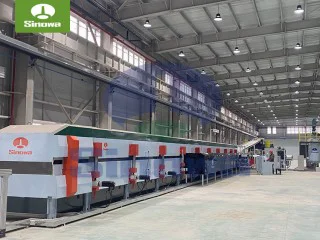
After completing the curing and composite molding process, the continuous strip-shaped sandwich panel is transported to the cooling and shaping unit. The high-temperature panel just out of the curing channel has not yet completely stabilized in internal structure, and rapid or uneven cooling will cause internal stress imbalance, leading to panel bending, deformation or size deviation. The production line adopts gradual air cooling and heat dissipation structures to reduce the panel temperature uniformly and slowly, allowing the internal molecular structure of the foam core to complete secondary stabilization and eliminate residual molding stress. The cooling process is matched with synchronous linear conveying to ensure that the panel remains flat and stable during movement, maintaining the straightness and flatness of the overall structure.
The precision cutting and trimming unit is responsible for converting continuous strip panels into finished products of standard specifications. Equipped with high-stability cross-cutting and edge-trimming structures, this unit can complete fixed-length cutting and edge finishing according to customized dimensional requirements. The cutting system features high-precision blade operation and stable conveying positioning, which can achieve smooth cutting sections without burrs, cracks or material peeling, and effectively protect the integrity of the edge structure of the foam core and surface layers. For different types of foam materials and surface layer substrates, the foam sandwich panel machine can adjust cutting speed and blade operating parameters adaptively to avoid structural damage caused by improper cutting force, ensuring that the dimensional tolerance of each finished panel is controlled within a tiny range and the consistency of batch products is guaranteed.
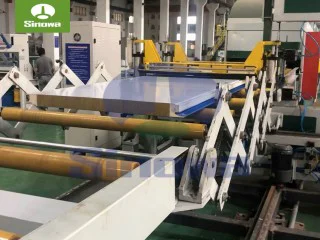
The final stage of the production process covers finished product conveying, stacking and auxiliary finishing. The cut standard panels are automatically conveyed to the sorting platform, where unqualified products with minor defects are manually screened out, while qualified products are stacked neatly by an automatic stacking device. The orderly stacked panels are convenient for subsequent packaging, storage and transportation, reducing manual handling errors and product damage rates in the turnover process. The entire production process from raw material input to finished product output is continuous and uninterrupted, with all functional units operating in synchronous linkage, which greatly improves production efficiency compared with traditional discontinuous production modes and reduces manual operation links.
The core advantages of foaming sandwich panel production line is reflected in high automation, stable product performance and flexible production adaptability. In terms of automated control, the entire production process adopts integrated parameter regulation, and key indicators such as raw material proportioning, foaming temperature, pressing pressure, conveying speed and cutting size can be intelligently adjusted according to different product design requirements. This intelligent regulation mode avoids the instability of product quality caused by empirical operation, and realizes standardized and standardized production of sandwich panels. For different application scenarios, the production line can adaptively produce foam sandwich panels with different core densities, thickness specifications and structural strengths by adjusting process parameters, meeting the diversified needs of different fields.
In terms of product performance control, the continuous foaming and composite molding technology of the foam board production line ensures that the internal cell structure of the foam core is fine and uniform, with no uneven density or local hollow defects. The integrated composite structure formed by synchronous foaming and bonding makes the surface layers and the foam core tightly combined, with excellent peel resistance and shear resistance. The finished sandwich panels have outstanding lightweight characteristics, effectively reducing the self-weight of building and equipment enclosure structures, while retaining excellent thermal insulation, sound insulation and shock absorption properties. The stable closed-cell foam structure can effectively block heat conduction and sound transmission, and also has good moisture-proof and corrosion-resistant effects, enabling the panels to maintain stable performance in complex temperature and humidity environments for a long time.
In terms of production stability and cost control, the continuous operation mode of the foam sandwich panel line minimizes production downtime and material waste. The precision metering system accurately controls the usage of each raw material component, avoiding raw material loss caused by excessive proportioning in traditional manual batching. The automated assembly line operation reduces labor input in multiple processes, optimizes production labor allocation, and improves overall production efficiency. At the same time, the standardized production process reduces the rate of defective products in batch production, further improving the utilization rate of raw materials and the economic benefits of production.
With the continuous upgrading of composite material manufacturing technology, foam sandwich panel production machine is constantly evolving towards higher precision, higher efficiency and more energy-saving operation. The optimized structural design of the new generation of production lines further improves the uniformity of foaming reaction and the stability of composite molding, enabling the physical properties of finished panels to be more consistent and reliable. The improved temperature control and heat recovery systems reduce energy consumption in the production process, realizing more environmentally friendly and low-carbon manufacturing. In addition, the production line has stronger product compatibility, which can meet the production needs of multi-type foam core materials and multi-specification composite panels, and can quickly adapt to the personalized and customized production requirements of the market.
The products manufactured by foam sandwich panel manufacturing line has extremely high application value in multiple industries. In the field of industrial and civil building enclosure, these panels are used for factory wall and roof enclosure, temporary building structures and interior partition decoration, relying on their lightweight, high-strength and heat-insulating advantages to reduce building load and improve building energy-saving efficiency. In cold chain storage and refrigeration engineering, the excellent thermal insulation performance of foam core panels can effectively maintain the stable internal temperature of cold storage and refrigerated facilities, reduce energy consumption of refrigeration equipment, and ensure the operating efficiency of cold chain systems. In the transportation industry, lightweight sandwich panels are applied to the carriage body manufacturing of refrigerated vehicles, special transport vehicles and mobile equipment cabins, reducing vehicle self-weight while improving structural stability and thermal insulation capacity. In addition, these panels are also widely used in equipment anti-corrosion enclosures, sound insulation barriers and new energy facility enclosure structures, showing broad market adaptability.
In actual production operation, the stable performance of the foam sandwich panel making machine depends on the matching of process parameters and daily standardized maintenance. The foaming reaction process is very sensitive to environmental temperature, humidity and raw material activity, so the production environment needs to be kept relatively stable to avoid external interference affecting product quality. Regular inspection and maintenance of metering devices, mixing systems, conveyor belts and cutting components can ensure the long-term stable operation of the equipment, avoid production failures caused by component wear and parameter deviation, and maintain the continuity and stability of batch production. Scientific operation and maintenance management not only extend the service life of the production line equipment, but also ensure the long-term consistency of finished product quality, providing a reliable guarantee for large-scale industrial production.
In summary, the sandwich panel foam production line is an efficient and intelligent integrated manufacturing system that integrates chemical reaction, mechanical transmission, precision control and composite molding technologies. It achieves standardized, large-scale and high-quality production of foam sandwich panels through continuous and automated process flow, solves the problems of unstable quality, low efficiency and high cost in traditional intermittent production, and provides high-performance composite panel products for multiple industries. With the continuous development of new material technology and manufacturing upgrading, the process performance and production capacity of foam sandwich panel production machinery will be further optimized, and their application scope in energy-saving buildings, intelligent equipment and green manufacturing fields will continue to expand, becoming an important supporting equipment for the development of modern composite material industry.
https://www.cnsinowa.com/sandwich-panel-machines/sandwich-panel-foam-production-line.html