 sandwich panel machine
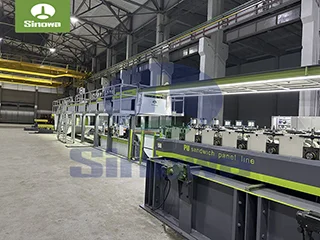
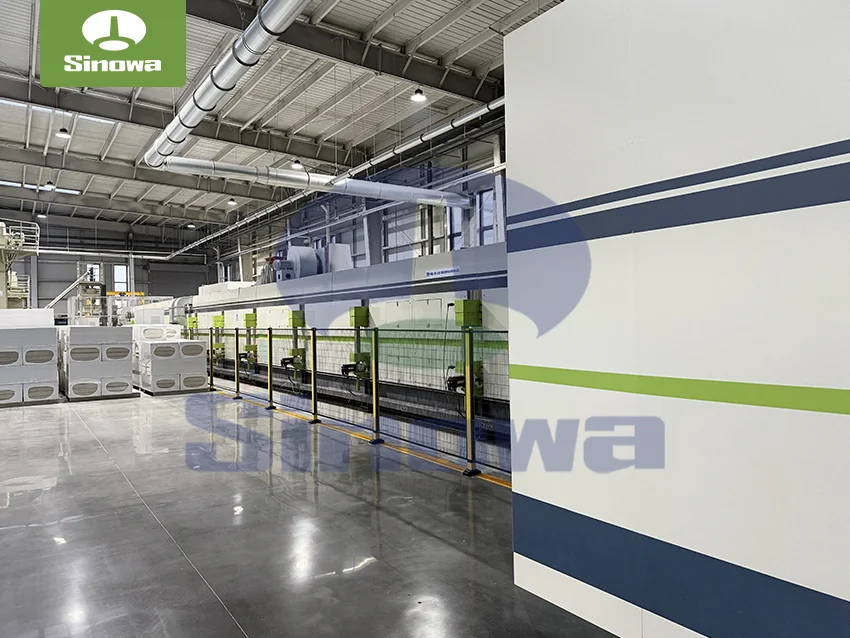
The overall structure of a reliable insulation sandwich panel production line is designed based on continuous streamlined production logic, consisting of multiple interconnected and coordinated functional units that work in tandem to complete the entire panel forming process from raw material feeding to finished product output. The complete production workflow covers raw material conveying, surface pretreatment, core material laying, foaming compounding, constant-temperature curing, precision shaping, fixed-length cutting, and finished product stacking, with each functional link optimized for stability and coordination to avoid production fluctuations caused by single-point equipment failure. The mechanical structure adopts a reinforced frame design with high-rigidity materials, which can effectively resist vibration and deformation during long-term high-load operation, ensuring the overall stability of the production line. All transmission components are processed with high-precision craftsmanship, with matched friction and wear resistance, reducing equipment loss and failure rates during continuous operation, and laying a solid foundation for long-term stable production.
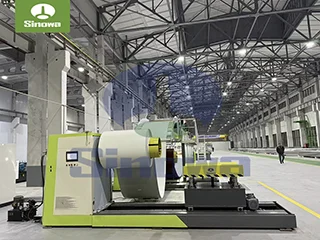
The raw material feeding and conveying unit is the starting point of the entire production process and an important guarantee for consistent material supply. This unit is responsible for the orderly output and stable conveying of upper and lower surface base materials and intermediate insulation core materials. The surface base materials, usually metal sheet substrates with good flatness and ductility, are uncoiled and leveled through a dedicated conveying mechanism to eliminate wrinkles, deformations, and internal stress generated during material winding. The fully automated conveying structure realizes uniform and synchronous feeding of upper and lower plates, effectively avoiding dimensional deviations and compounding misalignment caused by asynchronous material delivery. For different types of insulation core materials, including granular, plate-shaped, and liquid foaming materials, the equipment is equipped with adaptive feeding structures that can adjust the feeding speed and laying thickness according to production process requirements, ensuring uniform distribution of core materials between the two layers of surface materials and laying the groundwork for consistent insulation performance of finished panels.
The roll forming and surface pretreatment process further optimizes the structural performance and bonding effect of the base materials. After leveling and conveying, the surface materials pass through multi-group roller sets for gradual cold bending and forming, which can process flat base plates into various profile structures matching architectural design requirements. The roller spacing and forming radian of the roll forming system are precisely calibrated to ensure uniform stress on the plate surface, no local indentation or deformation, and consistent overall flatness of the formed plates. Meanwhile, the equipment is equipped with a surface cleaning and activation mechanism to remove dust, oil stains, and oxide layers on the surface of base materials. This pretreatment process significantly enhances the bonding force between the surface plate and the intermediate core material, preventing delamination, cracking, and peeling of composite panels during long-term use. The entire forming and pretreatment process operates continuously without intermittent shutdowns, effectively improving production continuity while maintaining high processing accuracy.
The core material compounding and foaming integration system is the core functional module that determines the insulation performance and structural firmness of sandwich panels. For liquid foaming core materials, the equipment adopts a precise proportional mixing and injection structure, which can fully mix multiple raw material components according to process requirements and evenly inject the mixed foaming liquid into the gap between the upper and lower surface plates. The internal flow channel structure of the injection device is optimized to avoid material accumulation and uneven mixing, ensuring that the foaming raw materials react fully and stably. With the help of continuous pressure from the double-belt pressing structure, the foaming material expands evenly and fills the entire interlayer space, forming a dense and uniform closed-cell structure after curing. For solid core materials, the equipment realizes automatic laying, leveling, and pre-pressing of core materials, eliminating gaps between core materials and surface plates, and ensuring the overall compactness of composite panels. The entire compounding and foaming process is dynamically adjusted in real time with the production speed, realizing the perfect coordination of mechanical movement and chemical reaction.
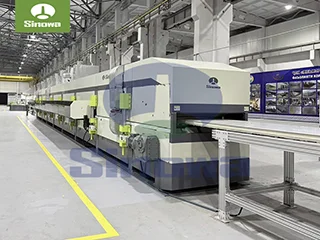
Constant-temperature curing and pressure maintaining shaping are key links to stabilize the structural performance of sandwich panels. After compounding and foaming, the preliminary formed panels enter the constant-temperature curing channel, where the internal temperature and pressure environment are precisely controlled to promote the complete curing and molding of the core material. The curing system adopts a uniform heat conduction design, which can maintain a consistent temperature field in the entire curing area, avoiding local incomplete curing or excessive curing caused by temperature differences. During the curing process, the double-belt pressing mechanism maintains stable and uniform pressure on the panel surface, which can effectively control the thickness tolerance of the panel, prevent surface bulging or depression, and ensure the flatness and dimensional uniformity of the finished panel. Through scientific curing and pressure maintaining procedures, the bonding strength between the core material and the surface plate is maximized, and the internal structural stability of the panel is improved, enabling the finished product to have excellent compression resistance, bending resistance, and aging resistance.
The precision cutting and post-processing unit realizes the fixed-length forming and fine finishing of finished panels. After curing and shaping, the continuous integrated panel is conveyed to the cutting station, where the high-precision cutting device performs fixed-length trimming according to set parameters. The cutting mechanism adopts a stable transmission and positioning structure, which can realize fast and smooth cutting without burrs, cracks, or deformation at the cutting edge. The equipment supports flexible adjustment of cutting length and width to adapt to the diversified size requirements of different application scenarios. After cutting, the edge trimming and finishing process is completed synchronously to optimize the flatness and sealing performance of the panel edge, avoiding heat loss and moisture penetration caused by edge gaps. The entire cutting and post-processing process is highly automated, with real-time monitoring of cutting accuracy to ensure that each finished panel meets unified dimensional standards and quality specifications.
What makes the reliable insulation sandwich panel line superior to ordinary production equipment lies in its excellent operational stability and quality consistency control capability. The equipment adopts a highly integrated automatic control system, which centrally regulates all links such as material feeding, forming, foaming, curing, and cutting. The control system can monitor operating parameters such as equipment speed, processing temperature, working pressure, and material dosage in real time, and automatically adjust deviations to keep the production process in a stable state. This intelligent control mode effectively reduces quality fluctuations caused by manual operation errors, ensuring that the thermal insulation performance, structural strength, and dimensional accuracy of each batch of finished panels remain highly consistent. In terms of mechanical operation, the equipment is designed with fault tolerance and anti-interference structures, which can adapt to slight changes in raw material parameters and production environment, maintaining stable operation under long-term continuous working conditions and reducing the frequency of equipment shutdown and maintenance.
In terms of production efficiency and energy consumption control, well-designed insulation sandwich panel machinery has significant practical advantages in industrial production. The continuous streamlined production mode eliminates intermittent waiting time in traditional segmented production, greatly improving unit time output and production efficiency. The optimized transmission and structural design reduces mechanical friction resistance and invalid energy consumption during equipment operation, realizing efficient energy utilization while ensuring production capacity. The matching material utilization system can precisely control the dosage of foaming materials and auxiliary raw materials, reducing raw material waste and improving the economic benefits of production. In addition, the equipment operates stably with low noise and low vibration, meeting the environmental protection and safety production requirements of modern industrial workshops, and creating a good operating environment for long-term batch production.
Daily maintenance and standardized operation are important guarantees to maintain the long-term reliability of the insulation sandwich panel making machine. The equipment is designed with a modular structure, which facilitates daily inspection, component replacement, and cleaning maintenance. The key transmission parts and precision components are equipped with protective structures to reduce the erosion of dust, moisture, and chemical residues, extending the service life of core components. Daily maintenance work mainly includes regular lubrication of transmission parts, cleaning of material residual in feeding and foaming flow channels, calibration of forming and cutting accuracy, and inspection of temperature and pressure control systems. Standardized maintenance operations can effectively avoid equipment aging, performance degradation, and frequent failures caused by long-term operation, ensuring that the equipment always maintains optimal production performance. At the same time, the automated early warning system can identify abnormal operating parameters in advance, remind operators to troubleshoot potential faults, and avoid large-scale production shutdowns and quality problems.
The finished sandwich panels produced by reliable insulation sandwich panel machine has excellent comprehensive performance and wide application coverage. Benefiting from the precise process control and stable compounding technology of the equipment, the finished panels have uniform internal structure, good thermal insulation and heat preservation effect, and can effectively reduce building energy consumption, which is suitable for thermal insulation and enclosure structures of industrial plants, public buildings, and prefabricated houses. The panels have good sound insulation, fire resistance, and moisture resistance, with stable structural performance and no easy delamination or deformation after long-term use, meeting the strict quality requirements of construction engineering, cold storage refrigeration, clean workshop, and other fields. With the continuous innovation of building energy-saving and prefabricated construction concepts, the market demand for high-quality insulation sandwich panels is constantly expanding, which also puts forward higher requirements for the performance, stability, and intelligence of supporting production equipment.
Looking at the development trend of the industry, reliable insulation sandwich panel manufacturing machine is evolving towards higher intelligence, higher precision, and stronger adaptability. With the continuous progress of mechanical manufacturing and automatic control technology, the new generation of production equipment realizes more refined process parameter control and more intelligent fault diagnosis and operation adjustment functions. The equipment can adapt to the production of multiple types of core materials and composite structures, meeting the diversified and personalized production needs of the market. At the same time, the optimization of energy-saving and environmental protection structures further reduces production energy consumption and operational costs, improving the overall economic and environmental benefits of production. As the core equipment of the insulation panel manufacturing industry, the reliable insulation sandwich panel production machine will continue to play a key role in promoting the standardized production, quality upgrading, and technological progress of the industry, and provide solid equipment support for the high-quality development of prefabricated construction and energy-saving building industries.
https://www.cnsinowa.com/sandwich-panel-machines/reliable-insulation-sandwich-panel-machines.html