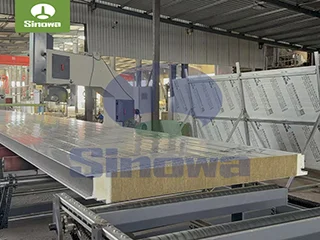
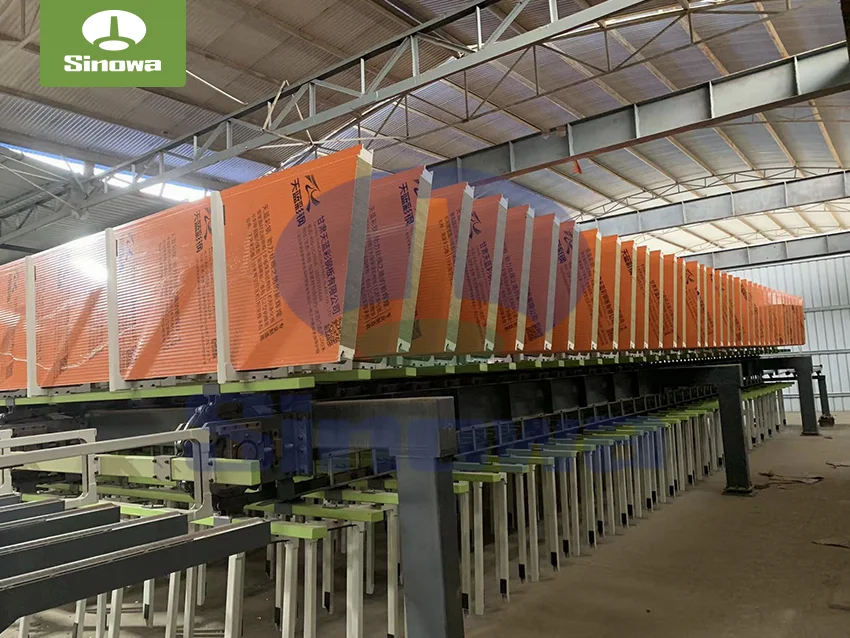
 sandwich panel line
The entire production workflow starts with scientific raw material preparation and pretreatment, which lays a solid foundation for consistent product quality. The core raw materials of rockwool sound insulation boards are natural mineral rocks with stable physical and chemical properties, which are selected and screened to remove impurities and irregular bulk materials. The raw material pretreatment unit of the rock wool sandwich panel production line is equipped with crushing, screening and drying equipment, which crushes large raw ore into uniform granular particles with controllable particle size. Vibrating screening devices classify the processed materials to ensure that only particles meeting the melting standard enter the next production link, avoiding uneven melting and defective fiber formation caused by inconsistent material volume. For raw materials with excessive moisture, the supporting drying system removes internal residual water through constant-temperature hot air circulation, controlling the moisture content within a stable range. This standardized pretreatment process effectively eliminates quality fluctuations caused by raw material differences, ensuring the stability of subsequent high-temperature melting and fiber forming processes.
High-temperature melting is the core link that determines the basic fiber quality of rockwool materials. The pretreated uniform mineral particles are quantitatively and continuously sent into a closed high-temperature melting furnace through an automatic feeding system. The furnace relies on stable thermal energy supply to create an extreme high-temperature environment exceeding 1400 degrees Celsius, which completely melts solid mineral particles into homogeneous and viscous molten liquid. The furnace body is built with high-temperature resistant refractory materials, which can withstand long-term extreme heat operation while reducing internal heat loss and maintaining constant melting temperature. The closed structural design of the furnace also avoids external dust interference and heat emission, realizing environmentally friendly and efficient melting. In the melting process, the internal temperature field and material feeding speed are precisely adjusted through automatic control systems, ensuring that the molten liquid maintains stable fluidity and purity. Uniform molten liquid is the prerequisite for forming fine and uniform rockwool fibers, and directly affects the pore structure and sound insulation effect of the final board products.
After high-temperature melting, the smooth molten liquid flows into the high-speed centrifugal fiber forming system, which is the key equipment to convert raw materials into fibrous structures. The rockwool sandwich panel production line adopts high-efficiency multi-roller centrifugal spinning technology, and the molten liquid is evenly thrown out through high-speed rotating centrifugal wheels under the action of centrifugal force. The viscous molten material is stretched and refined in the spinning chamber to form countless slender and flexible mineral fibers with uniform diameter. During the fiber forming process, fine atomized binder liquid is evenly sprayed around the newly formed fibers through a precision spraying system. The binder can coat the surface of each fiber uniformly, which enables discrete fibers to form mutual adhesion force in the subsequent stacking process, laying the foundation for the formation of integral board structure. The whole fiber forming and binder spraying process is carried out in a closed negative pressure environment, which effectively prevents fiber floating and material waste, and ensures the uniformity of binder distribution on the fiber surface, avoiding local hardening or loose structure of the finished board.
The fiber collection and wool felt laying process determines the flatness and structural uniformity of the initial board blank. The fine fibers sprayed with binder are uniformly collected by the negative pressure cotton collecting device and then transmitted to the pendulum laying machine. The pendulum laying equipment adopts reciprocating cross laying technology, which stacks fibers layer by layer in multiple directions to form a thick and uniform fiber wool felt. Different from single-direction laying, multi-dimensional cross stacking can make the internal fiber arrangement of the wool felt more disordered and three-dimensional, forming a rich and interconnected porous structure inside the material. This special structural design is crucial for the sound insulation performance of the board, as a large number of tiny pores can effectively absorb and consume sound wave energy, reducing sound transmission and noise reflection. The rock wool board production line can adjust the laying thickness and stacking density of the fiber wool felt according to different product specifications, realizing flexible production of sound insulation boards with different thicknesses and density grades to adapt to diverse acoustic engineering needs.
Curing and shaping is the key process to fix the fiber structure and form stable board performance. The loosely stacked fiber wool felt is sent to the pre-pressing device first, which carries out uniform low-pressure pressing on the wool felt to discharge excess air inside the fiber layer and preliminarily shape the wool felt to avoid loose deformation in the subsequent curing process. The pre-pressed board blank is continuously transported into the constant-temperature curing oven, where the internal temperature is stably controlled between 180 degrees Celsius and 250 degrees Celsius. Through circulating hot air convection, the binder coated on the fiber surface undergoes complete chemical curing reaction, producing stable bonding force between fibers. After curing, the discrete fibers are firmly bonded into an integral rigid board structure with fixed shape and stable density. The intelligent temperature control system of the curing oven can adjust the heating temperature and running speed in real time according to the thickness and density of the board blank, ensuring thorough and uniform curing of each part of the board, preventing incomplete curing leading to structural looseness or excessive curing causing material hardening and pore shrinkage, so as to maintain the optimal porous sound insulation structure.
Controlled cooling and stress relief treatment follow the curing process to ensure the dimensional stability of finished products. The high-temperature cured rockwool boards are transported out of the curing oven and enter the closed cooling channel, where graded natural cooling and air cooling are adopted to reduce the board temperature evenly and slowly. Rapid temperature drop is avoided in the cooling process, which effectively eliminates internal structural stress generated by high-temperature curing and pressing. This gradual cooling mode can prevent the finished board from warping, deforming or cracking in subsequent use and storage, and improve the overall flatness and structural stability of the product. After cooling, the internal structure of the rockwool board tends to be stable, with uniform pore distribution and firm fiber bonding, and the basic sound insulation and physical mechanical properties of the product are fully formed.
Precision cutting and finishing processes realize the standardized molding of finished products. The cooled semi-finished boards are sent to the automatic cutting unit of the rock wool sandwich panel line, which includes longitudinal cutting, transverse cutting and edge trimming equipment. High-precision servo control systems control the cutting size and path accurately, cutting the continuous board into finished products of specified length and width. The edge trimming process polishes the rough edges of the boards to ensure flat and neat product edges without burrs or irregular gaps. The production line is equipped with an automatic waste recycling system, which collects the edge materials and leftover materials generated in the cutting process, and the recycled materials are crushed and reintroduced into the raw material pretreatment link after screening, realizing cyclic utilization of resources and reducing production consumption. After cutting and finishing, the appearance size and structural flatness of the rockwool sound insulation boards fully meet industrial and architectural application standards.
The intelligent control and linkage operation of the whole rockwool insulation panel production line ensures the high efficiency and stability of mass production. All links from raw material feeding, melting, spinning, laying, curing to cutting are connected through automatic conveying equipment, realizing uninterrupted continuous production. The central control system monitors the operating parameters of each equipment module in real time, including melting temperature, spinning speed, laying thickness, curing temperature and conveying speed, and automatically adjusts abnormal parameters to maintain the consistency of the production process. The modular design of the rockwool sandwich panel making machine makes the equipment operation more coordinated, effectively reducing manual intervention and human error, and greatly improving production efficiency and product yield. Meanwhile, the closed production design of the whole line minimizes the overflow of fibers and dust in the production process, realizing clean and environmentally friendly production operation.
The process optimization of the rock wool sandwich panel machine endows rockwool sound insulation boards with unique performance advantages different from ordinary insulation materials. The three-dimensional disordered fiber porous structure formed by precise spinning and laying technology enables the product to have excellent sound absorption performance for medium and low frequency noise, which can effectively weaken sound wave vibration and reduce sound energy transmission. The stable fiber bonding structure formed by scientific curing process ensures that the board has good compression resistance and toughness, and it is not easy to deform or collapse after long-term use, maintaining lasting and stable sound insulation effect. In addition, the inorganic mineral characteristics of raw materials make the finished products have good moisture resistance and structural stability, which can avoid mildew, rot and performance degradation caused by humid environment, and adapt to complex indoor and outdoor application scenarios.
In practical industrial production, the rockwool board production line can realize flexible parameter adjustment according to different application scenarios. By changing raw material ratio, fiber fineness, laying density and curing parameters, it can produce sound insulation boards with different acoustic performance, thickness and mechanical strength. Lightweight low-density boards are suitable for indoor wall and ceiling sound absorption decoration, while high-density thick boards can be used for equipment noise reduction, partition sound insulation and industrial workshop acoustic treatment. This flexible production mode greatly expands the application scope of rockwool sound insulation boards and meets the personalized acoustic optimization needs of different fields.
With the continuous improvement of industrial manufacturing level and the increasing demand for building acoustic environment optimization, the rockwool sound insulation board production line is also constantly upgraded in terms of process refinement and intelligent level. The continuous optimization of raw material pretreatment technology further improves the uniformity of material processing; the upgrading of centrifugal spinning equipment makes fiber fineness more precise and consistent; the intelligent curing control system further enhances the stability of product structure. The continuous progress of production technology not only improves the production efficiency and product quality of rockwool sound insulation boards, but also promotes the continuous innovation and development of building sound insulation and noise reduction materials, providing more reliable material support for high-quality acoustic environment construction in modern buildings and industrial fields.
https://www.cnsinowa.com/sandwich-panel-machines/rockwool-sound-insulation-board-production-line.html