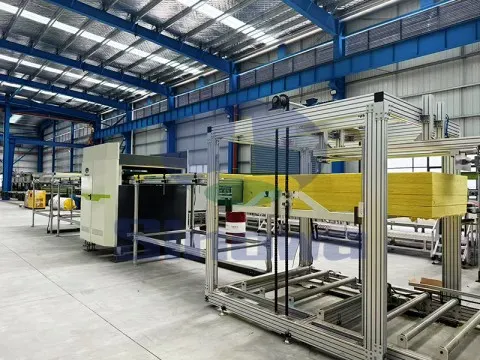
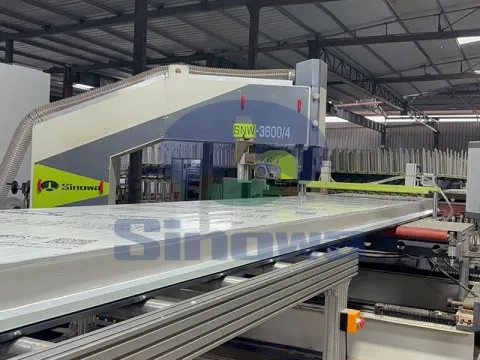
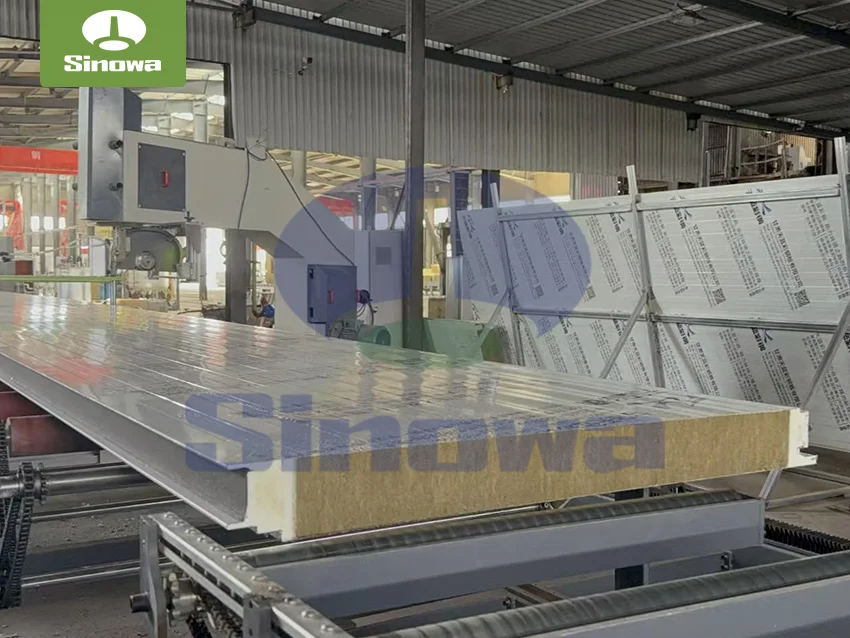
 sandwich panel line
Rockwool sandwich panels, also known as stone wool sandwich panels, are composite panels composed of two layers of surface materials and a middle rockwool core. The surface materials are usually color steel plates, aluminum plates or other metal sheets with good corrosion resistance and decorative properties, while the core material is rockwool made of natural rock minerals such as basalt, diabase and dolomite through high-temperature melting, fiber drawing, curing and other processes. This special structure gives rockwool sandwich panels multiple excellent performances: it is non-combustible and has strong fire resistance, which can effectively delay the spread of fire in residential buildings and protect the life and property safety of residents; it has excellent thermal insulation performance, which can reduce the energy consumption of residential heating and air conditioning, help achieve the goal of energy conservation and emission reduction, and improve the living comfort of residents; at the same time, it has good sound insulation effect, which can isolate outdoor noise and indoor sound transmission, creating a quiet and comfortable living environment. In addition, rockwool sandwich panels are light in weight, high in strength, easy to install and long in service life, which can greatly shorten the construction period of residential buildings and reduce the overall construction cost. These advantages make rockwool sandwich panels widely used in exterior walls, interior partitions, roofs and other parts of residential buildings, especially in high-rise residential buildings, low-rise villas and affordable housing projects.
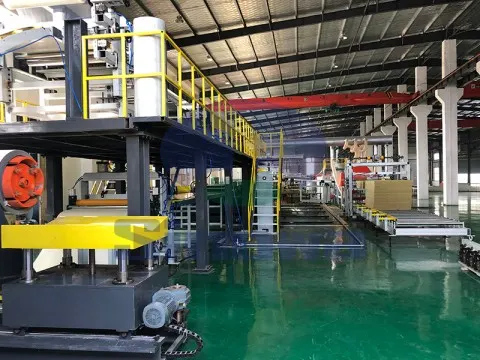
The rockwool sandwich panel production line is a continuous and automatic equipment system that integrates mechanical, electrical, hydraulic and chemical technologies, which can realize the whole process of rockwool sandwich panel production from raw material processing to finished product packaging. The working principle of the production line is to process the surface materials and rockwool core material through a series of coordinated processes such as uncoiling, forming, gluing, compounding, curing, cutting and stacking, so as to produce rockwool sandwich panels that meet the specifications and performance requirements of residential buildings. The production line is highly automated, which can minimize human intervention, ensure the stability and consistency of product quality, and greatly improve production efficiency. Compared with the traditional manual or semi-automatic production mode, the rockwool sandwich panel production line not only reduces the labor intensity of workers, but also reduces the waste of raw materials, realizing the economical and efficient production of rockwool sandwich panels.
The production process of the rockwool sandwich panel production line for residential buildings is a systematic and continuous process, which can be roughly divided into several key links: raw material preparation, surface material processing, rockwool core processing, compounding and curing, cutting and finishing, and packaging and storage. Each link is closely connected and mutually restricted, and the quality of each link directly affects the final performance and quality of the rockwool sandwich panel.
Raw material preparation is the foundation of the entire production process, and the quality of raw materials directly determines the performance of the finished rockwool sandwich panel. For the surface materials, it is necessary to select metal sheets with appropriate thickness and performance according to the use requirements of residential buildings. The surface of the metal sheets should be flat, free of scratches and corrosion, and have good adhesion to the adhesive. Before entering the production line, the metal sheets need to be inspected and cleaned to remove surface oil, dust and other impurities, so as to ensure the bonding effect between the surface material and the rockwool core. For the rockwool core material, natural rock minerals need to be selected as raw materials, and the raw materials should be crushed into uniform particles through crushing equipment, then sent to the melting furnace for high-temperature melting. The melting temperature is usually controlled at 1400-1600 degrees Celsius, so that the rock particles can be completely melted into a molten state. The molten rock liquid is then drawn into fine rockwool fibers through a fiber drawing machine, and the fibers are sprayed with a certain amount of binder and curing agent, and then formed into rockwool blankets or rockwool boards through a curing oven. The rockwool core material used in residential buildings needs to have appropriate density and thickness, so as to ensure its thermal insulation, fire resistance and sound insulation performance.
Surface material processing is the next key link, which mainly includes uncoiling, leveling and forming of metal sheets. The metal sheets are usually stored in the form of coils, and the uncoiling machine on the production line will uncoil the metal coils at a uniform speed. During the uncoiling process, the tension control device will adjust the tension of the metal sheet to ensure that the sheet is flat and does not wrinkle. After uncoiling, the metal sheet enters the leveling machine, which removes the internal stress of the sheet through the extrusion of multiple rollers, making the surface of the sheet flatter and improving the flatness of the finished panel. Then, according to the design requirements of residential building panels, the leveling metal sheet enters the forming machine, which bends and forms the sheet into the required shape through a series of forming rollers. The forming shape can be adjusted according to the needs, such as flat panels, corrugated panels, etc., to adapt to different parts of residential buildings such as exterior walls and roofs. The forming process needs to strictly control the forming speed and pressure to ensure that the shape of the surface material is accurate and the dimensional error is within the allowable range.
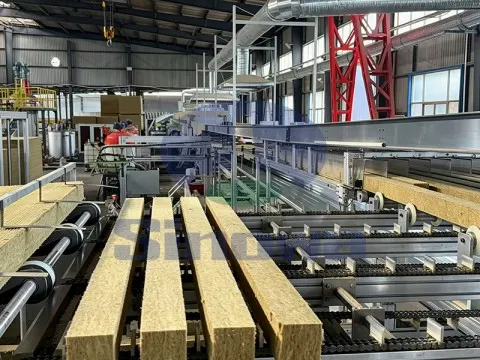
Rockwool core processing is mainly to cut the pre-made rockwool blankets or rockwool boards into the required size and thickness according to the specifications of the sandwich panel. The rockwool core cutting machine on the production line is equipped with a high-precision cutting blade, which can cut the rockwool core material into uniform size quickly and accurately. During the cutting process, it is necessary to control the cutting speed and cutting angle to avoid the rockwool fibers from falling off and affecting the quality of the core material. At the same time, the cut rockwool core material needs to be inspected to remove the unqualified products with uneven thickness, loose structure and other problems, so as to ensure that the rockwool core material entering the compounding link meets the quality requirements. In addition, in order to improve the bonding effect between the rockwool core and the surface material, the surface of the rockwool core can be treated with a primer, which can enhance the adhesion between the core material and the adhesive.
Compounding and curing is the core link of the entire production process, which realizes the combination of the surface material and the rockwool core material to form a complete rockwool sandwich panel. First, the surface material after forming is sent to the gluing machine, and the gluing machine sprays a uniform layer of adhesive on the inner surface of the surface material. The type and dosage of the adhesive need to be selected according to the material of the surface material and the rockwool core, so as to ensure that the bonding strength between the two meets the requirements. The adhesive should have good weather resistance, water resistance and high temperature resistance, so as to adapt to the different use environments of residential buildings. After gluing, the surface material and the cut rockwool core material are sent to the compounding machine together, and the compounding machine presses the surface material and the rockwool core material tightly through the pressure roller, so that the adhesive can fully contact with both, and realize the initial bonding. Then, the initially compounded sandwich panel enters the curing oven for curing treatment. The curing temperature and time need to be strictly controlled according to the type of adhesive and the thickness of the panel. Generally, the curing temperature is between 80-120 degrees Celsius, and the curing time is 20-60 minutes. During the curing process, the adhesive will gradually solidify, so that the surface material and the rockwool core material are firmly bonded together, forming a sandwich panel with stable structure and high strength. After curing, the sandwich panel will have good overall performance, which can meet the use requirements of residential buildings.
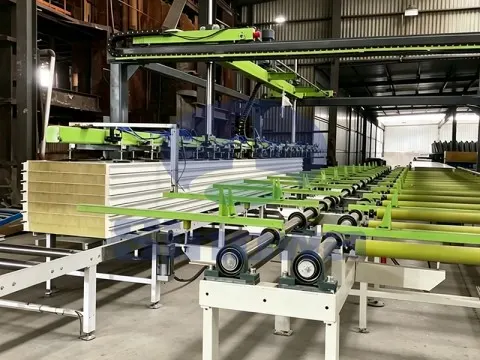
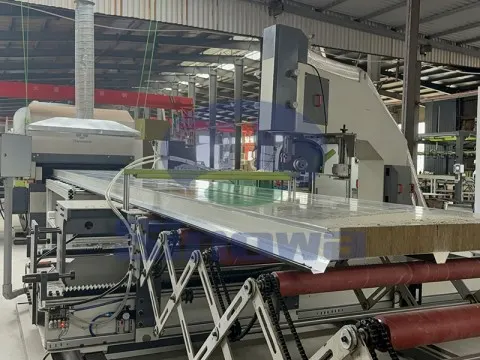
Cutting and finishing is to cut the cured continuous sandwich panel into the specified length according to the order requirements, and perform edge trimming and surface finishing. The cutting machine on the production line adopts a high-precision cutting system, which can realize non-stop cutting during the continuous production process, ensuring the cutting accuracy and efficiency. The cutting length can be adjusted freely according to the needs of residential building construction, which is flexible and convenient. After cutting, the edge of the sandwich panel may have burrs, unevenness and other problems, which need to be trimmed by the edge trimming machine to make the edge of the panel smooth and neat. At the same time, the surface of the sandwich panel is inspected, and the unqualified products with surface scratches, bonding defects and other problems are removed, so as to ensure the appearance quality of the finished product. In addition, some residential building projects may require the surface of the sandwich panel to be sprayed or coated, which can be completed in the finishing link to improve the decorative performance and corrosion resistance of the panel.
Packaging and storage is the final link of the production process, which is to package the qualified finished rockwool sandwich panels to avoid damage during transportation and storage. The packaging machine on the production line usually uses plastic film, foam cotton or carton for packaging, and the packaging should be tight and firm to prevent the panel from being damp, scratched or deformed. After packaging, the panels are stacked neatly in the warehouse according to the specifications and models, and the warehouse should be kept dry, ventilated and free from pollution. During storage, it is necessary to avoid stacking too high to prevent the panels from being crushed, and to separate different specifications and models to facilitate management and transportation. The packaged rockwool sandwich panels can be directly transported to the residential construction site for installation, which greatly improves the construction efficiency.
The rockwool sandwich panel production line for residential buildings is composed of a variety of core components, each of which plays an important role in the production process. The main core components include uncoiling machine, leveling machine, forming machine, rockwool cutting machine, gluing machine, compounding machine, curing oven, cutting machine, edge trimming machine, stacking machine and packaging machine. These components are connected in sequence to form a continuous production line, and each component is controlled by a centralized control system to ensure the coordinated operation of the entire production line. The centralized control system adopts advanced digital servo technology, frequency conversion vector technology and hydraulic control technology, which can realize the automatic control and monitoring of the entire production process. Operators only need to input the required production parameters through the man-machine interface, and the production line can automatically complete the entire production process, which is easy to operate and reduces the probability of human error. In addition, the production line is also equipped with a variety of safety protection devices, such as emergency stop buttons, safety gratings, etc., to ensure the safety of operators and equipment during the production process.
Compared with the traditional production mode, the rockwool sandwich panel production line for residential buildings has obvious advantages in production efficiency, product quality, cost control and environmental protection. In terms of production efficiency, the production line adopts continuous automatic production, and the production speed can be adjusted according to the needs, generally 3-8 meters per minute. Based on 250 working days per year and 10 working hours per day, the annual production capacity can reach hundreds of thousands of square meters, which can meet the large demand of residential building projects for rockwool sandwich panels. In terms of product quality, the production line realizes the precise control of each production link through the automatic control system, which ensures that the thickness, size, bonding strength and other indicators of the finished panel are within the standard range, and the product quality is stable and consistent. At the same time, the production line reduces the waste of raw materials, and the utilization rate of raw materials can reach more than 95%, which effectively reduces the production cost. In terms of environmental protection, the production line adopts environmentally friendly adhesives and production processes, which reduces the emission of harmful gases and pollutants. The rockwool core material is made of natural rock minerals, which is non-toxic, harmless and recyclable, in line with the concept of green and sustainable development of residential buildings. In addition, the production line has low energy consumption, which can save a lot of energy during the production process, helping to achieve the goal of energy conservation and emission reduction.
With the continuous development of the residential construction industry, the requirements for building materials are getting higher and higher, which also promotes the continuous upgrading and development of the rockwool sandwich panel production line. In the future, the rockwool sandwich panel production line will develop in the direction of intelligence, integration and customization. Intelligence will be further improved, and the production line will adopt more advanced intelligent control technologies, such as Internet of Things, big data and artificial intelligence, to realize real-time monitoring, fault early warning and intelligent adjustment of the production process, improving production efficiency and product quality. Integration will be strengthened, and the production line will integrate more functions, such as raw material detection, product testing and packaging, to form a one-stop production system, reducing the complexity of the production process and improving production efficiency. Customization will become a development trend. According to the different needs of residential building projects, the production line can flexibly adjust the production parameters to produce rockwool sandwich panels of different specifications, thicknesses and performances, meeting the personalized needs of different residential buildings. At the same time, with the continuous improvement of environmental protection requirements, the production line will further optimize the production process, adopt more environmentally friendly materials and technologies, reduce environmental pollution, and realize green production.
In addition, the application of rockwool sandwich panels in residential buildings will be more extensive. With the promotion of energy-saving and environmental-friendly buildings, rockwool sandwich panels, as a high-performance energy-saving and fireproof material, will be widely used in new residential buildings and old residential renovation projects. In high-rise residential buildings, rockwool sandwich panels can be used as exterior wall insulation materials, which can not only improve the thermal insulation performance of the building, but also enhance the fire resistance of the building, ensuring the safety of residents. In low-rise villas, rockwool sandwich panels can be used as exterior walls and roofs, which are beautiful, durable and easy to install, improving the living comfort and quality of the villa. In affordable housing projects, rockwool sandwich panels can reduce the construction cost and shorten the construction period, while ensuring the quality and performance of the building, which is in line with the construction concept of affordable housing. With the continuous expansion of the application field, the demand for rockwool sandwich panels will continue to increase, which will further promote the development of the rockwool sandwich panel production line industry.
In conclusion, the rockwool sandwich panel production line for residential buildings is an important equipment in the modern residential construction industry, which provides high-quality, efficient and environmentally friendly rockwool sandwich panels for residential buildings, and promotes the development of the residential construction industry towards energy conservation, environmental protection, safety and efficiency. The production line has the advantages of high automation, stable product quality, low production cost and environmental protection, which can meet the large demand of residential building projects for rockwool sandwich panels. With the continuous progress of technology and the continuous improvement of market demand, the rockwool sandwich panel production line will continue to upgrade and develop, and play a more important role in the future residential construction industry. It is believed that with the wide application of rockwool sandwich panels and the continuous improvement of production line technology, the quality and level of residential buildings will be further improved, creating a more comfortable, safe and energy-saving living environment for people.
Sinowa is a professional manufacturer of sandwich panel machine in china, we provide diversified and high-performance sandwich panel production lines, including fully automatic continuous PU sandwich panel line and customized special lines to meet mass production and personalized order demands. These sandwich panel lines support processing multiple foam core materials, such as PU, PIR, mineral wool, rock wool and glass wool, covering different insulation and fireproof standards.
Featuring stable operation, high efficiency, energy saving and easy maintenance, our PU sandwich panel line deliver sandwich panels with excellent thermal insulation, fire resistance, sound insulation and lightweight durability. The finished panels are widely applied in industrial workshops, warehouse roofing and wall cladding, cold storage insulation, serving global construction and industrial insulation markets.
https://www.cnsinowa.com/sandwich-panel-machines/rockwool-sandwich-panel-production-line-for-residential-building.html