sandwich panel line
The fundamental design logic of a rock wool sandwich panel production line originates from the physical characteristics of raw materials and the structural requirements of finished panels. Rockwool, as the core filling material, is made from natural mineral raw materials after high-temperature melting and fiber forming, featuring porous internal structures, low thermal conductivity, and excellent structural toughness. Metal sheets used for surface layers possess high tensile strength and surface flatness, capable of resisting external mechanical impact and environmental erosion. To firmly combine these two materials with distinct physical attributes, the production line adopts a sequential assembly processing mode. Each functional unit in the production line undertakes independent processing tasks while maintaining precise collaborative linkage, avoiding material deformation, adhesive detachment, and internal voids during production. The overall structural layout of the production line follows the linear material conveying principle, with raw material feeding stations arranged at the front end and finished product stacking areas set at the tail end, forming an uninterrupted production circulation system that minimizes material transfer intervals and improves production continuity.
The complete composition of a rock wool sandwich panel line covers multiple functional modules, including metal sheet unwinding and pretreatment units, rockwool material arrangement systems, automatic gluing mechanisms, constant-temperature composite pressing equipment, curing devices, precision cutting assemblies, and finished product conveying and stacking structures. Every module is equipped with independent power transmission components and adjustable control structures to adapt to raw materials of different specifications. The metal sheet processing part focuses on eliminating surface impurities and structural bends of coiled metal sheets. Raw metal coiled materials often have surface dust, oil stains, and minor bending deformation due to long-term storage and transportation. The pretreatment unit removes surface attachments through physical wiping and low-temperature drying, and conducts continuous rolling and straightening to ensure the flatness of metal sheets before composite processing. This pretreatment procedure lays a foundation for the uniform bonding of subsequent adhesives and avoids local wrinkles or gaps on panel surfaces caused by uneven sheet flatness.
The rockwool feeding and arrangement system is one of the core modules that determine the internal quality of sandwich panels. Bulk rockwool raw materials are transported to the production line through auxiliary conveying equipment, and then undergo loose processing inside the dedicated material arrangement device. The internal mechanical pendulum structure evenly spreads rockwool fibers on the horizontal conveying platform, realizing planar dense arrangement of fiber structures. Different from random stacking of raw rockwool materials, the pendulum laying method can optimize the internal fiber distribution state, make the density of rockwool filling layers uniform, and enhance the overall compression resistance and internal bonding strength of finished panels. During the material arrangement process, the system can automatically adjust the laying thickness and stacking density of rockwool according to preset production parameters, meeting the processing requirements of panels with different thermal insulation specifications. After arrangement, the rockwool layer will pass through preliminary compression rollers to eliminate excessive internal gaps, maintaining stable thickness of the filling layer and avoiding uneven thickness of finished products.
Gluing treatment is a key link to realize permanent bonding between metal sheets and rockwool layers. The production line is equipped with an automatic circulating gluing system, which quantitatively transports high-viscosity composite adhesives to the gluing nozzle through pressure pipelines. The gluing mechanism adopts a surface uniform coating mode, forming a continuous and dense adhesive film on the inner surface of metal sheets. The system can accurately control the single coating amount and gluing range of adhesives through flow regulating components, preventing product quality problems such as adhesive overflow and local glue shortage. Before formal bonding, the glued metal sheets will pass through a low-temperature preheating area to reduce the surface viscosity of adhesives, accelerate the initial curing reaction, and enhance the adhesion between adhesives and metal surfaces. The entire gluing process is carried out in a closed environment, which not only ensures the uniformity of gluing but also reduces the volatilization of adhesive components and maintains a stable processing environment inside the production workshop.
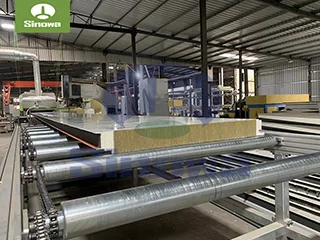
The composite pressing module undertakes the core bonding and shaping task of sandwich panels. After the metal sheets with adhesive films and the arranged rockwool layers are accurately aligned up and down, they are sent to the pressing equipment through synchronous conveying rollers. The pressing structure adopts double-layer opposite rolling design, with adjustable pressing gaps and constant pressure control function. During the pressing process, the equipment maintains stable mechanical pressure to make the metal sheets closely fit with the rockwool core layer, and squeeze out residual air between bonding interfaces to eliminate internal bubbles. The internal temperature of the pressing area is kept within a reasonable constant-temperature range through circulating heating components. Moderate temperature can optimize the fluidity of adhesives, make adhesives penetrate into the tiny gaps of rockwool fibers, and improve the interlayer bonding firmness. The running speed of the pressing mechanism is synchronized with the front-end feeding speed to avoid material stretching or stacking caused by speed difference, ensuring the continuity and stability of composite processing.
The curing system is an indispensable post-processing structure for composite panels, responsible for completing the deep curing of adhesives and stabilizing the overall structural performance of panels. The cured composite semi-finished products are continuously transported into the closed curing furnace through the conveying track. The interior of the furnace adopts gradient temperature control technology, forming a reasonable temperature difference distribution from the inlet to the outlet. In the low-temperature area at the front end of the furnace, the adhesives continue to undergo cross-linking reaction; in the high-temperature stable area in the middle, the molecular structure of adhesives is fully solidified; in the cooling buffer area at the tail end, the overall temperature of the panels gradually decreases to room temperature. This gradient curing mode can effectively avoid panel deformation and internal stress concentration caused by one-time high-temperature heating. The internal circulating air system of the furnace ensures uniform temperature distribution in all areas, so that every position of the panels can obtain consistent curing conditions, further improving the overall structural uniformity of finished products.
After curing and cooling, the continuous long-strip composite panels enter the precision cutting stage. The cutting module is equipped with high-speed rotating cutting saws and intelligent length positioning systems. The system can preset cutting dimensions according to production orders, and complete fixed-length transverse cutting and edge trimming longitudinal cutting through real-time positioning and tracking. The cutting tool is made of wear-resistant metal materials, which can maintain smooth cutting sections and avoid fiber burrs and metal edge warping during cutting. For panels requiring special edge structures, the production line is also equipped with edge folding and grooving components, which complete edge shaping while cutting, facilitating subsequent on-site assembly and splicing of panels. All cutting and shaping actions are automatically controlled by the operating system, with extremely high dimensional accuracy, effectively reducing the error range of finished product sizes and meeting the installation matching requirements of building engineering.
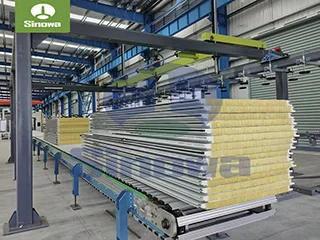
The tail end of the sandwich panel production line is equipped with finished product conveying and automatic stacking devices. The cut qualified panels are transported to the stacking platform through the low-speed conveying track. The double-station stacking structure is adopted in the stacking link, enabling two sets of stacking mechanisms to operate alternately. While one station completes stacking and sorting, the other station receives newly processed panels, realizing uninterrupted cyclic stacking and improving the collection efficiency of finished products. The stacking mechanism is equipped with flexible clamping components to avoid surface scratch damage to metal panels during handling. After stacking to the preset quantity, the finished product groups are automatically transported out of the stacking area, reserving space for subsequent stacking work. The entire tail-end processing link does not require manual intervention, reducing labor contact in the finished product processing stage and ensuring the neat appearance and complete structure of panels.
In terms of control system configuration, modern rock wool sandwich panel machine adopts integrated intelligent control modes. The core control unit realizes unified scheduling of all functional modules through programmable logic components. The human-computer interaction interface is simple and intuitive, allowing operators to adjust production speed, pressing pressure, curing temperature, cutting size and other parameters in real time. The system has an automatic detection function for operating status. When abnormal conditions such as material jamming, parameter deviation and component failure occur during operation, the system will trigger automatic alarm and temporary shutdown procedures to avoid equipment damage and unqualified product batches. In addition, the control system is equipped with a data storage function, which can record daily production output, parameter adjustment records and equipment operation status, providing data support for subsequent production optimization and equipment maintenance.
The mechanical performance design of the production line fully considers the long-term continuous operation demand of industrial production. The main frame is welded with high-strength metal profiles, with stable structural rigidity and strong anti-vibration ability, which can avoid equipment displacement and part loosening caused by long-term mechanical vibration. The transmission parts adopt wear-resistant mechanical accessories, and the rotating and connecting components are equipped with lubrication structures to reduce friction loss during operation and extend the service life of equipment. All electrical control components are arranged in closed waterproof and dustproof boxes, adapting to the complex processing environment of building material factories, and reducing equipment failure rates caused by dust, moisture and other environmental factors. The overall operation noise of the production line is controlled within a low range through mute transmission structures, which conforms to the environmental protection processing standards of modern production workshops.
In terms of production adaptability, a standardized rockwool sandwich panel production line has strong specification adjustment capabilities. It can process panels with different thicknesses by adjusting the pressing gap and rockwool laying thickness, and meet the production demands of panels with different filling densities by changing the operating parameters of the material arrangement system. For metal sheets of different thicknesses and surface types, the pretreatment and pressing modules can be adaptively adjusted to ensure the bonding stability of different raw materials. The adjustable production speed enables the equipment to switch between mass standardized production and small-batch customized production, balancing production efficiency and product diversity. This flexible adjustment performance makes the production line applicable to various production scenarios and meets the differentiated procurement demands of different engineering projects.
The product quality control logic in the production line runs through the entire processing flow. In the raw material feeding stage, the system carries out preliminary screening on the flatness of metal sheets and the uniformity of rockwool fibers to eliminate unqualified raw materials. In the gluing and pressing stage, real-time monitoring of gluing amount and pressing pressure is realized through sensing components to avoid bonding defects. In the curing stage, the temperature and time parameters are strictly locked to ensure sufficient curing reaction of adhesives. After the cutting is completed, the automatic detection device checks the dimensional accuracy and surface flatness of the finished products, and separates the individual unqualified products generated in the production process. The whole-process quality monitoring mode reduces the manual detection pressure, maintains the consistency of batch product quality, and improves the overall qualification rate of finished panels.
From the perspective of production energy consumption and environmental protection, the optimized structural design of modern production lines effectively reduces resource waste. The circulating gluing system realizes the recycling of residual adhesives, avoiding raw material waste caused by excessive gluing. The closed curing furnace reduces heat loss and improves energy utilization efficiency. No harmful chemical substances are generated during the entire production process, and the dust generated by rockwool processing is collected by a centralized dust removal device, which will not cause dust pollution to the workshop environment. The residual leftover materials generated by cutting can be uniformly recycled and reprocessed, realizing the cyclic utilization of raw materials. This environmentally friendly and low-consumption production feature makes the production line conform to the sustainable development concept of the modern building material industry.
In practical industrial application, the operating efficiency of rockwool sandwich panel production lines is affected by multiple factors such as raw material quality, parameter setting and daily maintenance. High-quality raw materials with stable thickness and uniform texture can reduce the frequency of equipment parameter adjustment and improve continuous production efficiency. Reasonable parameter matching can avoid resource consumption caused by excessive pressure and excessive temperature. Regular daily maintenance including component lubrication, dust cleaning and circuit inspection can reduce equipment failure downtime and maintain long-term stable operating efficiency. In actual production and processing, the production line can maintain a stable operating speed within a reasonable range, and complete continuous processing of multiple panels per unit time, meeting the large-scale material supply demand of construction engineering.
With the continuous upgrading of the building material manufacturing industry, the technical optimization direction of rockwool sandwich panel production lines is gradually clear. The future equipment will develop towards higher automation intelligence, more compact structural layout and lower energy consumption. The intelligent sensing technology will realize automatic identification and adaptive adjustment of raw material specifications, further reducing manual intervention. The optimized mechanical structure will reduce the occupied space of the production line and improve the space utilization rate of the workshop. The new energy-saving heating components will reduce the energy consumption of the curing link and realize low-carbon production. At the same time, the production line will strengthen the linkage with the automated warehousing system to realize the integrated operation of production, transportation and storage, and further improve the overall intelligent manufacturing level.
As important processing equipment in the field of building thermal insulation materials, rockwool sandwich panel production lines connect raw material processing and finished product manufacturing, and provide reliable equipment support for the popularization and application of rockwool composite panels. Its systematic mechanical structure, standardized production process and intelligent control mode ensure the excellent physical performance and stable quality of finished panels. In the future, with the continuous progress of industrial manufacturing technology and the improvement of building energy-saving standards, this type of production line will be further optimized in processing performance and functional structure, constantly adapting to the changing market demand of the construction industry. Relying on efficient, environmentally friendly and stable production characteristics, rockwool sandwich panel production lines will maintain an important position in the building material manufacturing industry and make continuous contributions to the high-quality development of modern construction engineering.
https://www.cnsinowa.com/sandwich-panel-machines/rockwool-sandwich-panel-production-line.html