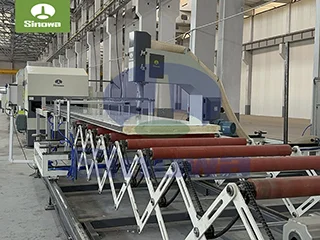
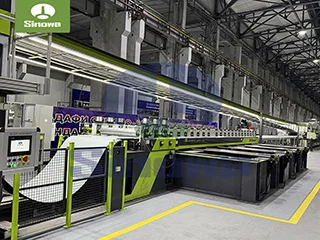
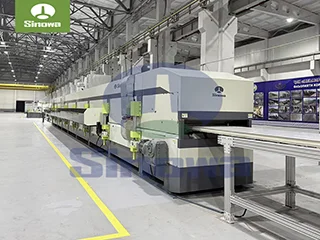
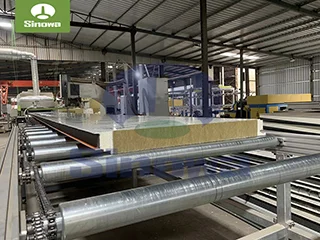
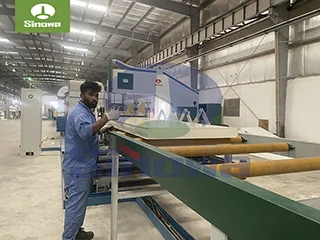
sandwich panel line
Raw material preparation constitutes the initial and fundamental stage of the entire production workflow of a roof panel production line. The commonly used raw materials are metal coils with uniform thickness and smooth surface, including coated metal sheets, alloy metal plates and other composite metal materials. These raw materials are selected based on the service environment of finished roof panels, with considerations given to corrosion resistance, tensile strength and surface ductility to ensure the processed panels can withstand extreme weather changes such as strong wind, heavy rain and ultraviolet radiation. Before entering the formal molding process, the raw material coils need to be fixed on the material unwinding device of the roof sandwich panel machinery. The unwinding structure is designed with stable damping components to ensure that the metal coil releases materials at a constant speed without uneven tension, which effectively avoids material deformation, wrinkling and surface scratches caused by unstable feeding. In this stage, simple manual inspection is carried out to eliminate raw materials with obvious surface defects, uneven thickness and edge cracks, laying a solid foundation for subsequent continuous processing and stable product quality.
After the completion of raw material feeding, the metal sheet will enter the leveling and preprocessing link, which is a crucial procedure to eliminate internal stress of raw materials. Long-term storage and rolling of metal coils will produce subtle bending deformation and internal structural stress, which may lead to irregular warping of finished products if not handled properly. The leveling unit of the roof sandwich panel machine is composed of multiple groups of parallel pressing rollers arranged at equal intervals. Through the mutual extrusion of upper and lower rollers, the curved metal sheet is gradually flattened, and the internal stress generated during coil rolling is fully released. Meanwhile, the preprocessing system is equipped with surface cleaning components to remove dust, metal debris and residual attachments on the surface of the sheet. This cleaning operation protects the subsequent rolling mold from abrasive wear and ensures the flatness and smoothness of the outer surface of the finished roof panel. The running speed of the leveling unit is synchronized with the overall rhythm of the production line, maintaining a stable material transmission state to prevent speed difference from causing secondary deformation of the metal sheet.
Roll forming serves as the core processing section of the roof sandwich panel manufacturing line, determining the geometric shape, structural strength and appearance effect of the final product. This process adopts cold forming technology, which shapes the flat metal sheet into wave-shaped, trapezoidal or customized profiled panels through gradual extrusion of multiple sets of precision rolling rollers without high-temperature heating. The rolling rollers are made of high-hardness and wear-resistant alloy materials, with elaborately calculated pass structures. Each group of rollers undertakes different deformation tasks, and the deformation amount of the metal sheet is controlled within a reasonable range in every rolling procedure to avoid material cracking and surface damage caused by excessive instantaneous extrusion. The number of roller groups varies according to the complexity of the panel profile; panels with intricate curved structures require more rolling procedures to realize slow and smooth deformation. During the forming process, the sensor components installed beside the rollers monitor the sheet thickness, bending angle and transmission position in real time, and transmit the collected data to the central control system for dynamic parameter adjustment, so as to offset the material rebound phenomenon and ensure the dimensional accuracy of the formed panels.
Following the roll forming process, the roof panel will go through reinforcement and edge trimming procedures to optimize the structural performance and appearance quality of the product. Some production lines are equipped with embossing and rib pressing structures, which press uniform reinforcing ribs on the surface of the formed panel. These raised rib structures can significantly improve the bending resistance and load-bearing capacity of the roof panel, enabling it to bear external pressure such as snow accumulation and heavy wind without permanent deformation. The edge trimming device cuts off the irregular rough edges on both sides of the panel to ensure consistent width and neat edge lines of each finished panel. The trimming tool adopts high-precision cutting components with smooth cutting surfaces, which will not produce burrs and metal cracks. All processing parameters in this link are linked with the main control system, and operators can adjust the trimming range and embossing depth according to customized production requirements to meet the diversified size standards of different building projects.
Fixed-length cutting is an indispensable procedure to convert continuous long-strip panels into single finished products. Modern continuous sandwich panel line is equipped with flying shear cutting structures, which can complete high-speed cutting operation under the condition of non-stop material transmission. Different from traditional static cutting equipment, the flying shear device keeps synchronous moving speed with the panel during cutting, which effectively avoids the dimensional error caused by material pause and displacement. Before cutting, the high-precision counting and measuring components of the system automatically record the transmission distance of the panel. When the material reaches the preset fixed length, the control system instantly sends cutting instructions to drive the shear tool to complete instantaneous cutting. The cutting speed is matched with the molding speed of the front-end process to ensure the continuity of the entire production flow without frequent start-stop operations. The internal buffer structure of the cutting unit can reduce the vibration generated by mechanical shearing, preventing vibration from affecting the flatness of the cut section and the structural stability of adjacent panels.
Surface treatment and auxiliary curing processes further enhance the service performance and decorative effect of roof panels. For coated metal raw materials, the roof sandwich panel production machine is equipped with protective isolation components to reduce friction and abrasion between mechanical structures and the coating during processing, maintaining the uniformity of the surface color and anti-corrosion layer. For panels requiring enhanced weather resistance, the post-processing unit carries out secondary surface treatment, including uniform coating of protective coatings and low-temperature curing treatment. The intelligent temperature control system accurately adjusts the curing temperature and ventilation volume to make the protective coating tightly bonded to the metal substrate, effectively improving the ultraviolet resistance, oxidation resistance and stain resistance of the panel. In addition, some production lines are equipped with waterproof edge folding structures, which fold and press the splicing edges of the panels to form a sealed waterproof structure. This structural design can reduce the rainwater penetration risk at the building roof splicing gaps and optimize the overall waterproof performance of the roofing system.
The automatic control system acts as the intelligent brain of the entire roof panel production line, coordinating the synchronous operation of all mechanical units. The system adopts programmable control modules, with a simple and intuitive human-computer interaction interface. Operators only need to input production parameters such as panel size, molding radian and cutting length in the initial stage, and the equipment can realize one-key start-up and continuous unmanned operation. A large number of high-sensitivity sensors are distributed in each processing link to monitor operating parameters including equipment running speed, material tension, processing temperature and mechanical pressure in real time. Once abnormal conditions such as material jamming, parameter deviation and component failure occur, the system will automatically trigger an early warning mechanism and suspend the operation of faulty units to prevent batch unqualified products and mechanical damage. The control system also has data storage and parameter copying functions, which can quickly call mature production parameters for repeated orders, shortening the parameter debugging time and improving production efficiency.
Finished product sorting and stacking is the final link of the production line, realizing orderly collection and temporary storage of qualified roof panels. The sorted conveying structure transports the cut single panels to the stacking platform at a constant speed. The flexible buffering contact parts on the platform avoid hard collision between metal panels, preventing surface coating peeling and edge deformation. The automatic stacking device arranges the panels neatly according to fixed layers and spacing, and carries out simple isolation protection between stacked panels to reduce friction scratches during stacking and transportation. After stacking to the preset height, the system prompts the staff to complete the transfer and handling of finished products. The whole stacking process is completed by mechanical automation, which reduces manual handling errors and labor intensity, and improves the tidiness and transportation convenience of finished product storage. Meanwhile, the sorting system can automatically screen out defective products with surface scratches, dimensional deviations and structural deformities, separating unqualified materials from qualified finished products to ensure the delivery quality of batches of products.
Reasonable daily maintenance and standardized operation management are essential to extend the service life of the roof panel production line and maintain stable production efficiency. The key moving parts such as rolling rollers and transmission bearings need regular lubrication treatment to reduce mechanical friction loss and avoid abnormal noise and component wear caused by long-term high-load operation. The cutting tools and trimming components shall be cleaned and polished regularly to remove residual metal debris and keep the cutting edge sharp, so as to ensure the flatness of panel cutting sections. It is necessary to regularly check the sensitivity of sensors and the stability of circuit connections in the control system, calibrate detection data regularly to prevent parameter deviation from affecting product processing accuracy. In terms of production management, operators need to follow standardized operation procedures, avoid arbitrary modification of system parameters during equipment operation, and complete equipment cleaning and power-off maintenance after daily production. A complete maintenance record system helps track the operating state of the equipment, formulate targeted component replacement plans, and reduce unexpected downtime losses caused by equipment failure.
With the continuous development of industrial manufacturing technology, the technical upgrading direction of roof sandwich panel production line is increasingly clear, focusing on energy conservation, intelligence and material adaptability optimization. Modern optimized production lines adopt energy-saving transmission structures and low-power driving components, which effectively reduce comprehensive energy consumption while maintaining high-speed operation. The upgraded servo regulation system realizes more precise control of molding pressure and feeding speed, minimizing material loss caused by processing errors. In terms of material adaptation, the new generation of production lines can process a variety of composite metal materials, realizing compatible production of panels with different thicknesses and raw material types. In addition, the intelligent remote monitoring function is gradually popularized. Staff can view the real-time operating status of the production line through remote terminals, collect production data for operational analysis, and provide data support for subsequent production optimization and process improvement.
In the context of the booming global construction industry, the application value of roof sandwich panel line is constantly highlighted. The efficient continuous processing capability of the production line meets the large-scale material supply demand of infrastructure construction, industrial plant construction and urban commercial building projects. The standardized processing mode ensures the consistency of the size and performance of finished roof panels, which is convenient for rapid assembly and construction on the construction site, shortens the overall construction cycle, and reduces the comprehensive construction cost. In the future, with the continuous innovation of building materials and manufacturing technology, the roof panel production line will further realize structural simplification, intelligent optimization and environmental upgrading, adapt to more complex construction environments and personalized customization needs, and provide more reliable technical support for the high-quality development of the modern construction industry. The continuous progress of such production equipment will also promote the standardized and refined development of the building roofing material manufacturing industry, injecting lasting impetus into the upgrading of the global construction manufacturing level.
https://www.cnsinowa.com/sandwich-panel-machines/roof-panel-production-line.html