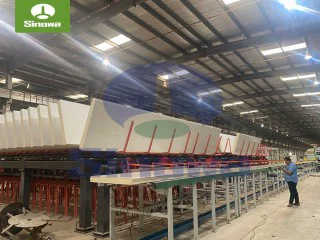
sandwich panel line
A complete continuous sandwich panel manufacturing line is a highly integrated electromechanical system composed of multiple functional modules, with each module cooperating closely in accordance with preset technological sequences to realize automated assembly line operation. The overall structural design follows the logic of material flow, ensuring that raw materials move smoothly in a single direction on the production line without redundant handling procedures, which effectively reduces material transportation loss and time consumption. From the perspective of functional partitioning, the production line can be divided into several core functional sections including surface material pretreatment unit, raw material metering and mixing unit, continuous feeding and composite molding unit, constant-temperature curing unit, fixed-length cutting unit, post-processing shaping unit and automatic stacking unit. Every functional section contains specialized mechanical components and sensing detection devices, and the entire production process is regulated by a centralized control system to maintain stable operating parameters. Each structural unit has its unique design purposes and technological characteristics, and the coordination between units directly determines the overall production capacity and product quality stability of the production line.
The surface material pretreatment unit serves as the starting point of the entire production process, undertaking the processing work of upper and lower surface materials of sandwich panels. Common surface materials include metal sheets and non-metal decorative plates, and different surface materials require targeted pretreatment processes based on their physical properties. For metal surface materials, the pretreatment procedures mainly include uncoiling, surface cleaning, tension leveling and surface activation treatment. The uncoiling mechanism adopts a roller-type bearing structure to place coiled surface materials, and it can realize stepless speed regulation to match the operating rhythm of the subsequent production line. During the operation, the uncoiling mechanism releases the coiled materials at a uniform speed to avoid material deformation caused by instantaneous tension fluctuation. After uncoiling, the surface materials pass through the cleaning assembly, which removes surface dust, oil stains and oxide attachments through physical wiping and air drying treatment. These impurities, if not eliminated, will reduce the bonding tightness between surface materials and core materials, leading to delamination and degumming of finished panels in subsequent use. The tension leveling mechanism is equipped with multiple sets of precision pressure rollers, which apply uniform pressure to the surface materials to eliminate tiny wrinkles and bending deformation generated during coiling and transportation, ensuring the flatness of the surface materials. In the surface activation link, physical treatment methods are adopted to improve the surface roughness of the materials, thereby enhancing the adsorption capacity of the adhesive and further optimizing the composite bonding effect. For non-metal surface materials such as fiber cement boards and decorative color plates, the pretreatment process also includes edge trimming and surface dedusting to ensure that the material specifications meet the composite molding standards.
The raw material metering and mixing unit is the core link to determine the internal quality of sandwich panel core materials, mainly responsible for the accurate proportioning and homogeneous mixing of various raw materials required for core material foaming or filling. Common core materials for sandwich panels include polyurethane foam, rock wool, mineral wool and other thermal insulation fillers, and different core material types correspond to independent metering and mixing processes. For foam core materials formed by chemical reaction, multiple groups of sealed storage tanks are used to store liquid raw materials. Each storage tank is equipped with a high-precision metering pump and a flow sensing device, which can dynamically monitor the raw material output in real time and automatically adjust the pumping speed to maintain the precise proportion of different raw materials. After being pumped out according to the set ratio, the liquid raw materials enter the high-speed mixing chamber, where the built-in spiral stirring blades conduct three-dimensional circulating stirring to eliminate raw material stratification and uneven mixing. The mixing chamber adopts a heat-insulating and sealed structural design to avoid the influence of external temperature on the chemical reaction rate of raw materials and prevent volatile raw materials from escaping to cause material loss and environmental pollution. For fibrous core materials such as rock wool, the metering unit adopts gravity weighing equipment to control the feeding amount of raw materials, and the crushing and scattering mechanism disperses the agglomerated fibrous raw materials to ensure the uniformity of core material filling. In addition, this unit is equipped with an automatic material replenishment system. When the raw material storage capacity is lower than the preset threshold, the system will send out a prompt signal to remind operators to supplement raw materials, avoiding production interruption caused by material shortage.
The continuous feeding and composite molding unit is the key section to complete the sandwich structure assembly of panels, undertaking the functions of bottom material conveying, core material laying, upper cover material fitting and preliminary pressing and shaping. After pretreatment, the lower surface material is horizontally laid on the synchronous conveying roller table, and the conveying system drives the plate body to move forward at a constant and stable speed. The mixed core material raw materials are evenly sprayed or laid on the surface of the lower surface material through the automatic distributing mechanism. The distributing mechanism can adjust the discharging range and thickness according to the preset panel specifications, ensuring that the core material is evenly distributed without gaps or accumulation in the transverse direction of the plate body. For liquid foaming core materials, the flow rate of the distributor is matched with the moving speed of the conveying roller table to realize continuous and uniform material distribution. After the core material is laid, the upper surface material is gradually folded and covered on the upper surface of the core material through the guiding roller group. The guiding roller group adopts an arc-shaped transition design to prevent rigid scratching and bending damage to the surface material during the covering process. Subsequently, the initially assembled composite plate enters the multi-group pressing roller set. The pressing rollers are arranged symmetrically up and down, and the spacing between the upper and lower rollers can be adjusted freely according to the thickness parameters of the produced panels. Under the action of uniform mechanical pressure, the bonding interface between the surface material and the core material is closely fitted, and the internal air bubbles are squeezed out to avoid hollow layers inside the panels. At this stage, the composite plate initially forms a complete sandwich structure, and the overall outline tends to be stable, laying a foundation for subsequent curing and shaping processing.
The constant-temperature curing unit is responsible for accelerating the curing and molding of the bonding interface and core materials, improving the structural stability and overall strength of composite panels. This unit adopts an integrated closed oven structure, with the interior divided into multiple independent temperature control zones to realize staged temperature rise and constant-temperature curing. Different temperature parameters are set in different curing zones according to the chemical characteristics of core materials and adhesives. In the low-temperature pre-curing zone, the temperature is controlled within a relatively low range to slowly trigger the molecular reaction of the internal raw materials of the core material, avoiding structural defects such as internal voids and uneven density caused by excessive rapid reaction. In the medium-temperature strengthening zone, the temperature is appropriately increased to accelerate the cross-linking reaction of the adhesive molecules, so that the bonding force between the surface material and the core material is continuously enhanced. In the high-temperature shaping zone, a stable high-temperature environment is maintained to complete the final solidification and molding of the core material, and eliminate the internal stress generated during the composite process. The interior of the curing oven is equipped with a circulating hot air system, which makes the temperature distribution in the cavity uniform, ensuring that all parts of the moving composite plate receive consistent heat treatment. Meanwhile, the heat insulation layer is laid on the outer wall of the oven to reduce internal heat loss, which not only maintains the stability of the internal temperature environment but also reduces energy consumption in the production process. The curing time is automatically matched with the conveying speed of the production line, and the plates can complete the curing reaction thoroughly during the continuous conveying process without manual static placement, realizing seamless connection of continuous production.
The fixed-length cutting unit realizes the precise segmentation of continuous long plates to meet the size requirements of commercial finished products. After being cured and shaped, the integral continuous sandwich panel has stable structural performance and no deformation, which provides favorable conditions for fixed-length cutting. This unit is equipped with an intelligent length measuring system and a high-speed cutting execution mechanism. The length measuring system uses high-precision sensing components to record the moving distance of the plate body in real time. When the plate reaches the preset cutting length, the system automatically sends a cutting instruction. The cutting mechanism adopts a gantry-type mobile cutting structure, which moves synchronously with the conveying speed of the plate during cutting to avoid shear deformation and incision burrs caused by the relative speed difference between the cutting tool and the plate body. The cutting blade is made of high-hardness wear-resistant materials, which can maintain smooth cutting edges during long-term continuous operation and reduce the damage to the surface coating of the plate. In addition, this unit is equipped with an edge trimming function. After cutting, the irregular edges on both sides of the plate are trimmed to ensure that the overall dimensional tolerance of the finished plate is controlled within a tiny range. The cutting parameters can be adjusted through the central control terminal, realizing flexible switching of plates with different lengths and widths, and meeting the diversified size production requirements of the market.
The post-processing shaping unit is used to optimize the surface quality and edge structure of the cut single plates, eliminating minor defects generated in the production process. This unit includes functional components such as surface polishing, edge sealing, defect detection and cleaning. The polishing mechanism uses flexible polishing pads to gently polish the surface of the plates, removing tiny scratches, residual adhesive and floating dust on the surface, improving the surface smoothness and appearance finish of the plates. For sandwich panels with edge sealing requirements, the automatic edge sealing equipment coats high-performance sealing materials on the cutting edges of the plates. The sealing materials can fill the tiny gaps at the edges, effectively preventing moisture, dust and corrosive substances from penetrating into the interior of the plates, and improving the environmental adaptability and service life of the products. The built-in visual detection device conducts real-time scanning on the surface and internal structure of the plates, automatically identifying defective products with defects such as delamination, bubbles and uneven thickness, and marking the defective products. The cleaning assembly uses high-pressure clean air and soft dust removal rollers to thoroughly clean the surface attachments of the plates, ensuring that the surface of the finished plates is clean and free of impurities. All post-processing procedures are completed automatically on the production line without manual intervention, which effectively improves the consistency of product quality.
The automatic stacking unit is the terminal link of the production line, responsible for orderly collection and stacking of processed qualified finished plates. This unit adopts a mechanical arm grabbing structure and a movable stacking platform. The mechanical arm is equipped with a flexible adsorption fixture, which can stably grab the plates without damaging the surface coating and edge structure of the plates. According to the preset stacking sequence and spacing, the mechanical arm places the plates flat on the stacking platform. The stacking platform has a horizontal moving function, which can automatically adjust the station position after a single stack of plates is stacked, realizing alternating material receiving at double stations. This structural design eliminates the production pause caused by single-station stacking, ensuring the continuous and uninterrupted operation of the front-end production line. After the stacking height reaches the preset standard, the system sends out a material taking reminder signal, and the staff only need to transfer the stacked finished plates to the storage area through handling equipment. In addition, the stacking unit is equipped with a safety protection device. When foreign objects invade the stacking area or the mechanical structure fails, the system will automatically trigger an emergency stop to avoid equipment collision and safety accidents. The automatic stacking mode replaces traditional manual handling, greatly reducing labor intensity and improving the neatness and uniformity of finished product stacking.
In the actual production operation process, the continuous sandwich panel manufacturing line relies on an intelligent centralized control system to realize the coordinated operation of all functional units. The control system takes the industrial controller as the core, connects the sensing components and execution mechanisms of each link through the data transmission circuit, and collects real-time data such as operating speed, processing temperature, feeding flow and cutting size in the production process. The human-computer interaction terminal displays all operating parameters in real time, and operators can set and adjust production parameters through simple touch operations. The system has an automatic parameter correction function. When the detected data deviates from the preset standard, the controller will automatically fine-tune the operating state of the equipment to keep the production parameters within the optimal range. Meanwhile, the system is equipped with a fault self-diagnosis function. Once mechanical jamming, raw material interruption and parameter abnormality occur, the system will quickly locate the fault point, send out an alarm prompt and display the fault cause on the terminal, which is convenient for maintenance personnel to carry out rapid troubleshooting. The intelligent control mode reduces the dependence on manual experience, realizes standardized and digital production management, and effectively guarantees the stability of long-term continuous production.
Compared with intermittent batch production equipment, continuous sandwich panel manufacturing lines have irreplaceable comprehensive advantages in production performance and economic benefits. In terms of production efficiency, the continuous operation mode eliminates the idle waiting time between processes. All production links are carried out synchronously, and the single-line daily output is far higher than that of discontinuous production equipment, which is suitable for large-scale mass production orders. In terms of product quality consistency, the continuous production line adopts unified parameter standards and automated processing procedures. The raw material ratio, pressing pressure, curing temperature and cutting size of each batch of products remain highly consistent, avoiding product quality fluctuations caused by manual operation differences. In terms of raw material utilization rate, the closed raw material conveying structure and precise metering control reduce raw material waste and volatilization loss. The optimized structural design of the production line minimizes the trimming residual materials in the processing process, thereby reducing the comprehensive production cost. In terms of operational safety, the highly integrated mechanical structure reduces manual contact links. All dangerous moving parts are equipped with protective structures, and the intelligent monitoring system can timely eliminate potential safety hazards, improving the overall safety level of production. In addition, the production line has strong compatibility, which can adapt to the production of sandwich panels with different surface materials, different core material types and different thickness specifications, realizing multi-purpose use of one line and meeting the diversified production needs of manufacturers.
Sandwich panels produced by continuous manufacturing lines have excellent comprehensive performance and are widely used in multiple industrial and civil fields. In the industrial building field, such panels are used for the enclosure structures of factory workshops, warehouses and logistics parks. Their lightweight characteristics can reduce the load-bearing pressure of building frames, and the excellent thermal insulation and fire resistance can optimize the internal production environment of buildings. In the cold chain storage industry, high-density foam sandwich panels are applied to the construction of cold storage and constant-temperature storage rooms. The low thermal conductivity of the core material effectively reduces the internal and external heat exchange, maintaining the low-temperature stable state inside the storage room and reducing energy consumption for refrigeration. In the special purification engineering field, smooth and corrosion-resistant sandwich panels are used for the interior decoration of dust-free workshops, medical laboratories and sterile processing rooms. The panels are not easy to accumulate dust and are convenient for cleaning and disinfection, meeting the high environmental cleanliness requirements of special places. In the temporary building field, the assembled sandwich panels can be quickly combined into temporary houses, office rooms and disaster relief resettlement houses, with the advantages of simple installation and short construction cycle. In addition, such panels also have application value in the fields of transportation facility decoration, municipal engineering enclosure and agricultural breeding buildings, showing broad market adaptability.
Despite the mature application of current continuous sandwich panel manufacturing lines in the industry, the equipment manufacturing industry is still carrying out continuous technological optimization and upgrading combined with market demand changes. In terms of energy conservation and consumption reduction, the production line optimizes the heating structure of the curing oven and adopts high-efficiency heat exchange materials to reduce heat loss. The frequency conversion speed regulation technology is applied to all transmission motors to realize automatic power adjustment according to the production load, effectively reducing comprehensive energy consumption. In terms of environmental protection improvement, the production line adds waste gas collection and purification devices in the raw material mixing and foaming links to filter and purify volatile harmful gases and avoid air pollution. The residual materials generated in the production process are automatically collected and recycled to realize resource reuse. In terms of intelligent upgrading, the production line is gradually embedded with industrial Internet technology to realize remote data monitoring and remote fault diagnosis. Manufacturers can master the operating state of the equipment in real time through mobile terminals and computer terminals, realizing refined management of the production process. In terms of product adaptation optimization, the mechanical structure of the production line is optimized to realize the rapid switching production of multi-density core materials and multi-texture surface materials, further expanding the product coverage and improving the market competitiveness of the equipment.
In the context of the global emphasis on energy conservation, environmental protection and efficient industrial production, the continuous sandwich panel manufacturing line will maintain a stable development trend in the future. On the one hand, with the continuous progress of building energy-saving policies and green building concepts, the market demand for high-performance thermal insulation composite panels will continue to grow, driving the technological iteration and equipment upgrading of continuous production lines. On the other hand, the deep integration of automation technology, Internet technology and mechanical manufacturing technology will further improve the intelligent level of the production line, realize unmanned operation in more production links, and reduce labor management costs. In addition, the production line will develop towards modularization and personalized customization. According to the differentiated production needs of different manufacturers, functional modules can be freely combined to meet the personalized production requirements of special-specification sandwich panels. At the same time, the equipment will pay more attention to environmental protection and low-carbon design, optimize the production process flow, reduce the generation of pollutants in the production process, and conform to the sustainable development direction of the global manufacturing industry.
To sum up, the continuous sandwich panel manufacturing line is a systematic and intelligent industrial production equipment integrating mechanical transmission, chemical control, thermal processing and intelligent monitoring. It completes the whole process from raw material pretreatment to finished product stacking through the collaborative operation of multiple functional units, realizing efficient, stable and standardized production of sandwich panels. The production line has prominent advantages in production efficiency, product quality, resource utilization rate and operational safety, and the produced sandwich panels are widely used in many fields such as industrial construction, cold chain logistics and purification engineering. With the continuous progress of industrial manufacturing technology and the continuous upgrading of market demand, continuous sandwich panel manufacturing lines will keep optimizing in energy conservation, environmental protection, intelligence and compatibility, and continuously provide high-quality composite building materials for all walks of life. In the future green building and efficient manufacturing system, this type of production line will occupy a more important industrial position and make greater contributions to the high-quality development of the modern building material industry.
https://www.cnsinowa.com/sandwich-panel-machines/continuous-sandwich-panel-manufacturing-line.html