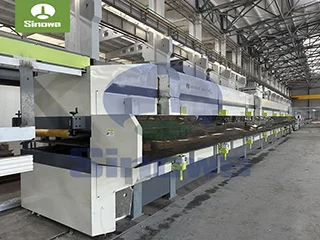
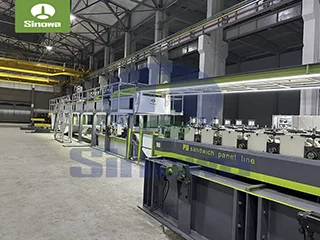
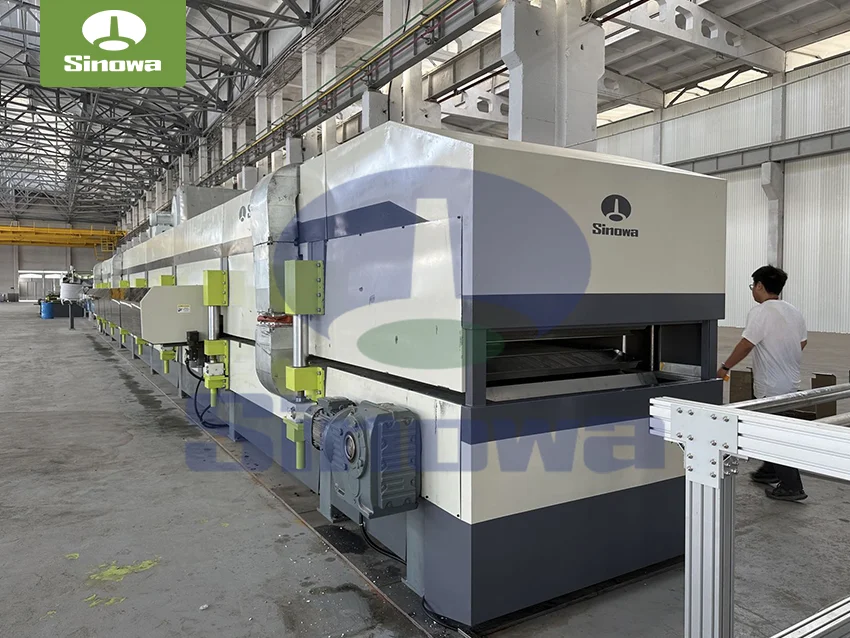
 sandwich panel machine
The overall structural composition of the composite PU sandwich panel machine follows a modular and systematic design concept, with each functional module cooperating closely to complete standardized and streamlined production. The front-end feeding module is the starting point of the entire production line, mainly responsible for the automatic unwinding and preliminary leveling of various coil raw materials. This module can adapt to multiple surface material substrates including metal coils, color-coated plates, and flexible composite materials, with automatic deviation correction and tension control functions built into the feeding structure. These functions effectively avoid material wrinkling, deviation, and uneven feeding during high-speed operation, laying a solid foundation for the flatness and dimensional accuracy of subsequent finished panels. Before formal forming, the equipment is also equipped with a surface pretreatment structure, which can remove surface dust, oil stains, and oxide layers of raw materials through physical treatment methods. This pretreatment process greatly enhances the bonding tightness between the surface material and the polyurethane foam core layer, preventing delamination, cracking, and peeling of the composite panel during long-term use, and significantly improving the service life and structural stability of the product.
Following the feeding and pretreatment process is the precision roll forming module, one of the key units that determine the appearance and structural specifications of the sandwich panel. This module adopts multi-group continuous rolling forming technology, through the gradual extrusion and shaping of precision rolling rollers, the flat surface material is processed into various customized section profiles, including flat panels, wave-shaped panels, and edge-bending structural panels applicable to different installation scenarios. The rolling roller group is processed with high-precision machining technology, with stable dimensional tolerance and wear resistance, ensuring that each batch of panels maintains consistent profile specifications and structural dimensions. The forming speed and roller spacing of the roll forming system support stepless adjustable control, which can flexibly adapt to surface materials of different thicknesses and hardness, meeting the diversified profile processing needs of wall panels, roof panels, and special-shaped structural panels. After roll forming, the surface material will be accurately conveyed to the composite laminating station in a fixed track state, maintaining a stable horizontal state to ensure the uniformity of subsequent foaming and compounding.
The foaming and mixing module is the core functional unit of the entire composite polyurethane sandwich panel machine, which directly determines the thermal insulation performance, density uniformity, and bonding strength of the sandwich panel core material. Polyurethane foam is formed by the chemical reaction of two main raw materials, polyol and isocyanate, and the equipment is equipped with a high-precision metering and mixing system to control the proportion of the two raw materials in real time. The precision metering pump delivers the raw materials to the high-pressure mixing head at a stable and accurate flow rate, realizing instantaneous and uniform mixing of the raw materials. Different from traditional manual or semi-automatic mixing methods, the closed high-pressure mixing structure avoids raw material stratification and uneven mixing, ensuring that the foaming raw materials have consistent chemical activity and fluidity. The mixed polyurethane raw materials are evenly poured and distributed on the lower surface material through the automatic pouring system, with adjustable pouring width and thickness, which can precisely match the production specifications of panels of different sizes. In the subsequent compounding process, the upper surface material is synchronously covered, and the three-layer structure of upper surface material, polyurethane foam raw material, and lower surface material enters the double-track laminating conveyor as a whole.
The constant-temperature laminating and curing module undertakes the key process of foam expansion, solidification, and composite bonding, which is the core link to realize the integrated forming of sandwich panels. The double-track laminating conveyor maintains stable transmission speed and uniform pressure distribution, and the internal closed curing cabin can realize precise temperature regulation and constant-temperature operation. After entering the laminating equipment, the polyurethane raw materials undergo orderly foaming and expansion under constant temperature and pressure conditions, and the foam gradually fills the gap between the upper and lower surface materials. The uniform pressure constraint of the double-track chain plate limits the irregular expansion of the foam, ensuring that the thickness of the panel is consistent and the internal foam structure is dense and uniform. With the progress of the chemical reaction, the polyurethane foam is completely solidified and cured, forming a rigid porous core layer, and producing a strong and permanent bonding force with the upper and lower surface materials. The whole curing process is completed in a continuous transmission state, without intermittent pause, which not only improves production efficiency but also avoids structural differences of panels caused by discontinuous curing. The length of the curing cabin and the transmission speed can be adaptively adjusted according to the panel thickness and raw material formula, ensuring that the foam is fully cured and the composite structure is firm and reliable.
The rear-end processing module of the equipment includes fixed-length cutting, edge trimming, and finished product conveying units, realizing the final shaping and sorting of continuous composite panels. The high-precision cutting system adopts automatic tracking and fixed-length cutting technology, which can set arbitrary cutting lengths according to production requirements. The cutting tool has high hardness and wear resistance, ensuring smooth and flat cutting sections without burrs, deformation, or material damage. The cutting process is non-stop synchronous cutting with the production line, which does not affect the continuous operation of the entire production process and effectively guarantees production continuity. After cutting, the edge trimming device performs fine trimming on the edges of the panel to eliminate irregular edges generated in the forming process, making the overall dimensions of the panel more accurate and the assembly and installation more convenient. Finally, the qualified finished panels are stably output through the conveying system, and the automatic stacking device completes orderly stacking of finished products, reducing manual handling operations and improving the overall automation level of production.
In terms of operational performance and technical advantages, modern composite PU sandwich panel production line has achieved significant breakthroughs in energy conservation, environmental protection, production stability, and intelligent control. The equipment adopts a closed-loop foaming and production structure, which effectively reduces the volatilization of chemical raw materials in the production process and lowers the emission of harmful substances, realizing green and environmentally friendly production. The built-in thermal energy circulation system can fully recycle the heat generated in the curing process, reducing the energy consumption of heating equipment and achieving efficient energy saving in the production process. At the same time, the entire production line adopts an integrated intelligent control system, with centralized control of feeding, forming, foaming, curing, cutting and other processes. The system can realize real-time monitoring of production parameters, automatic early warning of equipment operation faults, and automatic adjustment of process parameters, which greatly reduces the dependence on manual operation. Operators only need to set production specifications and process parameters in the control terminal, and the equipment can complete fully automated batch production, effectively reducing human error and improving product yield and production consistency.
The product performance advantages brought by the precise operation of composite PU sandwich panel line is extremely prominent, making PU sandwich panels widely used in multiple industrial fields. The uniformly foamed polyurethane core layer has extremely low thermal conductivity, giving the panel excellent thermal insulation and heat preservation performance, which can effectively reduce the heat transfer of building envelopes. This performance makes the panels the preferred material for cold storage, constant-temperature workshops, and energy-saving building exterior walls and roofs. The integrated composite structure formed by one-time continuous molding has high overall structural strength, good compression resistance, bending resistance and impact resistance, and can adapt to complex outdoor environments such as strong wind and rain erosion. In addition, the dense porous structure of polyurethane foam also endows the panel with good sound insulation and noise reduction effects, which can effectively isolate external noise and improve the internal environmental comfort of buildings. The surface material after special pretreatment and composite molding has good weather resistance, corrosion resistance and oxidation resistance, and can maintain stable performance and beautiful appearance during long-term outdoor use, with low later maintenance cost.
In practical industrial production applications, composite polyurethane sandwich panel line show strong flexibility and adaptability, and can meet the production needs of panels for different scenarios by adjusting process parameters and equipment modules. By replacing different surface material feeding modules and adjusting roll forming parameters, the equipment can produce lightweight decorative panels for interior decoration, high-strength load-bearing panels for industrial buildings, and low-temperature resistant special panels for cold chain facilities. By optimizing the foaming ratio and curing process, the density, hardness and thermal insulation performance of the core layer can be adjusted in real time, realizing the customized production of multi-specification and multi-performance panels. The continuous production mode of the equipment greatly shortens the production cycle of a single panel, and the large-scale continuous production capacity can meet the bulk procurement demand of large engineering projects, providing efficient material support for the rapid construction of modern buildings and industrial facilities.
With the continuous upgrading of industrial manufacturing technology and the increasingly stringent requirements for building energy conservation and environmental protection, the technical iteration of composite polyurethane sandwich panel production line is also accelerating. The future development direction of the equipment focuses on higher intelligent automation, more precise process control, lower energy consumption and wider material adaptability. The upgraded equipment will realize more refined parameter control in foaming density, bonding strength and panel flatness, further improving the comprehensive performance of finished panels. At the same time, the equipment will be compatible with more new environmental protection surface materials and modified polyurethane raw materials, adapting to the development trend of green building materials. In addition, the integrated intelligent management system will realize the interconnection of production data, equipment operation data and product quality data, providing data support for standardized production and quality traceability of sandwich panels, and promoting the overall upgrading of the composite panel manufacturing industry.
In summary, composite PU sandwich panel machine as core intelligent equipment in the field of modern composite building materials, integrate mechanical transmission, chemical reaction control, constant-temperature intelligent regulation and automatic control technology. They realize efficient, stable and standardized continuous production of polyurethane sandwich panels, and their excellent production performance and flexible production capacity lay a solid foundation for the wide application of PU composite panels in construction, cold chain, industry and other fields. With the continuous progress of manufacturing technology and the continuous expansion of market demand, such equipment will continue to optimize in terms of energy efficiency, intelligence and product adaptability, and become an important driving force for the high-quality development of the green building materials industry and modern construction engineering.
https://www.cnsinowa.com/sandwich-panel-machines/composite-pu-sandwich-panel-machine.html