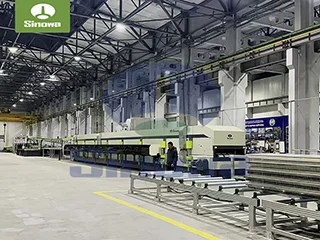
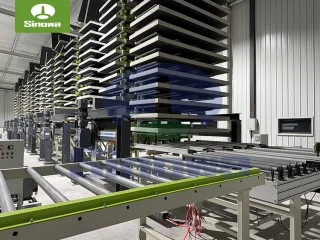
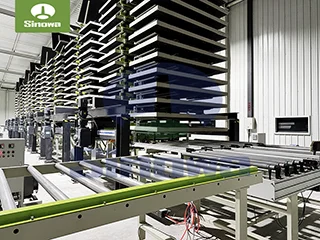
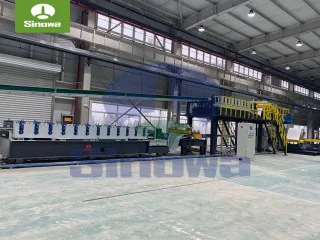
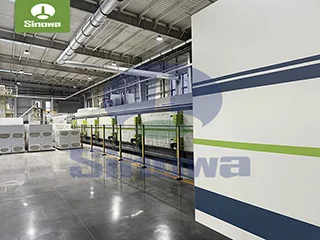
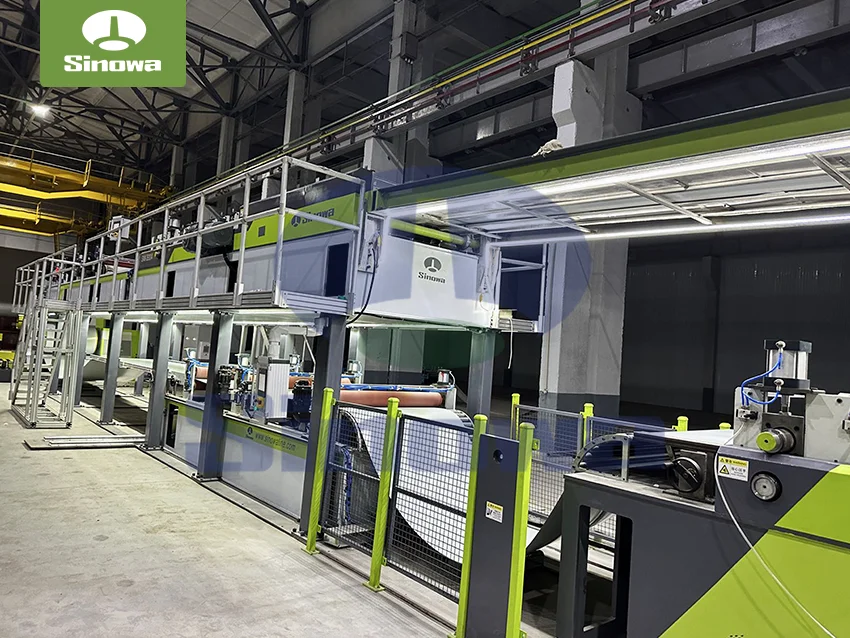
 sandwich panel line
The overall composition of a standard roof insulation board production line covers a complete set of interconnected functional units, forming a closed-loop continuous production system from raw material input to finished product output. The entire system can be divided into raw material pretreatment and conveying module, precision metering and mixing module, continuous foaming and composite molding module, constant-temperature curing and shaping module, precision cutting and trimming module, as well as finished product conveying and stacking auxiliary modules. Each unit operates in a coordinated and synchronous manner, with mechanical transmission and intelligent parameter control replacing traditional manual operation, effectively reducing human error, improving production consistency, and realizing large-scale and standardized production of roof insulation boards. The structural design of the production line follows the principles of streamlined operation and space optimization, ensuring smooth material transmission between processes without intermediate stagnation, which lays a foundation for efficient and stable long-term operation.
Raw material pretreatment and conveying is the initial link that determines the basic quality of finished insulation boards. The raw materials for roof insulation boards mainly include matrix base materials, foaming agents, curing agents, flame retardant additives, and functional modifiers, all of which require standardized pretreatment before entering the production process. In this stage, solid raw materials are screened and crushed to remove impurity particles and unqualified large-particle materials, ensuring uniform particle fineness of raw materials; liquid raw materials are stored in sealed constant-temperature tanks to maintain stable fluidity and chemical activity. The entire conveying process adopts closed pipeline and screw conveying equipment, which not only avoids raw material loss caused by open transmission but also prevents dust and volatile substances from diffusing into the production environment, realizing clean production. The conveying speed and material supply volume are dynamically adjusted according to the operating speed of the subsequent production process, ensuring continuous and stable material supply for the follow-up mixing and foaming links and avoiding quality fluctuations caused by insufficient or excessive raw material supply.
Precision metering and mixing is the core process that directly determines the physical and chemical properties of roof insulation boards. The insulation sandwich panel production line is equipped with high-precision metering devices for different types of raw materials, which can accurately control the proportion of various raw materials according to the preset process formula. The matching ratio of matrix materials, foaming components and functional additives directly affects the foaming density, cell structure, thermal conductivity and flame retardant performance of the final board. After precise metering, all raw materials are sent to the high-efficiency mixing system, where high-speed stirring and circulating mixing are carried out to achieve uniform fusion of different components. The mixing module is equipped with an independent temperature control system to maintain a constant reaction temperature in the mixing cavity, avoiding insufficient mixing reaction or local material deterioration caused by temperature deviation. Fully mixed raw material mixtures have stable chemical activity and uniform component distribution, which provides a reliable prerequisite for consistent foaming and molding effects, and effectively avoids common product defects such as uneven board density and inconsistent performance in batch production.
Continuous foaming and composite molding is the key link for the formation of the insulation board’s core structure. The uniformly mixed raw material mixture is evenly injected into the molding cavity of the continuous molding equipment through a high-pressure feeding system. Different from intermittent production equipment, the continuous production structure enables raw materials to complete foaming, expansion and preliminary shaping in a linear continuous state. Under the dual action of constant temperature and constant pressure in the molding zone, the foaming components in the raw materials undergo stable chemical reactions, generating uniform and fine closed-cell structures inside the material. This closed-cell structure is the core source of the roof insulation board’s excellent thermal insulation and sound insulation performance, as it can effectively lock static air and reduce heat conduction and sound wave transmission. For composite roof insulation boards with surface protective layers, the molding link also realizes synchronous lamination of surface materials and core foaming materials. The surface base materials are unwound, leveled and pretreated by the automatic unwinding system, and are closely compounded with the foaming core material in the molding zone. The synchronous composite process ensures tight bonding between the surface layer and the core layer, avoiding delamination and cracking of the board during subsequent use, and improving the overall structural strength and surface flatness of the finished product.
Constant-temperature curing and shaping is an essential process to stabilize the internal structure and mechanical properties of insulation boards. The initially molded insulation board has not yet completed the full chemical reaction, and the internal cell structure and material bonding state are in an unstable state. If processed directly, it is prone to deformation, shrinkage and structural damage. Therefore, the production line is equipped with an independent constant-temperature curing channel, where the molded board is transported at a constant speed for staged heat preservation and curing treatment. The curing zone adopts graded temperature control, with temperature parameters adjusted according to the material formula and board thickness, ensuring that the internal chemical reaction of the board is fully completed and the molecular structure tends to be stable. Through scientific curing treatment, the internal stress of the insulation board is completely released, the dimensional stability of the product is significantly improved, and problems such as later shrinkage, warping and cracking of the board are effectively avoided. Meanwhile, the curing process further optimizes the compactness of the closed-cell structure, making the thermal insulation performance and mechanical strength of the board more stable and durable, adapting to the long-term outdoor use environment of roof buildings.
Precision cutting and trimming is the finishing process to standardize the size and appearance of finished products. After curing and cooling to a stable state, the continuous long-strip board is transported to the cutting unit through the conveying system. The cutting module is equipped with servo-driven tracking cutting equipment, which can realize dynamic following cutting with the continuous operation of the board, ensuring no pause in the production process and improving overall production efficiency. The system can flexibly set cutting length and width parameters according to different customer and engineering requirements, realizing customized production of multiple specifications. In addition to fixed-length cutting, the trimming equipment removes irregular burrs and uneven parts on the edges of the board, corrects the overall dimensional deviation, and ensures that the straightness and flatness of the board meet construction standards. For roof insulation boards that need on-site assembly and splicing, the production line can also complete grooving and chamfering processes in one step through auxiliary processing devices, making the on-site installation and splicing of boards more convenient and tight, improving the overall construction efficiency and sealing effect of the roof insulation layer. The entire cutting and trimming process features high precision and low loss, with minimal material waste while ensuring product dimensional accuracy.
The final stage of the production process covers finished product conveying, quality inspection and automatic stacking. The cut and trimmed standard boards are transported to the inspection station through the conveying roller table, where the system completes online detection of board thickness, flatness, surface integrity and dimensional accuracy. Unqualified products with dimensional deviation, surface defects or structural abnormalities are automatically screened out to ensure that all products entering the finished product area meet quality standards. Qualified finished boards are then sent to the automatic stacking device, which realizes orderly stacking and arrangement according to fixed specifications, facilitating subsequent packaging, transportation and storage. The automated stacking method avoids manual handling damage to the board surface and structural deformation caused by irregular stacking, and greatly improves the efficiency of finished product sorting and storage. The entire post-processing link realizes unmanned automatic operation, which effectively reduces labor costs and improves the overall automation level of the production line.
The advanced operational advantages of modern roof insulation panel production line is mainly reflected in intelligent control, stable product performance and flexible production capacity. The entire production process is controlled by a centralized intelligent control system, which can monitor and adjust key parameters such as raw material ratio, mixing temperature, foaming pressure, curing time and cutting size in real time. All production data can be recorded and stored automatically, which is convenient for production traceability and process optimization. When abnormal parameter fluctuations occur in the production process, the system will trigger automatic adjustment and early warning functions, effectively avoiding batch quality problems. In terms of product performance stability, the standardized closed-loop production process ensures that the cell structure density, thermal conductivity, compressive strength and weather resistance of each batch of products are kept within a stable range, solving the problem of uneven quality in traditional manual and semi-automatic production modes. In terms of production flexibility, the production line can quickly switch production formulas and product specifications, meeting the production demands of different types of roof insulation boards such as conventional thermal insulation type, high-strength load-bearing type and fire-resistant enhanced type, with strong market adaptability.
In terms of production efficiency and energy consumption control, the optimized structural design of the insulation sandwich panel line realizes efficient utilization of resources. The closed raw material conveying and metering system minimizes raw material waste, and the circulating temperature control and heat preservation system reduces energy loss during production. The continuous non-stop production mode greatly improves the unit time output, and the streamlined process layout shortens the material transmission path, reducing mechanical energy consumption and production cycle. At the same time, the production line is equipped with a perfect waste recycling and purification device, which can process residual materials and trace volatile substances generated in the production process, meeting the requirements of clean production and environmental protection production. This energy-saving and environmental protection production mode not only reduces the operating cost of production enterprises but also conforms to the development trend of green building materials and low-carbon industry.
Daily operation and maintenance management are crucial to ensuring the long-term stable operation of the roof insulation board production line. Regular inspection and maintenance of key equipment such as metering devices, mixing systems, molding equipment and cutting systems can effectively avoid equipment failure and production shutdown. It is necessary to calibrate the precision metering components regularly to ensure the accuracy of raw material ratio, clean the residual materials in the mixing and molding cavities to prevent material accumulation from affecting product quality, and check the operating state of transmission components to ensure smooth material conveying. In addition, real-time monitoring of the operating temperature, pressure and operating speed of the production line is required during daily production, and the process parameters shall be adjusted appropriately according to environmental changes and raw material batch differences to maintain the stability of the production process. Scientific and standardized maintenance management can not only extend the service life of production equipment but also ensure the long-term consistency and stability of product quality.
With the continuous development of the construction industry’s energy-saving and green development concepts, the market demand for high-performance roof insulation boards is constantly upgrading, which also promotes the continuous technological innovation of roof insulation board production lines. The future development direction of production lines focuses on higher intelligence, higher production accuracy, lower energy consumption and more diversified product adaptation. The introduction of more precise sensor monitoring systems and automatic parameter optimization algorithms will further improve the intelligent level of production, realize unattended operation and intelligent scheduling of the entire production process. The optimized foaming and molding technology will further improve the internal structural uniformity of insulation boards, enhance the thermal insulation, fire resistance and weather resistance of products, and meet the higher energy-saving standards and service life requirements of modern buildings. At the same time, the multi-functional integrated production design will enable a single production line to produce more types of roof insulation products, realizing multi-purpose machine and flexible production, and providing more efficient and economical production solutions for building materials production enterprises.
In practical engineering applications, the roof insulation boards produced by advanced continuous production lines have significant application advantages. The stable structural performance and excellent thermal insulation effect can effectively reduce the heat exchange between the building interior and the external environment, reduce the energy consumption of building air conditioning and heating, and achieve the goal of building energy saving and emission reduction. The good compressive strength and structural stability enable the boards to adapt to complex roof laying environments, resist external pressure and temperature changes, and avoid structural damage and performance attenuation during long-term use. The standardized and unified product size and excellent assembly performance improve the convenience and efficiency of on-site construction, shorten the construction cycle of roof insulation projects, and reduce the difficulty of construction operation. These excellent application performances are all derived from the precise process control and standardized production mode of the professional roof insulation board production line, which provides reliable product quality guarantee for building roof insulation engineering.
In conclusion, the roof insulation board production line is a systematic and intelligent industrial production system integrating multiple processes and technologies. It realizes standardized, large-scale and high-quality production of roof insulation boards through precise raw material processing, stable chemical reaction control, scientific molding and curing, and precise finishing processing. With the continuous progress of industrial technology and the continuous improvement of building energy-saving requirements, the production technology of roof insulation board production lines will continue to be optimized and upgraded, providing more high-performance and environmentally friendly insulation materials for the construction industry, and making important contributions to the development of green buildings and low-carbon construction.
https://www.cnsinowa.com/sandwich-panel-machines/roof-insulation-board-production-line.html