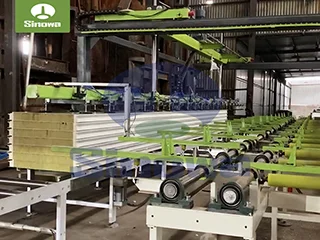
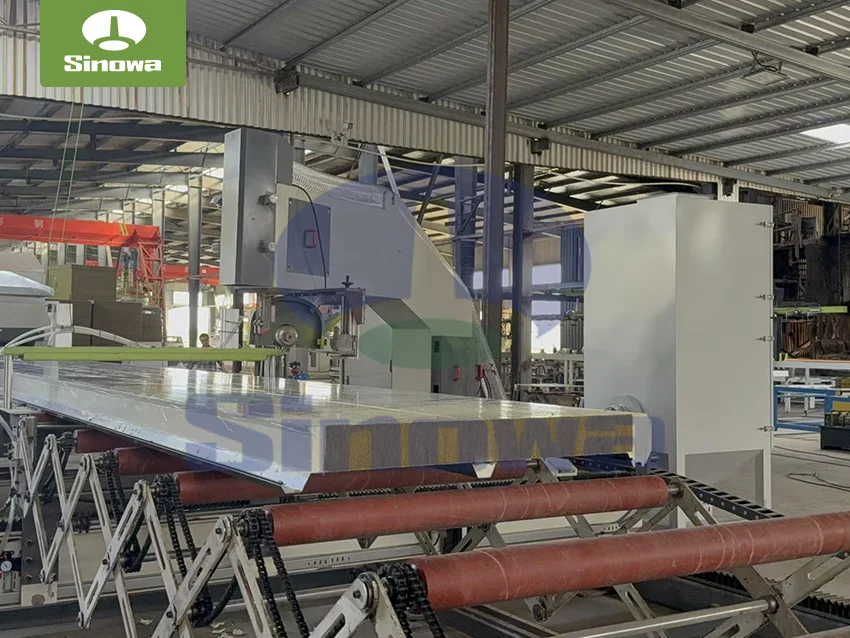
 sandwich panel line
The entire production workflow of external wall rock wool insulation boards starts with scientific raw material preparation and proportioning, which lays a fundamental foundation for the quality stability of subsequent products. The main raw materials adopted in the production are natural inorganic mineral materials with stable physical and chemical properties, which feature high temperature resistance, non-combustibility and anti-aging characteristics, perfectly matching the core performance requirements of building external wall insulation materials. Before formal processing, all raw materials need to go through strict pretreatment procedures, including crushing, screening, impurity removal and drying. Large bulk mineral raw materials are crushed into uniform granular particles by professional crushing equipment, and irregular impurities and unqualified large particles are screened out to ensure consistent particle size of raw materials. After crushing and screening, the raw materials are dried to remove internal moisture, avoiding the adverse effects of moisture on high-temperature melting efficiency and fiber forming quality. Subsequently, multiple raw materials are proportioned and mixed according to fixed process ratios through an automatic batching system. The automated batching module achieves precise quantitative feeding and uniform mixing of different raw materials, effectively avoiding performance differences of finished products caused by uneven raw material proportioning, and ensuring the overall consistency of product fire resistance and thermal insulation performance in batch production.
High-temperature melting is one of the most critical core processes in the entire rock wool sandwich panel production line, which completes the transformation from solid mineral particles to molten magma and creates basic conditions for subsequent fiber processing. The uniformly mixed raw materials are continuously and stably transported to the melting equipment through an automatic feeding system, and heated and melted in a high-temperature environment ranging from 1400℃ to 1600℃. In the high-temperature melting environment, the solid mineral particles undergo complete physical melting and structural reorganization, turning into homogeneous and smooth molten magma without solid particle residues. The melting system is equipped with intelligent temperature adjustment and material feeding linkage devices, which can dynamically balance the feeding speed and melting temperature according to the production load, ensuring that the raw materials are fully melted each time while avoiding energy waste caused by excessive temperature. Stable high-temperature melting quality can eliminate internal structural defects of subsequent fibers, prevent the generation of inferior coarse fibers and particle impurities, and fundamentally guarantee the tensile strength, toughness and thermal stability of rock wool fibers, which is the key link to determine the durability of external wall insulation boards in long-term building application.
After the high-temperature melting process, the homogeneous molten magma is immediately sent to the centrifugal fiber forming system, which is the core equipment unit for converting magma into ultra-fine rock wool fibers. The rockwool insulation board production line is equipped with a high-speed variable-frequency centrifugal device, which relies on high-speed rotating rollers to generate strong centrifugal force. When the molten magma flows onto the surface of the high-speed rotating rollers, it is rapidly thrown and stretched into continuous ultra-fine inorganic fibers with uniform diameter. The rotating speed of the centrifugal system can be flexibly adjusted according to the product performance requirements, so as to precisely control the diameter and length of the fibers, forming fine and soft fiber structures suitable for external wall insulation. In the fiber forming process, a quantitative atomized adhesive is sprayed evenly on the surface of the newly formed fibers through a professional spraying system. The adopted adhesive is an environmentally friendly high-performance polymer material, which has excellent high-temperature resistance and bonding activity. It can be evenly attached to the surface of each fiber without causing chemical corrosion or performance damage to the inorganic fibers, and provides stable bonding conditions for the subsequent integral molding of fiber felt. The whole fiber forming and glue spraying process is carried out in a closed environment, which not only ensures the uniformity of adhesive coverage, but also effectively avoids fiber scattering and environmental pollution, realizing clean production operation.
The fibers with adhesive attached enter the pendulum felt laying and net forming system to complete uniform accumulation and preliminary shaping of fiber layers, which determines the thickness uniformity and structural compactness of rock wool boards. Different from ordinary flat laying methods, the pendulum felt laying technology adopted by the external wall rock wool board production line can realize staggered and overlapping laying of fibers in multiple directions. The pendulum mechanism swings back and forth stably at a fixed frequency, so that the dispersed single fibers are evenly accumulated on the conveying platform to form a fluffy and uniform fiber felt layer with stable thickness. This multi-directional overlapping laying structure enables the internal fibers of the rock wool felt to form a three-dimensional cross-distributed network structure, effectively improving the overall structural toughness and pressure resistance of the product, and avoiding the problem of easy delamination and deformation of traditional single-direction laid rock wool boards. In the felt laying stage, the system can automatically adjust the swinging frequency and conveying speed according to the preset thickness and density parameters of the product, accurately controlling the accumulation thickness of the fiber felt, so as to meet the production requirements of insulation boards with different specifications for external wall insulation projects. After felt laying, the preliminary fiber felt has a loose and porous structure, with good air permeability and thermal insulation potential, but it needs further curing and setting to form a stable solid board structure.
Curing and molding is the key process to convert loose fiber felt into solid and stable rock wool insulation boards with fixed shapes and structural strength. The fiber felt after uniform laying is continuously conveyed into a constant-temperature curing furnace through an automatic conveying system, and undergoes high-temperature curing and pressure shaping in a closed and constant-temperature environment. The internal temperature of the curing furnace is evenly distributed, and the adjustable constant-temperature environment enables the adhesive inside the fiber felt to undergo rapid and uniform cross-linking curing reaction. With the gradual curing of the adhesive, the scattered fibers are closely bonded into an integrated whole, forming a stable porous fiber structure. At the same time, the matching pressure setting device performs micro-pressure shaping on the fiber felt during the curing process, which can effectively adjust the internal compactness of the board, eliminate the loose gaps inside the fiber layer, and ensure that the overall density and thickness of the rock wool board are uniform and consistent. The whole curing process is intelligently controlled by the system, with accurate temperature, time and pressure parameters, which can effectively avoid product quality problems such as incomplete curing, uneven hardness and local deformation. The rock wool board after curing and molding has stable structural performance, moderate hardness and toughness, excellent overall uniformity, and can adapt to the complex external environment of building external walls for long-term use.
After curing and molding, the continuous integral rock wool board base material enters the precise cutting and finishing stage to realize standardized sizing and shaping of finished products. The rock wool sandwich panel line is equipped with an integrated automatic cutting system, including longitudinal trimming and transverse fixed-length cutting units. The longitudinal trimming device accurately cuts off the irregular edges on both sides of the continuous board body to ensure that the width of the board body is consistent and the edges are flat and smooth. The transverse cutting unit automatically completes fixed-length cutting according to the preset product specification parameters, cutting the continuous long board into rock wool insulation boards of standard dimensions required for external wall construction. The cutting system adopts high-precision servo control technology, with extremely high cutting accuracy and stable operation, which can ensure that the error of product dimension is controlled within a tiny range, avoiding the problem of on-site construction adaptation difficulties caused by dimensional deviation. In addition, the rock wool sandwich panel machine is equipped with an automatic edge trimming and deburring device, which polishes the cutting edges of the finished boards to make the board surface flat and the edges smooth, effectively improving the fitting effect during on-site laying and installation of external wall insulation, and reducing construction gaps. The waste materials generated during the cutting process are automatically collected and recycled through the matching waste recovery system, realizing resource reuse and reducing production waste.
The finished rock wool boards after cutting and finishing will go through final quality inspection and automatic sorting and packaging procedures. The intelligent detection system of the rockwool sandwich panel production line conducts real-time online detection of the thickness, density, flatness and surface integrity of the finished boards, automatically identifying and eliminating unqualified products with dimensional deviation, surface defects and structural inconsistency. Qualified finished products are automatically sorted and stacked by the mechanical sorting system, and then enter the packaging link. The automatic packaging device completes sealed packaging of the finished boards, which can effectively protect the product surface from dust, moisture and mechanical damage during transportation and storage, and maintain the stable performance of the rock wool boards until construction and application. The whole process from raw material input to finished product output is completed by automated mechanical equipment and intelligent control systems, with minimal manual intervention, which not only greatly improves production efficiency and output stability, but also effectively reduces the quality fluctuation caused by human operation errors.
The overall structural design and process configuration of the external wall rock wool insulation panel production line fully adapt to the performance requirements of building external wall insulation scenarios, with outstanding production advantages and product application values. The whole production system realizes continuous and automated sandwich panel assembly line operation, with smooth connection between each process link and no redundant intermediate links, which significantly improves the overall production efficiency and meets the large-scale material supply demand of modern building energy-saving projects. The intelligent parameter adjustment function of the production line enables flexible switching of product specifications, which can produce rock wool insulation boards with different densities, thicknesses and structural strengths, meeting the diversified construction requirements of different building types, different wall structures and different regional energy-saving standards. In terms of product performance control, the precise control of each process link ensures that the produced rock wool boards have uniform fiber structure, stable thermal insulation performance, excellent fire resistance and good sound absorption and noise reduction effects. The porous three-dimensional fiber network structure inside the product can effectively block heat conduction and sound transmission, while the inorganic raw material characteristics enable the product to have non-combustible and high-temperature resistant properties, which can effectively improve the fire safety level of building external walls.
In terms of production environment and energy-saving control, the modernized external wall rock wool insulation sandwich panel machine is equipped with perfect environmental protection and energy-saving systems. The closed production design effectively prevents fiber dust and harmful gas from overflowing during the production process, and the matched dust collection and purification device can collect and filter scattered fibers and dust in the production area, keeping the production workshop clean and meeting environmental production standards. The melting furnace and curing furnace adopt energy-saving heating structures and intelligent temperature control technologies, which can dynamically adjust energy supply according to production demand, reduce ineffective energy consumption, and realize low-energy and low-consumption production. At the same time, the waste material recycling system recycles and reprocesses the cutting waste and unqualified products generated in the production process, realizing full utilization of raw materials, reducing resource waste, and conforming to the development trend of green and low-carbon manufacturing in the modern building materials industry.
In the context of the booming development of the global green building industry and the continuous improvement of building energy-saving and safety requirements, the market demand for high-performance external wall rock wool insulation boards continues to grow, which also puts forward higher requirements for the automation level, production precision and product quality stability of supporting production lines. The advanced external wall rock wool insulation sandwich panel manufacturing line relies on mature and optimized process flow and intelligent mechanical control technology, breaking through the limitations of traditional manual and semi-automatic production modes, and realizing standardized, large-scale and high-quality batch production of insulation boards. The products manufactured by the line have stable physical and chemical properties, strong environmental adaptability, and can resist the adverse effects of external temperature changes, humidity erosion and aging for a long time in complex building external wall environments, maintaining long-term and effective thermal insulation and fire protection effects. With its excellent production stability and product adaptability, this type of sandwich panel machinery has become the core supporting equipment for the standardized production of building external wall thermal insulation materials, providing reliable material guarantee for the energy-saving transformation and safety upgrading of modern buildings, and playing an important role in promoting the sustainable development of the construction industry.
https://www.cnsinowa.com/sandwich-panel-machines/external-wall-rock-wool-insulation-board-production-line.html