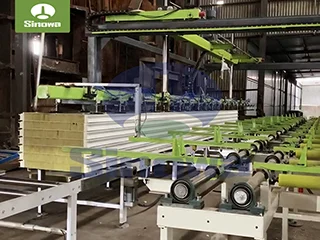
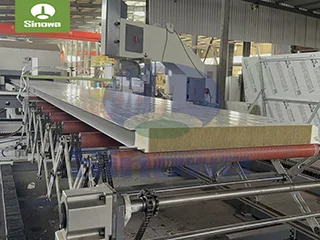
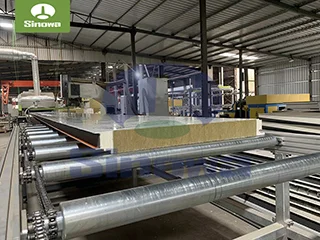
sandwich panel line
The initial stage of the rock wool board production line focuses on raw material pretreatment and proportioning, which lays a fundamental foundation for subsequent melting and fiber forming processes. The main raw materials for producing rock wool boards are natural mineral rocks and industrial solid by-products with stable chemical properties, which need to go through strict screening, crushing, cleaning and particle size classification before entering the melting link. Impurities such as soil, sundries and heterogeneous mineral particles mixed in raw materials will be removed in the pretreatment process, because irregular impurities will not only affect the melting efficiency of high-temperature furnaces, but also cause structural defects in rock wool fibers and reduce the overall uniformity of finished boards. After purification treatment, the raw materials are sent to professional crushing equipment to be processed into uniform granular materials with controllable particle size range. Granular raw materials with consistent specifications can ensure stable feeding speed in the subsequent conveying process, and maintain uniform melting state in the high-temperature melting environment, avoiding local over-melting or under-melting phenomena. In the automatic proportioning system of the production line, multiple types of raw materials are mixed according to fixed material ratios. The scientific proportioning design optimizes the chemical composition of the molten melt, thereby improving the toughness, high-temperature resistance and corrosion resistance of the final rock wool fibers. The whole raw material processing section adopts closed mechanical conveying structures to reduce material scattering and dust emission, realizing clean and efficient raw material preparation work.
After completing raw material proportioning and pretreatment, the uniformly mixed granular materials are continuously transported to the high-temperature melting furnace, which is the core thermal processing unit of the entire production line. The melting furnace maintains a stable ultra-high temperature internal environment, where the solid mineral raw materials are gradually heated, softened and completely melted into homogeneous liquid melt. In order to ensure the fluidity and uniformity of the melt, the internal temperature of the furnace needs to be kept within a reasonable fixed range, avoiding excessive temperature that leads to raw material composition deterioration or insufficient temperature that causes incomplete melting. The interior of the melting furnace is equipped with thermal insulation structures and uniform heating components, which can eliminate local temperature differences in the furnace body and ensure that each batch of raw materials receives consistent thermal energy. During the melting process, the internal gas circulation system continuously adjusts the air intake and exhaust volume to maintain a stable combustion atmosphere, and timely discharge the waste gas generated by raw material combustion and high-temperature decomposition after harmless treatment. The liquid melt flowing out from the bottom of the melting furnace has smooth texture and stable viscosity, which meets the basic physical conditions for subsequent fiber stretching and forming. The melting link consumes a large amount of thermal energy, so the production line is equipped with an intelligent temperature control system to dynamically adjust the heating power according to the feeding amount and melting state, realizing energy saving and stable operation of the melting furnace.
The high-temperature melt flowing out of the furnace enters the fiber forming section, which is the key procedure to determine the basic morphological characteristics of rock wool products. The production line adopts centrifugal fiber forming technology to process the liquid melt. The high-speed rotating centrifugal equipment throws the melt out under the action of strong centrifugal force. In the throwing process, the melt is stretched into slender and continuous fibrous structures under the combined action of air flow traction and self-gravity. In order to optimize the fiber forming effect, the air flow blowing device around the centrifugal equipment outputs stable high-speed air flow, which further refines the fiber diameter and improves the uniformity of fiber distribution. During the fiber forming process, a specific amount of adhesive is evenly sprayed on the surface of newly formed rock wool fibers through the automatic spraying system. The adhesive can enhance the bonding force between fibers, so that the scattered fibers can form an integral structure with certain mechanical strength in the subsequent stacking process. All parameters in the fiber forming link, including centrifugal rotation speed, air flow pressure and adhesive spraying amount, are intelligently regulated by the central control system. Fine parameter adjustment can produce rock wool fibers with different diameters and toughness, meeting the production requirements of rock wool boards with different densities and usage scenarios. Compared with simple blowing fiber forming technology, centrifugal forming technology applied in modern production lines has higher fiber yield and more stable fiber quality, effectively reducing defective products in the production process.
The dispersed rock wool fibers after fiber forming are sent to the cotton laying system for directional stacking and blank forming, which determines the thickness uniformity and internal structural density of rock wool board blanks. The mainstream production line adopts pendulum cotton laying technology, which is upgraded on the basis of the traditional sedimentation cotton laying method. The pendulum mechanism swings regularly and reciprocates above the conveying mesh belt, so that the falling rock wool fibers are stacked layer by layer in an orderly manner. Different from the flat single-layer fiber distribution of the sedimentation method, the pendulum cotton laying method can change the spatial distribution direction of fibers, forming a three-dimensional interwoven fiber structure inside the blank. This layered overlapping structure significantly improves the interlayer bonding strength and compression resistance of rock wool boards, avoiding delamination and deformation during long-term use. During the cotton laying process, the production line automatically adjusts the swinging frequency of the pendulum mechanism and the operating speed of the conveying belt according to the preset blank thickness parameters. When the fiber stacking thickness reaches the production standard, the pressing rollers arranged above the conveying belt carry out primary pressing treatment on the loose fiber blank. The primary pressing process eliminates the gap between loose fibers, preliminarily shapes the blank, and ensures that the overall thickness of the blank remains uniform without local bulges or depressions. The closed cotton laying cabin can avoid external air flow interference, prevent fiber scattering, and maintain a clean production environment while ensuring stable blank forming quality.
The initially pressed rock wool blank is transported to the constant temperature curing furnace through the conveying system to complete adhesive curing and blank hardening, which is an indispensable process to stabilize the mechanical properties of finished products. The interior of the curing furnace maintains a constant high-temperature drying environment, and the internal circulating hot air flows evenly to ensure that each position of the blank can receive consistent heat treatment. Under high-temperature conditions, the adhesive sprayed on the fiber surface undergoes chemical curing reaction, gradually solidifying and forming a firm bonding structure between interwoven fibers. With the completion of the curing reaction, the loose fiber blank is transformed into a rigid integrated board with fixed shape and stable structure. The curing time and temperature are core control parameters of this link. Excessively low temperature or insufficient curing time will lead to incomplete adhesive reaction, resulting in poor structural stability and easy deformation of finished boards; excessively high temperature will cause adhesive aging and fiber performance degradation, affecting the service life of rock wool boards. The curing furnace of the production line is equipped with an internal temperature sensing array, which feeds back real-time temperature data to the central control system. The system dynamically adjusts the hot air circulation volume and heating power to keep the internal temperature fluctuation within a tiny range, realizing precise and efficient curing treatment. After curing, the rock wool board has basic physical properties such as pressure resistance, bending resistance and structural stability, and the internal fiber bonding state reaches the qualified standard for finished products.
The high-temperature rock wool boards discharged from the curing furnace have high surface and internal temperature, so an independent cooling conveying section is arranged in the production line to complete natural and auxiliary cooling treatment. The high-temperature boards are placed on the heat-resistant conveying mesh belt and slowly pass through the closed cooling channel. The cooling channel is equipped with a natural ventilation heat dissipation structure and a low-speed air circulation device, which accelerates the heat dissipation of the boards without damaging the internal fiber structure. Slow cooling can avoid the structural cracks and performance attenuation caused by rapid temperature change of high-temperature boards. During the cooling process, the production line is equipped with a surface detection device to preliminarily screen the appearance quality of rock wool boards. The detection system automatically identifies unqualified products with surface depressions, cracks and uneven thickness, and marks them for subsequent sorting and elimination. After cooling treatment, the surface temperature of the rock wool board drops to the normal ambient temperature, and the board texture becomes more stable, meeting the processing conditions for subsequent fixed-size cutting and finishing. The cooling section is reasonably connected with the front-end curing equipment and the back-end cutting equipment to ensure uninterrupted continuous material transportation and improve the overall operation efficiency of the production line.
The cooled rock wool semi-finished products enter the precision cutting system to complete fixed-size cutting, edge trimming and shaping processing. The cutting system of the modern production line is composed of longitudinal cutting units and transverse cutting units, which cooperate with each other to realize one-time forming of standard-sized rock wool boards. The longitudinal cutting equipment is responsible for trimming the irregular edges on both sides of the boards and cutting the wide semi-finished boards into strips with fixed width. The high-speed rotating cutting blades have smooth cutting surfaces, which will not cause fiber scattering and edge cracking of rock wool boards. The transverse cutting equipment cuts the long strip boards into standard length specifications according to the preset dimensional parameters. All cutting actions are controlled by the intelligent numerical control system, which can accurately position the cutting position and control the cutting error within an extremely small range. For rock wool boards needing special-shaped processing, the production line can be equipped with customized cutting accessories to complete grooving, chamfering and other fine processing. After cutting and shaping, the rock wool boards have neat edges, uniform specifications and smooth surfaces, fully meeting the dimensional requirements of building construction and industrial insulation engineering. The waste materials generated in the cutting process are collected by the centralized recovery device, and the crushed waste materials can be reintroduced into the raw material proportioning link after treatment, realizing resource recycling.
The sorted qualified rock wool boards will go through surface finishing and automatic packaging procedures in the final processing section of the production line. The finishing process includes surface dust removal, slight pressing and flatness correction. The high-pressure air flow dust removal device thoroughly cleans the floating fibers and dust on the board surface to improve the surface smoothness of finished products. For individual boards with slight surface unevenness, the fine pressing mechanism carries out micro-adjustment to ensure that the flatness of each board meets the delivery standard. After finishing, the rock wool boards are stacked neatly by the automatic stacking device. The stacking system adjusts the stacking quantity and arrangement mode according to the storage and transportation requirements, and the stacked boards maintain vertical and stable overall structure without inclination and extrusion deformation. The automatic packaging equipment wraps the stacked rock wool boards with protective packaging materials, which can effectively prevent dust pollution, moisture erosion and mechanical collision damage during storage and transportation. Meanwhile, the packaging structure can also avoid the scattering of residual fibers on the board surface, ensuring the cleanliness of the construction application environment. The packaged finished products are transported to the finished product storage area by the conveying device, and classified and stored according to different specifications and performance types to facilitate subsequent transportation and distribution.
A complete rock wool board production line is also equipped with auxiliary supporting systems that cannot be ignored, including dust removal and purification system, power distribution control system, waste heat recovery system and fault monitoring system. The dust removal and purification system covers all processing links easy to generate dust such as raw material crushing, fiber forming and cutting. It collects scattered mineral dust and fiber waste gas through negative pressure air suction equipment, and discharges the purified gas after multi-stage filtration, which effectively reduces environmental pollution and improves the working environment of the production workshop. The waste heat recovery system collects the high-temperature waste gas generated by the melting furnace and curing furnace, and converts the waste heat into reusable thermal energy for raw material preheating and workshop heating, which significantly reduces the overall energy consumption of the production line and improves energy utilization efficiency. The central power distribution control system integrates all mechanical equipment and detection components in the production line. Workers can monitor the operating state of each link in real time through the intelligent control terminal, and remotely adjust operating parameters such as feeding speed, melting temperature and cutting size. The real-time fault monitoring system is embedded in each key equipment component. Once abnormal vibration, temperature fluctuation and material blockage occur in the equipment, the system will automatically send alarm signals and locate the fault point, and synchronously start the emergency protection program to avoid equipment damage and production stagnation caused by faults.
In the actual industrial production process, the rock wool sandwich panel production line has outstanding characteristics of high automation, continuous production and flexible parameter adjustment. From raw material feeding to finished product packaging, most operation links are completed by mechanical automatic equipment, which reduces manual intervention, lowers the error rate caused by human operation, and ensures the consistency of product quality in different production batches. The assembly line layout mode realizes the seamless connection of each processing unit, and the materials are continuously transported and processed in the production line, avoiding material stagnation and waiting time, greatly improving the daily output of rock wool boards. In view of the diverse application requirements of the market, the production line can adjust raw material proportioning, fiber forming parameters and pressing density according to different usage scenarios, and produce differentiated rock wool boards such as ultra-light thermal insulation type, high-density compression resistant type and high-temperature resistant industrial type. This flexible production mode enables the production line to adapt to the changing market demand and expand the application coverage of rock wool products.
With the continuous progress of industrial manufacturing technology, the technological upgrading pace of rock wool board production line is accelerating constantly. The traditional production line has the problems of high energy consumption, large dust emission and single product type. The modern optimized production line adopts energy-saving heating structures, closed dust removal devices and intelligent sensing components, which realizes the dual improvement of production efficiency and environmental protection level. In terms of structural optimization, the integrated design of melting furnace and fiber forming equipment reduces material transportation links and heat loss, and the modular assembly mode of the production line simplifies the equipment maintenance and replacement process. In terms of intelligent upgrading, the introduction of big data statistical analysis technology can record the production parameter data of each batch of products, summarize the optimal production scheme through data analysis, and continuously optimize the product performance. In addition, the production line gradually expands the utilization range of industrial solid waste raw materials, rationally uses recyclable mineral waste residues to replace part of natural raw materials, which not only reduces the consumption of natural mineral resources, but also realizes the harmless disposal of industrial waste, conforming to the development direction of green environmental protection industry.
The reasonable operation and standardized maintenance of the rock wool board production line are crucial to prolong the service life of equipment and maintain stable product quality. In daily production, workers need to regularly check the wear degree of key components such as melting furnace lining, centrifugal rotating parts and cutting blades, and replace severely worn parts in a timely manner to avoid equipment performance degradation affecting product quality. The interior of the conveying pipeline and processing cabin needs regular dust cleaning to prevent dust accumulation from blocking the pipeline and polluting the production environment. The lubrication maintenance of mechanical moving parts can reduce friction loss between components and ensure the smooth operation of the equipment. Meanwhile, the production enterprise needs to formulate standardized operation procedures to regulate the parameter adjustment range and operation steps of each link, avoid equipment damage caused by misoperation. Regular system debugging and performance calibration of the intelligent control system can ensure the accuracy of detection data and the rationality of parameter control, providing stable technical support for long-term continuous production of the production line.
From the perspective of industrial chain development, the rock wool board production line, as the core carrier of rock wool material manufacturing, supports the stable development of the upstream mineral raw material processing industry and the downstream building thermal insulation, industrial anti-corrosion and noise reduction industries. The stable operation of the production line ensures the sufficient market supply of rock wool boards, and the continuous technological optimization of the production line promotes the continuous improvement of product performance. In the context of the global emphasis on building energy conservation and environmental protection, inorganic thermal insulation materials represented by rock wool boards have broad market development space. As the key production equipment, the rock wool board production line will continue to develop in the direction of higher automation, lower energy consumption, greener emission and more diversified production functions in the future. Through continuous technological innovation and structural optimization, the production line will further improve production efficiency, reduce production costs, and produce higher-quality rock wool products to meet the increasingly stringent material usage standards in the construction and industrial fields. The in-depth research and intelligent upgrading of rock wool board production line technology will also inject continuous impetus into the sustainable development of the inorganic fiber thermal insulation material industry, promoting the whole industry to move towards high-quality and green development.
https://www.cnsinowa.com/sandwich-panel-machines/rock-wool-board-production-line.html