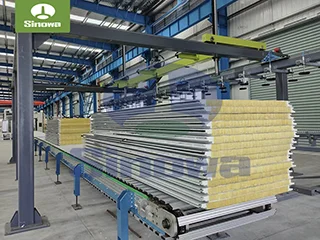
sandwich panel line
The operational logic of the rock wool sandwich panel production line is based on the physical and chemical characteristics of natural mineral raw materials, completing the transformation from original ore materials to finished insulation panels through a series of precise physical processing and mild chemical shaping processes. The core production concept focuses on maintaining the pure fiber structure of rockwool, reducing impurity interference in the production process, and maximizing the inherent advantages of mineral fiber materials such as thermal insulation, sound absorption and fire resistance. All equipment units in the line operate in coordinated linkage, with each process parameter precisely controlled to ensure that the fiber density, pore structure, overall flatness and structural stability of each batch of rockwool panels remain in a stable range, meeting the unified quality requirements of industrial and architectural engineering applications.
The front-end part of the pure rock wool sandwich panel line is mainly responsible for raw material pretreatment and proportioning, which is the primary link to ensure the purity and quality stability of rockwool products. The production system adopts an automatic closed feeding and proportioning structure, which can screen, crush and mix natural mineral raw materials including basalt, dolomite and industrial slag according to fixed material ratios. In this process, the intelligent metering device accurately controls the feeding amount of each raw material, eliminating the quality difference caused by manual proportioning errors. At the same time, the closed operating environment effectively isolates external dust and impurities, ensuring the high purity of the raw material mixture. The uniformly mixed raw materials will be transported to the high-temperature melting equipment through a fully enclosed conveying pipeline, avoiding material loss and secondary pollution during transportation, and creating a pure raw material foundation for subsequent fiber forming.
High-temperature melting and centrifugal fibrosis are the core processes that determine the fiber structure and basic performance of rockwool panels. The proportioned mineral raw materials are sent to a high-temperature melting furnace and heated at a constant ultra-high temperature environment close to 1500 degrees Celsius, so that the solid mineral raw materials are completely melted into a uniform liquid state. The high-temperature melting process fully reconstructs the internal physical structure of natural ores, eliminating the hard crystal structure and unstable components in the original minerals, and forming a homogeneous molten liquid suitable for fiber processing. After full melting and homogenization, the liquid mineral materials flow steadily into the high-speed centrifugal fiber forming unit. The high-speed rotating centrifugal equipment stretches the molten liquid into fine and uniform mineral fibers through powerful centrifugal force, forming countless slender and flexible rockwool fiber monomers. The fiber fineness and length are automatically adjusted and controlled by the equipment operating parameters, ensuring that the fiber structure is fine and uniform, without coarse particles and impurity fibers, which is crucial for improving the overall flexibility and structural uniformity of rockwool panels.
After the completion of fiber forming, the rockwool sandwich panel production line enters the fiber collection, lapping and pre-pressing stage, which shapes the initial outline of the rockwool panel. The dispersed rockwool fibers are evenly collected and gathered by the professional cotton collecting device to form a continuous fiber cotton layer with uniform thickness and density. The pendulum lapping equipment in the line adopts reciprocating uniform lapping technology, which makes the fibers cross and stack in multiple directions, effectively improving the three-dimensional structural stability of the fiber layer and avoiding the problem of loose structure and easy layering caused by single-direction fiber arrangement. With the continuous operation of the conveying system, the stacked fiber cotton layer enters the pre-pressing equipment for preliminary compression shaping. The pre-pressing process reasonably adjusts the compression amplitude and speed according to the preset panel density standards, discharging the excess air inside the fiber layer, preliminarily fixing the fiber arrangement structure, and making the overall thickness and density of the fiber blank tend to be uniform, which prepares for the subsequent formal curing and molding.
In order to enhance the structural firmness and overall usability of rockwool panels, a quantitative binder spraying process is embedded in the middle section of the production line. The environmentally friendly binder is evenly sprayed on the surface and inside of the fiber blank through a high-precision atomizing spraying system. The atomized binder particles are fine and uniform, which can fully adhere to the surface of each rockwool fiber, forming a uniform bonding film without blocking the microporous structure inside the fiber layer. The spraying dosage is precisely controlled by the intelligent system, which not only ensures the stable bonding force between fibers and avoids fiber falling off and panel cracking in subsequent use, but also prevents excessive binder from affecting the air permeability and thermal insulation performance of the panel. After spraying, the fiber blank is fully buffered and infiltrated in the conveying process, so that the binder can evenly penetrate into every corner of the fiber structure, realizing integrated bonding of the overall fiber layer.
Thermal curing and constant-temperature shaping are key processes to finalize the structural performance of pure rockwool panels. The pre-pressed fiber blank with binder is continuously sent to the constant-temperature curing furnace through the conveying device. The interior of the curing furnace maintains a stable and uniform high-temperature curing environment, and the internal temperature and air circulation state are dynamically adjusted in real time according to the thickness and density of the panel. Under the action of constant temperature heat energy, the binder undergoes stable curing reaction, producing firm bonding force between fibers, and permanently fixing the three-dimensional network structure of rockwool fibers. The closed curing space ensures that the temperature distribution is uniform, avoiding local over-curing or under-curing, so that the bonding strength of each part of the panel is consistent. After curing, the overall structure of the rockwool panel becomes compact and stable, with no loose fibers or hollow layers, and the basic physical properties such as thermal insulation, sound absorption and compression resistance are fully formed and stabilized.
After curing and molding, the high-temperature rockwool panels will enter the automatic cooling and shaping process. The rock wool sandwich panel machine is equipped with a graded cooling system, which adopts natural air cooling and circulating air cooling combined mode to slowly reduce the surface and internal temperature of the panel. The graded cooling method avoids the quality problems such as panel deformation, warping and internal structural cracking caused by rapid temperature difference. In the cooling process, the panel is kept flat and stable on the conveying platform, and the residual stress inside the fiber structure is gradually released, further optimizing the flatness and structural stability of the finished panel. After reaching the normal temperature state, the performance and shape of the rockwool panel are completely fixed, and it has stable mechanical properties and environmental adaptability.
The subsequent precision cutting and edge trimming process ensures the dimensional accuracy and appearance quality of pure rockwool panels. The rock wool board production line is equipped with a high-precision automatic cutting system, which can set different cutting sizes according to actual application requirements. The cutting equipment adopts stable mechanical transmission structure and high-precision positioning device, which can complete fixed-length cutting without stopping the production line, realizing uninterrupted continuous production. The cutting blade is made of high wear-resistant materials, which can cut the rockwool fiber layer smoothly without burrs, fiber pulling and edge collapse. At the same time, the automatic edge trimming device trims the four sides of the cut panel to ensure that the edges and corners are neat and the overall dimension error is controlled within a tiny range. In addition, the supporting waste recycling device automatically collects the cutting waste and edge materials, which can be reprocessed and utilized after crushing and screening, realizing efficient utilization of production resources and reducing material waste.
The final stage of the production line includes finished product inspection, automatic stacking and packaging and warehousing. The integrated detection device installed on the line conducts real-time online detection on the thickness, density, flatness and surface quality of the finished rockwool panels, automatically screening out unqualified products to ensure that all delivered products meet uniform quality standards. Qualified finished panels are automatically transported to the stacking platform by the conveying system, and the intelligent stacking device carries out orderly layered stacking according to fixed specifications, with neat stacking and stable placement, avoiding extrusion deformation of the panels. Finally, the automatic packaging equipment completes the overall packaging of the stacked panels. The packaging structure can effectively protect the panels from dust, moisture and mechanical damage during transportation and storage, maintain the dry and clean state of the pure rockwool structure, and ensure that the product performance remains stable after leaving the factory and during subsequent storage and transportation.
The overall structural advantages of the pure rockwool sandwich panel line are reflected in high integration, high automation and high production stability. The whole production process from raw material feeding to finished product packaging is completed by linkage operation of mechanical equipment, with minimal manual participation, which greatly reduces the impact of human factors on product quality. The modular equipment layout makes the production line compact in structure and smooth in process connection, avoiding process stagnation and performance attenuation caused by discontinuous production. The intelligent parameter adjustment system can adapt to the production requirements of rockwool panels with different thicknesses and densities, realizing flexible switching of production specifications and meeting the diversified application needs of different engineering scenarios.
In terms of production quality control, the pure rockwool sandwich panel production line realizes full-process closed-loop control. Each production link is equipped with real-time monitoring and feedback devices, which can dynamically adjust operating parameters according to production status, ensuring the consistency of product quality in the whole production cycle. The pure production environment effectively avoids impurity mixing, making the produced rockwool panels have purer fiber structure, more stable performance, better fire resistance, thermal insulation and sound absorption effects compared with ordinary rockwool products. The internal fiber network structure is uniform and compact, with strong compression resistance and deformation resistance, and can maintain stable physical and chemical properties for a long time in complex environments such as high temperature, low temperature and humidification, without aging, deformation or performance attenuation.
From the perspective of production efficiency and energy saving, the optimized structural design of the rockwool board production line effectively improves resource utilization efficiency. The closed melting and curing system reduces heat loss, realizing efficient utilization of heat energy and reducing unnecessary energy consumption. The automatic material circulation and waste recycling system maximizes the utilization rate of raw materials, reduces production waste, and meets the development requirements of green and low-carbon production. At the same time, the continuous production mode greatly improves the single-line production capacity, realizes large-scale and batch standardized production, and provides sufficient high-quality pure rockwool panel products for the market.
The pure rockwool panels produced by this professional insulation board production line have extremely high application value in multiple fields. In the field of building energy conservation, the excellent thermal insulation performance of the panels can effectively reduce the heat transfer of building envelopes, reduce building energy consumption, and create a comfortable indoor temperature environment. In industrial equipment and pipeline insulation engineering, the stable high-temperature resistance and thermal insulation performance of the panels can effectively isolate heat transfer, ensure the stable operation of industrial equipment, and reduce industrial energy loss. In the field of building fire protection and noise reduction, the pure mineral fiber structure has excellent non-combustible performance and multi-level sound absorption structure, which can effectively block the spread of fire and reduce environmental noise, improving the safety and comfort of buildings and industrial sites.
With the continuous improvement of modern engineering requirements for building energy conservation, safety and environmental protection, the market demand for high-purity and high-performance rockwool panels is constantly upgrading, and the pure rockwool panel production line, as professional supporting equipment for high-quality rockwool panel production, is also constantly optimized and upgraded in technology and structure. The continuous iterative improvement of automation level, intelligent control accuracy and green production performance of the production line further enhances the quality stability and production efficiency of rockwool panels, and promotes the standardized and high-quality development of the rockwool insulation material industry. In the future, with the continuous development of energy-saving and environmental protection industries, the pure rockwool panel manufacturing line will play a more important role in the field of building thermal insulation and industrial energy conservation, providing reliable basic material support for the development of green buildings and low-carbon industry.
https://www.cnsinowa.com/sandwich-panel-machines/pure-rockwool-panel-line.html