 sandwich panel line
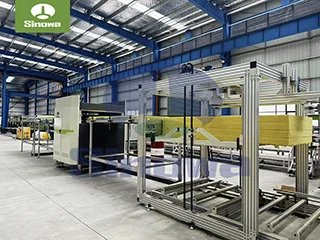
The overall structural design of the rockwool wall sandwich panel production line follows a modular and continuous layout, with each functional unit closely connected and synchronized to eliminate production interruptions under normal operating conditions, except for routine equipment maintenance and raw material replacement. The entire system can be divided into multiple core functional modules, including raw material feeding and pretreatment, surface plate forming, core material processing, automatic gluing and composite pressing, thermal curing, fixed-length cutting, conveying and sorting, as well as automatic stacking. Each module operates in precise coordination through a central frequency conversion control system, which adjusts operating speed, processing parameters, and operational status in real time to ensure the consistency and stability of the entire production process. The mechanical structure of the rockwool sandwich panel production line is optimized for long-term continuous operation, with wear-resistant and durable components that reduce equipment failure rates and extend the service life of the whole line, adapting to the high-intensity production needs of modern building material factories.
Raw material preparation and feeding serve as the foundational stage of the entire production process, directly determining the forming quality and functional performance of finished wall panels. The main raw materials involved in production include metal coiled materials for panel surface layers and high-density rockwool materials for the core insulation layer. Before formal production, all raw materials undergo strict manual and mechanical screening to remove unqualified materials with uneven thickness, structural defects, or inconsistent density, avoiding quality risks in subsequent processing. For metal coiled materials used as surface layers, the rock wool sandwich panel production line is equipped with an automatic uncoiling device, which can stably and evenly release coiled materials at a constant speed. This device is matched with a deviation correction mechanism to effectively prevent material offset and wrinkling during the unwinding process, ensuring the flatness and dimensional accuracy of the surface plate base material. In addition, the surface of the metal plate will be covered with a protective film in the feeding stage to avoid scratch damage during subsequent forming, gluing, and composite processing, maintaining the flat and smooth decorative effect of the panel surface.
Following the feeding process is the roll forming treatment of the surface metal plate, a key step to shape the structural appearance and enhance the mechanical strength of the wall panel. The rock wool sandwich panel line adopts multi-pass roll forming technology, which gradually bends and shapes the flat metal plate through groups of precision arranged forming rollers. Compared with traditional stamping forming, continuous roll forming features more uniform stress distribution and higher dimensional consistency, effectively improving the overall rigidity and load-bearing capacity of the panel. During the forming process, the equipment can complete fine processing such as edge trimming and pre-bending of the metal plate according to the structural requirements of wall panels, laying a foundation for tight edge sealing and assembly of subsequent finished products. The entire forming process is automatically controlled by digital programs, which can adjust forming radian, plate width, and edge structure parameters to adapt to the production of wall panels with different specifications and structural types, realizing flexible production of diversified products.
The processing of rockwool core materials is the core link that endows wall panels with excellent thermal insulation, fire resistance, and sound insulation performance. High-quality rockwool raw materials are made from natural basalt and other mineral raw materials through high-temperature melting and centrifugal fiber forming, featuring stable physical and chemical properties and excellent functional characteristics. In the rock wool board production line, the bulk rockwool materials are first processed by an automatic slitting and shaping system, which cuts and sorts the rockwool raw materials into regular strip structures with uniform width and thickness. The precision slitting system ensures consistent core material specifications for each panel, avoiding local density unevenness that may affect the overall insulation and fireproof performance of the wall panel. After slitting, the rockwool strips are arranged in a cross-butted manner to form a continuous and seamless core layer structure, which eliminates the heat conduction gap caused by core material splicing and maximizes the thermal insulation and sound absorption effect of the panel. Meanwhile, the rock wool sandwich panel machine is equipped with a core material automatic laying device, which can uniformly pave the rockwool core materials on the inner side of the lower metal plate, ensuring flat and compact laying without hollowing or stacking.
Gluing and composite pressing are crucial processes to realize the integrated bonding of metal surface plates and rockwool core materials, determining the structural firmness and service life of finished wall panels. The rockwool sandwich panel making machine is equipped with a high-precision automatic gluing system, which evenly sprays special environmental adhesive on the inner surfaces of the upper and lower formed metal plates. The gluing system can accurately control the glue output and spraying range according to the plate area and production speed, ensuring uniform glue distribution without missing spraying or excessive glue accumulation. Before gluing, the metal plates will undergo preheating treatment through a constant-temperature heating device, which optimizes the surface activity of the plates and greatly enhances the bonding force between the adhesive and the metal surface. After the completion of gluing, the upper and lower metal plates and the rockwool core layer enter the double-belt composite pressing device synchronously. The constant-pressure and constant-speed pressing mode enables close fitting between layers, eliminating gaps and delamination phenomena. The composite pressing process maintains stable pressure and running speed throughout, ensuring consistent bonding strength of each position of the panel and avoiding quality problems such as local debonding in long-term use.
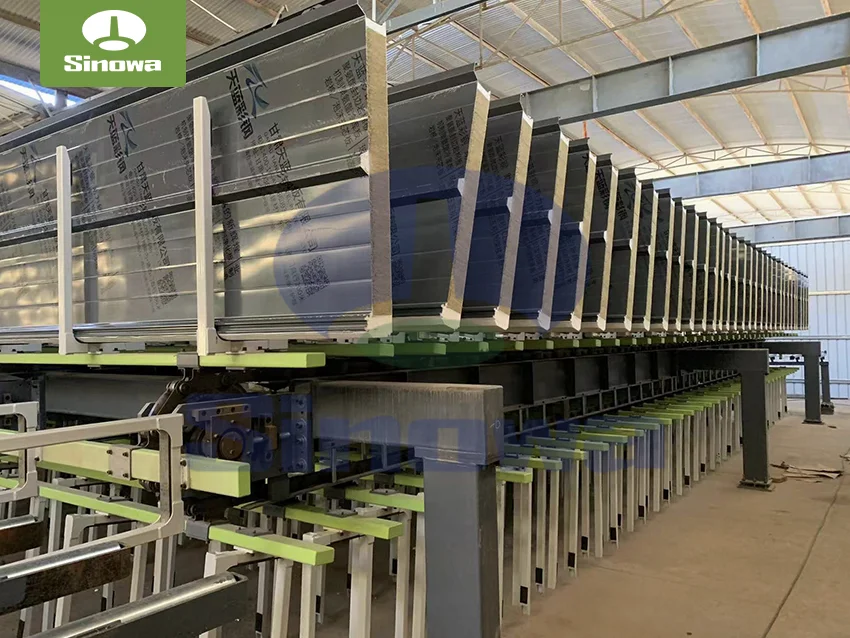
Thermal curing treatment is an essential step to accelerate adhesive solidification and stabilize the composite structure of wall panels. The integrated double-belt heating system of the rockwool insulation board production line provides a constant-temperature curing environment for composite panels, with the internal temperature evenly distributed through circulating heating design. After composite pressing, the semi-finished panels pass through the heating tunnel at a constant speed, and the moderate and stable temperature promotes the rapid and full solidification of the adhesive, forming a firm integrated composite structure. The intelligent temperature control system can adjust the heating temperature according to different production speeds and environmental conditions, ensuring that the adhesive achieves the best curing effect while avoiding excessive temperature that causes material performance damage or insufficient temperature that leads to incomplete curing. After thermal curing, the overall structural stability of the wall panel is significantly improved, with enhanced compression resistance, bending resistance, and layer bonding firmness, meeting the long-term use requirements of building exterior walls, interior partition walls, and industrial workshop enclosures.
Fixed-length cutting and edge finishing processes realize the final shaping of wall panels and ensure the standardization of product specifications. The rockwool insulation panel production line adopts a non-stop dynamic cutting technology, which can complete accurate fixed-length cutting of panels in the continuous running state of the production line, effectively improving production efficiency and avoiding production pause losses caused by intermittent cutting. The high-precision servo cutting system can set arbitrary cutting lengths according to production requirements, with extremely high dimensional accuracy of finished products. After cutting, the equipment automatically completes edge trimming and burr removal of the panel end faces, making the panel edges flat and neat, which facilitates subsequent on-site assembly and installation. In addition, the rockwool sandwich panel manufacturing machine is equipped with a deviation prevention and correction device during the cutting process, which can monitor the running state of panels in real time and fine-tune the position to ensure the straightness and dimensional uniformity of each finished panel.
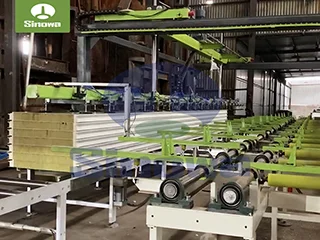
The final stage of production includes automatic conveying, sorting and stacking of finished panels. The cut qualified wall panels are transported to the sorting platform through the synchronous conveying system, and the equipment automatically screens and eliminates individual unqualified products with dimensional deviations or surface defects through intelligent detection. Qualified finished panels are adsorbed and transported by automatic suction cup devices, and neatly stacked on the finished product rack according to fixed specifications. The automatic stacking system can adjust the stacking quantity and arrangement mode according to product specifications, realizing standardized storage of finished products and facilitating subsequent packaging, transportation and warehouse management. The whole process from raw material feeding to finished product stacking realizes automated operation with minimal manual intervention, which not only reduces labor intensity and labor costs, but also effectively avoids product quality fluctuations caused by human operation errors.
The rockwool wall board production line has outstanding technical advantages in operational performance and product quality control. The whole line adopts a centralized intelligent control system, with all production parameters adjustable and observable in real time, realizing visualized and refined production management. The frequency conversion speed regulation technology enables the sandwich panel manufacturing line to adapt to different production loads, maintaining stable operation at both high-speed mass production and low-speed refined production states, with low energy consumption and high operational efficiency. In terms of product quality control, the continuous production mode ensures consistent structural performance and dimensional accuracy of each batch of wall panels. The rockwool core layer produced by this line has uniform density and stable structure, and the composite wall panels have excellent fire resistance, thermal insulation, sound insulation and mechanical properties, which can adapt to various complex building use environments.
In terms of production applicability, this rockwool sandwich panel machinery features strong flexibility and wide compatibility. It can match metal surface plates of different thicknesses and types, and produce wall panels with different core layer densities and structural thicknesses by adjusting core material processing and composite parameters. The diversified product types produced can meet the construction needs of civil buildings, commercial buildings, industrial plants, clean rooms and other different scenarios. Meanwhile, the modular structural design of the production line facilitates daily maintenance and later function upgrading. Each functional module is independently assembled and debugged, making it convenient for equipment inspection, parts replacement and technical transformation, reducing equipment maintenance costs and downtime loss.
From the perspective of industry development, the rockwool wall panel manufacturing line conforms to the development trend of green and energy-saving buildings. The raw materials used in the production process are environmentally friendly and pollution-free, with no harmful substances produced during processing and use. The finished wall panels have excellent energy-saving and heat preservation effects, which can effectively reduce building energy consumption and improve building thermal comfort. At the same time, the automated and intensive production mode of the production line improves the resource utilization rate of raw materials, reduces material waste in the production process, and realizes energy-saving and efficient production. With the continuous improvement of building energy-saving standards and the increasing demand for safe and environmentally friendly building materials, the rockwool sandwich panel production machine will continue to play an important role in the field of building material manufacturing, providing reliable and high-quality panel products for the modern construction industry and promoting the upgrading and development of the overall building insulation material industry.
https://www.cnsinowa.com/sandwich-panel-machines/rockwool-wall-panel-production-line.html